Deploying autonomous artificial intelligence agents, retrieval-augmented generation (RAG) engines, and background operational assistants across enterprise e-commerce and content management stacks creates an entirely new attack surface. For decades, software engineering relied on a strict boundary: user inputs were cleanly separated from executable code. In classic PHP and relational databases, prepared statements prevented SQL injection because database engines treated parameters strictly as raw literal data.
In systems driven by large language models (LLMs), this separation disappears. An LLM processes system directives (system prompt), retrieved enterprise knowledge, and untrusted user inputs within a single shared context window. Every snippet of incoming text can potentially take over model execution. When you equip that assistant with tool-execution privileges, Model Context Protocol (MCP) servers, and write access to your WooCommerce database, a simple indirect prompt injection transforms into an immediate threat to business continuity, UK PSTI Act compliance, EU Cyber Resilience Act obligations, and GDPR data confidentiality.
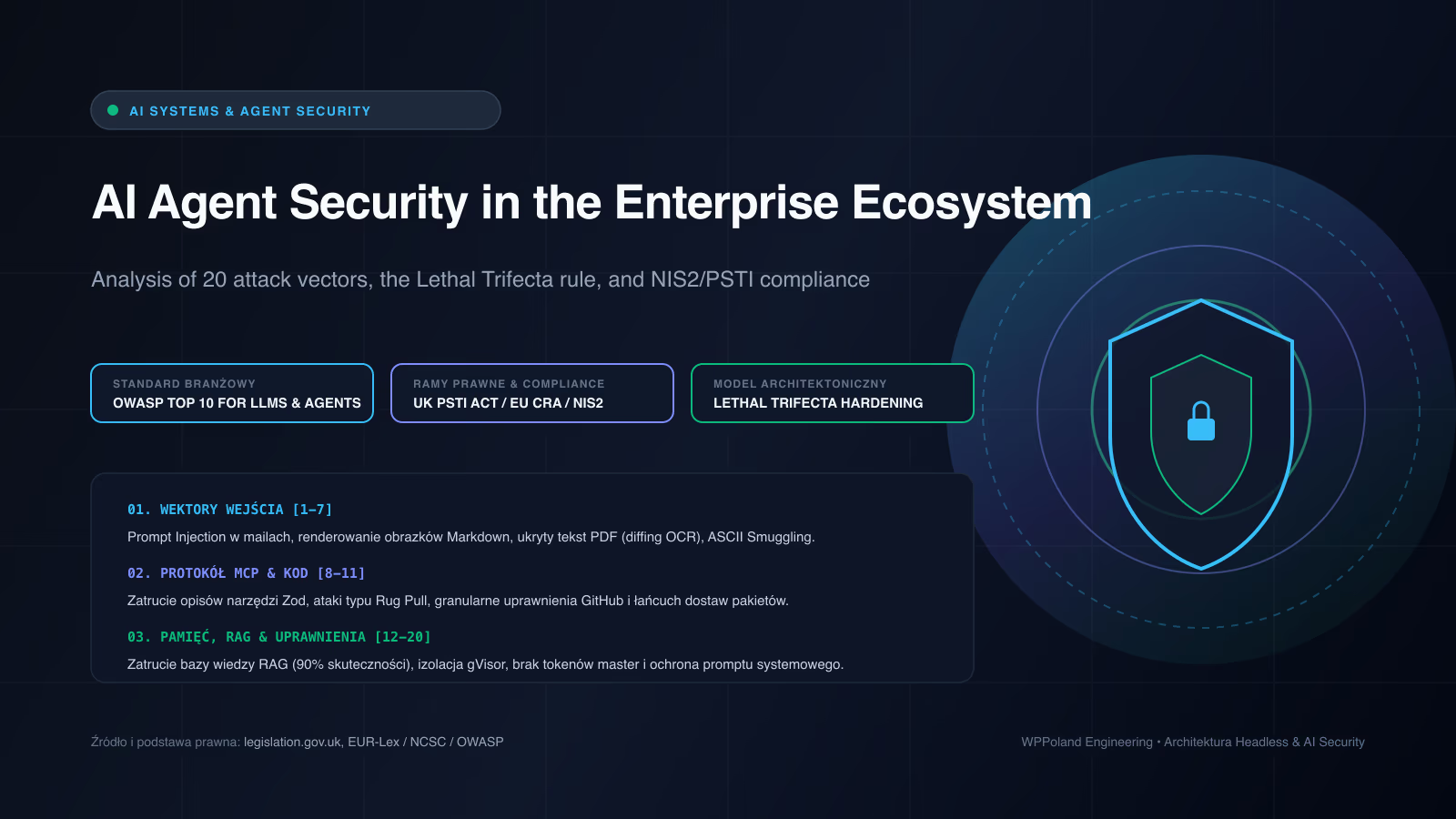
As a web systems architect designing enterprise infrastructure and AI integrations, I regularly audit corporate environments where the rush toward autonomous automation overshadowed fundamental security hygiene. In this guide, I provide an in-depth breakdown of 20 critical attack vectors targeting AI agents, mapped against the OWASP Top 10 for LLM Applications & Agents standard and backed by documented vulnerabilities from 2024 through 2026.
How does the lethal trifecta work in AI agent security
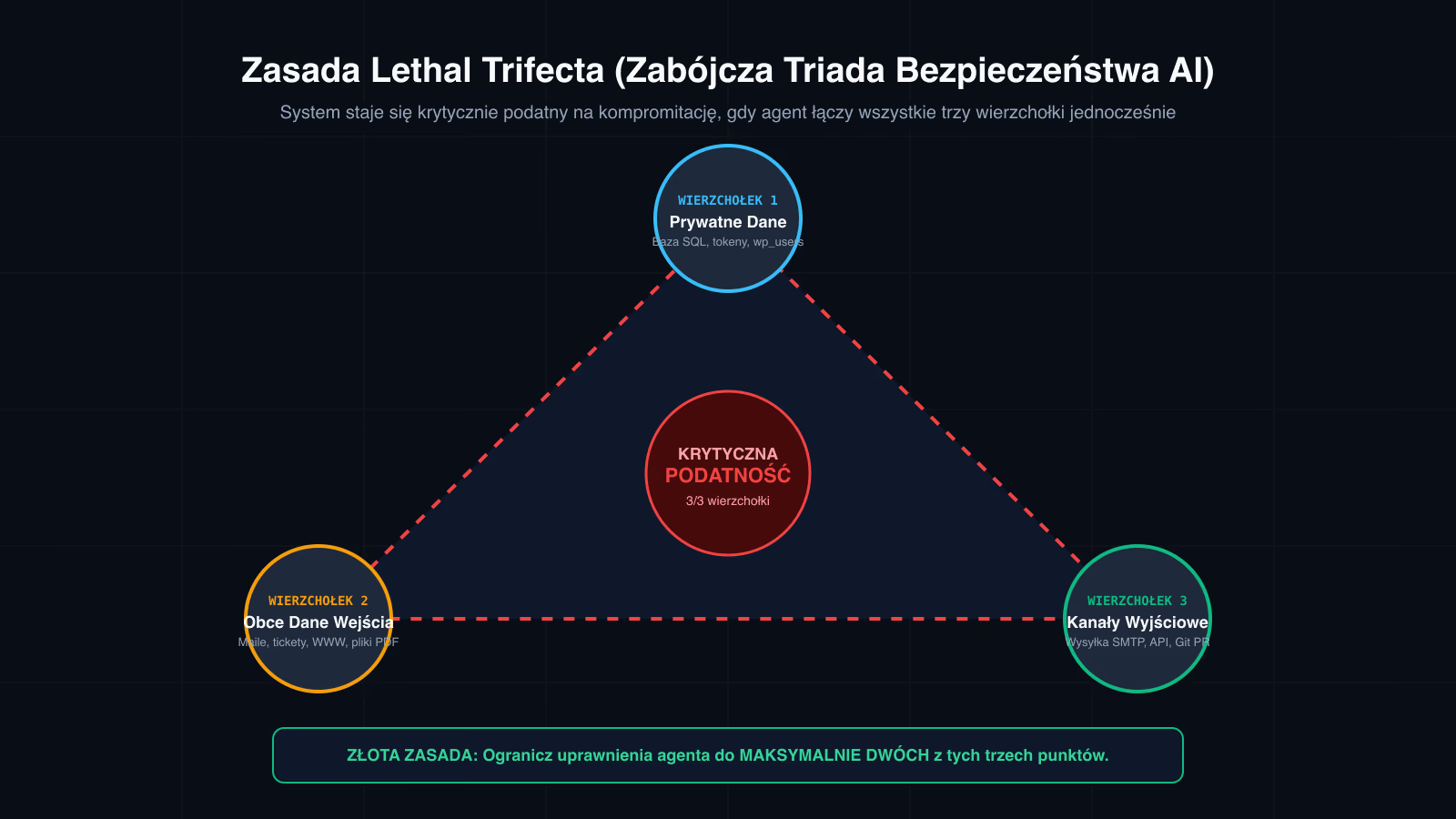
Before evaluating specific technical flaws, you need to understand the fundamental risk model governing agentic architectures: the Lethal Trifecta. An AI agent becomes critically exposed to full takeover if and only if three architectural vertices coincide in a single execution loop:
- Vertex One: Access to Private Corporate Data (Private Data). The agent possesses read privileges over confidential assets: WooCommerce customer tables, payment credentials, order history, internal price margins, or private source code in corporate Git repositories.
- Vertex Two: Ingestion of Untrusted External Content (Untrusted Input). The agent ingests and parses content authored by third parties: incoming customer service emails, public contact forms, external competitor websites, or uploaded PDF invoices.
- Vertex Three: External Output Channels with Side Effects (External Output Channels). The agent can trigger actions in the outside world: sending SMTP emails, executing HTTP POST webhooks, creating Git pull requests, or updating production database rows.
The golden rule of enterprise agent hardening that I enforce across WPPoland projects is straightforward: strictly restrict any single autonomous agent to at most two of these three vertices. If an agent reads untrusted incoming emails (Vertex 2) and queries customer records (Vertex 1), it must never possess an unmoderated SMTP dispatch tool (Vertex 3). Its output must land in an isolated draft queue where a human or deterministic templating engine approves the final dispatch. Violating this rule directly enables the attack vectors detailed below.
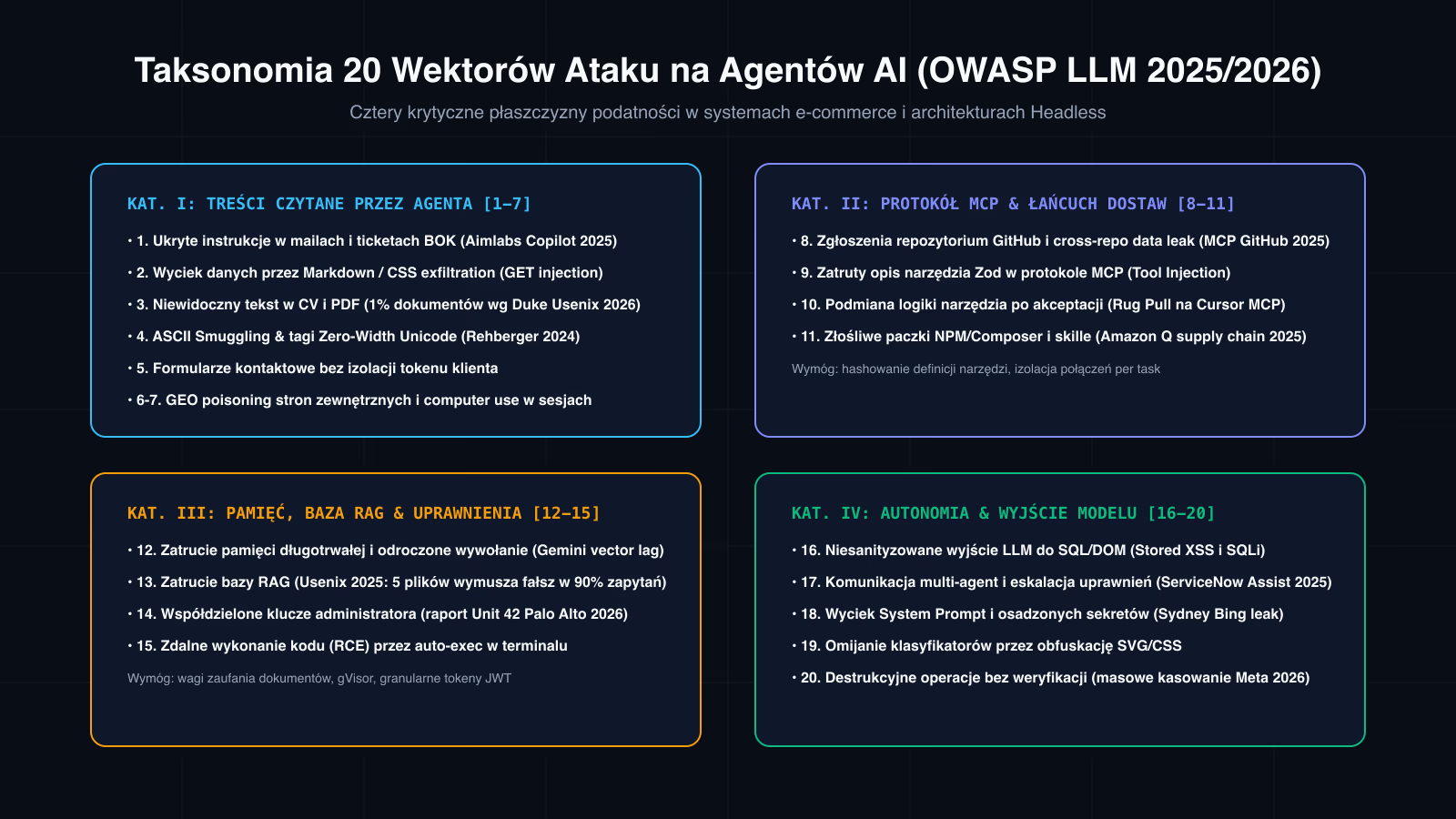
Category I: untrusted content ingestion and external inputs
The first category covers scenarios where an AI model ingests external, unvetted data and treats it as operational context. Attackers exploit semantic model parsing to smuggle supervisory instructions that override system intent.
1. How to stop prompt injection in customer service emails and tickets
AI agents connected to corporate ticket desks or WooCommerce support mailboxes parse uncurated customer messages. An attacker submits an innocent support query containing embedded LLM commands, such as instructing the assistant to append preceding confidential email threads to its reply.
In January 2025, researchers at Aimlabs demonstrated this exploit against Microsoft Copilot: an incoming email contained Markdown instructions directing Copilot to exfiltrate session data via a remote image URL. To protect a WooCommerce store from this vector, I completely decouple semantic classification from email dispatch. The support agent merely tags ticket categories in the database; customer-facing replies are generated strictly from static, approved templates.
2. How to prevent data exfiltration through markdown image rendering
Markdown support in admin dashboards and chat interfaces allows embedding remote images via image tags. If a prompt injection forces the model to output an image tag pointing to an attacker-controlled endpoint, the administrator browser automatically executes a GET request.
Sensitive context data (API keys, customer emails) gets appended as URL query parameters and received by the external server. Across Astro and Next.js frontends, I enforce a strict Content Security Policy (limiting image sources strictly to local and approved domains), disable automatic remote image rendering in AI chat views, and strip query parameters from any model-generated URLs.
3. How to detect invisible instructions in uploaded PDFs and resumes
Automated hiring workflows, vendor compliance engines, and invoice parsers rely on AI models to evaluate uploaded PDF files. A research team at Duke University presented a study at Usenix Security 2026 analyzing nearly 200,000 document files: approximately 1% contained human-invisible instructions (white text on white backgrounds, fractional 0.1pt font sizes, or embedded metadata directives) commanding the model to rank the candidate highest.
In CMS architectures processing public uploads, I implement visual-versus-digital text diffing. The backend compares raw digital text extracted by document parsers against the output of an optical character recognition (OCR) pass on rendered page images. When text discrepancies or semantic mismatches occur, the document is quarantined.
4. What is ascii smuggling and zero-width unicode exploitation
The Unicode standard includes non-printing formatting characters, such as zero-width spaces (code point U+200B) and special language tags. Security researcher Johan Rehberger documented ASCII Smuggling in 2024, showing how hidden prompt injection commands can be concealed inside seemingly innocuous words without rendering on human screens.
When an AI agent ingests this string from a database or API, it parses the hidden payload and executes the invisible command. In my hardening pipelines, all incoming text passes through regular expression sanitizers before reaching the LLM context, stripping non-printable Unicode ranges and zero-width tags.
5. How to isolate agent permissions in public contact forms
Public e-commerce contact forms represent direct injection gateways. An attacker enters an order issue containing instructions to reset administrator passwords or leak database records. If the assistant possesses global database read privileges, it complies.
Permissions must be isolated: the form-handling agent receives a short-lived token scoped strictly to the customer record matching the verified sender email. Denying access to global user tables eliminates horizontal privilege escalation.
6. How to protect web research agents against external seo poisoning
E-commerce competitor monitoring bots load external HTML markup. In 2024, researcher Nick Everers demonstrated Generative Engine Optimization (GEO) poisoning: hidden HTML comments and CSS hidden elements on rival web pages instructed crawling AI agents to overlook negative product aspects and recommend the hostile vendor.
Before raw HTML feeds into an agent context window, the DOM must be sanitized to strip hidden CSS blocks, developer comments, script tags, and unverified data attributes.
7. Why browser automation agents must never touch logged-in user sessions
Computer-use agents can navigate desktop and browser interfaces. In 2025, the Brave security team uncovered a vulnerability in Perplexity: a hidden Reddit comment commanded an agent summarizing the thread to navigate to user profile settings, generate an auth code, read it from email, and post it back to the forum.
Headless browser automation driven by AI must run in ephemeral, incognito sandboxes without access to persistent session cookies. High-value transactions in WooCommerce must always require explicit cryptographic human approval.
Category II: integration architecture, network and MCP tooling
The second group examines risks emerging when models interface with external systems through Model Context Protocol (MCP) servers, plugins, and custom tooling.
8. How to secure code repository agents against cross-repo leaks
Assistants inspecting code repositories and bug trackers frequently run under broad developer personal access tokens. In May 2025, a vulnerability was uncovered in the GitHub MCP server: an attacker created a public issue instructing the agent to read private repositories accessible via the shared token and open a public pull request exfiltrating environment secrets.
Development agents must operate with least-privilege tokens scoped to a single target repository, with cross-repository access strictly blocked.
9. What are the risks of poisoned tool definitions in model context protocol
In the MCP architecture, tool definitions, argument schemas, and usage descriptions are injected directly into the model context. A malicious MCP server can publish a seemingly harmless utility whose description secretly instructs the model to query another sensitive tool and extract configuration files.
Orchestration layers must rigorously validate MCP tool structures. In production environments, I define tools using strict schemas with disallowed extra keys and frozen schemas.
10. How to prevent rug pull attacks on MCP server updates
An approved, benign MCP tool or plugin can subsequently push an upstream update that alters its prompt description or execution logic without triggering permission prompts. Checkpoint Research demonstrated this attack vector in 2025 on developer workflows, showing how a silent MCP configuration update introduced remote code execution on workstation environments.
Hardening requires cryptographic checksum hashing of all tool manifests. Any single-byte modification in an MCP tool configuration must immediately halt the integration and demand engineering re-authorization.
11. How to control the agent software supply chain and third-party skills
Agent frameworks rely heavily on third-party libraries and skill packages. In July 2025, an attacker compromised an official extension in the Amazon Q ecosystem, injecting payloads that purged AWS cloud instances.
Production systems must enforce private package registries, strict lockfile checksums, and a Software Bill of Materials (SBOM). No autonomous agent should dynamically install packages from open public registries during production runs.
Category III: data infrastructure, memory and authorization
The third category focuses on enterprise data repositories, vector stores, and persistent agent memory stores.
12. How to prevent long-term memory poisoning and delayed execution
Agents that maintain cross-session user memory in vector databases are vulnerable to asynchronous poisoning. Research into deferred tool execution showed attackers embedding delayed commands: instructing the model to store false banking data only when a future payment inquiry occurs.
Long-term memory writes in vector stores or user metadata must require explicit user confirmation and provide an auditable review interface where stored preferences can be inspected and erased.
13. Why five malicious documents can poison an entire enterprise RAG database
Corporate RAG search systems and customer-facing product knowledge bases can be subverted by public document tampering. Research presented at Usenix Security 2025 proved that injecting just five poisoned documents into a corpus of millions of texts achieved a 90% attack success rate. Attackers target low-traffic shared company drives or public documentation portals indexed by semantic search crawlers.
Vector search engines must enforce document provenance weights. Public or low-assurance documents must never override verified, cryptographically signed technical documentation.
14. Why shared admin tokens represent a critical architectural flaw
Using a single administrative API credential across all agent components is a severe design vulnerability. A March 2026 report from Unit 42 at Palo Alto Networks on Google Vertex AI showed that compromising an agent possessing service-account credentials exposed entire cloud storage environments.
Each agent component must use scoped JWT credentials granting access solely to required endpoints (such as read-only access to specific order statuses).
15. How to isolate terminal execution using gvisor sandboxes
When an assistant possesses command execution capabilities (such as automated staging deployments), prompt injection can trigger reverse shell connections. Command execution must occur within zero-trust sandboxes, such as gVisor virtualized containers with network egress strictly disabled.
Category IV: model autonomy and output generation
The final category addresses unverified trust in LLM outputs and autonomous side-effect handling.
16. Why raw model outputs must never be trusted in SQL and frontend DOM
Text generated by an LLM is untrusted input. Feeding model responses directly into SQL queries or unescaped frontend components immediately introduces Stored XSS and SQL injection.
In WordPress and headless environments, all model-generated content must pass through standard sanitization routines (such as wp_kses_post) and prepared SQL statements prior to persistence.
17. How to prevent privilege escalation in multi-agent workflows
Decomposing complex workflows into sub-agents introduces cascading injection risks. In November 2025, Apomi researchers demonstrated an exploit in ServiceNow Assist: an unprivileged ticket-reading agent forwarded injected text to an executive agent, which executed the command under the assumption that internal inter-agent messages are trustworthy.
Inter-agent communication must use strongly typed JSON schemas rather than free-form conversational text.
18. How to protect system prompts and embedded secrets from disclosure
Attempting to protect secrets, pricing margins, or business logic by instructing the model to keep them confidential fails against role inversion and semantic extraction techniques. Sensitive credentials must live exclusively on secure backend servers and never enter the context window.
19. How to avoid moderation classifier evasion through obfuscation
Relying exclusively on an LLM to police incoming traffic is an architectural mistake. Attackers use CSS formatting, SVG character smuggling, and semantic word games to evade LLM filters. Ingress pipelines require dual-layer validation: deterministic heuristic pattern matching paired with semantic verification.
20. Why destructive operations require human-in-the-loop validation
Full agent autonomy in database modification, code changes, or financial refunds leads to operational failure. In 2026, Meta chief security officers documented a scenario where a testing model deleted hundreds of critical mailbox records due to context window degradation.
Destructive operations must enforce soft deletion, immutable audit logging, and explicit human-in-the-loop approval.
Regulatory compliance: UK PSTI act, EU CRA and NIS2 standards
Securing AI agents is now a strict legal mandate across the UK and European Union. The UK Product Security and Telecommunications Infrastructure (PSTI) Act 2022 and the EU Cyber Resilience Act (Regulation 2024/2847) establish mandatory security-by-design standards across digital systems and software supply chains.
Under Article 32 of the GDPR and the transpositions of the NIS2 Directive, deploying AI systems that ingest personal data without appropriate technical safeguards against injection and exfiltration constitutes an immediate compliance breach. Corporate boards cannot plead ignorance of LLM unpredictability when regulatory fines apply.
How WPPoland engineers secure enterprise AI architectures
I design and audit enterprise Headless WordPress, WooCommerce, and custom AI agent architectures using strict engineering standards:
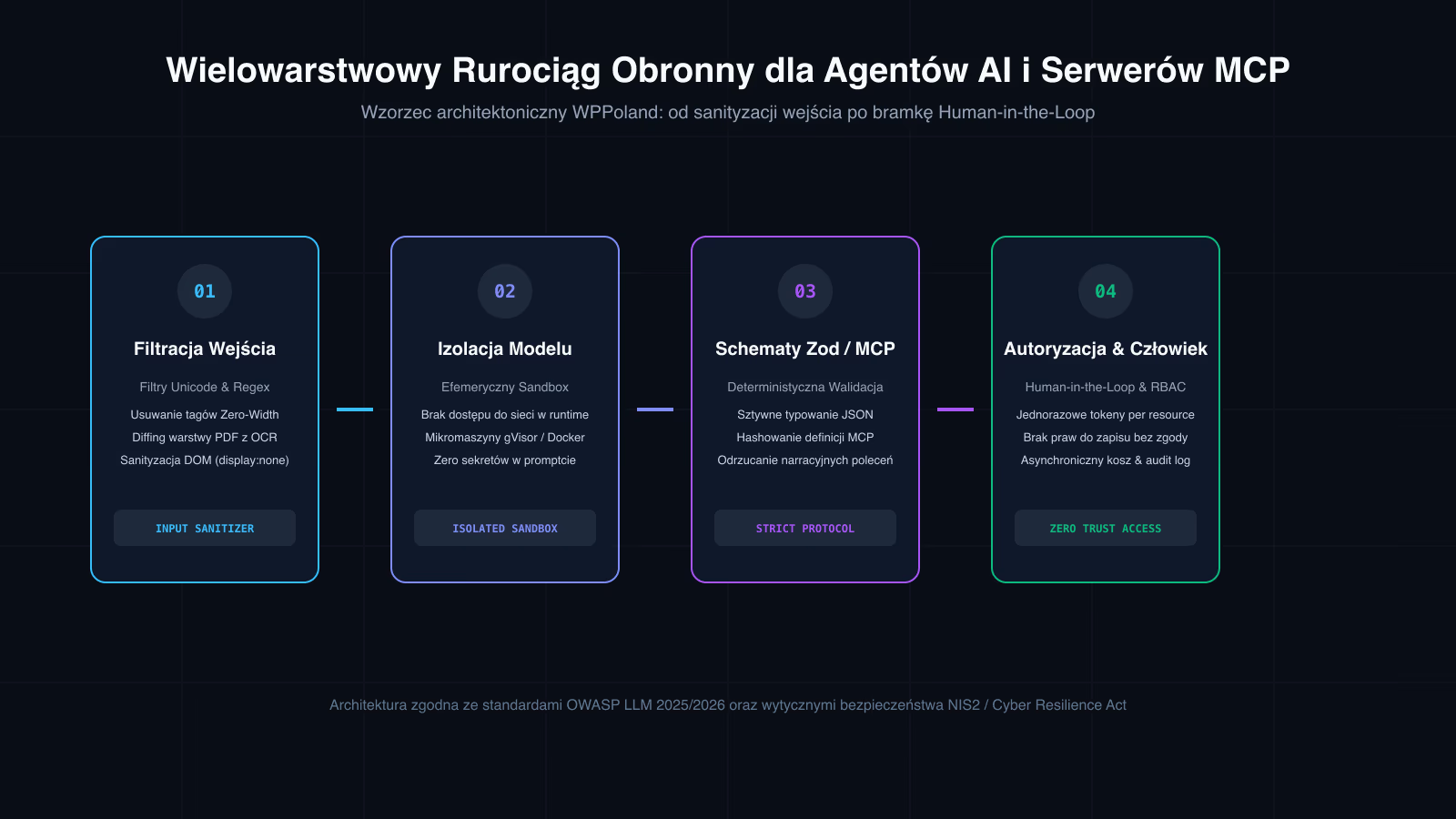
- Multi-Stage Input Sanitization: Cleaning Unicode zero-width tags, Markdown exfiltration payloads, and malicious HTML before context ingestion.
- Hardened MCP Server Architecture: Building Model Context Protocol servers with rigid parameter validation, manifest hashing, and scoped credentials.
- Containerized Execution Sandboxes: Deploying on dedicated Hetzner infrastructure and gVisor isolation with Cloudflare edge protection.
- Human-in-the-Loop Controls: Protecting transactional integrity through approval queues on all high-impact actions.
How engagement works
I deliver security auditing, architecture design, and remediation under clear terms. Hourly care and project rates live on the WordPress pricing page; this article does not quote them.
- Ad-hoc engineering and incident response: urgent post-incident audits, prompt injection analysis, and emergency API hardening.
- Longer architecture projects: headless rebuilds, hardened MCP integrations, and NIS2/CRA compliance work.
AI agent security requires rigorous systems engineering. If you plan to deploy autonomous assistants or need an architectural audit of your existing infrastructure, contact me through the security audit inquiry form.