On 27 October 2026 Ben Horowitz and Michael McGuiness published an essay arguing that the data platform behind AI agents becomes the system of record of the firm, and that people in every company turn into managers of agents. If you run a shop or a service firm on WordPress, WooCommerce and a CRM, the useful question is smaller: what would an agent need from my business to do anything reliable, and do I already have it? The answer is mostly yes, in a messier form than you would like.
I write this as a WordPress developer and consultant, not as a Databricks customer. Horowitz’s firm, Andreessen Horowitz, led Databricks’ Series A in 2013 and is listed among its existing investors in the company’s August 2026 release, so the essay is an investor’s view of a company he holds. I use it as a pointer and check every figure I quote against the primary source, which I read on 31 October 2026. Where only the essay says something, I say so.
What is a system of record for AI agents?
A system of record is the place your firm treats as the truth: when the CRM, the spreadsheet and the shop disagree about a customer’s address, this is the one that wins. Ali Ghodsi, the CEO of Databricks, told CNBC in May 2026 that the lakehouse had become the system of record and that he jokes about calling it SORA, “the system of record for agents”. It is a joke he made on television, not a product.
The substance behind the joke is a claim about agents. Ghodsi put it in one sentence at the Data + AI Summit in June 2026:
AI does not have an intelligence problem, it has a context problem.
Ali Ghodsi, Databricks keynote, 16 June 2026 (official transcript, answers.databricks.com)
A model that can reason about a refund policy is useless if it cannot see the order, the product, the previous emails and the rule that says refunds over a limit need approval. The model is rented; the context is yours. That is why the question of who holds the record matters more than which model you pick this quarter.
For a small firm the record already exists. It is the WooCommerce orders and customers, the product catalogue with its attributes and categories, the stock figures, the order notes, the helpdesk threads and the invoices. What is missing is usually discipline: three spellings of the same status, a custom field that means different things to two staff members, a spreadsheet that quietly became the real stock list. An agent exposes every one of those, because it will read them literally.
Does a small business need Databricks to run AI agents?
No. Databricks reported on 13 August 2026 that it had passed a 7 billion dollar revenue run-rate with growth above 80% year on year in its second quarter, a 5 billion dollar funding round at a 190 billion dollar valuation, more than 1,000 customers consuming at over 1 million dollars a year and 70% of the Fortune 500. Those are company figures for a private company, unaudited. They tell you the product sells to very large organisations with many databases that were never designed to talk to each other.
Its argument, in short: agents need one governed place to read from, and consolidating siloed databases into that place is the product. Ghodsi said on CNBC that you cannot grant an agent access to each of your proprietary siloed databases, so the agents “just go to this lakehouse”. That is a real problem at a bank with hundreds of systems. It is not your problem if your commerce data sits in one MySQL database behind WooCommerce and your mail sits in one inbox.
Two Databricks claims are worth checking because they get repeated. Horowitz writes that agents launch more than 17 million databases a day. Databricks’ own 16 June 2026 release says its Lakebase handles 12 million database launches a day, and a May 2026 engineering post says “tens of millions”. I use 12 million. Horowitz also describes accuracy rising from about 50% to 84.5% with Genie Ontology. The primary source says Genie answered 84.5% of questions correctly on the first attempt against 52.4% for the strongest general-purpose coding agent, on an internal Databricks benchmark of 28 real-world data-analysis questions, with competitors anonymised. That is a vendor result on a small test. It shows that giving an agent a model of your business helps; it does not show a number you can expect.
I will use Databricks as the large-company example and nothing more.
How many UK and Irish firms use AI, and how many use agents?
Adoption is real and uneven. Eurostat’s 2025 survey of enterprises with 10 or more staff, using at least one AI technology, gives Ireland 19.64%, the EU27 19.95%, Germany 25.97%, Spain 20.27%, Portugal 11.54% and Poland 8.36%. Ireland was at 14.90% in 2024, so it grew almost five points in a year. By size, Irish firms with 10 to 49 staff were at 16.75%, medium firms at 28.02% and large firms at 57.27%. The Irish Central Statistics Office, counting slightly differently, published 20.2% for 2025, with 17.2% of small, 28.6% of medium and 57.7% of large enterprises.
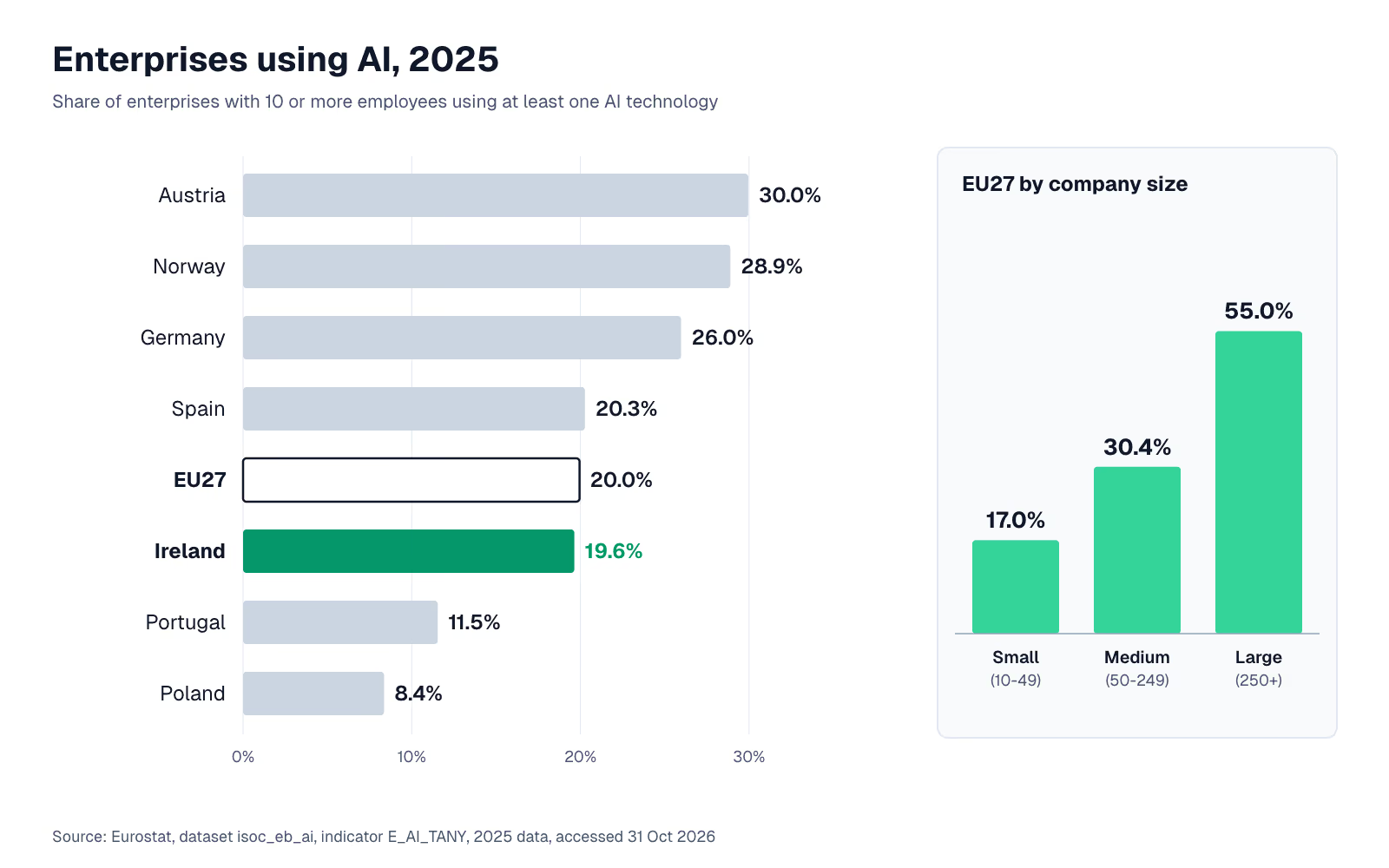
Share of enterprises with 10 or more staff using at least one AI technology, 2025. Source: Eurostat isoc_eb_ai, fetched 31 October 2026.
The UK is outside Eurostat. The Office for National Statistics reported on 8 October 2026 that 30% of businesses used at least one type of AI in September 2026, and 38% of those with 10 or more employees, from a survey it labels official statistics in development. That is a different survey, with a different population and timing, so I do not put 38% next to 19.64%. What both sets of figures agree on is the shape: large firms are far ahead of small ones, and most small firms are still on the first rung.
The first rung is mostly a chat window. An agent is a different thing: software that takes a goal, calls tools, reads and changes data and keeps going without a person typing each step. The statistics above do not separate the two, and I know of no official one that does. So I looked at the only agent data I can measure myself.
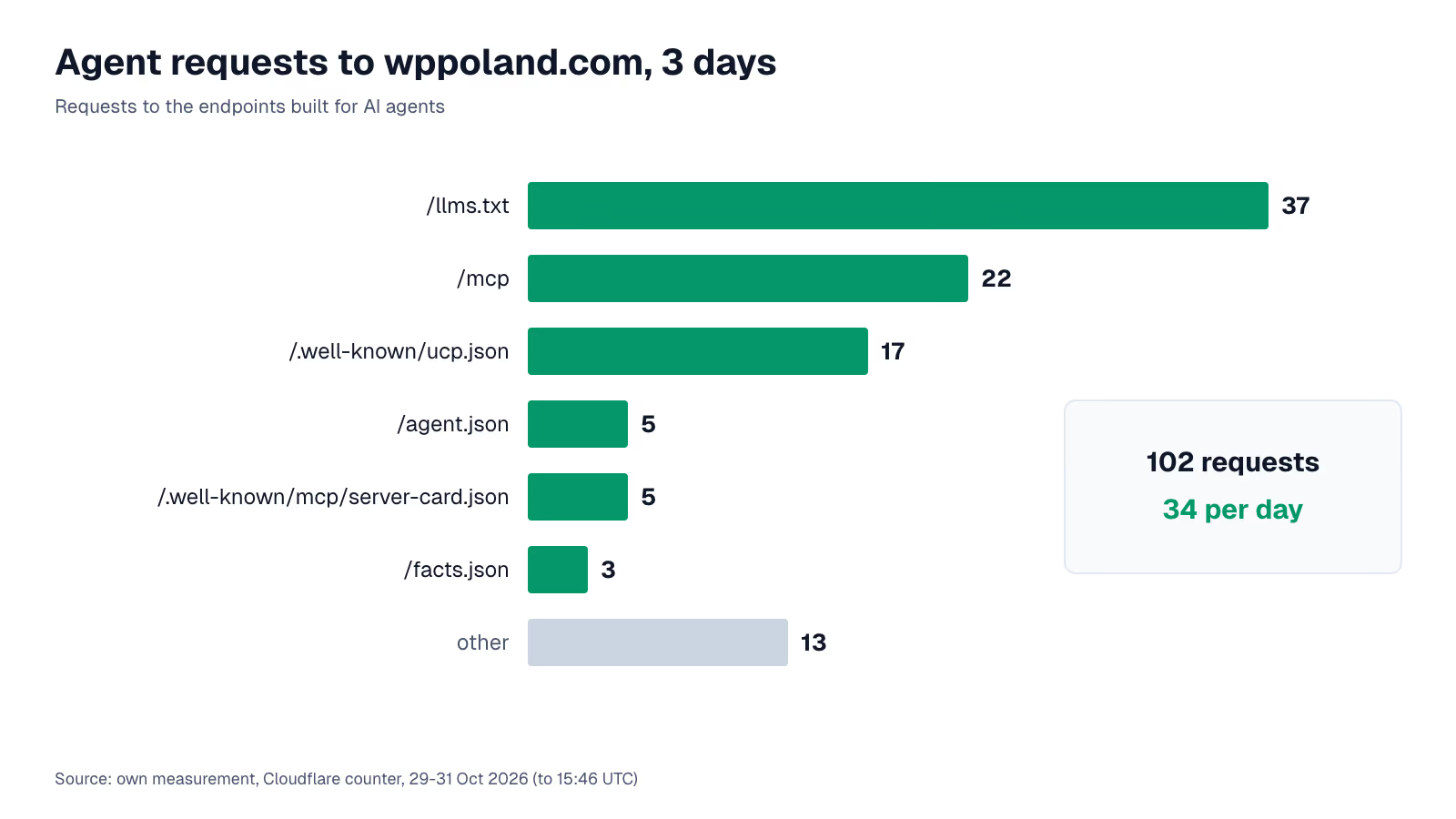
Requests to agent surfaces on wppoland.com, Cloudflare counter, 29 to 31 October 2026. Own measurement.
In the three days to 31 October 2026, wppoland.com received 102 requests to agent-facing files and endpoints, 34 a day: 37 to /llms.txt, 22 to the /mcp endpoint, 17 to /.well-known/ucp.json, 5 to /agent.json, 5 to the MCP server card, 3 to /facts.json and 13 to others. In August 2026 I counted about 102 a day, two thirds on the MCP endpoint. Windows of a few days on a small site are noisy, so I read the two numbers together as: agents are real visitors, still few, and they look for a machine-readable description of the business first. A shop that publishes nothing machine-readable gives them nothing to read.
How fast are AI agents getting better at long tasks?
Fast enough that planning on today’s limits is a mistake, and uneven enough that planning on a trend line is one too. METR, a research group that measures this, defines the 50% time horizon as the length of task, in human working time, that a model completes with a 50% success rate. Its March 2025 paper found that this horizon had doubled roughly every seven months since 2019. Its data file, last updated in September 2026, puts GPT-4 in March 2023 at about 4 minutes, Claude Opus 4.6 in February 2026 at about 719 minutes (12 hours) and Claude Mythos Preview in April 2026 at about 1,045 minutes (17.4 hours). Since 2023 the doubling time fits at about 129 days.
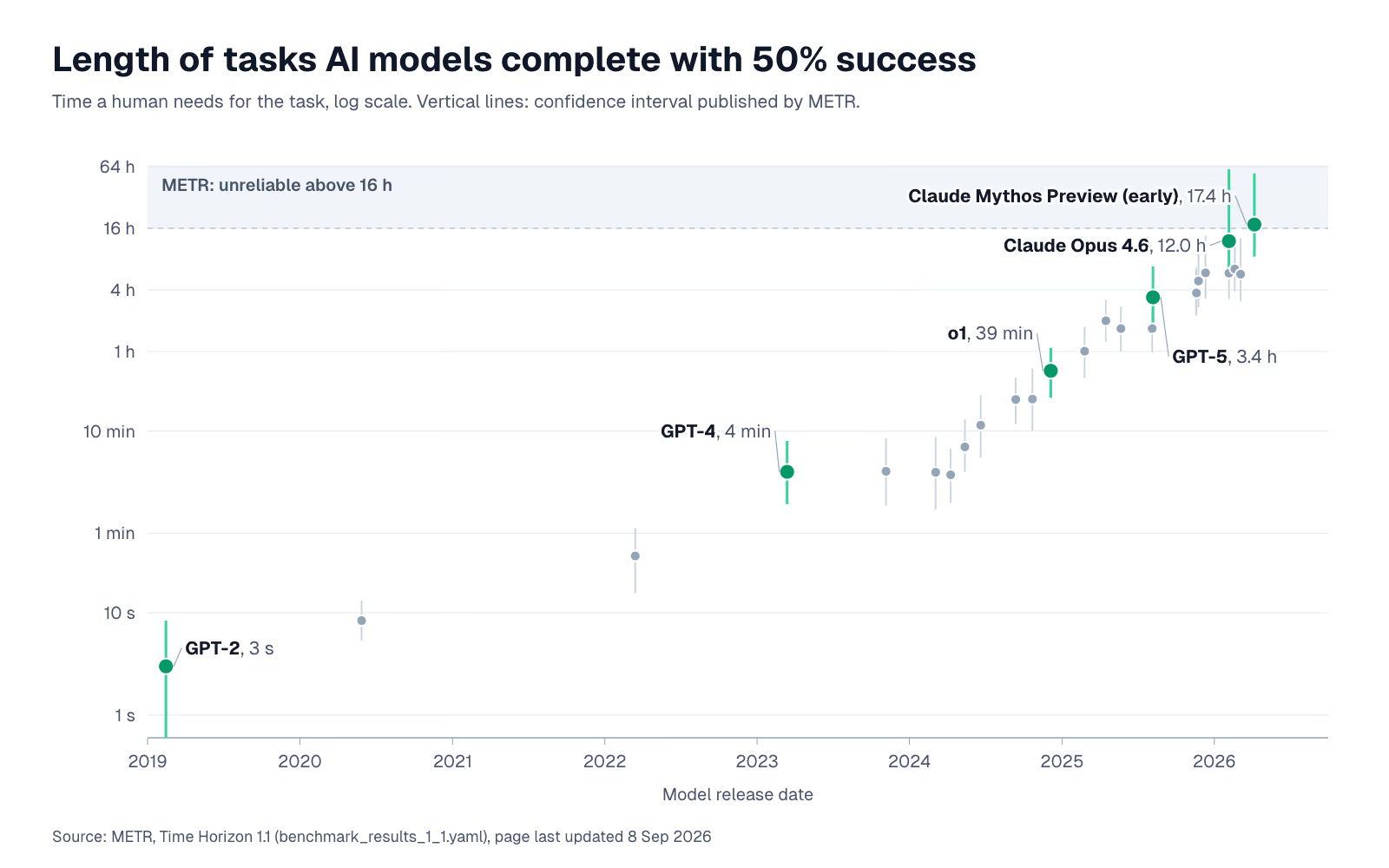
50% time horizon of AI models on METR’s task suite, log scale, data to September 2026. Source: METR.
Read the caveats before you quote that. METR itself says measurements above 16 hours are unreliable with its current task suite, which covers the Mythos point; the confidence interval on it runs from about 509 to 3,304 minutes. The tasks are software tasks, so the numbers say little about answering a customer or reconciling an invoice. And success at 50% is a coin toss: a firm cannot run payroll on it. The honest reading is that the length of work an agent can attempt on its own is growing quickly, so the question of who checks the result grows with it.
Ghodsi’s other claim, that AGI “has already arrived”, rests on Humanity’s Last Exam, a set of 2,500 expert questions where the best model on the Scale leaderboard I checked on 31 October 2026 scored 54.8%. I leave the label alone and keep the number: roughly half of very hard exam questions. Neither figure tells you whether an agent will handle your order desk.
What does an AI agent need to work inside a firm?
Four things, which I phrase as the four questions every employee also answers before acting. What is true. What does it mean. What am I allowed to do. Did it work. Horowitz and Ghodsi describe these in Databricks vocabulary: the lakehouse, the ontology, the governance layer and evaluation. Here they are on a WordPress and WooCommerce stack.
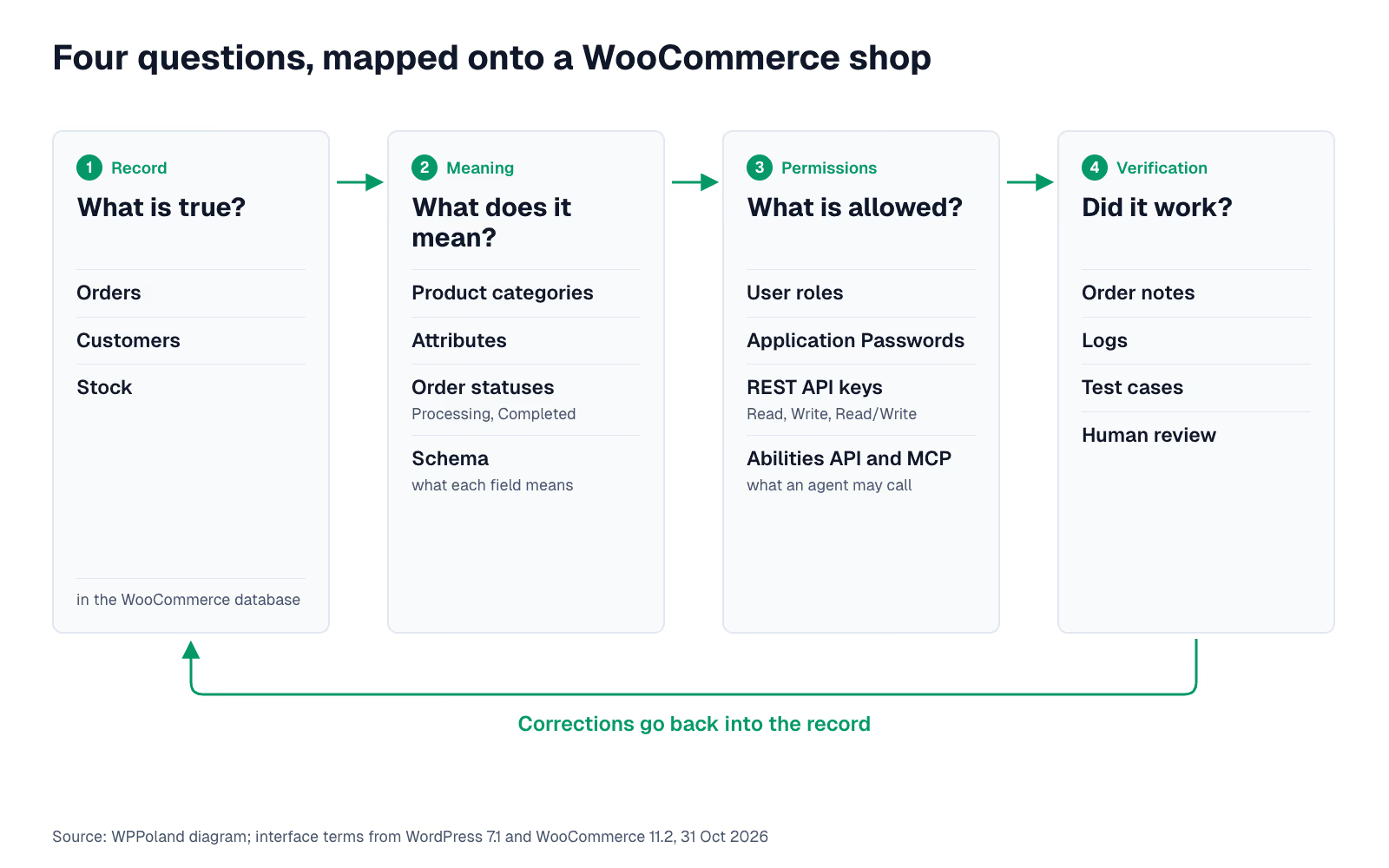
The four questions an agent needs answered, mapped onto a WooCommerce store. Own diagram, wppoland.com.
| Question | Enterprise term | In your WordPress or WooCommerce firm |
|---|---|---|
| What is true? | System of record | Orders, customers, products, stock in the shop database; invoices in the accounting tool; one agreed owner per fact |
| What does it mean? | Ontology, semantic layer | Product categories and attributes, order statuses, customer groups, tags, a written glossary |
| What is allowed? | Governance, access control | WordPress roles and capabilities, Application Passwords, REST API key scopes, MCP abilities |
| Did it work? | Evaluation, observability | Order notes, server and plugin logs, a list of test cases with expected answers |
I take them one at a time, because the failure mode differs for each.
What is true: your orders and customers database as the record
A WooCommerce store keeps the commercial truth in its own database: who ordered what, at which price, with which tax, and what happened next. If that database is also where stock is decremented and refunds are recorded, you have a system of record for the shop. The test is simple. Take ten recent questions you would ask a colleague (“did this customer pay?”, “is this item in stock?”, “was this order refunded?”) and check that one place answers each, without anyone adding “but check the spreadsheet”.
Where the truth is split, an agent will pick one of the copies, and it will pick without telling you. The usual splits in small firms are stock held in a warehouse tool and in WooCommerce, customer contact data in the shop and in a mailing platform, and refunds recorded in the payment provider but never in the order. Decide which system owns each fact before you connect anything. The decision is the work; the connection is an afternoon.
There is also a reason to keep the record in a system you control. A model is a service you rent and can swap. What your agents learn about your business, in the form of corrected answers, rules and examples, should live in your data and your documents, not in a vendor’s memory. Satya Nadella made a related point in June 2026, writing that every company will need human capital and token capital, the AI capability it builds and owns, and that the loop of learning “becomes the new IP of the firm”. Whatever you think of the phrasing, the practical rule is cheap to follow: store corrections, rules and test cases in files you can export, so that changing the model next year costs you a configuration change and not what you learned.
What does it mean: taxonomy, attributes and statuses as your ontology
An ontology sounds grand. In a shop it is the list of words the business uses and what each one refers to. “Processing”, “on hold” and “completed” are order statuses, but does “on hold” in your firm mean waiting for payment, waiting for stock or waiting for a person? A product attribute called “size” may be centimetres on one product and a clothing size on another. A category called “Sale” mixes a price state with a type of product. A human colleague has learned to read around this. An agent will not, and will answer the customer with the literal version.
Databricks’ Genie Ontology is an automated attempt at the same problem: it builds a model of how the company’s data relates, and Databricks reports that this raised the first-attempt accuracy of answers on its own 28-question test from 52.4% for the best general agent to 84.5%. I have no reason to doubt the direction. A model that knows what your terms mean answers better than one that guesses. For a shop, you can get most of the effect by hand:
- Write a one-page glossary: each order status, each custom field, each customer group, with one sentence on what it means and who sets it.
- Fix the obvious duplicates: two categories for the same thing, attributes that mix units, statuses used for two purposes.
- Put the glossary where the agent can read it: a page, a file in the repository, a field in the system prompt. Keep it in version control so you can see what changed.
This is the least glamorous step, and in my experience it moves answer quality more than switching to a larger model.
What is allowed: roles, application passwords and abilities
The question people ask first is whether the agent may touch the shop. The better version is what it may do, to which data, and who approves. WordPress and WooCommerce have the pieces, and they changed over the last year.
WordPress 6.9, released in late 2025, introduced the Abilities API, a way for core, plugins and themes to register what they can do in a form that other software can discover. The official MCP Adapter exposes those abilities to AI agents as Model Context Protocol tools, resources and prompts. Its README states that abilities are private by default and that you opt each one in. WooCommerce registers product and order abilities and documents MCP as subject to WordPress and WooCommerce permissions. The feature is in developer preview, so treat it as something to test on a staging site, not to give to a customer-facing bot. In WooCommerce 11.3 the deprecated MCP endpoint was removed and now returns HTTP 410, which is a reminder that the surface is still moving.
Authentication for remote connections is a WordPress username plus an Application Password, a mechanism WordPress has had since version 5.6. WooCommerce’s documentation says not to use your account password or a REST API key for this, and to use a dedicated WordPress user with only the capabilities the MCP client needs. The older WooCommerce REST API keys still work for other integrations, with three scopes (Read, Write, Read/Write), and the consumer secret is shown only once, so a lost key is replaced, not recovered.
Here is how I sort actions into what an agent may do on its own, what needs a human and what stays off:
| Action | Mechanism | Default I set |
|---|---|---|
| Read products, stock, order notes | Dedicated user with a minimal role; Application Password; read abilities such as products and order notes | Allowed from day one |
| Read customer name, address, email | Same user, with the capability granted deliberately | Off until a use case needs it |
| Draft a reply to a customer | Agent writes to an internal note or a draft, nothing is sent | Allowed |
| Send the reply | A person clicks send | Human |
| Change an order status | Write ability or REST key with Write scope | Human approval, one status at a time |
| Create a refund | Payment provider and WooCommerce | Never autonomous |
| Edit price or stock | Write ability | Staging first, then approval |
| Install or update plugins | WordPress admin | Never by the agent |
The pattern is the one I describe in the guide on letting an AI agent edit a live website safely: start with read access, add one write action at a time, keep the action reversible, and make a person the last step before anything leaves the building. If you want to build the server side yourself, the guide to building an MCP server for WooCommerce and the read-only open-source MCP server show two ways, and MCP versus REST explains when each one wins.
Before you let any automated process, agent or not, touch plugins or updates, you want a restore point. Migrator, a free plugin of mine, can take an optional backup right before plugin, theme and WordPress core updates (switched on under Migrator, Scheduled Backups) and can restore only the plugins, themes or uploads, leaving the database untouched. It is one way to get a restore point; any backup tool with tested restores does the same job.
Did it work: order notes, logs and a list of test cases
The fourth question is the one most small firms skip. An agent that answers customers is a process that makes decisions, and you need to know afterwards what it did and whether it was right. Three layers cost almost nothing to add.
Order notes are the first. WooCommerce lets you attach a private note to an order. Have the agent write one for every action it takes: what it read, what it concluded, what it did. When a customer disputes something, you read the order and see the agent’s reasoning next to the human’s.
Logs are the second. The web server access log shows which agent identity called which endpoint and when. The WordPress and plugin logs show what failed. Keep them for long enough to investigate a complaint, and read them when you add a new ability.
The third is a test list: twenty to fifty real questions from your inbox, each with the answer a good colleague would give. Run the agent against the list after every change to the model, the prompt or the glossary, and read the answers that changed. This is the small-firm version of evaluation, and it is also what lets you switch models without losing what you learned: the list and the glossary are yours, so the next model is graded against the same standard.
What does an AI agent look like in a WooCommerce shop?
An illustration, not a client story: a shop that sells garden furniture, with a few thousand orders a year and one person in customer service. The common email is “where is my order”. Today, the person opens the order, checks the carrier tracking page, writes a reply.
An agent version, built on the four questions:
- True. The order, its status, the shipping method and the tracking number live in WooCommerce. The carrier’s tracking is the second source, and the glossary says that for delivery status the carrier wins.
- Means. “Completed” in this shop means handed to the carrier. “On hold” means waiting for a bank transfer. The glossary says so, and the agent’s prompt includes it.
- Allowed. The agent’s user can read orders and order notes and write a private note. It cannot see full payment details, change a status or send mail. It drafts, and the person presses send.
- Worked. Every draft ends with a note on the order that lists what the agent read. A weekly review of twenty drafts against the test list shows where it went wrong.
In practice, the first two weeks surface the problems with the record, not with the agent: an order status used for two meanings, a tracking field filled in by hand for some carriers and by a plugin for others, a customer in the system twice. Fixing those improves the shop with or without an agent, and that is the best argument for starting here.
This design has no autonomy. It is a drafting assistant with a careful permission set. It saves the person the lookup, not the judgement. I would run it that way for a quarter, read the notes, and only then consider letting it send routine replies for one narrow class of question.
How does an AI agent change what a firm is?
Horowitz’s essay builds on an old argument. In 1937 Ronald Coase asked why firms exist at all if markets allocate resources through prices. In his 1991 Nobel lecture he summarised the answer:
What the prices are has to be discovered. There are negotiations to be undertaken, contracts have to be drawn up, inspections have to be made, arrangements have to be made to settle disputes, and so on.
Ronald Coase, Nobel Prize lecture, 9 December 1991 (nobelprize.org)
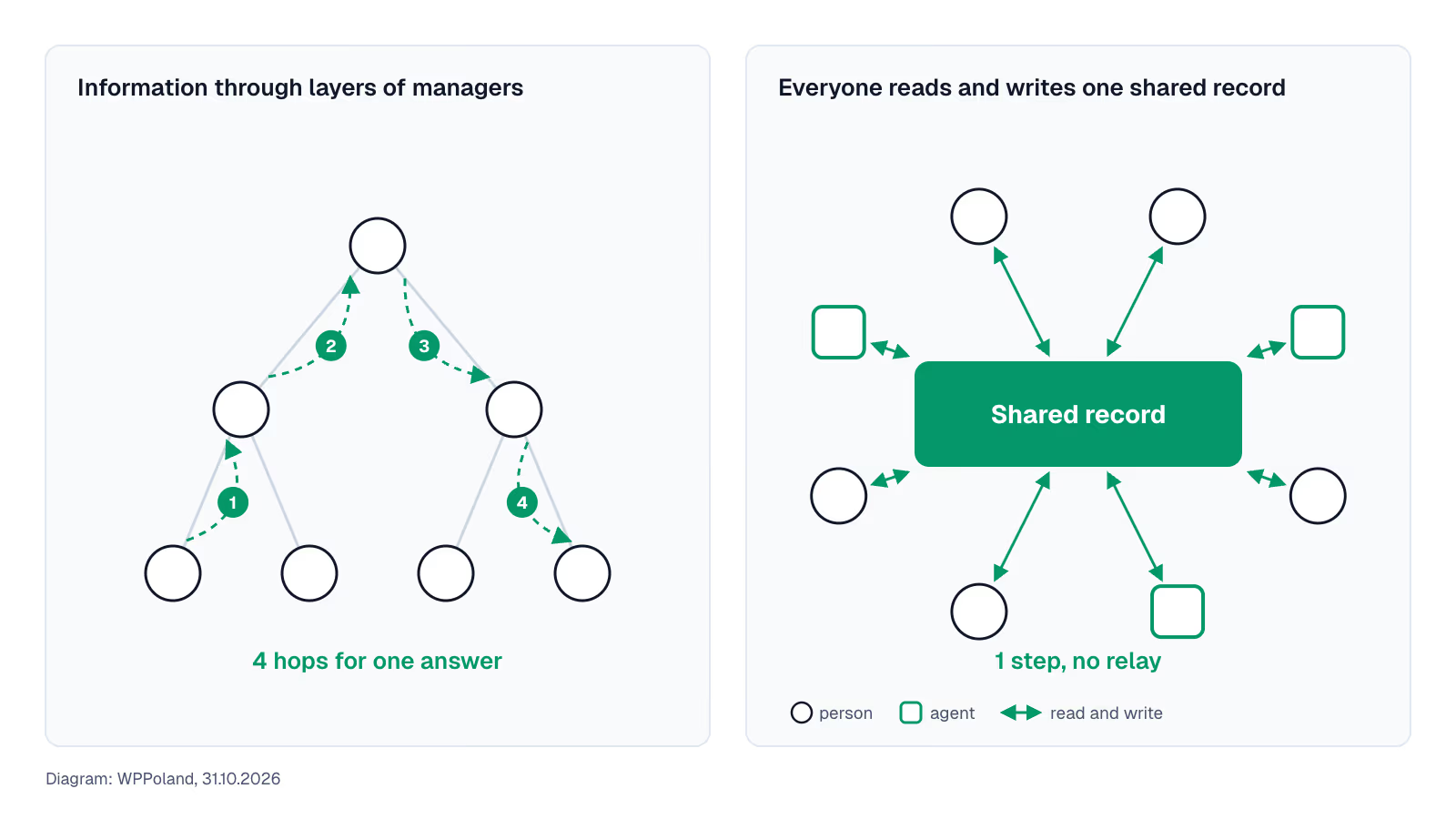
Those are transaction costs, and a firm exists where organising work internally costs less than buying each step on the market. If agents cut the cost of coordination, of looking things up, relaying information and checking, the boundary of the firm moves. Jack Dorsey made the same argument for management in March 2026: companies move fast or slow with information flow, and a system that keeps a continuously updated model of the business can do some of the relaying that middle management used to do.
Herbert Simon described the mechanism in 1979, writing about an airline reservation system. A central memory does not centralise decisions, because it lets many people decide at once:
On the contrary, it allows each of the decentralized decision points to take actions independently, confident that automatic updating by the central memory will take care of all interactions among decisions.
Herbert A. Simon, “The Consequences of Computers for Centralization and Decentralization”, in The Computer Age: A Twenty-Year View, MIT Press, 1979, p. 219
That is the argument for a shared record. When everyone, human or software, works from the same up-to-date picture, each can act without asking the others. It is also why a messy record is expensive: every disagreement between copies becomes a coordination cost again. James Burnham’s 1941 book on managerial power is the other pole of Horowitz’s essay, the worry that professional managers drift from domain knowledge. His version of the answer is that people become managers of agents, and that domain knowledge matters more.
I would put it less grandly for a small firm. The person who knows the product, the customer and the exception becomes more valuable, because the lookup work around them is cheaper. And what the owner must manage changes: not only people and suppliers but a set of tools with permissions, a glossary and a test list. Alfred North Whitehead wrote in 1911 that civilisation advances by extending the number of operations I can perform “without thinking about them”. An agent that handles the routine lookup is that, as long as someone still thinks about it at the decisive moments.
Does the EU AI Act apply to a UK or Irish firm using agents?
For an Irish firm, yes, as an EU member state. For a UK firm, it can. Article 2(1) of Regulation (EU) 2024/1689 covers providers and deployers established in a third country where the output of the AI system is used in the Union. A UK shop that sells into the EU and uses an agent whose output reaches EU customers is the kind of case the article is written for. I read the regulation text on 31 October 2026 and cannot tell you how a given regulator will treat a given shop; this is a reason to check, not a verdict.
The dates changed in July 2026. Regulation (EU) 2026/1744, adopted on 8 July 2026, published on 24 July and in force from 27 July 2026, amends the AI Act. High-risk rules for Annex III systems now apply from 2 December 2027, and for Annex I systems from 2 August 2028. New prohibitions apply from 2 December 2026, and the general date of 2 August 2026 stays. The AI literacy duty in Article 4 was replaced by a softer one: providers and deployers take measures to support the development of AI literacy, and the text says it “does not require providers or deployers to guarantee any specific level of AI literacy of any individual”. Do not rely on older summaries that say “ensure a sufficient level”. A shop answering customer emails with a drafting assistant is unlikely to be a high-risk use; a firm that scores job applicants or customers’ creditworthiness is a different matter and needs its own review.
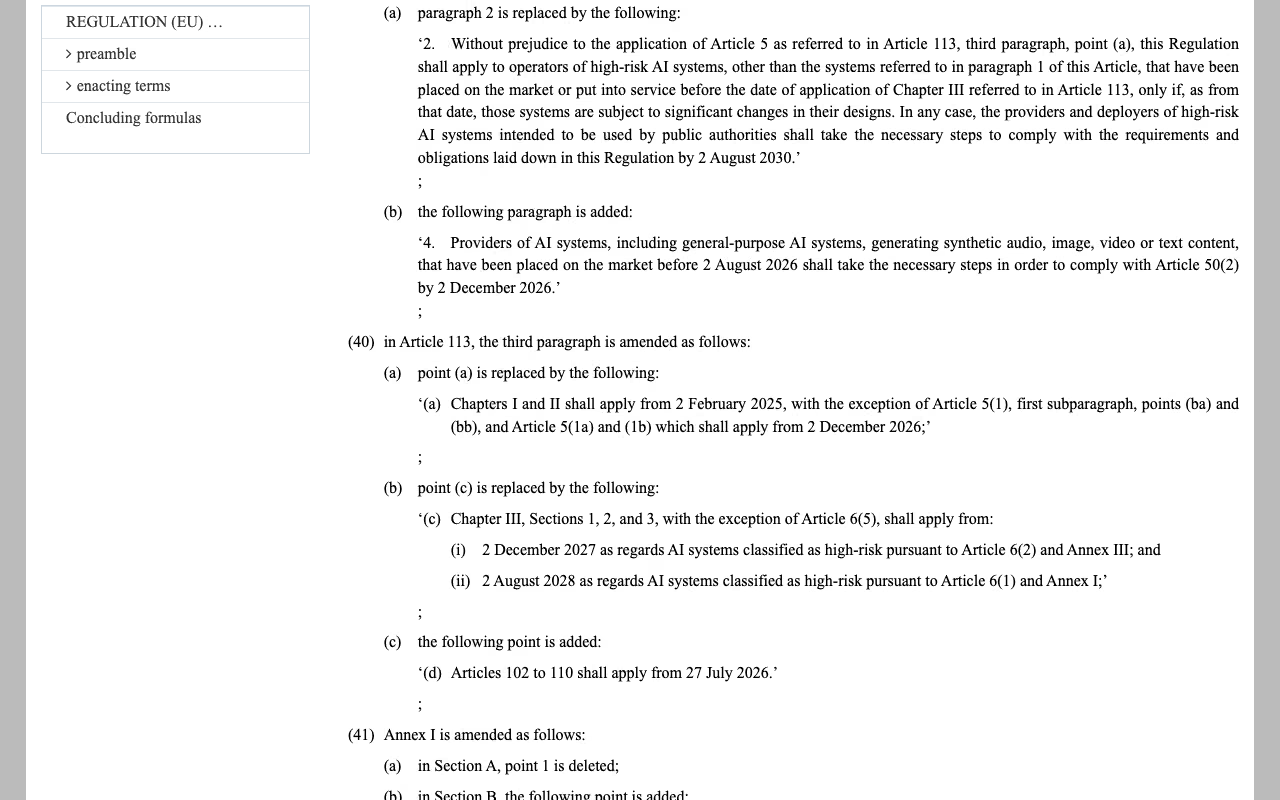
Regulation (EU) 2026/1744, point (40), new application dates in Article 113 of the AI Act. Source: EUR-Lex, read 31 October 2026.
Eurostat’s 2025 data shows why firms hesitate. Among EU firms that considered AI but did not use it, 70.31% named a lack of expertise and 53.61% unclear legal consequences. The Irish figure for barriers is not published. The practical answer to both is the same list: know which data the agent reads, keep a log, keep a person in the loop and write down what the agent is for.
What should I do in the next 90 days?
A plan that fits a firm with one developer or a freelancer, and no data team:
| Weeks | Do | Done when |
|---|---|---|
| 1 to 2 | List the ten questions you ask your own systems daily and name the one system that owns each answer | A one-page table of questions, owners and known conflicts |
| 3 to 4 | Write the glossary of statuses, fields and groups; merge obvious duplicates | The glossary is in a file under version control |
| 5 to 6 | Create the agent user with a minimal role and an Application Password on a staging site; connect read-only | The agent reads products and order notes, nothing else |
| 7 to 8 | Collect twenty to fifty real questions with good answers; run the agent against them | A scored list you can re-run after any change |
| 9 to 10 | Turn on private order notes for every agent action; set up log retention | You can reconstruct any answer after a complaint |
| 11 to 12 | Let it draft replies for one narrow class of question; a person sends | A weekly review of drafts, with errors fed back to the glossary and list |
| 13 | Decide: expand, keep or stop | A written decision with the evidence |
If you want help with the connection layer, the pages on AI integration for WordPress, MCP integration and MCP server development describe what I build. Most of the value arrives before any code: in weeks 1 to 4 you are repairing the record, which your staff and your reporting also benefit from.
What should I not do?
- Do not give the agent your admin account. One compromised prompt becomes a compromised shop. Use a dedicated user with a minimal role.
- Do not use a REST API key in place of a scoped user for MCP. WooCommerce says not to, and a key with Write scope reaches everything the scope covers.
- Do not start with write access. Read first, draft second, act last, one action at a time.
- Do not let an agent talk to customers unreviewed on day one. The test list exists to earn that step.
- Do not copy an enterprise stack because an essay named it. You do not need a lakehouse; you need one agreed place for each fact.
- Do not treat a vendor benchmark as your result. 84.5% on 28 questions is a signal about direction.
- Do not keep what the agent learned inside the vendor. Corrections, rules and test cases belong in your files, so a model swap is cheap.
- Do not skip the legal read. Check whether Article 2 of the AI Act reaches you, and ignore any summary that quotes the pre-July 2026 dates.
For the engineering side of working with agents, I cover the development workflow in agentic engineering as a new model of software development. For an agent-ready commerce setup, the AI implementation page lists what I take on.
What I could not confirm
Two statements in the essay have no primary source I could find: that Databricks sees more queries from agents than from people, and that Block used Databricks to ground its coding assistant goose in company context. I leave both out as facts and mention them only as claims. Marc Andreessen’s line about Fortune 500 executives being professional managers is quoted in the essay from a post whose text does not contain that sentence, so I do not use it. The Neon acquisition price is not in Databricks’ release; I do not state one. The METR measurement above 16 hours is, by METR’s own account, unreliable. Everything else above was read in a primary source on 31 October 2026.