Google updated its Search Essentials documentation and Search Quality Rater Guidelines on 1 October, formalizing stricter definitions regarding scaled content abuse and synthetic author profiles. Across digital marketing channels, commentators quickly proclaimed the death of AI-assisted publishing. The underlying engineering facts and empirical search data paint a different picture. Search crawlers do not discard pages because a language model generated the tokens. Instead, ranking systems systematically penalize repetitive patterns where an article provides no verified effort beyond the raw output of a single user prompt.
Whether you operate a corporate portal on WordPress, an international store on WooCommerce, or a modern headless application on Astro, you need an engineering understanding of how search algorithms evaluate automated publishing. In this technical guide, we break down the contentEffort attribute discovered in internal Google documentation, compare vendor claims against market studies from Ahrefs and Lily Ray, and provide reproducible remediation procedures to protect programmatic city pages, developer glossaries, and editorial author profiles from algorithmic devaluation.
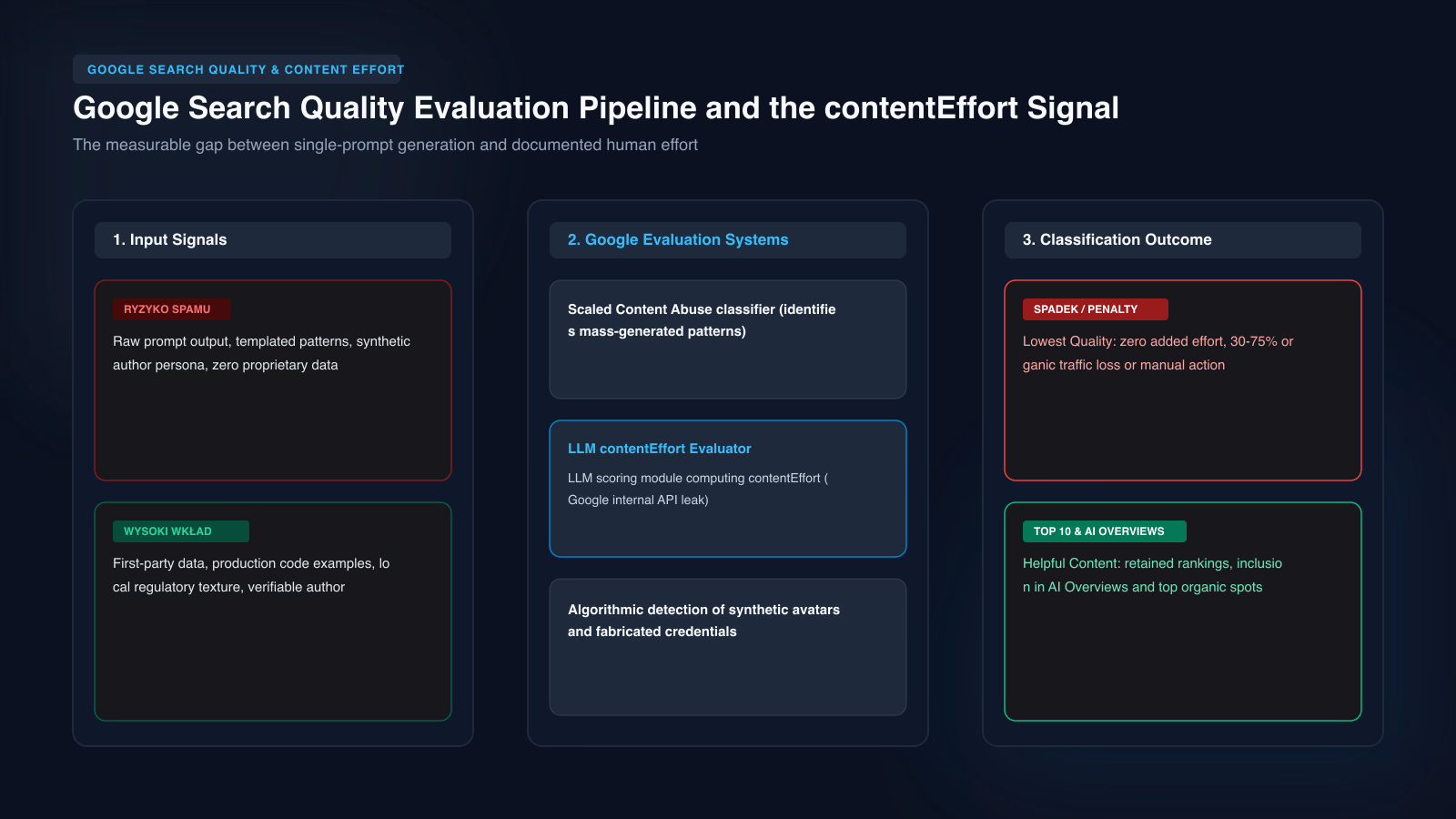
Google Search quality evaluation pipeline: from raw input signals through the contentEffort scoring module and scaled content abuse filters to final SERP visibility. Source: technical analysis by wppoland.com based on Google Search Essentials, verified 1 November 2026.
Will AI-generated content get banned by Google?
The primary concern among engineering leads and e-commerce directors is whether deploying articles drafted by ChatGPT, Claude, or internal LLM pipelines triggers automatic search penalties. The short answer is no, provided the resulting asset solves a searcher’s problem and incorporates verifiable human effort.
In its official documentation governing web search spam (Spam Policies for Google Web Search), Google has removed ambiguity surrounding automated text generation. The critical definition focuses on scaled content abuse:
Scaled content abuse is when many pages are generated for the primary purpose of manipulating search rankings and not helping users. This abusive practice is typically focused on creating large amounts of unoriginal content that provides little to no value to users, no matter how it’s created.
Google Search Central, Spam Policies, Scaled content abuse section, 1 October 2026
Notice the explicit phrasing: “no matter how it’s created.” The search index does not distinguish between low-cost manual copy farms, scraped article spinners, or transformer models. What matters is the ratio of unique utility to derivative filler. If a website publishes dense paragraphs that merely rearrange the top ten ranking results without adding empirical measurements or original analysis, the page is flagged as lowest quality content.
Another major architectural shift in the 1 October documentation update is the expansion of Main Content. Previous SEO practices prioritized extensive text blocks to satisfy keyword density algorithms. Google now explicitly recognizes functional tools, financial calculators, interactive product configurators, and internal search filters as legitimate primary content. A lightweight page featuring 300 words of technical explanation coupled with an interactive shipping tax calculator provides significantly higher utility than a 3000-word generic treatise on supply chain history.
If you manage an enterprise website and need to evaluate your publishing surface against current search quality standards, a technical baseline is critical. At WPPoland, we conduct full infrastructure audits through our WordPress site check service, examining both rendering performance and content architecture.
What is the contentEffort metric in the Google algorithm leak?
In May 2024, thousands of internal API documentation files from Google’s engineering repositories were publicly leaked. Independent search engineers, led by analyses from SparkToro and iPullRank, mapped thousands of previously undocumented attributes within Google’s indexing and scoring services.
One of the most consequential parameters in that documentation is named contentEffort. This attribute is calculated within Google’s content scoring pipeline using dedicated language models running directly on indexing clusters. Its objective is to compute a machine estimate of the actual creative, logistical, and technical labor invested in a document.
How does Google’s evaluation engine estimate contentEffort in production? Several distinct algorithmic markers stand out:
First, first-party data density. When an article contains original performance benchmarks, internal server metrics, reproduction steps from proprietary staging environments, or bespoke configuration parameters, the scoring model detects factual entities that do not exist elsewhere in the index. The contentEffort score increases accordingly.
Second, token efficiency and absence of verbose filler. Off-the-shelf generative AI models exhibit a characteristic writing style marked by symmetrical paragraph lengths, grand introductory declarations, and redundant concluding summaries. To an evaluation model trained on informational density, this verbosity signals low effort. Conversely, documentation that provides immediate CLI commands, SQL queries, or configuration snippets registers as high-effort engineering output.
Third, interactive and architectural depth. An asset that combines editorial guidance with custom frontend components (such as an interactive SVG canvas, dynamic comparison filters, or syntax-highlighted code blocks with copy hooks) demonstrates software development investment. Prompting an AI tool takes five seconds, whereas engineering a responsive interactive UI requires measurable technical work.
The emergence of contentEffort in internal systems mirrors the terminology used in Google’s human rating instructions, where articles assembled without editorial review are categorized as “lowest quality due to minimal or zero effort.”
How much AI content actually ranks in Google top 10?
Debates surrounding AI in search are frequently clouded by marketing hyperbole. To evaluate the actual operational reality, we must examine large-scale empirical studies of competitive search engine results pages (SERPs).
A comprehensive study conducted by Ahrefs analyzed thousands of high-volume commercial queries, measuring the proportion of ranking content generated primarily by artificial intelligence:
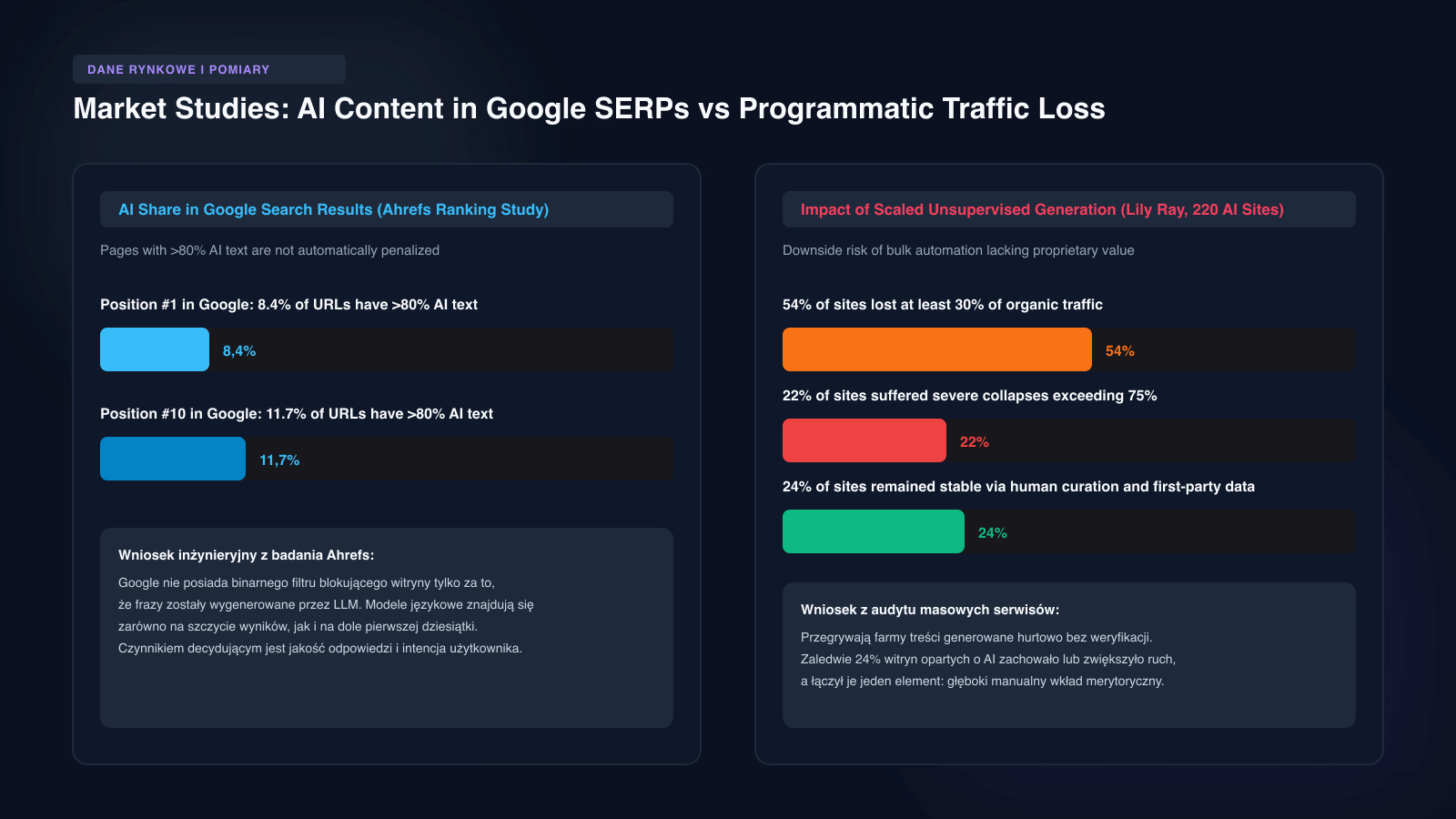
Proportion of AI-dominated content ranking in Google top 10 according to Ahrefs, alongside traffic collapse metrics for uncurated programmatic sites from Lily Ray. Source: Ahrefs Content Study and Lily Ray Advisory, 2026.
In position one of Google organic results, 8.4% of analyzed pages were composed of text that was over 80% machine-generated. In position ten, that figure rose to 11.7%. Across the entire first page of Google, approximately one out of every ten ranking results is dominated by AI-generated copy.
These empirical metrics disprove the claim that Google runs a binary detector that automatically deindexes text written by large language models. If such a filter were operational, these URLs would not rank at the top of competitive search landscapes. What allows these pages to succeed is established domain authority, clean backlink profiles, flawless Core Web Vitals, and alignment with the searcher’s intent.
However, the outlook changes when examining websites that attempted to use language models as autonomous content factories without human quality control. Prominent search consultant Lily Ray published an in-depth audit of 220 domains that implemented programmatic AI publishing across 2024 to 2026, scaling from hundreds to tens of thousands of automated articles per month.
The findings from the Lily Ray cohort demonstrate the severe downside of unsupervised automation:
- 54% of analyzed sites suffered organic traffic losses of at least 30% following Google Core Updates and targeted spam releases.
- 22% experienced catastrophic traffic collapses, losing more than 75% of their total organic audience.
- Only 24% managed to maintain their search positions or achieve sustainable growth. Every domain in this successful minority employed rigorous subject-matter review, injected proprietary case studies, and integrated primary data.
The hazard does not stem from using AI as an accelerator, but from believing an automated script can substitute for genuine industry experience. At WPPoland, we assist businesses dealing with algorithmic penalties through our AI-built website rescue service, systematically restructuring automated libraries into compliant, high-performing corporate assets.
Which page types lose the most traffic after Google updates?
Reviewing the domains that sustained severe traffic drops after the recent Google updates reveals eight vulnerable architectural patterns. Each format represents a prime target for scaled content abuse classifiers.
Here is the breakdown of the eight high-risk page structures:
Pairwise product comparison pages (Tool A vs Tool B). Programmatic affiliate publishers frequently spin out thousands of permutations pairing two software tools or consumer items. Because the generator outputs identical comparative matrices and generic prose for every pair, the visitor receives no hands-on benchmark data or real installation testing.
Isolated glossary entries and single-term definitions. Generating hundreds of 300-word pages explaining basic industry acronyms (such as “what is an API” or “what is headless CMS”) without practical application. Search algorithms downgrade these pages because AI Overviews and Wikipedia already answer basic definitions directly in the search interface.
Self-serving rankings that place the publisher first. Listicles such as “Top 10 E-commerce Agencies” where the authoring company invariably awards itself the top spot while listing generic criticisms for competitors. The absence of a verifiable testing methodology flags the article as biased marketing collateral.
Template-driven “alternatives to [competitor]” pages. Programmatic landing pages targeting brand keywords of market leaders. When these pages simply rewrite competitor pricing pages without evaluating API limitations, database migration challenges, or real customer support SLAs, search engines devalue them as thin content.
Generic programmatic city and regional landing pages. A widespread tactic in local search where a single 1500-word service outline is duplicated across 200 geographic locations by swapping the municipal name token in the H1 tag and URL slug.
Thin Q&A farms built for Generative Engine Optimization (AEO/GEO). Mass-producing dozens of brief FAQ pages based on search autocomplete queries in hopes of capturing citations inside Perplexity or SearchGPT. Lacking proprietary documentation, these URLs face prompt deindexing.
Disconnected filler articles (parasite and off-topic SEO). Publishing lifestyle, medical, or financial advice on an industrial equipment domain solely to harvest tangential search impressions. Search engines evaluate root topical authority and penalize domains that stray outside their core expertise.
Automated catalog aggregations without product testing. E-commerce dropshipping stores that ingest supplier CSV feeds and process descriptions through basic AI rewording. Lacking original product photography, hands-on dimensions, or proprietary video demonstrations, they score near zero on contentEffort.
Every one of these formats suffers from the same defect: they were designed to exploit search indexing rather than deliver definitive value to a human decision-maker.
How to protect programmatic city pages from duplicate content penalties?
Local service landing pages (such as /web-development-dublin/, /web-development-cork/, or /web-development-galway/) remain essential customer acquisition channels. However, duplicating the same body copy across hundreds of metropolitan targets is an immediate vulnerability under current spam guidelines.
When Google detects that a network of location URLs shares 90% identical prose with only town names swapped, the impact is not limited to individual page drops. The search engine can assign a domain-wide quality classifier that depresses rankings across the homepage and core service pillars.
To insulate regional pages from duplicate content penalties, implement an architecture of local differentiation grounded in data that language models cannot fabricate:
First, integrate genuine case studies from the target region. Instead of claiming generic regional coverage, document specific projects: identify the regional client, outline the warehouse management integrations deployed, and describe local hosting configurations.
Second, address local legal and administrative requirements. In Ireland and the United Kingdom, reference domestic consumer protections and regulatory authorities. For consumer-facing services, cite compliance with the Consumer Rights Act 2022 (Act No. 37 of 2022 in Ireland) enforced by the Competition and Consumer Protection Commission (CCPC). In cross-border e-commerce across the European Union, reference Rome I Regulation consumer conflict rules (Regulation (EC) No 593/2008 Art. 6) rather than domestic Polish statutes.
Third, detail local physical logistics. For merchant platforms, document concrete regional fulfillment: specify local courier distribution centers, click-and-collect warehouse locations, and regional delivery cut-off times.
Fourth, implement structured LocalBusiness schema in JSON-LD format, incorporating exact GPS coordinates, local telephone routing, and unambiguous references to official Wikidata entities.
Here is an example of an engineered JSON-LD payload for a local development service page:
{
  "@context": "https://schema.org",
  "@type": "ProfessionalService",
  "name": "WPPoland - Enterprise WordPress & Headless Engineering Dublin",
  "url": "https://wppoland.com/en/dublin/",
  "telephone": "+35312345678",
  "address": {
    "@type": "PostalAddress",
    "streetAddress": "Grand Canal Dock",
    "addressLocality": "Dublin",
    "postalCode": "D02",
    "addressCountry": "IE"
  },
  "geo": {
    "@type": "GeoCoordinates",
    "latitude": 53.3421,
    "longitude": -6.2397
  },
  "areaServed": {
    "@type": "City",
    "name": "Dublin",
    "sameAs": "https://www.wikidata.org/wiki/Q1761"
  },
  "priceRange": "$$",
  "knowsAbout": [
    "Headless WordPress Engineering",
    "Cloudflare Edge Computing",
    "WooCommerce High-Concurrency Scaling"
  ]
}
By saturating location pages with verified regional data and structured entity mapping, you build defensibility that cannot be replicated by automated scripts.
How to prevent glossary and definition pages from losing search rankings?
Technical glossaries were long favored by search marketers for programmatic traffic expansion. Generating hundreds of entries explaining concepts like REST API or database replication required minimal oversight. Following recent algorithmic adjustments, sites built on this model have seen organic visibility contract by over 60%.
The algorithmic logic is straightforward: a dictionary definition consisting of standard textbook paraphrasing carries negligible contentEffort. When a user asks “what is a WooCommerce action hook,” Google serves an AI Overview synthesized from developer documentation rather than directing traffic to an unvetted content portal.
To protect an engineering glossary, transition every definition into a production proof asset. Each term must incorporate three layers of information:
Layer one: A concise, accurate definition limited to one or two sentences, optimized for semantic speakable selectors.
Layer two: A verified production code snippet, terminal command, or configuration example. If you define “Redis Object Cache in WordPress,” do not settle for theoretical explanations. Show the exact WP_REDIS_CONFIG array in wp-config.php, specify Redis eviction policies (volatile-lru), and illustrate cache monitoring using redis-cli monitor.
Layer three: Common failure scenarios and performance diagnostics. Detail what happens when the mechanism fails under load, such as socket connection timeouts or memory exhaustion in high-traffic checkout flows.
Here is an architectural comparison between vulnerable glossary pages and defensible engineering documentation:
| Element | Fragile Implementation (High Penalty Risk) | Engineered Asset (High contentEffort) |
|---|---|---|
| Core Definition | Three paragraphs of generic AI prose stating that database indexing is vital for performance. | Single technical sentence defining indexing as an internal B-Tree data structure accelerating record retrieval. |
| Verification Code | Theoretical or generic SQL query copied from an introductory tutorial. | Production SQL script demonstrating EXPLAIN ANALYZE on WooCommerce wp_postmeta lookups. |
| Error Diagnostics | Vague warning that unindexed tables cause slow response times. | Concrete server log analysis highlighting MySQL thread locks and CPU spikes exceeding 90%. |
| Regulatory Context | No regulatory or compliance reference. | Technical privacy notes outlining data retention schedules under GDPR Art. 5(1)(e) when storing debug logs. |
When every glossary definition functions as an authoritative reference with reproducible code, the page resists algorithmic filters and attracts natural inbound citations from engineering teams.
Why does Google classify synthetic author photos and fake bios as deceptive?
Among the clearest mandates in the updated Google documentation is the strict prohibition against synthetic expert profiles. Many automated websites have attempted to manufacture E-E-A-T credentials by inventing fictional staff members with portraits generated via Midjourney or Stable Diffusion.
Google has categorized fabricated authors, fictitious credentials, and generated headshots as deceptive practices. The search engine explicitly stated that automated algorithmic classifiers, not merely human raters, actively identify these fabrications.
Google’s computer vision classifiers detect synthetic portrait generation by analyzing distinct visual artifacts:
- Irregular iris geometry, anomalous pupil reflections, and inconsistent corneal lighting.
- Morphological errors along earlobes, misaligned jewelry, and blurring where hair boundaries meet background textures.
- The total absence of a digital footprint across the Google Knowledge Graph.
If an indexing model detects that an author publishing advice on corporate law, financial compliance, or server security has no verifiable footprint (no corporate registry listing, no verified GitHub or LinkedIn profiles, and no independent third-party citations), the root domain incurs a trust devaluation.
In European and UK commercial environments, fabricating credentials also carries severe legal liabilities. Under the Irish Consumer Rights Act 2022 and the UK Digital Markets, Competition and Consumers Act 2024 (DMCC Act 2024), misleading consumers regarding commercial identities, professional qualifications, or expert reviews constitutes an unlawful deceptive commercial practice. Regulators including the Competition and Consumer Protection Commission (CCPC) in Ireland and the Competition and Markets Authority (CMA) in the UK maintain active enforcement powers against deceptive digital marketing.
Best practices for author implementation on WordPress:
- Attribute technical guides to real engineers and consultants who have direct experience with the systems discussed.
- Publish authentic team photography in natural working environments, converted to modern AVIF format without generative manipulation.
- Deploy comprehensive Person schema in JSON-LD, linking
sameAsarrays to verified external profiles such as LinkedIn, GitHub, or academic repositories.
Here is an authoritative schema block for an engineering author:
{
  "@context": "https://schema.org",
  "@type": "Person",
  "name": "Mariusz Szatkowski",
  "jobTitle": "Lead Systems Architect",
  "worksFor": {
    "@type": "Organization",
    "name": "WPPoland",
    "url": "https://wppoland.com"
  },
  "url": "https://wppoland.com/en/author/mariusz-szatkowski/",
  "sameAs": [
    "https://github.com/wppoland",
    "https://www.linkedin.com/in/mariusz-szatkowski/"
  ],
  "knowsAbout": [
    "WordPress Core Internals",
    "WooCommerce High-Concurrency Engineering",
    "Cloudflare Edge Infrastructure",
    "Google Quality Guidelines & GEO"
  ]
}
Authentic author documentation protects domain trust and serves as a decisive conversion asset during technical procurement reviews.
What is the single prompt test and how to run it on your website?
The single prompt test is a diagnostic heuristic developed by search systems engineers to measure the vulnerability of published content against automated devaluation.
The test principle is straightforward: If a competitor or web searcher can input your article’s title into ChatGPT or Claude as a single, unadorned prompt and receive an output matching your article in structure, arguments, and depth, your content has zero defensive value in search indexes.
Such pages are vulnerable to rapid devaluation because they lack proprietary entropy:
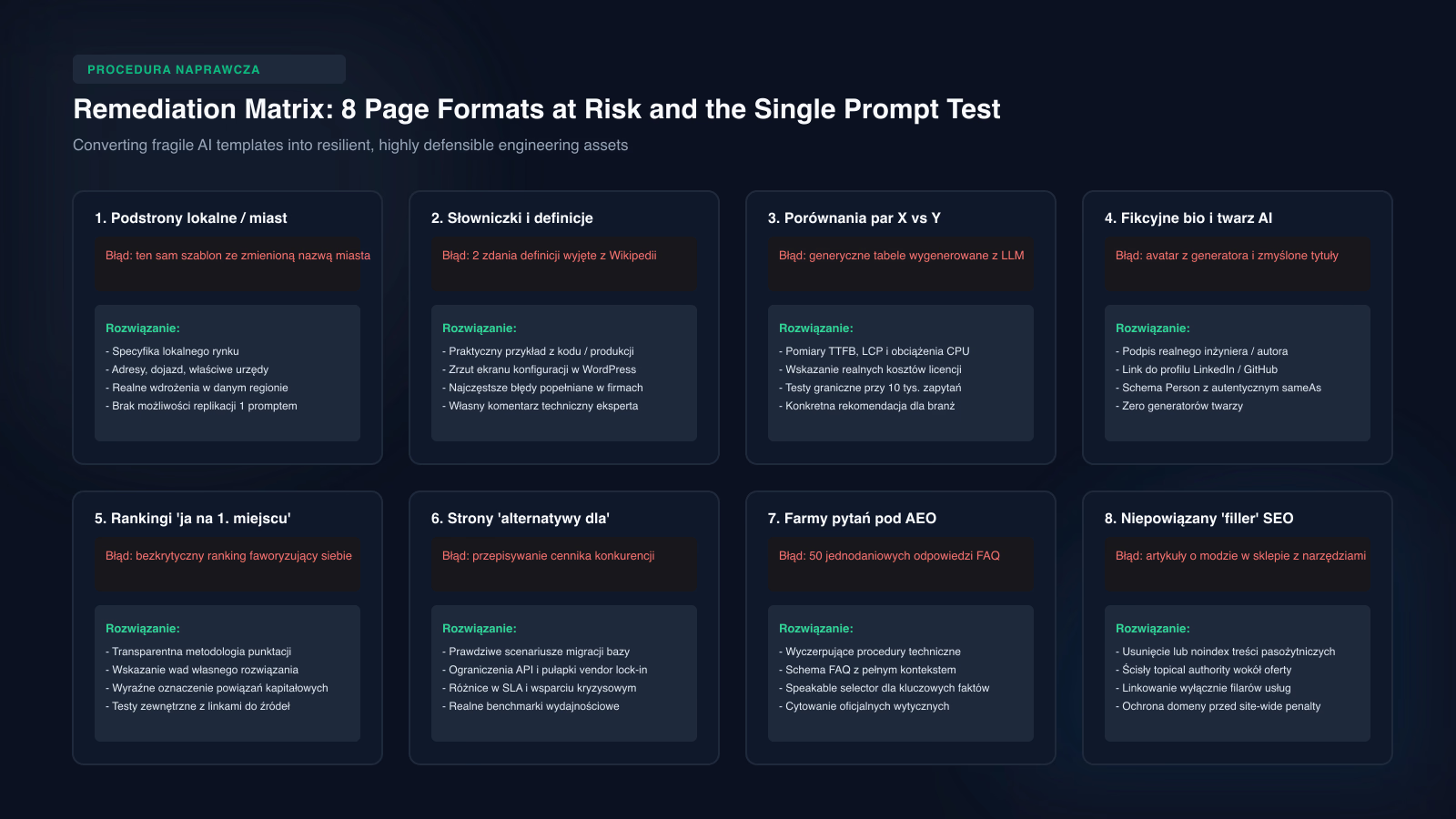
Remediation matrix for eight fragile page structures showing concrete technical interventions required to pass the single prompt test. Source: WPPoland engineering framework, 2026.
How to execute a single prompt audit across your site:
Step 1: Select five recent articles or top-level service categories from your CMS. Step 2: Submit the exact titles to a state-of-the-art model without supplementary system instructions or reference files. Step 3: Evaluate your published page against the raw model output across four criteria:
- Does your published text contain proprietary numbers, dates, costs, or benchmark timings absent from the AI draft?
- Does your page feature screenshots or architectural schematics extracted from real client environments?
- Does your article adopt an unambiguous technical stance based on field experience rather than balancing generic pros and cons?
- Does your copy cite verified statutory instruments, technical RFC standards, or official vendor advisories?
If your published material cannot answer yes to these criteria, it fails the single prompt test and faces depreciation during future Core Updates.
To pass the test, every article must incorporate at least one asset that an automated prompt cannot reproduce:
- An empirical stress-test log (such as a k6 benchmark profiling 500 concurrent checkout sessions on WooCommerce).
- A raw access log extract analyzing bot traversal behavior.
- An original case study detailing specific architectural interventions and measured latency improvements.
- A custom code solution addressing complex third-party API edge cases.
Injecting original primary evidence ensures your domain remains the source of truth for downstream models, securing consistent citations in AI Overviews and traditional organic SERPs. In our GEO and LLMO optimization programs, we implement semantic schema and knowledge graph linkages that maximize this citation index.
What to do when an e-commerce store or blog loses 70% of organic traffic?
Experiencing a severe traffic drop following an algorithmic update is stressful, but impulsive reactions like mass-deleting sections often cause deeper damage. Recovery demands an orderly, engineering-led turnaround.
Follow this five-phase remediation protocol:
Step 1: Performance segmentation in Google Search Console
Access Google Search Console and compare metrics from the past 28 days against the period prior to the algorithmic release. Segment URLs into three distinct buckets:
- Severely impacted pages that lost more than 70% of organic impressions (primary targets for remediation).
- Resilient URLs that maintained traffic (your domain’s core topical authority).
- Deindexed URLs that were dropped from the index entirely (signals of scaled content penalties).
Determine whether losses concentrated in specific templates, such as automated location pages, synthetic category descriptions, or uncurated blog entries.
Step 2: Ruthlessly remove or deindex peripheral content
If earlier SEO campaigns published hundreds of peripheral articles disconnected from your primary commercial offering, that low-effort bulk drags down domain authority. Remediate these pages systematically:
- Deploy 301 redirects to authoritative parent pillars if the deprecated URLs carry valuable external backlinks.
- Apply
X-Robots-Tag: noindexheaders if content must remain accessible to existing users without polluting the search index. - Return HTTP 410 Gone responses for completely obsolete programmatic pages, instructing search crawlers to purge them immediately from the crawl queue.
Step 3: Remediate top revenue-generating assets
Identify the top 20% of impacted URLs that historically drove qualified inquiries or sales. Execute a comprehensive editorial overhaul:
- Delete generic, padded introductory sections and replace them with verified technical specifications.
- Embed original operational diagrams, interface captures, and product photography.
- Implement Schema.org JSON-LD microdata referencing unambiguous Wikidata entities.
- Assign verified author credentials with transparent professional profiles.
Step 4: Infrastructure optimization and crawl budget recovery
Programmatic websites frequently suffer from hidden performance debt. Unindexed database queries, redundant plugin executions, and missing edge caching exhaust crawler budgets before high-value pages can be re-evaluated.
Harden the hosting layer:
- Deploy Redis object caching to eliminate redundant database queries in WordPress.
- Configure edge caching using Cloudflare Workers to serve static assets and cached HTML within single-digit milliseconds.
- Audit
robots.txtto block faceted search parameters and tracking query strings that waste crawl budget.
Step 5: Sitemap resubmission and observation
Submit updated XML sitemaps through Google Search Console. Domain-level quality classifiers do not reset instantly. Google algorithms require several crawl cycles across modified pages to confirm enduring quality improvements, typically requiring 4 to 12 weeks for visible traffic recovery.
| Phase | Operational Interventions | Expected Technical Outcome |
|---|---|---|
| Weeks 1-2 | Search Console segmentation, applying 410/noindex to uncurated programmatic batches. | Crawl budget cleared, index stabilized. |
| Weeks 3-6 | Manual editorial overhaul of top commercial assets, adding first-party data and Schema. | contentEffort increases, keywords re-enter top 50. |
| Weeks 7-10 | Core Web Vitals optimization, Cloudflare edge caching, author verification rollout. | E-E-A-T score improves, crawl frequency increases. |
| Weeks 11-16 | Reindexing completed, organic visibility in AI Overviews and search results restored. | Sustainable recovery of primary revenue terms. |
Search engines continue to reward efficiency, but the technical threshold has risen. Organizations that succeed use artificial intelligence to assist experienced engineers, rather than using automated tools as a substitute for verifiable technical expertise.