Migrate from WordPress to Astro in Malmö
Many businesses in Malmö run WordPress but face performance ceilings, security overhead, and rising hosting costs. Astro solves these with static HTML output, zero JavaScript by default, and edge deployment. I migrate existing WordPress sites to Astro with full SEO preservation, URL mapping, and 301 redirects.
- PageSpeed 95-100
Static HTML with zero JavaScript. Faster than any WordPress solution.
- SEO-safe migration
URL mapping, 301 redirects, Google rankings preserved.
- Cloudflare Pages hosting
Global CDN, free SSL, instant deployments. Hosting costs near zero.
Two things I do for companies in Malmö
Some readers arrive here because they searched for an SEO audit in Malmö, others because they want a faster website. The two jobs often meet. I am Mariusz Szatkowski, I have worked with WordPress since 2006, and I work alone from Gdynia in Poland, remotely and in writing. For Malmö companies I offer a written technical SEO and speed audit of an existing site, and new websites built with Astro from a design you supply. You can order the audit on its own and never hire me for the build.
What I do not do: graphic design, mockups and wireframes. Those come from you, your in-house designer or the agency that owns your brand. If the layout exists only in your head, I send a spreadsheet template in which you mark, view by view, which elements go where. I turn that into a working, responsive site.
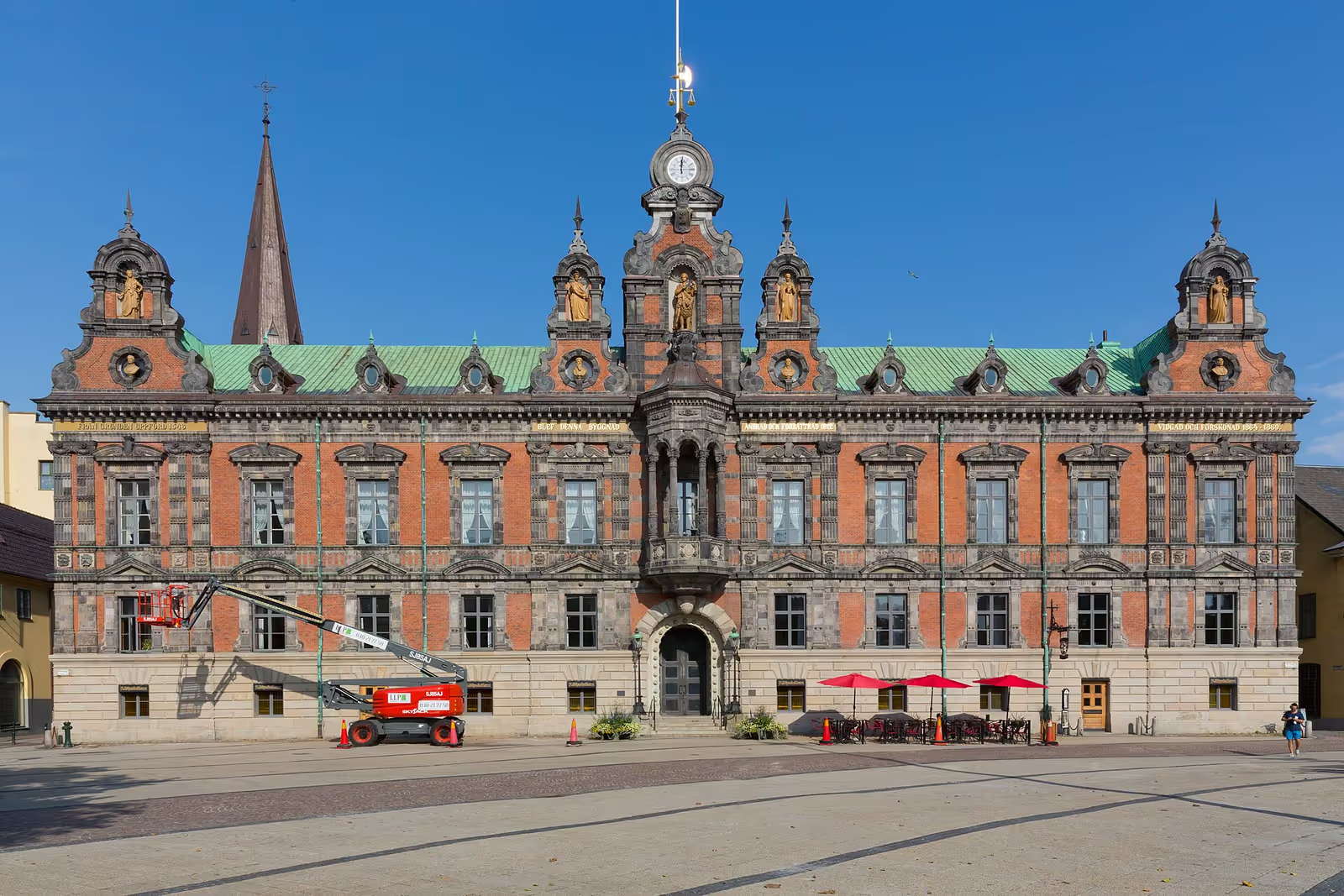
Photo: Liberaler Humanist, CC BY-SA 3.0, Wikimedia Commons.
The written technical SEO and speed audit
The audit answers one question: what stops search engines from finding, reading and showing your pages, and what slows them down for visitors. You get a document, not a dashboard export. Each finding names the URL or template where it occurs, the evidence, the effect, and the change I recommend, sorted so the cheapest fixes with the biggest effect come first.
What I check
- Indexing. Which pages carry
noindex, which are blocked in robots.txt, and whether those two collide. Google states that a noindex rule only works if the page is not blocked by robots.txt, because the crawler has to see the rule (Google Search Central). - Canonicals and duplicates. Filtered category pages, tracking parameters, trailing slash variants, print versions.
- Language versions. Many Malmö sites run in Swedish and English, some in Danish too. Google accepts hreflang in HTML, HTTP headers or the sitemap, and requires each language version to list itself and all others; pairs that do not point to each other are ignored (Google on localized versions).
- Redirects. Chains, loops, and old URLs from a previous platform that now return 404.
- Structured data. Whether the markup matches what is visible on the page.
- Speed. Field data where it exists, lab measurements where it does not, for the templates that carry your traffic.
- Third-party scripts. Chat widgets, tag managers, embedded video and booking tools, both for speed and for whether they load before consent.
Thresholds I measure against
I use only the official Core Web Vitals thresholds from web.dev: LCP up to 2.5 s, INP up to 200 ms, CLS up to 0.1, read at the 75th percentile of page loads and split between mobile and desktop. I do not promise a score. Google’s own documentation says good Core Web Vitals align with what its core ranking systems seek to reward, and recommends them for success in Search (Google Search Central). It does not say they lift a page to the top on their own, and neither do I.
What the audit is not
It is not keyword research, link building or a content strategy. If the report shows that the real problem is thin or duplicated content, I say so in writing and leave the editorial decision with you.
Building with Astro: what the framework actually does
For Astro facts I rely only on astro.build and its documentation.
- Current release. Astro 7.4 was published on 15 October 2026 (release post). It requires Node.js 22.22.0, adds an
astro build --timingsflag that prints where build time went, and letsimage.serviceuse one service for prerendered pages and another for pages rendered on demand. - Static by default. The rendering modes documentation says pages, routes and API endpoints are prerendered at build time unless you add an adapter and mark a page with
export const prerender = false. - Islands. According to the islands documentation, Astro renders UI components as HTML and CSS and strips client-side JavaScript automatically. A component becomes interactive only with a
client:*directive;client:visible, for example, loads it once it enters the viewport. Server islands withserver:deferrender a personalised part separately so it does not hold up the rest of the page.
In practice: a service page, a staff list or an opening-hours block needs no JavaScript in the browser. A booking form or a product configurator becomes an island and loads its own code. That is why I connect the audit and the build: the audit tells me which templates are slow and why, and the build fixes exactly those, measured against the same thresholds.
If your editors want to keep WordPress, it can stay as the editing backend while Astro serves the public site. The general overview is on my Astro developer page, and headless setups are covered on the headless CMS developer page. If the site should stay on WordPress, the WordPress speed-up service fits better than a rebuild.
Swedish rules a Malmö website has to carry
I am not a lawyer and this is not legal advice. Below are the provisions where a website has to do something technical. The texts come from the Riksdag’s statute database.
Cookies: lag (2022:482) om elektronisk kommunikation
Under 9 kap. 28 §, data may be stored in or read from a user’s terminal equipment only if the user gets information about the purpose and consents. Two exceptions: storage needed to transmit an electronic message over a network, and storage necessary to provide a service the user has explicitly requested. PTS writes that it carried out supervision in 2022 and 2023 of how website owners follow the cookie rules, and publishes guiding decisions.
For the build this means analytics, ad pixels and embedded video wait for consent. In an Astro site that is easy to enforce, because a script exists only where I put it. During the audit I record which requests fire before the visitor has chosen anything.
Personal data: GDPR and IMY
IMY, Integritetsskyddsmyndigheten, describes itself as Sweden’s data protection authority and checks that companies and authorities follow the GDPR. Contact forms, newsletter sign-ups and booking tools all collect personal data. The privacy policy text comes from you or your adviser; I place it, link it from every form and keep form data out of third-party scripts unless you decide otherwise.
Accessibility: lag (2023:254) and the European Accessibility Act
Lag (2023:254) om vissa produkters och tjänsters tillgänglighet entered into force on 28 June 2025 and implements Directive (EU) 2019/882. Section 4 lists e-commerce services among the services covered when intended for consumers, and section 2 defines them as services provided at a distance through websites and mobile services. Under section 10, services provided by microenterprises do not have to meet the accessibility requirements; section 2 defines a microenterprise as one with fewer than ten employees and an annual turnover or balance sheet total of no more than two million euro. Section 30 leaves the choice of supervisory authority to the government.
If you sell to consumers online and are above that size, accessibility belongs in the requirements, not in a later phase. I build semantic HTML, keyboard navigation and visible focus states. Colours, contrast and type sizes come from your design, so I review the design files before I start and report problems in writing. A broader legal check of a WordPress site is described on the EU compliance audit page.
Malmö as a market, from the city’s own figures
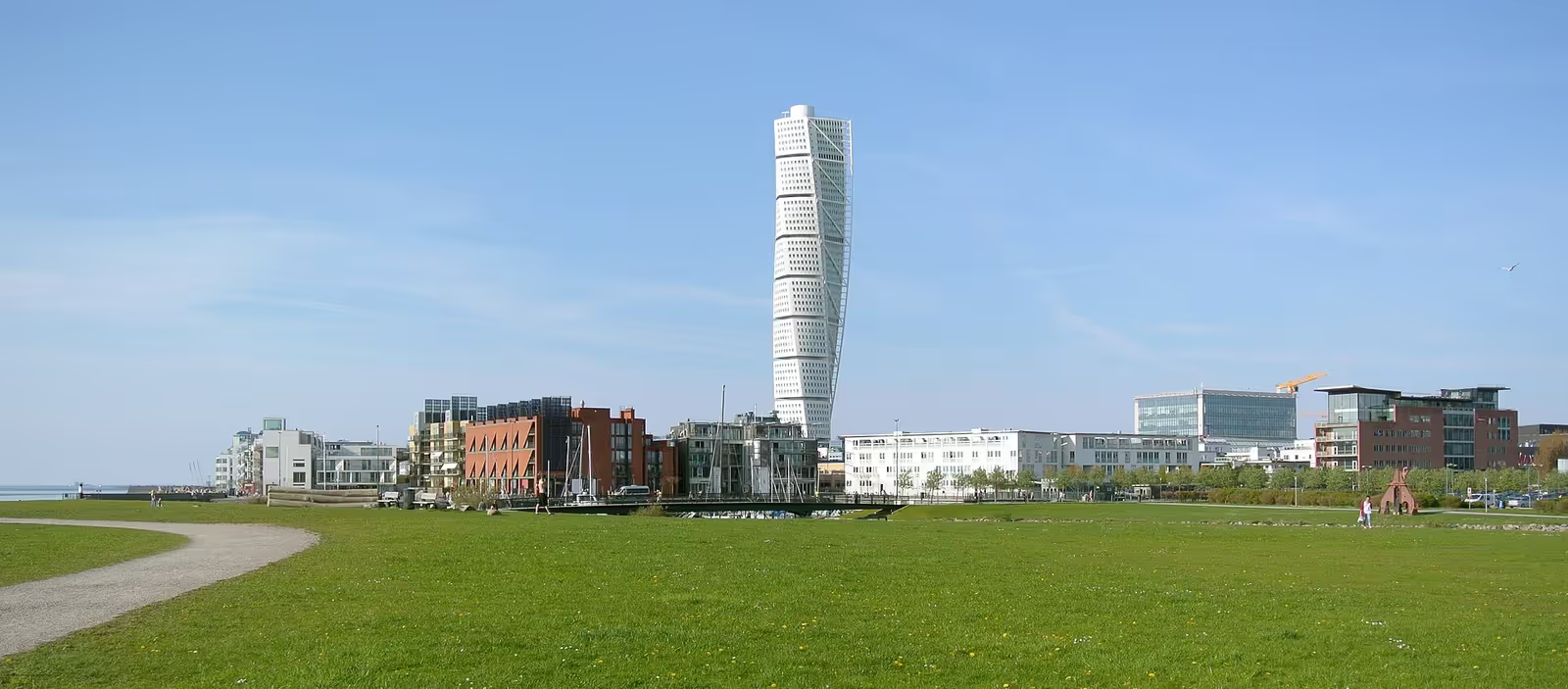
Photo: Adbar, CC BY-SA 4.0, Wikimedia Commons.
The city’s statistics page MalmöLäget, with figures from Stadskontoret, Malmö stad, reports 3,261 new companies started in Malmö during 2025 and 210,649 people working at workplaces in the city in 2024. It also reports 82,903 people commuting in and 51,969 commuting out in 2024.
The city’s tech sector page cites Malmö Invest with more than 800 companies and 8,000 employees in IT alone, mentions SaaS and climate tech, and names Minc as a tech startup house owned by Malmö stad. The sector overview also lists food, film, life science, design and games. For a SaaS company or a games studio the website is often a documentation site, a changelog and a careers page, which is close to the content Astro was built for.
Two public bodies are worth contacting before you commission any site. Malmö stad runs Företagslotsen, which guides new and existing business owners on permits and rules. Invest in Skåne, part of Region Skåne’s regional development department, advises international companies considering an establishment in Skåne and offers a guest office for 90 days to those testing the market. Neither decides anything about your website, but both can tell you what a Swedish company page is expected to contain before I build it.
From your first message to launch
- You write to me. Site address, goal, deadline, current stack, and whether you want the audit, the build or both.
- I ask in writing. Usually access to Search Console, the hosting, and a list of the pages that bring enquiries.
- Written scope. For an audit: which templates and how many URLs. For a build: pages, functions, integrations and assumptions, with design, texts and images listed as your deliverables.
- Staging. You review the build on a test address and comment in writing.
- Acceptance. I compare the result with the scope from step 3. New wishes become a separate scope with their own estimate.
- Afterwards. Optional maintenance with updates tested on staging and backups.
There is no fixed response time and no round-the-clock service: my answers come in writing, on working days.
What I need from you to start
- The design files (Figma, PDF) or the filled-in layout spreadsheet.
- Access to the domain, DNS, hosting and, if the site exists, to Search Console.
- Texts and images, in Swedish, English or both, and a list of URLs that must keep working.
- Privacy policy and cookie texts checked by you or your adviser.
- One person who approves in writing.
Checklist you can run yourself
| Check | Where to look | A problem if |
|---|---|---|
| Indexing | Search Console, page indexing report | key pages are excluded or marked noindex |
| robots.txt vs noindex | the robots.txt file and page source | a page is blocked and also carries noindex |
| Language versions | hreflang tags or sitemap | the Swedish page points to English, but not the other way round |
| Speed | Search Console, Core Web Vitals report | templates sit above LCP 2.5 s, INP 200 ms or CLS 0.1 |
| Consent | browser network tab on first visit | analytics or pixels load before any choice |
| Forms | each form page | no link to the privacy policy |
Send me your site
Write to me with your site address, what you want it to achieve, your deadline and the stack it runs on today, and say whether you want the audit, a new Astro build, or both. If a design already exists, attach it. My first written estimate costs you nothing. The quickest route is the contact page.
Selected projects
Examples of my work.
QUALITY WATCH - Mystery Shopping & Customer Experience Solutions
The Quality Watch project was created with the aim of presenting the services of a company specializing in improving customer service standards, quality management, customer experience, customer journeys and customer intelligence.
Real Estate Platform: DUNE CITY
The Dune City website was built for a prestigious apartment complex located on the 10-kilometre spit separating the Baltic ...
Real Estate Platform: lifetree.pl
The lifetree.pl website is a platform dedicated to personal development, healthy lifestyle, and inspiration from nature. The project was created for users se...
WordPress support & development in Malmö
See also in Sweden
Need this service: Astro developer in Malmö?
Describe your project by e-mail. I reply within 48 hours.
Describe your projectExplore other WordPress services and knowledge base
Migration to Astro, Next.js, and headless WordPress.
WooCommerce sync with ERP and wholesale systems.
Business process automation around WordPress and company systems.
Library of concrete automation use cases.
Headless WordPress, Sanity, Strapi, and Contentful with Astro or Next.js.
Astro, MDX, edge delivery, and Core Web Vitals measured on real traffic.
Custom WordPress engineering and architecture.
Scalable headless, ERP, and AI architecture for enterprise.
Related categories
Supporting articles
Six to sixteen weeks for typical engagements, with a four-phase shape: discovery, scoping, build and cutover, tuning. The variables are catalogue size, integration count, URL preservation, and editorial team readiness, not framework choice.
A definitive 4-year Total Cost of Ownership (TCO) analysis, real-world Core Web Vitals benchmarks, Astro 7 GraphQL APQ architecture, and a 10-point executive decision matrix for choosing between decoupled and traditional WordPress.

The Shopify Plus vs WooCommerce headless decision in 2026 is no longer a binary "platform vs custom" trade-off. Both can run headless, both integrate AI, both ship at the edge. The real axes are control, total cost over five years, and exit strategy. This article walks the matrix with confirmed platform facts.