Migrate from WordPress to Astro in Milan
Many businesses in Milan run WordPress but face performance ceilings, security overhead, and rising hosting costs. Astro solves these with static HTML output, zero JavaScript by default, and edge deployment. I migrate existing WordPress sites to Astro with full SEO preservation, URL mapping, and 301 redirects.
- PageSpeed 95-100
Static HTML with zero JavaScript. Faster than any WordPress solution.
- SEO-safe migration
URL mapping, 301 redirects, Google rankings preserved.
- Cloudflare Pages hosting
Global CDN, free SSL, instant deployments. Hosting costs near zero.
Mariusz Szatkowski works from Gdynia, Poland, on Astro builds for organisations whose boards, brand studios and procurement teams sit in Milan and across Lombardy. Typical clients anchor marketing along Porta Nuova and Piazza Gae Aulenti, run product and investor relations from towers around Via della Moscova, or pair a corporate HQ in the city with factories and showrooms in Brianza. They sell B2C lifestyle goods subject to Italy's consumer information rules, operate regulated fintech or payment brands, or host international groups that must publish Italian statutory pages beside English corridors for shareholders and EU tenders. A WordPress stack bloated with page-builder scripts, or a client-rendered SPA that paints the viewport before privacy notices render, creates avoidable friction with the Garante per la protezione dei dati personali and with consumer-facing duties under the Codice del consumo. Astro compiles public routes to static HTML, hydrates only widgets that need runtime logic, and keeps footer identity fields plus consent gating in version control where Milan counsel can review diffs.
What Lombardy HQs expect from a public marketing site
Milan concentrates Italy’s largest banks, asset managers, luxury groups, industrial design studios, and scale-ups that still sell to enterprise buyers. Briefs from procurement desks in Porta Nuova or from innovation leads tied to the Salone del Mobile ecosystem repeat technical demands even when the sector shifts from payments in the finance belt to configurators on design-tech microsites.
When I read scopes for Milan, these items appear in nearly every matrix:
- Consumer information on B2C paths, not only in a PDF linked once from the blog.
- Privacy notices and cookie choice aligned with Garante documentation before non-essential tags load.
- Core Web Vitals within the thresholds Google documents on web.dev, because buyers and journalists open links on LTE during commutes through Milano Centrale or Garibaldi.
- Italian and English trees where Italian carries statutory tone and English carries investor or export narrative without duplicate spam URLs.
- Heavy media (lookbooks, hero video, 360 product views) without shipping a full application runtime on every route.
Graphic design, motion, and photography come from your Milan agency or in-house studio. I turn approved Figma frames into responsive Astro layouts and attach trader identification, privacy links, and consent hooks your lawyers signed off.
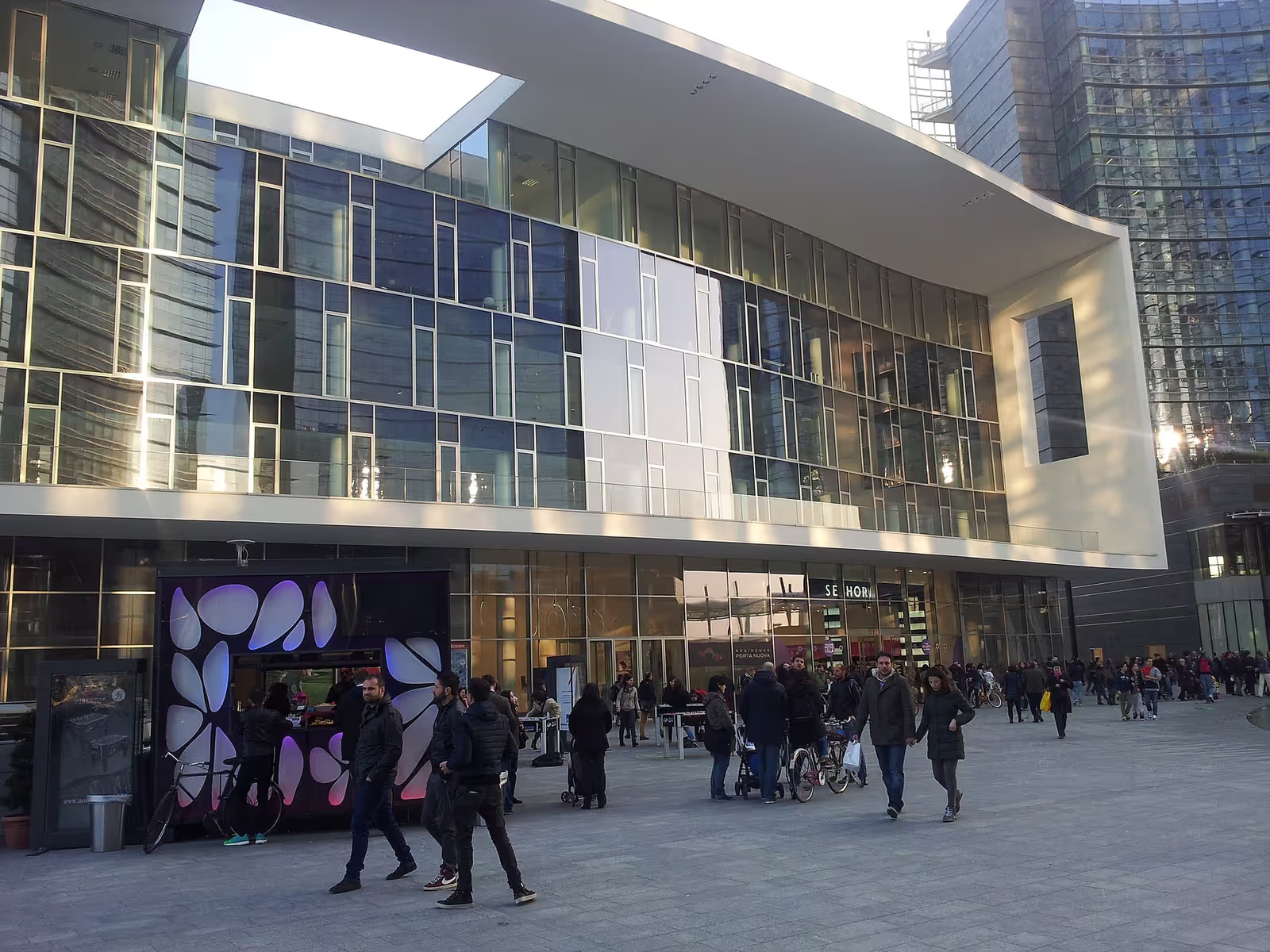
Photo: DaveM93, CC BY-SA 3.0, Wikimedia Commons.
Finance and fintech along Via della Moscova and Porta Nuova
Via della Moscova and the streets feeding Porta Nuova are not a single campus; they are a mesh of bank offices, payment startups, professional services firms, and fund managers whose sites must look conservative, load instantly, and survive counsel review after every template change.
For Lombardy finance sites I compile brochures to plain HTML and reserve client bundles for calculators, white-paper gates, or consent tooling. That split usually pulls Largest Contentful Paint and Interaction to Next Paint back inside the ranges Google documents on web.dev without asking visitors to download a SPA shell.
Porta Nuova briefs often arrive while the same company already runs a React cockpit for traders or analysts. Public Astro pages link out or embed small islands instead of rebuilding authenticated apps in the marketing repo.
Deliverables I ship for Milan finance and corporate buyers
- Group and subsidiary sites with Italian primary URLs and English investor sections.
- Governance and sustainability pages where counsel edits MDX or CMS entries but footers stay typed.
- Migration off WordPress multilingual stacks that slow mobile pages during earnings or collection launches.
- Split stacks where showroom editors stay in WordPress or Storyblok and Astro builds the CDN-cached storefront visitors crawl.
- Performance and schema audits on existing Astro repositories before a privacy or accessibility review.
I do not invent reference logos or turnover claims for this page. WordPress Meetup Milano and your own procurement network are better places to verify vendors than any anonymous portfolio tile.
Fashion, design tech and the Salone del Mobile calendar
Lombardy’s design economy stretches from corporate showrooms in Milan to suppliers in Brianza. Salone del Mobile and related Fuorisalone events compress marketing into tight windows: lookbooks, event maps, press kits, and reservation flows must stay fast when traffic spikes from international press and buyers.
Astro fits that calendar because static routes cache aggressively at the edge while islands power seat booking, showroom appointment widgets, or AR-ready product viewers your agency supplies. I defer to your creative director on typography and motion; my job is to keep Largest Contentful Paint stable when galleries load dozens of high-resolution stills.
Design-tech brands often sell configured products online. When configuration needs real-time pricing or inventory, I isolate that logic in an island and keep editorial copy static so SEO crawlers see complete text without waiting for hydration. When the business keeps a separate B2B portal on another stack, I document subdomain boundaries so robots and consent policies stay honest.
Media pipelines without sacrificing vitals
- Responsive
srcsetand modern formats (AVIF where brand allows) generated at build time or through an approved image CDN. - Lazy hydration for carousels so first paint is not blocked by slider JavaScript.
- Prefetch only on routes your analytics prove matter; no blanket client router across marketing pages.
- Video posters and deferred iframe embeds for runway clips hosted on your approved platform.
Codice del Consumo and Garante privacy on Astro layouts
Italy implements EU consumer protection through the Codice del consumo (D.Lgs. 206/2005). For B2C sites, information duties cover identity of the trader, characteristics of goods and services, pricing, delivery, withdrawal rights where applicable, and complaint channels. Milan consumer associations and the national framework expect those facts to be reachable without hunting through campaign landing pages.
The Garante per la protezione dei dati personali supervises GDPR application in Italy and publishes guidance on cookies, banners, and records of processing. Corporate counsel in Milan still cite the Garante’s cookie documentation when auditing marketing domains.
Because Astro renders footers and form preambles from data files in Git, procurement teams can compare pull requests during sprint review. After a fashion house swaps palettes overnight, I would rather diff a layout prop than chase consent toggles buried in a drag-and-drop theme.
| Surface | Legal anchor | How I wire it in Astro |
|---|---|---|
| Global footer | Trader identification and contact routes | Typed legalIdentity object injected into every layout |
| Product and checkout copy | Codice del consumo information duties on B2C paths | Locale-specific partials reviewed by your counsel |
| Newsletter and event signup | Lawful basis and transparency | Separate partial with unsubscribe copy per locale |
| Careers CRM hand-off | Privacy notice linkage | Form schema links to privacy policy slug in active language |
| Cookie banner | Garante expectations on choice before non-essential scripts | Consent island gates tag manager and pixels |
GDPR privacy policies remain your DPO’s text. My responsibility is technical alignment: no analytics network call before opt-in where your policy requires it, minimal fields on lead forms, and consent logs if you enable them.
Bilingual Italian and English trees without duplicate equity
Milan HQs routinely publish Italian for domestic consumers and regulators while English carries export, investor, or talent acquisition narratives. Assolombarda and Chamber of commerce surveys repeatedly show high adoption of multilingual sites among Lombardy exporters; the engineering task is to keep hreflang honest and consumer notices present on every locale that sells B2C.
I map languages to Astro content collections with explicit lang and translationGroup fields. Build scripts can assert that every Italian consumer paragraph has an English counterpart when the brief demands parity, or mark investor-only English pages so hreflang maps stay accurate. A missing Italian withdrawal summary should block release, not surface only after launch.
English corridors for EU procurement must still carry identification data your Italian counsel approves, even when tone is international. I keep statutory strings in typed modules so marketing cannot accidentally delete a VAT line during a homepage experiment.
Garante-aligned cookie and analytics loading
Marketing builds start with no third-party JavaScript until your consent island enables a category. That pattern matches how Milan privacy teams test Garante-aligned banners.
Before launch we co-author a script inventory: necessary, analytics, personalization, advertising. Loaders hang off that table so a new LinkedIn pixel becomes a reviewed pull request, not a CMS paste.
Whether you standardise on GA4, Matomo, or a hosted EU stack, loading waits for the choice your DPO documents. On staging, declining cookies should leave only necessary calls in the network panel, and we record screenshots for audit folders.
Islands architecture for lookbooks and B2B gates
Milan corporate and fashion sites rarely need full single-page-application behaviour on every route. What they do need is selective interactivity:
- Gated downloads for press kits or technical sheets where email domain matters.
- Product configurators for design divisions with long option lists.
- Showroom locators with filters for city centre versus Brianza plants.
- Event registration tied to marketing automation with double opt-in in Italian.
Astro islands host the interactive slice in React, Vue, or Svelte; the article body stays plain HTML for crawlers and assistive tech.
If dealers already authenticate in Next.js, I leave that portal alone and move only the public catalogue to Astro so organic traffic keeps a light first load.
Content collections for regulated and seasonal copy
Collection launches, statutory sustainability metrics, and Salone-week microsites fit content collections with Zod validation. Each entry carries lang, season or fiscalYear, and translationGroup fields. Charts render from figures your design or IR team uploads; I tag unknown metrics TBD rather than guessing turnover in prose.
Technical stack on Milan Astro engagements
Every repository targets current stable Astro with TypeScript strictness, Tailwind CSS design tokens from your brand PDF, and content collections for long-form pages. Deployment usually lands on Cloudflare Pages with automatic preview URLs per branch so Milan agencies can review without VPN fuss.
| Layer | Role on Milan corporate and fashion sites |
|---|---|
| Astro 5.x | Static marketing routes, view transitions where brand allows |
| TypeScript | Schema validation on legal and collection content |
| Tailwind CSS 4 | Utility layout matching supplied Figma spacing |
| React or Vue islands | Forms, consent, configurators |
| Cloudflare Pages | EU-friendly edge, custom headers for security policies |
| GitHub Actions | Lint, typecheck, Lighthouse CI on pull requests |
Schema.org blocks reuse the same typed records as footers: Organization with the Milan registered office, WebSite with inLanguage, and FAQPage only when questions appear on the page. We run the same rich-result tests your SEO retainer already bills for.
Written delivery from Gdynia without a Milan desk
I do not maintain an office in Porta Nuova or weekly onsite stand-ups in a tower lobby. Delivery stays async: email or tickets, shared Git, password-protected staging, and sign-off lists your procurement team can archive.
| Phase | Milan-side participants | What you receive |
|---|---|---|
| Intake | Marketing owner, legal counsel, SEO agency | Restated scope, risk log, language map |
| Architecture | IT security, DPO | Route diagram, cookie taxonomy, subdomain plan |
| Build sprints | Brand agency, content authors | Preview URLs, diffs for legal footers |
| Compliance pass | DPO, external counsel if B2C checkout exists | Evidence pack for cookie and identification checks |
| Launch | DNS owner, IR if investor pages move | Redirect file, Search Console checklist |
Central European working hours cover most Milan business days. Urgent production defects get written acknowledgement the same day when they block a campaign; feature scope still flows through change notes so procurement retains audit trail.
Pricing stays individual. Market surveys quote wide hourly bands for senior front-end contractors in Milan; my quotes follow scope after the written audit and name no figure on this page.
Migration from WordPress or Next.js without losing Lombardy SEO equity
Milan WordPress estates often mix Italian consumer widgets with English investor clones that drift apart. I merge sitemap exports, analytics top pages, Search Console samples, and CMS dumps into one redirect workbook before touching Astro.
Content lands as typed Markdown or components, not SQL blobs. Annual-report tables get human review after PDF copy-paste. Lighthouse runs on representative templates pre and post move so finance marketing sees numbers, not adjectives.
When Next.js already serves logged-in dealers, only the anonymous catalogue moves to Astro; authenticated routes stay on the stack that owns sessions.
Typical timeline for a Milan migration
- Weeks 1 to 2, content inventory, URL inventory, redirect mapping, structured data audit on the source site.
- Weeks 3 to 5, Astro project scaffolding, content model, component library, design system parity with the existing site.
- Weeks 6 to 8, content migration (markdown export, image rewriting, internal link rewriting, embed handling).
- Weeks 9 to 10, side-by-side performance and SEO measurement, Lighthouse CI, Search Console comparison, structured data validation.
- Week 11, DNS cutover with 301 redirects on the edge, post-launch monitoring of crawl errors and ranking changes for two weeks.
Local visibility for Milan and Lombardy queries
Local SEO for a corporate HQ is less about map packs and more about entity clarity: consistent name, address, and phone data in footers, LocalBusiness or ProfessionalService schema where appropriate, and location landing pages only when you operate retail beyond the tower lobby.
For AI-assisted discovery, clean semantic HTML and explicit about entities in structured data help parsers cite your governance or collection pages accurately. I avoid keyword-stuffed neighbourhood lists; Milan buyers punish transparent fluff.
Checklist before you sign any Astro contract in Milan
Use this list internally even if you choose another vendor:
- Confirm trader identification renders on Italian and English templates alike.
- Map B2C information duties for every product or checkout path that sells to consumers.
- Lock cookie taxonomy in writing before media teams drop new tag containers into staging.
- Decide whether English pages that still sell B2C must carry the same consumer notices as Italian routes.
- Check hreflang pairs in rendered HTML, not only inside a WordPress hreflang plugin dashboard.
- Name one counsel contact who must approve footer pull requests before merge to main.
- Capture Core Web Vitals on throttled mobile profiles mimicking Garibaldi commuter LTE, not only desk fibre.
- Document Salone or event microsites so consent and identification partials cannot be skipped on temporary routes.
How to start
Send your Milan domain, languages, and whether the project is greenfield, migration, or performance recovery. On Central European working days I reply with a written next step; staging credentials follow once scope is frozen. EU B2B contracting, individual quote after the audit, no Milan office and no improvised phone discovery.
Selected projects
Examples of my work.
E-commerce Development: nehrebeccy.pl
nehrebeccy.pl is a modern artistic agency that combines expertise in organising cultural events with a rich presentation of artistic offerings. The site was ...
E-commerce Development: nolaclub.pl
nolaclub.pl is an online store for nail polish and cosmetics distribution, with a product catalogue, checkout flow, and technical SEO.
E-commerce Development: Norwegian housing estate
osiedlenorweskie.pl is a website for a housing estate in Koszalin, presenting the place, architecture, and practical information.
WordPress support & development in Milan
Need this service: Astro developer in Milan?
Describe your project by e-mail. I reply within 48 hours.
Describe your projectExplore other WordPress services and knowledge base
Migration to Astro, Next.js, and headless WordPress.
WooCommerce sync with ERP and wholesale systems.
Business process automation around WordPress and company systems.
Library of concrete automation use cases.
Headless WordPress, Sanity, Strapi, and Contentful with Astro or Next.js.
Astro, MDX, edge delivery, and Core Web Vitals measured on real traffic.
Custom WordPress engineering and architecture.
Scalable headless, ERP, and AI architecture for enterprise.
Related categories
Supporting articles
Six to sixteen weeks for typical engagements, with a four-phase shape: discovery, scoping, build and cutover, tuning. The variables are catalogue size, integration count, URL preservation, and editorial team readiness, not framework choice.
A definitive 4-year Total Cost of Ownership (TCO) analysis, real-world Core Web Vitals benchmarks, Astro 7 GraphQL APQ architecture, and a 10-point executive decision matrix for choosing between decoupled and traditional WordPress.

The Shopify Plus vs WooCommerce headless decision in 2026 is no longer a binary "platform vs custom" trade-off. Both can run headless, both integrate AI, both ship at the edge. The real axes are control, total cost over five years, and exit strategy. This article walks the matrix with confirmed platform facts.