Migrate from WordPress to Astro in Rotterdam
Many businesses in Rotterdam run WordPress but face performance ceilings, security overhead, and rising hosting costs. Astro solves these with static HTML output, zero JavaScript by default, and edge deployment. I migrate existing WordPress sites to Astro with full SEO preservation, URL mapping, and 301 redirects.
- PageSpeed 95-100
Static HTML with zero JavaScript. Faster than any WordPress solution.
- SEO-safe migration
URL mapping, 301 redirects, Google rankings preserved.
- Cloudflare Pages hosting
Global CDN, free SSL, instant deployments. Hosting costs near zero.
Mariusz Szatkowski works from Gdynia, Poland, on Astro builds for organisations that sell maritime software, terminal equipment, inland logistics or energy-transition services into the Port of Rotterdam ecosystem. Typical briefs combine Dutch and English marketing on one hostname, quote forms that must survive plugin upgrades, and B2B catalogues that procurement teams open on phones inside Europoort gate complexes. A WordPress theme overloaded with page-builder blocks, or a client-rendered brochure that paints before statutory footers render, wastes crawl budget and creates friction under the Telecommunications Act (**Telecommunicatiewet**) Article 11.7a and under expectations the **Autoriteit Persoonsgegevens** (AP) sets for cookie choice and AVG transparency. Astro compiles marketing routes to static HTML, hydrates only widgets that need runtime logic, and keeps identification fields plus consent gating in version control where Dutch counsel can review pull requests before a Maasvlakte corridor campaign goes live.
What Rotterdam logistics and maritime buyers expect from a public website
Rotterdam is not a single buyer profile. A customs broker at Maasvlakte, a ship chandler scaling across the ARA range, a SaaS team selling berth planning APIs, and a Kop van Zuid employer-brand site for maritime engineers all need fast mobile pages, but compliance subtext differs. Logistics firms fight for visibility when Dutch and British procurement officers search on phones between terminal appointments. Maritime vendors sell into English-speaking technical buyers while AVG footers must stay honest in Dutch. Scale-ups around RDM Rotterdam need investor-ready storytelling without shipping a React runtime on every markdown release note.
When I read scopes for Rotterdam and the wider Randstad harbour belt, these items recur in RFP matrices and agency checklists:
- Article 11.7a cookie information visible before any non-essential script island hydrates, not hidden inside a PDF linked once from the blog.
- AVG transparency on lead forms, vacancy funnels and partner signup flows in Dutch and, when live, in English procurement copy.
- Cookie loading order that matches AP enforcement practice before any tag manager or analytics bundle fires.
- Core Web Vitals within the thresholds Google documents on web.dev, because terminal staff and journalists open links on industrial LTE during throughput press cycles.
- Bilingual trees where Dutch carries statutory tone and English carries technical specifications without duplicate spam URLs.
Photography, brand motion and illustration come from your Rotterdam agency or in-house studio. I implement supplied Figma or PDF frames as Astro layouts and pin AVG identification blocks below the visual brand layer.
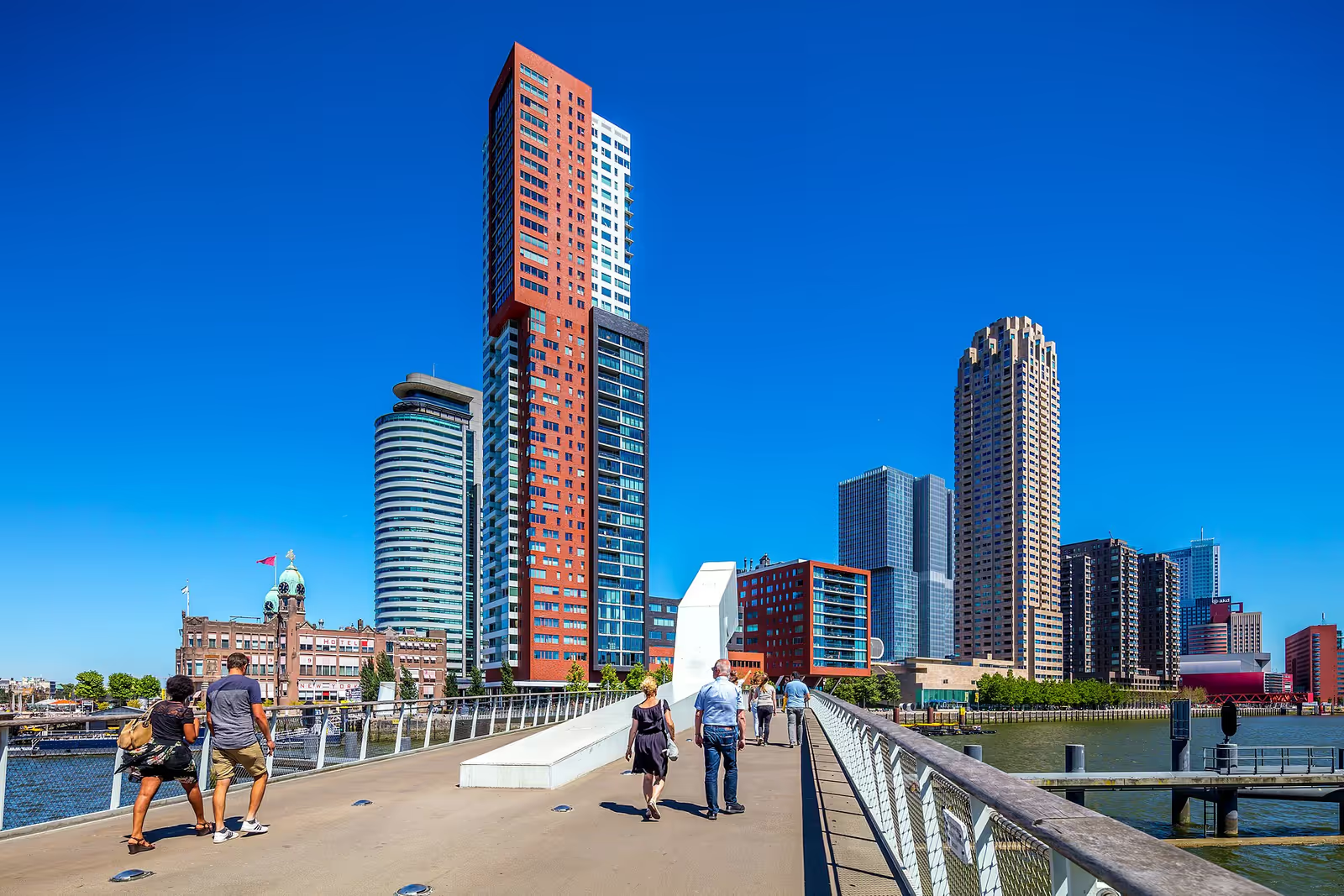
Skyline imagery stored in the project image set for Kop van Zuid and harbour context.
Port throughput, cyber risk and why marketing speed still matters
The Port of Rotterdam Authority reported total throughput of 428.4 million tonnes for 2025, down 1.7 percent, with 14.2 million TEU of containers, and 212.0 million tonnes for the first half of 2026 in its July 2026 update. Those numbers are not decoration for a landing page; they shape how forwarders, terminal operators and maritime suppliers time campaigns. When throughput headlines land, marketing wants a service update live in hours while operations still need quote forms and tracking links that behave on older Android browsers.
Authority communications also stress that digital threats against port-adjacent firms remain significant. A neglected public marketing site is part of a company’s attack surface even when the ERP lives elsewhere. Astro does not replace your SOC, but it reduces avoidable client-side attack area: fewer third-party scripts by default, explicit registers for what marketing adds mid-sprint, and static HTML that does not execute mystery PHP on every page view.
| Buyer segment | Typical Astro surface | Compliance touchpoint |
|---|---|---|
| Container line agency | Service catalogue with EN technical annex | Dutch cookie text on NL primary URLs |
| Terminal equipment OEM | Product docs plus lead forms | AVG purpose limitation on quote uploads |
| Inland barge operator | Seasonal capacity landings | Article 11.7a before remarketing pixels |
| Maritime SaaS scale-up | Pricing and security white papers | Consent before analytics on pricing pages |
| Kop van Zuid employer brand | Vacancy funnel in two languages | Recruitment form transparency in Dutch |
Multilingual service flows need explicit brief answers: which language is legally primary for footers, whether English targets UK buyers only or also EU tender portals, and whether German paths are a later phase. I map that to Astro locale folders, hreflang reciprocity on built HTML, and content collections so a missing Dutch data-processing paragraph blocks release.
Kop van Zuid, RDM and the maritime tech lane
Office towers along Kop van Zuid and innovation programmes at RDM Rotterdam host software teams that sell into shipping, offshore wind and hydrogen logistics. World Port Center and surrounding campuses concentrate international firms that recruit across Dutch and English-speaking markets. Competition for senior front-end contractors who understand both performance engineering and Dutch cookie law is real, which is why remote delivery with written acceptance criteria suits many harbour-belt marketing leads.
Astro suits harbour-belt product pages because they compile as static HTML unless you deliberately hydrate an island. Islands hold the pieces that genuinely need client logic: interactive tonnage calculators for B2B SaaS, demo request forms with KvK validation hooks, vacancy filters, or a consent manager. Everything else stays static, which keeps Largest Contentful Paint and Interaction to Next Paint inside the bands Google uses as ranking signals when your launch collides with a South Holland trade fair or an Authority stakeholder briefing.
Deliverables I ship for port-sector and Kop van Zuid buyers
- Product and employer-brand sites with Dutch primary URLs and English technical sections.
- Documentation microsites where engineers edit MDX while AVG footers remain typed YAML objects checked into Git.
- Migration off WordPress stacks that slow mobile articles during funding or throughput announcements.
- WordPress, Storyblok or headless Sanity as the editorial backend with Astro compiling the public edge-cached marketing layer at build time.
- Lighthouse, structured-data and cookie-loader audits on legacy Astro repos before counsel or procurement reviewers sign off.
Case studies on this site appear only with your written approval. If you need a Rotterdam reference, ask in channels your procurement team already uses, including WordPress Meetup 010, or request named peers in your corridor vertical.
Telecommunicatiewet Article 11.7a and AP expectations on Astro layouts
Dutch cookie rules sit in the Telecommunicatiewet, Article 11.7a, published on wetten.overheid.nl. In plain terms, storing or reading information on a visitor device through cookies or similar technology requires clear information and consent first, with exceptions for strictly necessary storage and for low-impact service measurement described in the statute. Those duties sit next to GDPR implementation rules the Autoriteit Persoonsgegevens supervises through the UAVG.
Randstad counsel often wants KvK-identified company strings visible on English procurement templates too, because the Dutch operator remains accountable for transparency even when the hero targets British or German technical buyers. Newsletter captures on a corridor-services campaign are still regulated communications: they need lawful basis, honest copy and unsubscribe mechanics users can reach without hunting settings pages. I bind each form variant to a typed partial so counsel signs Dutch and English strings once, and CI rejects campaign landings that lack the paired footer and consent linkage.
Because Astro renders footers from data files in Git, procurement teams and DPO colleagues can compare pull requests during sprint review. That is faster than chasing legal toggles in a page builder the night marketing recolours Maasvlakte hero photography.
| Surface | Dutch rule anchor | How I wire it in Astro |
|---|---|---|
| Global footer | AVG identification plus statutory contacts | Typed legalIdentity object injected into every layout |
| Quote or demo list | Purpose limitation on B2B leads | Separate partial with retention copy per locale |
| Partner CRM hand-off | Transparency on data use | Form schema links to privacy policy slug in active language |
| Cookie banner | Article 11.7a plus AP practice | Consent island gates tag manager and pixels |
Privacy policy prose remains your DPO’s text. On the engineering side I enforce zero pre-consent analytics calls, the smallest viable lead forms, and optional consent logs your DPO can export when AP asks for evidence.
AP-aligned cookie and analytics loading on Astro defaults
The Autoriteit Persoonsgegevens publishes guidance and decision summaries on autoriteitpersoonsgegevens.nl that Dutch DPO teams still cite during audits of logistics and maritime domains. Fresh Astro routes ship without client bundles until you name an island, which makes it practical to postpone analytics, heatmaps and remarketing until the banner records a purpose choice.
Before the first harbour-belt build I co-author a script ledger with your DPO: necessary, analytics, personalization, advertising. Each loader references that ledger, and the consent island decides which import may run. A mid-sprint LinkedIn pixel becomes a pull request against the ledger, never a silent CMS checkbox.
If GA4 or Matomo stays in scope, I add compile-time guards or runtime hooks exactly as your DPO memo describes. Acceptance uses staging proof: reject cookies, reload, confirm the network panel stays quiet until opt-in, then repeat on a service page that still carries a tracking widget island.
Islands architecture for port campaigns without SPA weight
Harbour-belt sites rarely need full single-page-application behaviour on every route. What they do need is selective interactivity:
- Capacity or sailing schedules that respect rate-parity rules without reloading the entire catalogue.
- Dutch and English route trees that keep statutory footers on separate URLs instead of client-side switches that repaint after hydration.
- Webinar and white-paper signups with Dutch double opt-in routed through your marketing automation stack.
- Partner portals that authenticate shippers in a small client island while tariff help pages ship as plain compiled HTML.
The Astro islands model isolates React, Vue or Svelte widgets while the article body remains plain HTML. Screen readers keep predictable heading order, and crawlers receive complete corridor copy on the first response without waiting for hydration.
When a subsidiary insists on Next.js for a logged-in operations dashboard, I still recommend Astro for the anonymous catalogue that feeds SEO. Hybrid architectures are normal along the Maas: performance-sensitive public HTML, heavier client bundles only behind authentication.
Content collections for service catalogues and policy copy
Safety data sheets, corridor FAQs, sustainability statements and cyber-resilience notices fit content collections with Zod validation. Each entry carries lang, serviceLine and translationGroup fields. Build scripts assert that every Dutch statutory paragraph has an English counterpart when the brief demands parity, or explicitly mark English-only tender pages so hreflang maps stay honest.
MDX allows embedded diagrams where your design agency supplies figures, but registration or certification numbers in prose still need a named source. Placeholders stay marked TBD until harbour counsel supplies identifiers; I never fabricate registry numbers to inflate copy.
Technical stack I use on Rotterdam Astro engagements
Every repository targets current stable Astro with TypeScript strictness, Tailwind CSS design tokens from your brand PDF, and content collections for long-form pages. Deployment usually lands on Cloudflare Pages with automatic preview URLs per branch so Rotterdam agencies can review without VPN fuss.
| Layer | Role on harbour-belt sites |
|---|---|
| Astro 5.x | Static marketing and catalogue routes, view transitions where brand allows |
| TypeScript | Schema validation on legal and service-line content |
| Tailwind CSS 4 | Utility layout matching supplied Figma spacing |
| React or Vue islands | Quote widgets, consent, calculators |
| Cloudflare Pages | EU-friendly edge, custom headers for security policies |
| GitHub Actions | Lint, typecheck, Lighthouse CI on pull requests |
Structured data comes from the same typed content: Organization with legal name and Dutch address, ProfessionalService where appropriate, WebSite with inLanguage, and FAQPage only where FAQs are visible on the page. Staging builds pass Rich Results checks plus the schema workflow your Rotterdam SEO partner already uses.
Written delivery from Gdynia without a Kop van Zuid desk
I do not maintain an office on Wilhelminapier or weekly onsite stand-ups at RDM. Work runs through written tickets, a shared repository, password-protected staging hosts, and acceptance lists your operations lead can forward to procurement.
| Phase | Rotterdam-side participants | What you receive |
|---|---|---|
| Intake | Marketing owner, legal counsel, SEO agency | Restated scope, risk log, language map |
| Architecture | IT security, DPO | Route diagram, cookie taxonomy, subdomain plan |
| Build sprints | Brand agency, content authors | Preview URLs, diffs for legal footers |
| Compliance pass | DPO, procurement liaison | Evidence pack for cookie and ID checks |
| Launch | DNS owner, integration vendor | Redirect file, Search Console checklist |
Central European working hours cover most Dutch business days. Urgent production defects get written acknowledgement the same day when they block a corridor campaign; feature scope still flows through change notes so procurement retains audit trail.
Pricing stays individual. Market surveys quote wide hourly bands for senior front-end contractors in the Netherlands; my quotes follow scope after the written audit and name no figure on this page.
Migration from WordPress or Next.js without losing harbour SEO equity
Many Randstad logistics domains grew on WordPress with page builders that embed Dutch legal shortcodes inconsistently across English clones. Migrations begin with one merged ledger: live crawl, CMS export, analytics landing extracts, and Search Console performance rows. Each legacy URL gets a disposition: keep the slug, single-hop 301 to a successor, or 410 when nothing legitimate replaces it.
Content arrives as reviewed Markdown and components, not raw database dumps. Page-builder fragments become components with human review, especially for tables lifted from PDF service manuals. Lighthouse captures on terminal-sector templates before and after cutover give harbour marketing leads board-ready performance deltas.
Next.js catalogue routes that were brochures lose default client bundles during cutover. Dashboards that already rely on React Server Components can remain on Next while anonymous service HTML compiles on Astro at the CDN edge.
Local visibility for Rotterdam and Randstad service queries
Local SEO for maritime B2B is part entity clarity, part technical trust: consistent identification data in footers, schema that matches how you actually operate corridors and terminals, and location landing pages only when you manage distinct branches beyond a single registered office.
For AI-assisted discovery, semantic HTML plus explicit about entities in JSON-LD help parsers cite your cyber-resilience or emissions pages without guesswork. I avoid keyword-stuffed district lists; Dutch procurement teams spot filler quickly.
Checklist before you sign any Astro contract in Rotterdam
Use this list internally even if you choose another vendor:
- Confirm Article 11.7a cookie copy renders before analytics islands on Dutch and English templates alike.
- Map AVG transparency for every form that triggers email campaigns or remarketing audiences.
- Freeze cookie categories before marketing installs tag containers ahead of throughput news cycles.
- Decide how KvK and contact identification appear on each service partial per language.
- Confirm hreflang pairs appear in built HTML, not only in a CMS configuration panel.
- Name one compliance contact who approves footer diffs before merge to main.
- Plan vitals measurement on real mobile profiles terminal staff use along the Maas.
How to start
Send your Rotterdam domain, languages, and whether the project is greenfield, migration or performance recovery. During CET business days I answer in writing with the next step and publish staging once scope is frozen. EU B2B contracting, individual quote after the audit, no Kop van Zuid office and no improvised phone discovery.
Selected projects
Examples of my work.
Real Estate Platform: predko.pl
predko.pl is a modern website dedicated to the life and career of rally driver Krzysztof Predko. The site was designed with fans of motorsports and anyone in...
Real Estate Platform: rezydencjapark.pl
Rezydencja Park Mielno is a complex of boutique apartments by the sea, created with the idea of harmony with the surrounding nature and providing a family at...
Real Estate Platform: sportostroda.pl
Sportostroda.pl is one of the interesting projects in my portfolio as a WordPress developer, realised as a local sports portal dedicated to the residents of ...
WordPress support & development in Rotterdam
Need this service: Astro developer in Rotterdam?
Describe your project by e-mail. I reply within 48 hours.
Describe your projectExplore other WordPress services and knowledge base
Migration to Astro, Next.js, and headless WordPress.
WooCommerce sync with ERP and wholesale systems.
Business process automation around WordPress and company systems.
Library of concrete automation use cases.
Headless WordPress, Sanity, Strapi, and Contentful with Astro or Next.js.
Astro, MDX, edge delivery, and Core Web Vitals measured on real traffic.
Custom WordPress engineering and architecture.
Scalable headless, ERP, and AI architecture for enterprise.
Related categories
Supporting articles
Six to sixteen weeks for typical engagements, with a four-phase shape: discovery, scoping, build and cutover, tuning. The variables are catalogue size, integration count, URL preservation, and editorial team readiness, not framework choice.

A definitive 4-year Total Cost of Ownership (TCO) analysis, real-world Core Web Vitals benchmarks, Astro 7 GraphQL APQ architecture, and a 10-point executive decision matrix for choosing between decoupled and traditional WordPress.

The Shopify Plus vs WooCommerce headless decision in 2026 is no longer a binary "platform vs custom" trade-off. Both can run headless, both integrate AI, both ship at the edge. The real axes are control, total cost over five years, and exit strategy. This article walks the matrix with confirmed platform facts.