Automattic wants .wordpress as a top-level domain of its own, and only it and its affiliates would be able to register under it. The application is on the list ICANN published on 7 October 2026. If a client forwards you an email offering a .wordpress pre-registration, the offer is empty.
Did Automattic apply for .wordpress?
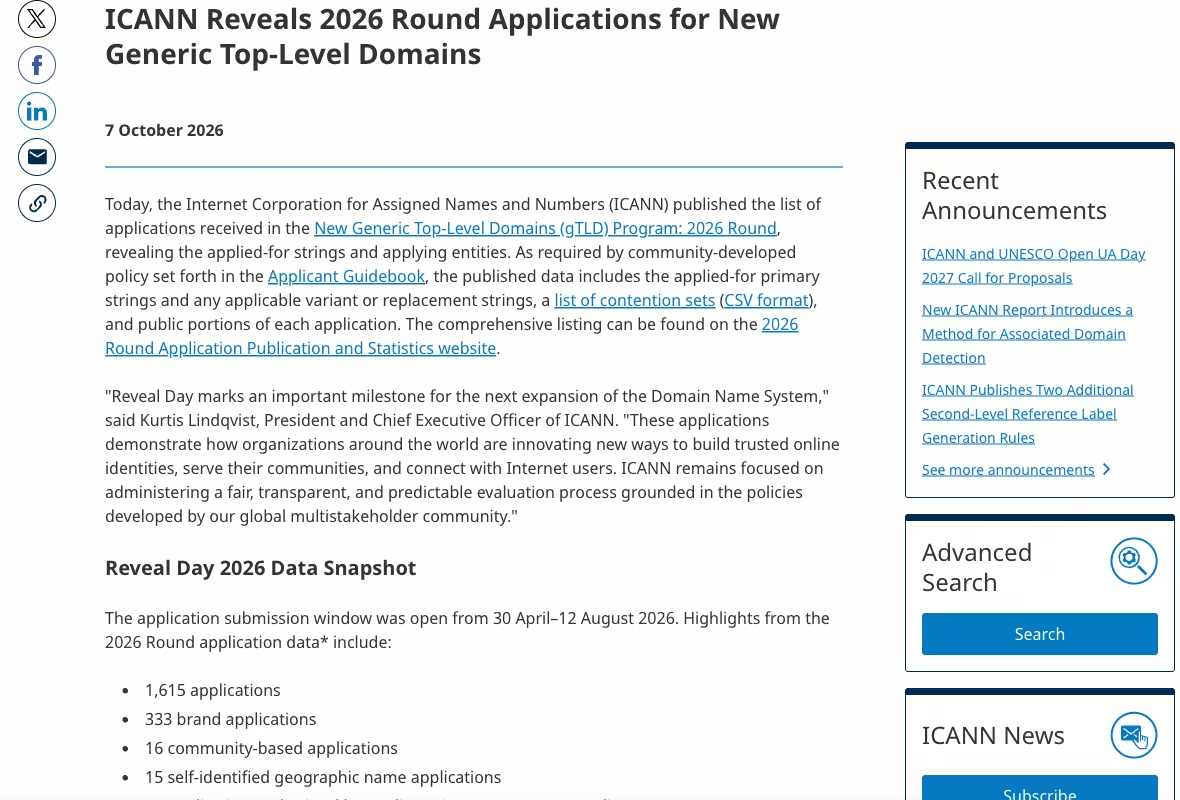
Yes. ICANN published the 2026 round application list on 7 October 2026: 1,615 applications, 333 of them in the brand category. The window ran from 30 April to 12 August 2026.
The Repository reports that the applicant is Knock Knock WHOIS There (KKWT), Automattic’s registry subsidiary, which has run .blog since 2016. The application pitches .wordpress as a trusted space Automattic will steward on behalf of the open-source project and the open web. It also defines it this way:
“a closed, single-registrant namespace dedicated exclusively to supporting the WORDPRESS brand, associated products and services, and related internal and external digital initiatives controlled by KKWT and its Affiliates.”
And, as The Repository quotes it:
“Registration of domain names within the TLD will not be made available to unaffiliated third parties,”
The full list sits on ICANN’s application publication site.
What does a closed .wordpress mean for site owners?
You cannot register anything under it. No yourcompany.wordpress, not at a registrar and not through WordPress.com. It would behave like .google or .apple: one owner, used for its own services.
One formal detail. According to The Repository, Automattic did not apply in the brand TLD category, the one used for company names such as .apple. It asked instead for an exemption from the Registry Operator Code of Conduct, the rules meant to stop a registry favouring itself. The exemption would let Automattic keep every .wordpress domain for its own use. For comparison, ICANN says the registry agreement for brand TLDs includes Specification 13, “which includes an exemption to the Code of Conduct”. The same article notes the application offers no voluntary commitments to the public interest.
ICANN will not approve closed TLDs for generic words. The application therefore states that the string WordPress “corresponds to a brand with multiple registered trademarks and thus is not a ‘Generic String’”. Whether ICANN accepts that is not yet known.
Who owns the WordPress trademark, if Automattic is the one applying?
That is where the dispute sits. According to The Repository, the WordPress Foundation owns the WordPress trademarks, and under a 2010 agreement Automattic holds an exclusive, perpetual commercial licence to use and sub-license them. The Foundation is not named in the application.
Paolo Belcastro, Automattic’s Head of Domains, told The Repository the trademarks belong to the Foundation and that has not changed:
“Automattic holds a limited commercial license from the Foundation, as it has since 2010, and its use of the WordPress name remains subject to that agreement and the Foundation’s oversight,”
He added that policies for using .wordpress would be published before any launch, and that applying keeps the name from being left “unclaimed or contested at auction”.
Kellie Peterson, Automattic’s Head of Domains from 2016 to 2023, criticised the application in “Automattic Wants .wordpress. It Doesn’t Own WordPress.” She argues that the exemption Automattic requested does not depend on owning the trademark. The Repository quotes her:
“A trademark license is a permission. Nothing in the exemption ties the TLD to that permission. If Automattic’s license to the WordPress name ever changed, .wordpress would stay right where it is,”
Peterson says in the same piece that she may have “a personal axe to grind” with Matt Mullenweg. For a site owner the takeaway is narrow: the dispute is about who controls a domain, not about whether you may use WordPress.
Which other strings did Automattic apply for?
Automattic filed 16 applications. CircleID names six:
“Automattic, through the company that operates .blog, filed 16, including .wordpress, .tumblr and .woo alongside .robot, .vibe and .human.”
The Repository adds .matt and .jazz. Per HostingDiscussion, working from ICANN data, .woo and .tumblr are flagged as brand applications and .wordpress is not. Automattic competes with other applicants for 11 strings, among them .pod, .robot, .vibe and .human. The full list of 16 could not be confirmed, so the rest are not named here.
The hint came earlier. On 24 August 2026 Domain Incite quoted an Automattic post saying “We’re not trying to find the next .com” and that it prefers a small number of options that complement .blog over dozens of extensions.
Is anyone competing with Automattic for .wordpress?
No. The Repository: “No one else has applied for .wordpress, according to ICANN’s published list.” HostingDiscussion counts .wordpress among five strings with a single applicant, alongside .jazz, .matt, .tumblr and .woo. The replacement period runs until 21 October 2026, so today’s picture is not final. ICANN publishes the confirmed list on 17 November 2026.
No rival applicant does not mean a clear road. Community and trademark owners can weigh in during the input and objections period. The Repository notes that under the Applicant Guidebook, Code of Conduct exemption requests are open to public review in that window.
What is the ICANN timeline after Reveal Day?
Dates from ICANN’s announcement:
- 8 to 21 October 2026: replacement period.
- 17 November 2026: String Confirmation Day, with the final string list and contention sets.
- 17 November 2026 to 16 March 2027: community input and objections.
- 27 November 2026: last day to withdraw with a 65% refund of the evaluation fee.
- First half of 2027: prioritization draw. String evaluation is expected to take about 180 days.
Objections go to WIPO, which ICANN appointed as the exclusive provider for legal rights objections (trademark owners) and string confusion objections. Later stages have no ICANN dates yet. CircleID estimates that the first uncontested TLDs “could go live in late 2027 or early 2028”. That is an estimate, not an ICANN date.
How does .wordpress relate to .blog?
Automattic has run .blog since 2016, and it is open: anyone can register. Domain Incite reported 200,000 registrations in 2019 after the WordPress.com partnership, and HostingDiscussion, citing Domain Name Wire, gives roughly 375,000 today. .wordpress is the opposite model, one company and no sales.
So do not read it as a replacement for .blog. The application does not say that.
What happened to closed brand TLDs from the 2012 round?
Closed company-owned domains are not new, and the record is mixed. Domain Incite counted in September 2021 that ICANN had records of 104 dot-brands terminated or asking to be terminated: 90 started by the registry, 14 by ICANN. Registries mostly dropped strings that were never used, or tried and then abandoned, with a smaller number following mergers or product end-of-life. ICANN’s own terminations were mostly operators getting cold feet during pre-delegation testing.
Examples from the same piece: SC Johnson gave up .afamilycompany, .duck, .glade, .off, .raid and .scjohnson. Some strings were sold or reopened, for instance .bond and .sbs went to ShortDot and .monster and .quest became open generics. That is a 2021 snapshot, and no newer count is given here.
The practical lesson: an application for a closed domain says little about whether, or how, it will be used. Until Automattic publishes its policies, plan nothing around .wordpress addresses.
Why do domains matter for the security of a WordPress site?
The usual trouble with domains is impersonation, not new extensions. APWG counted 1,069,681 phishing attacks in Q2 2026, up 10.1% from 971,181 in Q1. The report describes phishing as fooling people with “deceptive email addresses and messages, bogus web sites, and deceptive domain names”. A domain that resembles yours is a standard ingredient.
A closed .wordpress does not change that risk for your site. Lookalikes are registered in extensions that are open. Official .wordpress addresses might become easier to recognise, but that is an inference from the design, not from data.
What to check on your own domains now:
- The registrar account: two-factor authentication, ideally a hardware key, and a current contact email.
- Transfer lock enabled on every company domain.
- DNS records: remove entries nobody can explain, especially old CNAMEs pointing at expired services.
- Auto-renew on, and the expiry date in a calendar.
- Who has access to the registrar panel, and whether that list is current.
What should site owners do now, and what should they skip?
Buy nothing. No registrar can sell a .wordpress address today. The domain is not in the DNS root, and per the application it will not be sold to anyone outside Automattic. A reservation, waiting list or pre-registration is not a product that will ever be delivered. Tell clients before they pay.
What does make sense:
- Keep your current primary domain. Nothing in the ICANN process touches it.
- Do not write
.wordpressinto contracts, quotes or briefs as a future client address. - After 17 November 2026, look at the final ICANN list and the input period if you care how ICANN treats the application.
- Work through the checklist above. It is the only step that reduces real risk.
Domain settings are one part of keeping a site safe. Plugin updates, backups and testing updates on a copy first are the rest, and that is what our WordPress maintenance service covers.