Short answer: a countdown timer is legal as long as it tells the truth. If the offer really ends at the time shown and the price then goes up, you are fine. If the timer starts again on every visit or every day while the price stays the same, your shop is using a practice that is banned outright: section 55(1)(n) of the Consumer Protection Act 2007 in Ireland, and Schedule 20 paragraph 7 of the Digital Markets, Competition and Consumers Act 2024 in the UK. The CMA has already made Wowcher credit over 4 million GBP to its members over a timer of exactly this kind. The same applies to an “only 1 left” message that does not reflect your stock.
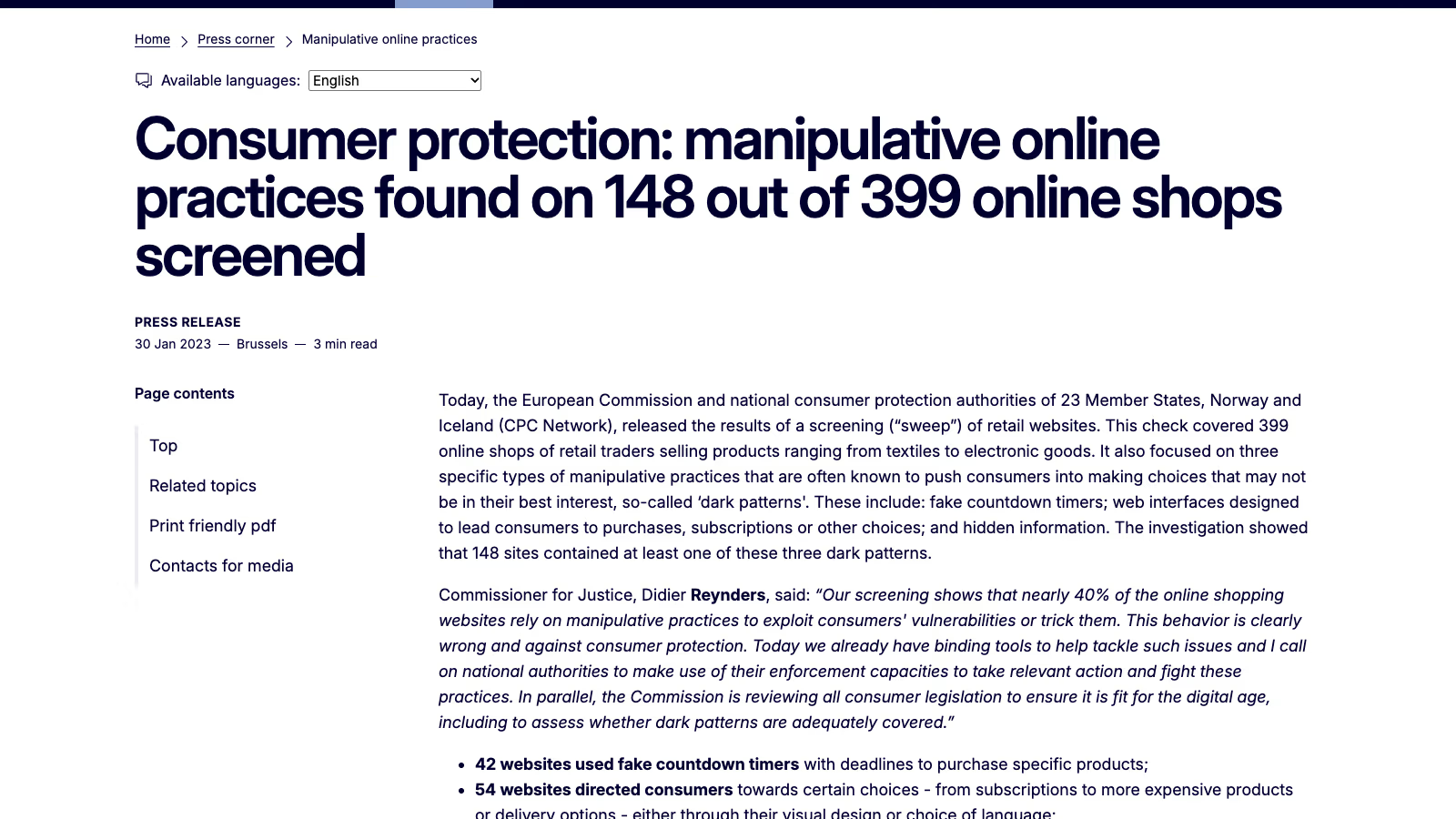 European Commission press release of 30 January 2023. Source: ec.europa.eu.
When is a countdown timer illegal?
Both Irish and UK consumer law keep a list of commercial practices that are unfair in all circumstances. On that list, a shop cannot argue that the customer would have bought anyway or that the timer made no difference to the decision. If the practice fits the description, it is prohibited.
In Ireland the rule sits in section 55(1)(n) of the Consumer Protection Act 2007, which prohibits:
making a false representation that a product is available only for a limited time, or on particular terms for a limited time, in order to elicit an immediate decision from a consumer…
Source: Consumer Protection Act 2007, s. 55, revised act.
In the UK, the Digital Markets, Competition and Consumers Act 2024 contains the list of always-unfair practices in Schedule 20, in force since 6 April 2025. Paragraph 7 reads:
Falsely stating that a product will only be available for a limited time, or that it will only be available on particular terms for a limited time, in order to elicit an immediate decision…
Source: DMCC Act 2024, Schedule 20.
Both provisions contain the same three conditions, and all three have to be met at once:
| Condition | Check question for the shop |
|---|---|
| A claim of limited time | Does the timer, banner or slogan say the offer or price ends soon? |
| The claim is false | When the time runs out, does the price really go up or the offer really disappear? |
| Aim: an immediate decision | Is the message meant to make the customer buy now instead of next week? |
A timer meets the first and third conditions by design, because that is the reason anyone puts one on a page. Whether it is legal comes down to the second condition alone: is what it shows true?
The Irish and UK wording both trace back to point 7 of Annex I to the EU Unfair Commercial Practices Directive 2005/29/EC (publications.europa.eu). The rule is therefore the same across the EU and the EEA, and the UK kept it after Brexit in its own statute. For a shop that sells into Germany, Spain or Poland as well as at home, that consistency is useful: one honest setup works everywhere.
What has the CMA done about fake timers?
The UK regulator has two published cases that show the two typical patterns.
The timer that always counts to midnight (Wowcher, 2024). Wowcher ran a permanent timer on its homepage that counted down to midnight, while most of the deals stayed at similar prices afterwards. The CMA also objected to “Running out!” claims. Wowcher gave undertakings without admitting liability and credited over 4 million GBP in refunds to more than 870,000 VIP members. The CMA’s summary of the rule is one sentence worth printing for your marketing team: “Timers must not mislead consumers or give a false impression that they have to act quickly to avoid missing out on a deal.” (CMA, 19 July 2024)
Timers, “high demand” and discounts together (Emma Sleep, 2026). In the case against the mattress retailer Emma, the High Court made an order on 22 May 2026. According to the CMA, Emma “admitted it broke consumer law by using misleading countdown timers, and false ‘high demand’ messages and ‘discount’ claims”. The outcome was court-enforceable undertakings with compliance monitoring, with no fine for this part of the case (CMA, gov.uk).
The practical lesson from both: the regulator checks what happens to the price and the offer once the timer reaches zero.
Under the DMCC Act the CMA can investigate breaches itself and issue infringement notices (ss. 180 to 182). Any shop running Black Friday 2026 in the UK is dealing with a regulator that holds these powers directly.
Is anyone checking timers in Ireland?
No Irish trader has been publicly named over countdown timers. That does not mean nobody is looking. The Competition and Consumer Protection Commission (CCPC) took part in the EU follow-up sweep of Black Friday sales and reported the results on 26 March 2026: of the traders checked, “18% used pressure-selling techniques, such as claiming a product is running out or using countdown timers” (CCPC, 26 March 2026). That sweep covered 314 traders.
The CCPC states that it “has enforcement powers under competition and consumer legislation”. Its tools include compliance notices, fixed payment notices, undertakings and prohibition orders (CCPC).
What does the European Commission say about fake timers and “last item” messages?
In 2021 the European Commission published guidance on the Unfair Commercial Practices Directive (notice 2021/C 526/01). In the part on data-driven practices and dark patterns (section 4.2.7), it says that creating urgency by falsely stating limited availability “includes fake timers and limited stock claims on websites” (publications.europa.eu).
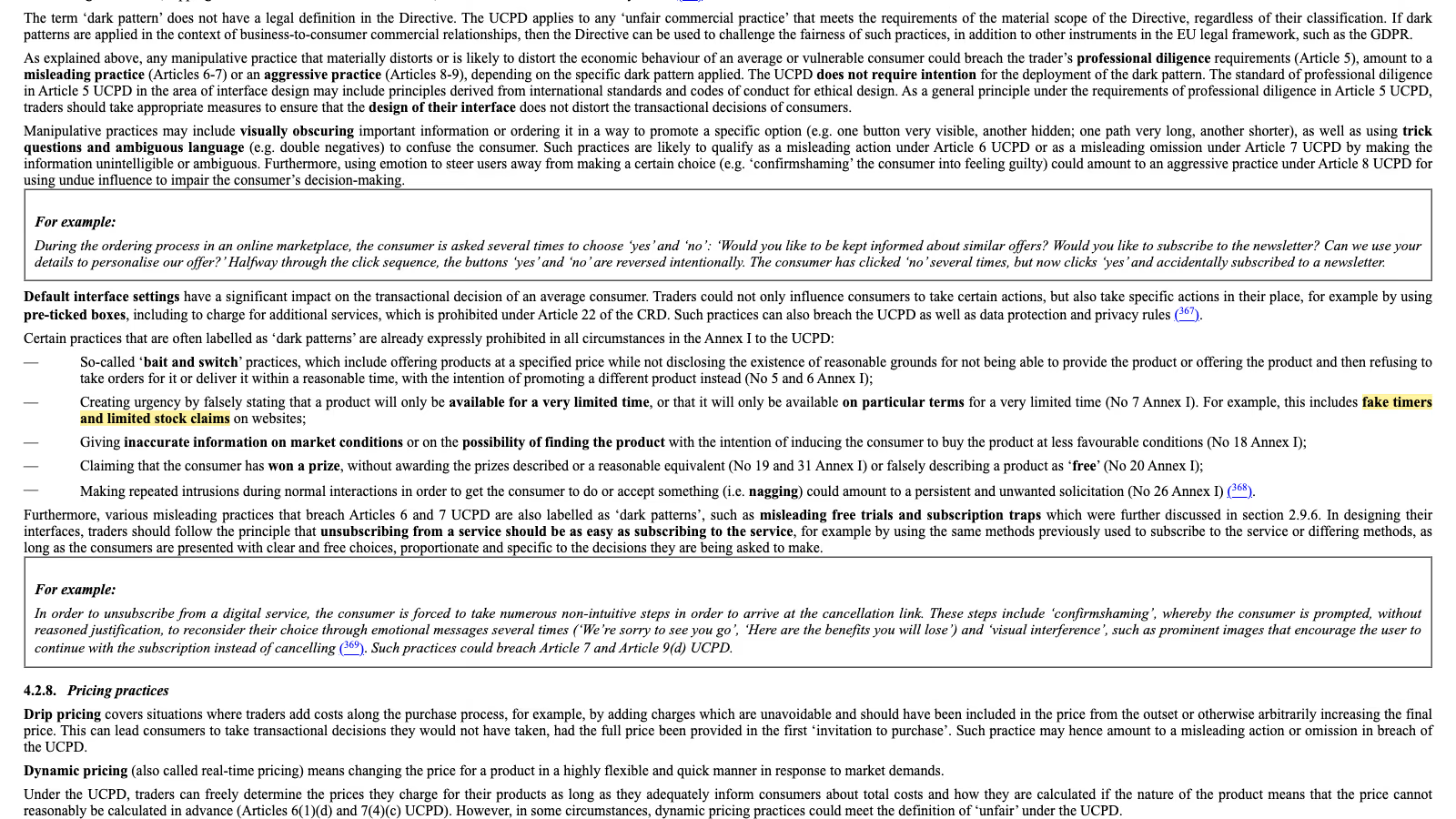 Commission guidance 2021/C 526/01, section 4.2.7. Highlight added. Source: eur-lex.europa.eu.
The problem is widespread. In the 2023 sweep, the Commission and the consumer authorities of 23 Member States, Norway and Iceland checked 399 online shops. “42 websites used fake countdown timers with deadlines to purchase specific products”, and 148 sites had at least one of the three dark patterns under review (European Commission, 30 January 2023).
In its section on air transport (4.3.4), the guidance sets out a principle that works for any shop: traders “should only present offers as time-limited if they will not be available at the same price afterwards”.
The guidance is not law, and it is written for the EU directive. It is still a reliable reading of the wording that both the Irish act and the DMCC Act copied, and the CMA’s own Wowcher case reaches the same conclusion on “Running out!” claims. For a shop, it means an “only 2 left” message is judged the same way as a timer: it has to come from your real stock level.
Which timers and messages are fine, and which are not?
| Mechanism | Verdict | Why |
|---|---|---|
| Timer to the end of a sale, with the date set in the product, after which the price reverts | fine | the claim is true |
| ”Offer ends at midnight” timer, and the next day the same price with a new timer | unfair | the pattern the CMA challenged in the Wowcher case |
| Timer that starts from the customer’s first visit, stored in a cookie | risky | every customer sees a different end, and clearing cookies restarts it |
| ”Today only” banner that stays up all week | unfair | the time claim is false |
| ”Only 2 left” shown from real stock levels | fine | the message reflects a fact |
| ”Last item” typed into the product description | unfair | the message does not depend on stock |
| ”Black Week” sale from 24 to 30 November, then prices go back up | fine | the period is fixed and true |
| ”Weekend only” discount code that also works on weekdays | unfair | the offer is still available at the same price afterwards (Commission guidance, 4.3.4) |
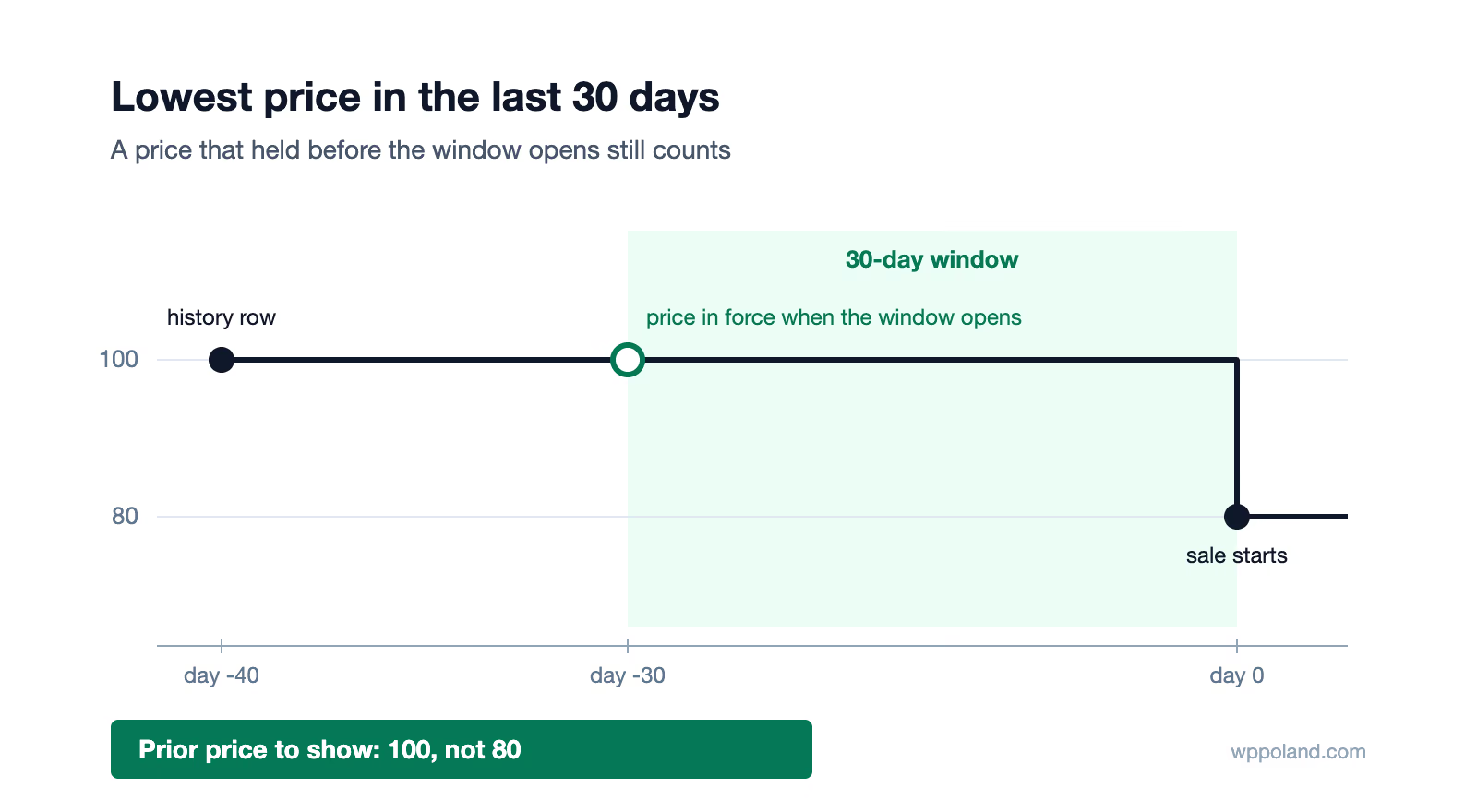
The “risky” verdict on the cookie timer follows from how it works. Such a timer counts time since the customer arrived. If the price does not change when it runs out, it meets the definition in section 55(1)(n) and Schedule 20 paragraph 7. If the price does change, but only for that one customer, the shop is charging different people different prices, which raises other questions, including the lowest price in the previous 30 days.
What can happen to a shop that uses a fake timer?
The answer differs between the two markets, and a shop selling into both should plan for the stricter one.
In the UK, the CMA can investigate a breach of Schedule 20 and issue an infringement notice under sections 180 to 182 of the DMCC Act. The published UK timer cases ended in undertakings: refund credits in the Wowcher case and court-enforceable undertakings with compliance monitoring in the Emma case. Both cases were announced under the company’s name on gov.uk, which for a consumer brand is a cost in itself.
In Ireland, the CCPC can use compliance notices, fixed payment notices, undertakings and prohibition orders. Which tool fits depends on the case, and no Irish timer case has been published yet, so there is no Irish benchmark for the outcome.
Selling from the UK to Ireland. Under Article 6 of the Rome I Regulation, a UK shop that directs its sales to Irish consumers is bound by Irish consumer law for those sales. A British WooCommerce shop with a euro price list and Irish shipping cannot rely on UK rules alone, and the reverse holds for an Irish shop actively targeting the UK, which falls under the DMCC Act.
How do you document that a promotion was genuine?
Neither the Irish act nor the DMCC Act is a reason to wait until a regulator asks before collecting evidence. Keeping records during the campaign makes any question from the CCPC or the CMA, or a customer complaint, quick to answer. Rebuilding them afterwards is much harder: WooCommerce stores the current sale dates in the product, but the admin does not show a history of price changes. Once a sale ends, its dates and sale price are cleared from the product.
For every campaign with a timer, keep:
- A written campaign plan: products, regular price, sale price, start and end date and time. A spreadsheet or an email to the team sent before launch is enough.
- A product export before launch and the day after the end. WooCommerce’s built-in CSV export includes regular prices, sale prices and sale dates. Two files with the date in the name show that the price went back up.
- Screenshots of the product page with the timer during the sale and without it afterwards, with the date visible.
- Coupon settings, including the expiry date, if the discount runs on a code.
- The price history you keep for lowest-price information. If your shop uses a plugin that records it, the same history shows that the price returned to its higher level after the campaign.
None of this needs an extra tool, and it turns a regulator’s question or a complaint into a reply with a few attachments.
Selling abroad? The same ban applies in other countries
The ban on false urgency comes from the EU directive, so every Member State has it in its own law. Norway applies it as part of the European Economic Area. If your shop directs offers to customers in another country, their local rule applies to those sales:
| Country | Provision | Source |
|---|---|---|
| Poland | ustawa o przeciwdziałaniu nieuczciwym praktykom rynkowym, art. 7 pkt 7 | api.sejm.gov.pl |
| Germany | UWG, Anhang zu § 3 Abs. 3, Nr. 7 | gesetze-im-internet.de |
| Austria | UWG, Anhang, Z 7 | ris.bka.gv.at |
| Spain | Ley 3/1991 de Competencia Desleal, art. 23.4 | boe.es |
| Portugal | Decreto-Lei 57/2008, art. 8.º alínea i) | diariodarepublica.pt |
| Norway | Forskrift om urimelig handelspraksis, § 1 nr. 7 | lovdata.no |
Switzerland has no list of practices that are always banned. A fake timer is assessed there under the general provisions of the Swiss Unfair Competition Act on misleading statements. An honest timer meets the requirements of all these countries at once, so a single configuration does the job.
How does a countdown timer relate to the lowest price in the last 30 days?
The timer rule and the lowest-price rule are separate, but on Black Friday they get checked together. Every time a shop announces a price reduction, it has to show the lowest price it charged in the 30 days before the reduction. The details and the usual mistakes are in the guide to the lowest price in the last 30 days in WooCommerce.
In practice the two rules connect like this: if a shop “ends” a sale every week and starts a new one at the same price, the lowest price in the last 30 days will equal the sale price. A customer who sees it knows straight away that the timer does not signal a real deal. An honest timer and a correct 30-day price back each other up. The Emma Sleep case shows that regulators look at them together: the timers and the “discount” claims were part of the same undertakings.
How do you set up an honest countdown timer in WooCommerce?
WooCommerce has sale scheduling built in. On the product edit screen, next to the sale price, there is a “Schedule” link that reveals the “Sale price dates” fields with a start and end date. The WooCommerce documentation states that the sale price stops displaying at 11:59 pm on the end date (woocommerce.com). After that the product reverts to the regular price. The daily woocommerce_scheduled_sales cron job does this, and since WooCommerce 10.5 so do Action Scheduler actions scheduled for each product.
An honest timer reads the same end date that changes the price, so the two cannot drift apart. A simple example for a child theme:
// child theme functions.php: sale end marker below the product price
add_action( 'woocommerce_single_product_summary', function () {
    global $product;
    if ( ! $product || ! $product->is_on_sale() ) {
        return;
    }
    $end = $product->get_date_on_sale_to();
    if ( ! $end ) {
        return; // sale without an end date: no timer
    }
    printf(
        '<p class="sale-ends" data-end="%s">Sale ends %s</p>',
        esc_attr( $end->getTimestamp() ),
        esc_html( wc_format_datetime( $end, 'j.m.Y, H:i' ) )
    );
}, 11 );
A script in the browser can turn this text into a live countdown, but it always takes the date from the data-end attribute, which comes from the product. Three rules follow from the law:
- No end date, no timer. A sale without a deadline must not pretend to be ending.
- One end for every customer. The timer does not start from the customer’s visit and is not stored in a cookie.
- At zero, the price really goes back. If you plan to extend the sale, do not show a timer to the original date. Extending once is a commercial decision. Extending every week is the pattern the CMA acted on.
There is also a technical trap that can make an honest timer stop telling the truth. WooCommerce ends sales through scheduled tasks, and in WordPress those are triggered by WP-Cron on page visits or by the server’s system cron. If wp-config.php sets DISABLE_WP_CRON to true and nobody has configured a cron job on the server, the sale may not end on time. The timer reaches zero and the sale price stays. Before a campaign, check under WooCommerce > Status > Scheduled Actions that tasks are running on schedule, and set a test sale on one product that ends in an hour.
Off-the-shelf timer plugins behave differently from one another. Some read the sale dates from the product; others have an “evergreen” mode where the timer counts from the first visit. Before installing one, check in its settings where it gets the end time, and do not enable any mode that counts from the visit.
How do you show low stock legally?
WooCommerce can show stock quantities on its own. Under WooCommerce > Settings > Products > Inventory, the “Stock display format” setting has an option “Only show quantity remaining in stock when low”, and the threshold is set in the “Low stock threshold” field. A message such as “2 in stock” then comes from the real number in your inventory, not from text typed into the description.
The trouble starts when WooCommerce stock does not match reality. A dropshipping shop, for example, may keep an artificial “3 in stock” in the admin because the wholesaler does not share stock levels. In that case a genuine mechanism displays false information, which is the “limited stock claim” the Commission guidance names and the kind of “Running out!” message the CMA challenged at Wowcher. If your stock is not synchronised with your warehouse or supplier, switch off the quantity display.
What should you check in your shop before Black Friday?
A checklist for the week before the sale starts:
- Every timer on the site reads its end date from the product or from one campaign setting, never from the customer’s cookie.
- Every sale with a timer has an end date in the “Sale price dates” fields or in the plugin settings.
- After the campaign, prices go back to regular. Check one product the day after the end.
- Banners saying “today only” or “final hours” have a take-down date written down, and someone is responsible for removing them.
- Stock quantity messages come from inventory that is actually synchronised.
- The lowest price in the last 30 days is shown with every price reduction.
- Time-limited discount codes have an expiry date set in the WooCommerce coupon itself.
- If you sell from the UK into Ireland, or the other way round, the campaign meets the rules of the customer’s country.
The coupon point is easy to miss: a WooCommerce coupon has an expiry date field. If a “weekend only” code has no expiry date, it keeps working, and the shop ends up running a permanent offer presented as a limited one without ever meaning to.
When is it worth getting help?
You can work through the checklist above yourself in the WooCommerce admin. A review is worth commissioning when timers come from several plugins at once, when prices and stock arrive from an ERP or a wholesaler, when the shop sells in several countries, or when you need to prove after a campaign when and how prices changed.
I configure sales, timers and coupons as part of WooCommerce development and shop builds, and before a big campaign I can review your shop settings against these rules. Write and tell me which promotion plugins you use and when your campaign starts, and I will send back a list of what to change.
This guide describes the law and published regulatory decisions in Ireland and the UK. It is not legal advice on a specific case.