Short answer: Drupal maintenance is the work that keeps a Drupal site on a release that still gets security fixes. In practice that means reading the security advisories every Wednesday, applying core and module updates through Composer, moving to a new minor version twice a year because only the two newest get fixes, keeping PHP inside the range both Drupal and php.net support, and testing backups. The effort depends less on traffic than on how many modules the site runs, how much custom code it carries and whether the hosting lets you work from the command line.
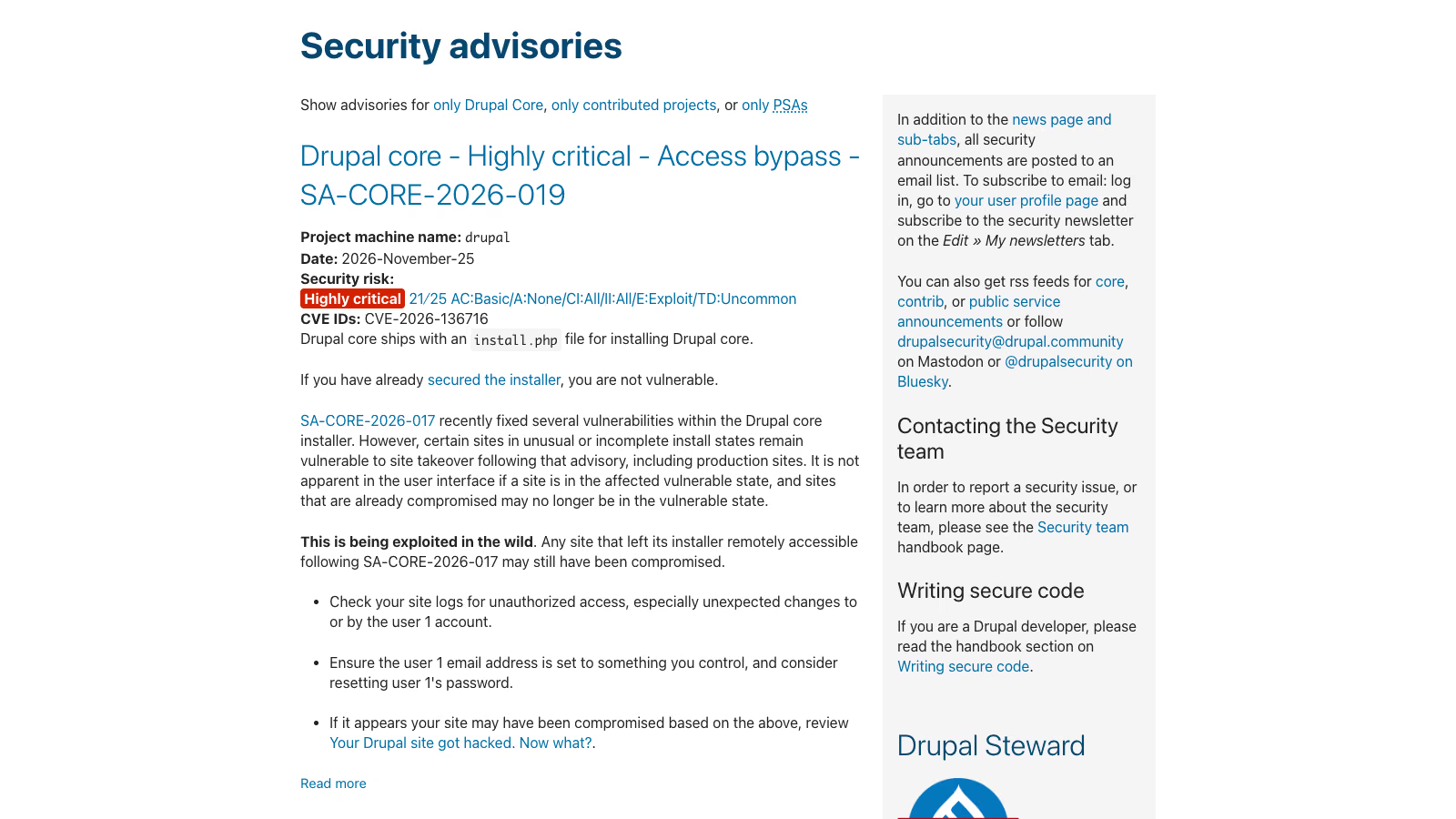 The security advisories page on drupal.org with the highly critical SA-CORE-2026-019 of 25 November 2026 at the top. Screenshot from 28.11.2026.
This guide is for organisations in the UK and Ireland that already run Drupal and want to know what a maintenance arrangement should cover and why one site costs more to look after than another. I do not give prices here; they depend on the site and are on the pricing page. Release dates and policies come from drupal.org, PHP dates from php.net, all checked on 28 November 2026.
If your site is still on Drupal 10 or Drupal 7, the urgent question is the upgrade, not the monthly routine. That decision has its own article: Drupal 10 end of life: upgrade or migrate. Drupal 10 stops receiving releases on 9 December 2026.
What does Drupal maintenance include?
A maintenance arrangement that is worth paying for covers these tasks, in roughly this order of frequency:
- Advisory triage every Wednesday. Read the core, contributed and public service announcement (PSA) feeds on drupal.org and decide for each item whether it touches your site.
- Patch updates of core and contributed modules through Composer, tested on a staging copy, then deployed with the database updates and a configuration export.
- A minor core update twice a year, after each June and December release, because the oldest supported minor drops out of security coverage.
- PHP upgrades before the version on the server runs out of support, and before Drupal stops listing it.
- Backups that are restored, on a schedule, to prove they work.
- The status report and the logs, checked after every update and when nothing has changed, because warnings about outdated PHP or a writable settings file appear there first.
- Replacing modules that the Security Team marks as unsupported.
- Planning the next major version a year ahead, so it does not turn into an emergency.
The order of commands inside step 2 does not change from site to site: composer update for the affected packages, drush updatedb, drush config:export, a check of the pages editors use most, then deployment. I describe that routine on the Drupal developer page, so I will not repeat it here. The drupal.org guide on updating core via Composer adds two details people skip: run composer outdated "drupal/*" first to see whether there is anything to do at all, and on production run composer install --no-dev from the tested lock file rather than composer update.
How often does Drupal release security updates?
The Drupal Security Team publishes on a fixed rhythm. According to its page on release numbers and timing, core security releases use one Wednesday a month, usually the third, and contributed projects can get a release on any Wednesday. The window is 16:00 to 22:00 UTC, which is late afternoon or evening in London and Dublin. Bug fix releases of core follow a separate window on the first Wednesday of the month, according to the release schedule.
The same page states that a window does not guarantee a release, and that a highly critical issue can be published outside it. For those, the team often posts a PSA a few days ahead so site owners can reserve time. Subscribing is free: there are RSS feeds for core, contributed projects and PSAs on the security page, and an email newsletter you can turn on in your drupal.org profile.
So the baseline workload is predictable. Most Wednesdays bring something for contributed modules, one Wednesday a month may bring a core release, and a few times a year a PSA moves everything else aside.
What happened with the Drupal installer advisories?
November 2026 is a good example of why “we update when we have time” is not a maintenance plan.
- 16 November: drupal.org published PSA-2026-11-16, announcing a core security release for 18 November between 17:00 and 21:00 UTC. It warned that at least one issue could be exploited by anonymous users and that “exploits might be developed within hours or days”. It also advised updating to the latest patch release beforehand, so that unrelated upgrade problems surface before the security window.
- 18 November: SA-CORE-2026-017, highly critical, remote code execution through the core installer
install.php. Fixed in Drupal 10.6.22, 11.3.22 and 11.4.13. - Afterwards: the advisory was updated: the Security Team “has received a report this was exploited on live sites as early as 2026-11-19 19:00 UTC”. That is about 26 hours after the fix was published.
- 25 November: SA-CORE-2026-019, highly critical again, access bypass, with the line “This is being exploited in the wild”. The first fix left sites in “unusual or incomplete install states” open to takeover. Fixed in 10.6.23, 11.3.23 and 11.4.14, and this time updating the code was not enough: the advisory requires running
update.phpon existing sites, checking logs for changes to the user 1 account, and setting the user 1 email address to one you control.
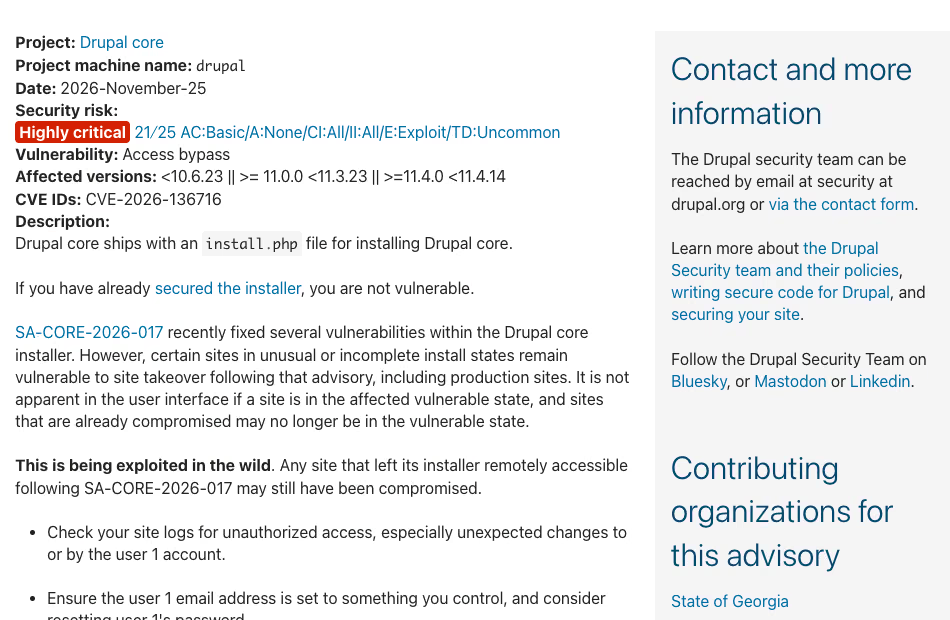 Affected versions and the exploitation note in SA-CORE-2026-019. Screenshot from drupal.org, 28.11.2026.
Three lessons from that fortnight shape how I set up maintenance:
- A site that was already on the latest patch release before 18 November needed one small update. A site several patch releases behind had to absorb all the skipped changes under time pressure.
- The second release came out on 25 November, which is not the third Wednesday of the month. Watching only the monthly window would have missed it.
- Security work does not end with
composer update. Here it included a database update, an account check and hardening of the installer, which the advisories recommend even after patching: block access toinstall.phpand make sure the web server cannot write tosettings.php.
Sites on Drupal 10.5.x or older, or on 11.2.x or older, got no release at all. The PSA lists them as end of life and points them to mitigation steps and an update.
Why minor Drupal updates are not optional
Many maintenance contracts I read cover “security updates” and treat minor versions as optional extras. On Drupal that leaves the site uncovered within a year.
The security advisory policy says that only the two most recent minor versions of core receive advisories, and gives the example that 11.3.x gets them until 11.5.0 is released. The release schedule turns that into dates:
| Branch | Security support ends | Source |
|---|---|---|
| 10.6.x | Week of 7 December 2026 (Drupal 10 end of life 9 December 2026) | drupal.org schedule |
| 11.3.x | Week of 7 December 2026, when 11.5.0 and 12.0.0 are released | drupal.org schedule |
| 11.4.x | 21 April 2027 | drupal.org schedule |
| Drupal 11 overall | Early December 2028 | drupal.org schedule |
| Drupal 12 overall | Early December 2030 | drupal.org schedule |
Source: Drupal core release schedule, checked 28.11.2026.
New minor versions arrive in June and December. A site on 11.3 today has days left before it needs 11.4 or 11.5 to keep getting fixes. That is why I put a minor update into every maintenance plan twice a year, a few weeks after each release once the first patch release is out. A minor update usually means more than core: contributed modules sometimes need new versions too, deprecated APIs start to log warnings, and the admin interface can change for editors.
Drupal 12 is the next turn of the same wheel. On 27 November 2026 drupal.org published 12.0.0-rc1, according to the core release feed. Upgrading a Drupal 11 site to 12 is a project, not a maintenance task, but maintenance prepares for it: every module update that removes a deprecation now is work you do not repeat later.
Which contributed modules get security coverage?
Core is only part of the risk. On 4 November 2026 drupal.org published 24 advisories for contributed projects and on 11 November another 24, according to the contributed advisories feed. They included widely used modules such as Scheduler, Mime Mail, Simple OAuth, GraphQL Core Schema and Paragraphs Edit.
What makes contributed modules a maintenance driver is the coverage rule in the security advisory policy:
- Only stable releases are covered. There are “no security advisories for development releases (-dev), alphas, betas, or release candidates”. A module pinned to a
-devor beta release gets fixed silently, if at all. - Only opted-in projects are covered. A project page with a grey shield and the line “Stable releases for this project are covered by the security advisory policy” is covered. Sandbox projects and code hosted outside drupal.org are not.
- External libraries are not covered. The policy states that no advisories are issued for external libraries or plugins, whether installed manually or with Composer.
- Unsupported projects get an advisory too. When a maintainer does not fix a reported issue, the Security Team publishes an advisory marking the project unsupported. SA-CONTRIB-2026-047 of 10 June 2026 did this for a brute force protection module, with all versions affected and the instruction: “If you use this project, you should uninstall it.”
The last point creates unplanned work. Replacing a module the site depends on means finding an alternative, migrating its configuration and data, and testing the features it provided. That is why my first step on a site I take over is a module inventory: which modules are covered, which run on non-stable releases, which carry local patches, and which have not had a release in years.
For the inventory itself, composer audit checks the installed packages against security advisories. The Packagist team explains that packages.drupal.org provides advisories for the packages it hosts, so Composer also warns when you require a Drupal module version with a known vulnerability.
Which PHP version does Drupal need?
Drupal and PHP have separate calendars, and maintenance has to respect both. This is the table from the drupal.org PHP requirements page:
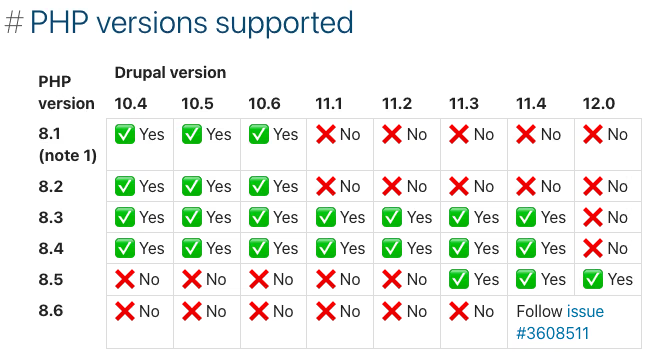 PHP support per Drupal minor version on drupal.org. Screenshot from 28.11.2026.
Read together with php.net, it gives these points for a Drupal 11 site:
- Drupal 11.3 and 11.4 support PHP 8.3, 8.4 and 8.5. Drupal 12.0 supports only PHP 8.5.
- PHP 8.3 gets security fixes until 31 December 2027, PHP 8.4 until 31 December 2028, PHP 8.5 until 31 December 2029.
- PHP 8.6 came out on 19 November 2026 and no Drupal version lists it as supported yet. A host that moves sites to the newest PHP automatically is a risk for a Drupal site.
- Drupal 11 is supported until early December 2028, so a Drupal 11 site on PHP 8.3 outlives its PHP. Moving to 8.4 or 8.5 belongs in the maintenance plan for 2027.
The page also notes that Drupal may ship an unscheduled minor release if a dependency drops a PHP version, and that the status report warns when the PHP installation is “too old”. I set the PHP version explicitly in the hosting panel or server configuration instead of following the host’s default, and change it on staging first.
Can Drupal update itself automatically?
Partly, and less than people expect. The Automatic Updates project is a contributed module, not part of core. Its current stable branch 4.x requires Drupal 11.2 or later and a Composer-managed site. It applies core patch releases in a sandboxed copy first. Updating contributed modules and themes is marked experimental and “NOT ready for use in a production environment”. It does not do major upgrades and does not support multisite. Drupal also has to be able to write to its own codebase, which the project page says makes hosts like Acquia and Pantheon unlikely to work with it.
So on most professionally hosted sites I keep updates in the Composer workflow on a development copy and deploy them. Automatic Updates is worth a look for a single small site on a server where Drupal can write to its own files, with someone still checking the result.
Another tool sometimes confused with maintenance is Drupal Steward, a paid web application firewall run by the Drupal Association and the Security Team. It applies a “virtual patch” for some highly critical core vulnerabilities at the network level. Both November advisories mention that Steward customers were already protected from known attack vectors, and both still recommend updating. Steward buys time; it does not replace the update.
What drives the cost of Drupal maintenance?
Prices depend on the project and stay on the pricing page. What makes one Drupal site more work than another can be measured before anyone quotes:
| Driver | How to recognise it | Why it adds work |
|---|---|---|
| Number of contributed modules | composer show "drupal/*" | More modules mean more advisories to triage each Wednesday and more version conflicts at each minor update |
| Custom modules and themes | Folders under modules/custom and themes/custom | Deprecations in your own code are yours to fix; nobody publishes an advisory for them |
| Non-stable releases | Versions ending in -dev, -alpha, -beta in composer.lock | No security advisories; each one needs a manual check |
| Local patches | A patches section in composer.json | Each patch must be checked against every new module release |
| Hosting access | Can you run Composer and Drush over SSH? | Without command-line access every update becomes a manual file upload of the whole codebase |
| PHP on the server | Status report, PHP section | A host that cannot offer PHP 8.3 or newer blocks Drupal 11 maintenance |
| Multisite | Several folders under sites/ | One update touches every site; Automatic Updates does not support it |
| Integrations | SSO, CRM, payment or search connectors | Each needs a functional test after updates |
| Editorial workflow | Content moderation, translations, many roles | More screens editors depend on, more to check after a minor update |
| Version distance | Version in the status report | A site several minors behind needs catching up before routine maintenance makes sense |
Two items usually decide the size of the job. The first is the module count combined with the share on non-stable releases: a site with 40 covered modules is calmer to look after than one with 15 modules of which five are pinned to development snapshots. The second is hosting. A Composer workflow with SSH, a staging copy and deployments from version control keeps each update small. A site edited directly on a shared host with FTP access makes every update slower and riskier.
What Drupal maintenance does not cover
To keep expectations honest, these are separate pieces of work that a maintenance plan prepares but does not include:
- Major upgrades. Drupal 10 to 11, and later 11 to 12, are projects with their own audit. The steps are in my Drupal 10 end of life article.
- Drupal 7. Security support ended on 5 January 2025 according to drupal.org, which names HeroDevs and Tag1 Consulting as extended support vendors. Routine maintenance cannot make a Drupal 7 site current; it needs a migration.
- New features and redesigns. They can run alongside maintenance but are scoped separately.
- Content work. Editors keep writing; maintenance keeps the platform under them working.
Drupal maintenance and UK GDPR
UK law does not name a CMS version. What it does require is set out in Article 32 of the UK GDPR: appropriate technical and organisational measures, taking into account “the state of the art”, and in point (d) “a process for regularly testing, assessing and evaluating the effectiveness” of those measures. A documented maintenance routine is one of the easiest ways to show that process exists.
The breach side matters as much. Article 33 requires notifying a personal data breach “without undue delay and, where feasible, not later than 72 hours after having become aware of it”. In November 2026 the second core advisory told site owners to check logs for unauthorised changes to the user 1 account. If that check finds something on a site with user accounts or form submissions, the 72-hour clock is already running. A maintenance arrangement should say who reads the logs, who decides whether a breach is reportable, and who contacts the regulator. My reading of these articles is a technical one, not legal advice.
In Ireland the GDPR applies directly, and the Data Protection Act 2018 establishes the Data Protection Commission as the supervisory authority. The same two articles apply.
For public bodies, accessibility rules also come into maintenance, because a minor update can change admin themes and forms. The UK and Irish accessibility regulations are covered in the Drupal 10 article, so I will only add that I re-test the main templates and forms after each minor update.
Drupal support agencies in the UK and Ireland
The Drupal community in both countries is mature, and there is no shortage of specialist suppliers. Two examples, both verified on their own sites on 28 November 2026:
- Zoocha, a UK Drupal agency, offers Drupal consultancy, development and support, and drupal.org lists it among the mid-size partners that help customers set up Drupal Steward.
- Annertech, an Irish agency that describes its work as “delivering ambitious digital experiences with Drupal”.
Hosting matters as much as the supplier. A plan with SSH access, such as those Krystal lists for its hosting tiers, lets you run Composer and Drush on the server. Check that before choosing between hosts, because maintenance without a command line costs more on every update.
An agency makes sense when you need design, content and development in parallel. For a single site or a small estate where the work is updates, audits and module fixes, one experienced developer is often enough. I work remotely for clients across the UK and Ireland and handle everything in writing, without calls or on-site meetings.
What to send for a Drupal maintenance quote
To assess the effort without access to the site, I need five things you can collect without a developer:
- The Drupal version and PHP version from Reports, Status report.
- The
composer.jsonandcomposer.lockfiles, or a note that the site is not managed with Composer. - The list of enabled modules from Extend, as a screenshot or export.
- The hosting setup: provider, whether there is SSH access, and whether a staging copy exists.
- Anything that must keep working during updates: forms, integrations, login methods, editorial workflow.
From that I can tell you which drivers in the table apply, whether the site needs catching up before routine maintenance makes sense, and when the next minor and major updates fall. Send it through the contact form. I reply by email within 24 hours on working days.
Last updated: 28.11.2026. Release dates and policies from drupal.org, PHP dates from php.net, UK GDPR text from legislation.gov.uk, all checked on 28.11.2026.