The UK and Ireland are both moving VAT invoices onto structured electronic formats, on different timetables. HMRC plans to require e-invoicing for all VAT invoices from April 2029. Irish Revenue starts on 1 November 2028 with large corporates, and on the same day every Irish business has to be able to receive e-invoices. A WooCommerce shop is touched in two places: the invoices it issues to VAT-registered buyers, and the purchase invoices it receives from its own suppliers. The sections below cover which orders are in scope under the published sources and what to prepare in the shop, the invoicing tool and the accounting system before the dates arrive.
This article describes official sources as published on 27 October 2026. Neither mandate is fully legislated yet, so treat the dates as the current plan and check the sources linked below before you commit budget. It is not tax advice for your business.
What is the e-invoicing mandate in the UK and when does it start?
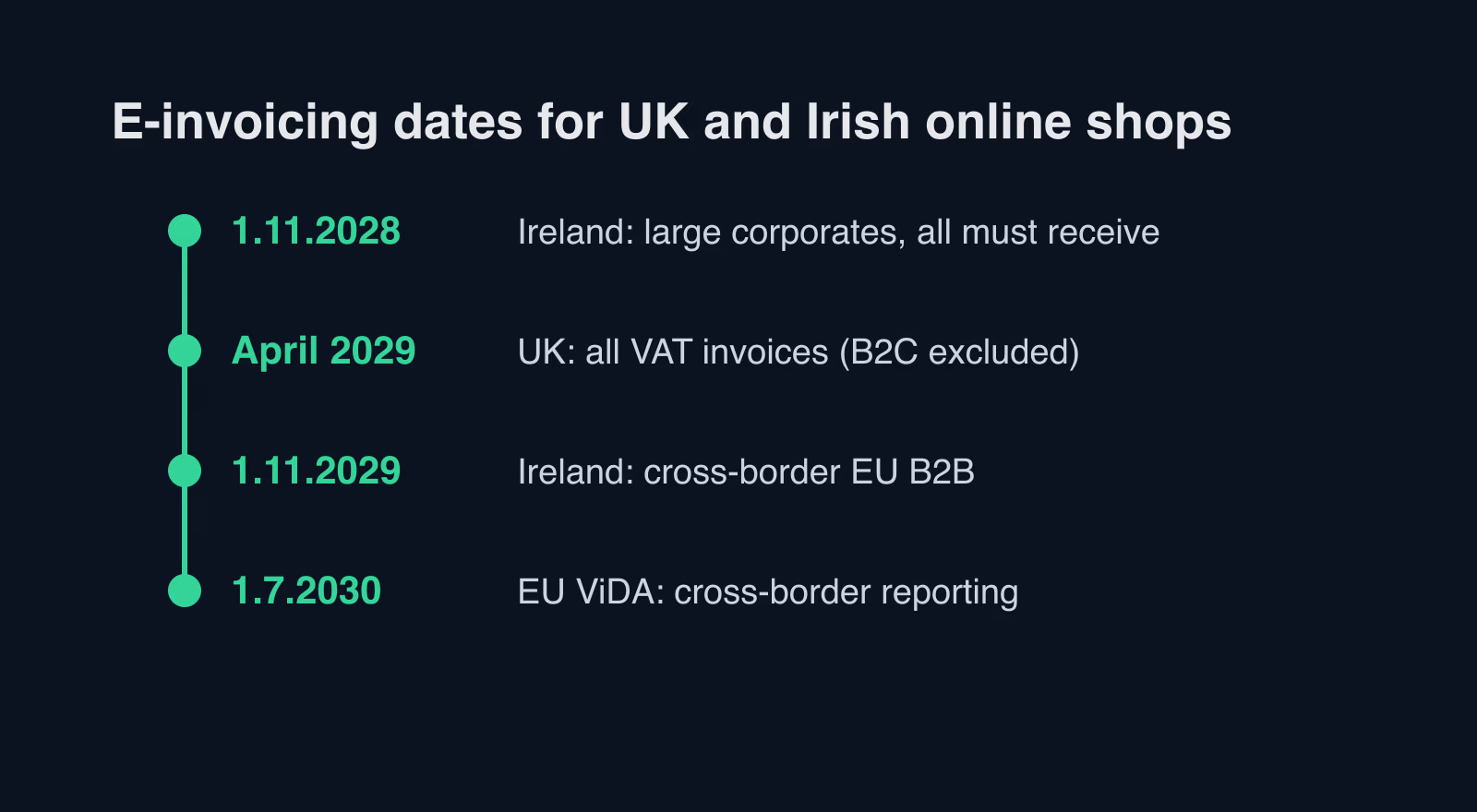
The government announced at Budget 2025 that all VAT invoices must be issued as e-invoices from 2029. HMRC’s Transformation Roadmap update of 27 July 2026 narrows that to a month: e-invoicing for all VAT invoices from April 2029. The same document says HMRC is working with the Department for Business and Trade on a roadmap, to be published at Budget 2026, setting out the milestones to implementation.
The consultation response, updated 26 November 2025, adds three points for planning:
- The mandate will not take effect until 2029, and the roadmap comes first.
- The government will not introduce real-time reporting of invoice data to HMRC alongside the 2029 mandate. It will keep exploring the idea.
- The UK has no single mandated e-invoice standard today. Public bodies covered by the Public Procurement Act 2023 must accept e-invoices that comply with BS EN16931, and NHS Supply Chain requires its suppliers to send e-invoices through the Peppol network.
What is still open on 27 October 2026: the technical model (many respondents asked for a decentralised model based on Peppol, but the government has not chosen one), the format, any phasing by business size and any exemptions. We searched GOV.UK for the Budget 2026 roadmap and did not find it published yet. Until it appears, the safe working assumption for a UK shop is a structured format based on EN 16931, sent over a network your software provider supports, for every VAT invoice from April 2029.
Ireland e-invoicing 2028: which businesses go first?
Revenue confirmed the phased rollout in a press release of 22 October 2026 and on its VAT Modernisation timeline page:
| Phase | Date | Who | Obligation |
|---|---|---|---|
| Phase One | 1 November 2028 | VAT-registered large corporates (about 2,400 businesses) | Issue e-invoices for domestic B2B sales and report a subset of the data to Revenue in real time |
| Phase One | 1 November 2028 | All businesses in Ireland | Be able to receive e-invoices |
| Phase Two | 1 November 2029 | VAT-registered businesses in cross-border EU B2B trade | The same domestic obligations |
| Phase Three | 1 July 2030 | All cross-border EU B2B transactions | ViDA requirements become mandatory |
“Large corporate” is a narrow term. Revenue’s Phase One page defines it as a VAT-registered business whose tax affairs are managed by Revenue’s Large Corporates Division and which is established, or has a fixed establishment, in Ireland. Revenue will write to the businesses that fall into Phase One. If you have not had that letter and your tax affairs are not handled by the Large Corporates Division, your shop is not issuing mandatory e-invoices in 2028.
The legal basis is the Finance Bill (No. 2) 2026, published on 19 October 2026, which amends the Value-Added Tax Consolidation Act 2010. Revenue states that the provisions remain subject to the legislative process. Revenue has also published draft regulations covering the use of Peppol, the transmission of data to Revenue and data requirements, and says they may change before they are finalised. Peppol will be the default network for sending e-invoices and the mandated method for reporting data to Revenue, and Revenue intends to become Ireland’s designated Peppol Authority from 1 January 2027.
Does an Irish WooCommerce shop that only sells to consumers need e-invoicing?
On the sales side, the published plan does not reach consumer orders. Phase One covers domestic B2B transactions of large corporates, Phase Two cross-border EU B2B trade. Revenue’s pages do not describe any e-invoicing duty for sales to private individuals.
On the purchase side, every Irish shop is in scope. The timeline page says that for all phases businesses must ensure they can receive and process e-invoices from any supplier mandated to issue them. If your packaging supplier, wholesaler or hosting company is a large corporate, it will send you structured e-invoices from 1 November 2028, and your bookkeeping has to accept them.
Revenue’s advice on timing: businesses that will only have to receive e-invoices from 1 November 2028 do not need to take action yet, and further guidance will follow on the eInvoicing Hub. Ask your accounting software provider now whether it plans to receive Peppol invoices and by when; the answer tells you whether you will need to change tools.
Do I need to issue VAT invoices to consumers from WooCommerce?
The e-invoicing mandates attach to VAT invoices, so the answer depends on when a VAT invoice is required at all. That rule differs between the UK and Ireland.
UK. VAT Notice 700, paragraph 16.2.1, says you must give a VAT invoice when you supply standard-rated or reduced-rated goods or services to another VAT-registered person, and that you do not need to issue VAT invoices to customers who are not VAT registered. Paragraph 16.6.2 adds a retail rule: if you make retail sales, you should give a customer a VAT invoice if asked, and you may face a financial penalty if you refuse a taxable person who asks. You do not have to check a customer’s VAT registration before you issue one.
Ireland. Revenue’s page on who must issue a VAT invoice lists the recipients: another accountable person, a Department of State, a local authority, a body established by statute, a person carrying on an exempt activity, a person other than a private individual in another EU Member State, and a person in another Member State where the reverse charge applies. Private individuals in the State are not on the list. For shops, an intra-Community distance sale of goods to non-registered persons needs a VAT invoice, unless you are registered for the Union scheme One Stop Shop for those sales.
Put together for a typical WooCommerce order:
| Order type | UK VAT invoice today | UK from April 2029 | Ireland VAT invoice today | Ireland e-invoice |
|---|---|---|---|---|
| Consumer in your own country | Not required, give one if asked | Outside the scope described so far | Not required | Outside the published phases |
| VAT-registered business in your own country | Required | E-invoice for every VAT invoice | Required | Large corporates from 1 November 2028 |
| VAT-registered business in another EU country | Not required for zero-rated exports of goods (para 16.2.1) | Not yet described | Required, with the buyer’s VAT number and the “intra-Community supply of goods” notation (services: “reverse charge applies”) | ViDA from 1 July 2030; from 1 November 2029 the seller’s domestic B2B sales are in scope |
| Consumer in another EU country (distance sale) | Not covered in this guide | Not described | Required unless you use the Union OSS | Not described |
The last column for Ireland describes the issuing duty only. The receiving duty from 1 November 2028 applies to every business regardless of what it sells.
Is a PDF invoice from WooCommerce an e-invoice?
For the UK rules in force today, a PDF counts. VAT Notice 700, paragraph 17.7, lists two common forms of electronic invoice: a structured file such as XML sent through an Electronic Data Interchange service, and a PDF document sent by email. Whatever the form, it must carry everything a paper VAT invoice carries, and you must be able to ensure authenticity of origin, integrity of the data and legibility of the content. The detailed conditions are in VAT Notice 700/63.
The coming mandates use a narrower definition. Revenue’s Phase One page says an e-invoice is issued, transmitted and received in a structured electronic format that allows automated processing, complies with the European Standard EN 16931, and excludes unstructured formats like PDF or scanned paper. The UK has not published its definition yet, but the April 2029 mandate is built around the same idea of invoice data flowing between systems.
For a WooCommerce shop this means the PDF your invoicing plugin attaches to the order email will not satisfy the Irish mandate, and probably not the UK one either. You can keep sending it as a readable copy, while the structured file becomes the legal invoice.
Does WooCommerce create VAT invoices on its own?
No. WooCommerce core creates orders, order emails and refunds. It does not issue invoices, does not number them in a VAT sequence and does not produce credit notes. Its default checkout address fields, defined in WC_Countries in the WooCommerce code on GitHub (checked on 27 October 2026), are first name, last name, company, address lines, city, county or state, postcode, country and phone. There is no VAT number field.
So the e-invoice will come from one of four places, and choosing one is the first decision to make:
| Who issues | How it works with WooCommerce | When it fits |
|---|---|---|
| Invoicing plugin inside WordPress | Builds the invoice from the order, numbers it, generates the file and sends it | Small catalogue, few B2B orders, if the plugin supports the required format and network |
| External invoicing service | Receives the order through the REST API or a webhook, issues and sends the e-invoice, returns the document number | Several sales channels, or when you want the network connection outside WordPress |
| ERP or accounting system | Pulls orders, issues invoices in the system that keeps your ledgers | Larger shops that already post orders into an ERP |
| Accountant | Issues invoices from your sales data | Very low B2B volume, accepting a delay |
Paragraph 17.8 of VAT Notice 700 allows you to outsource the issuing of sales invoices to a third party, and the legal obligations for content, storage and production remain with you. The same logic applies whichever tool you pick: the shop owner is responsible for invoices sent on its behalf.
For shops that already sync orders to an ERP, the e-invoice belongs in that system, because that is where numbering and ledgers live. Our WooCommerce ERP integration architecture guide covers the order sync, idempotency and failure handling an invoicing integration depends on. If the invoicing service sits outside WordPress, the API-first integration guide explains how to pass orders and status back over the REST API.
How do I collect a VAT number at WooCommerce checkout?
Every B2B e-invoice needs the buyer’s identity, and for intra-Community supplies of goods and reverse charge services Revenue requires the customer’s VAT number on the invoice. Since WooCommerce has no field for it, add one:
- Add an optional “VAT number” field to the billing section, shown when the customer fills in the company name or ticks “buying for a business”.
- Validate the format on entry. For UK numbers, HMRC runs the Check a UK VAT number service; for EU numbers, the European Commission’s VIES service.
- Store the number on the order as order meta, together with the validation result and the date of the check. An invoice issued months later must use the number as given at the time of sale.
- Decide what happens when validation fails: refuse the order, accept it as a consumer sale with VAT charged, or flag it for manual review. Write the rule down so support staff apply it the same way.
- Copy the number to the customer account so repeat buyers do not type it again, but still store it on each order.
Under the Irish mandate, the buyer’s ability to receive through Peppol becomes relevant too. The draft regulations deal with network use, and the final technical specifications are not out. Leave room in your order data for a Peppol participant identifier, and do not build the lookup until Revenue publishes the specifications.
What must a UK or Irish VAT invoice contain, and how should it be numbered?
The e-invoice carries the same legal content as a paper VAT invoice, in fields instead of print. The two lists overlap but are not identical.
UK, VAT Notice 700 paragraph 16.3.1: a sequential number based on one or more series that uniquely identifies the document, the time of supply (tax point), the date of issue where different, your name, address and VAT registration number, the customer’s name and address, a description of the goods or services, quantity, VAT rate and amount excluding VAT for each description, the gross total excluding VAT, the rate of any cash discount, the total VAT in sterling, and the unit price. A UK VAT invoice is normally issued within 30 days of the tax point (paragraph 16.2.3).
Ireland, Revenue’s page on information required on a VAT invoice: date of issue, a unique sequential number, supplier’s full name, address and registration number, customer’s full name and address, the customer’s VAT number and the notation “reverse charge applies” or “intra-Community supply of goods” where relevant, quantity and nature of goods, VAT-exclusive unit price, discounts, breakdown by VAT rate, total VAT, and the date of supply. Invoices in a foreign currency must also show the euro figures. A VAT invoice must issue within 15 days of the end of the month of supply.
Both countries allow simplified invoices below a threshold: in the UK for supplies of £250 or less with the customer’s agreement (paragraph 16.6.1), in Ireland up to €100 (Revenue, other types of VAT invoices). Whether simplified invoices survive the mandates is not settled in the sources read.
Three numbering rules follow for WooCommerce:
- The invoice number is not the order number. Orders get numbers when created, including failed and cancelled ones, which leaves gaps. Number invoices in their own series, assigned only when the invoice is issued.
- An issued invoice is immutable. If someone edits the order address afterwards, the invoice keeps the old data, and a correction needs its own document.
- Store the invoice number, issue date and file reference on the order, so support can find the invoice from the order screen and the accounting system can match payments.
How do WooCommerce refunds become credit notes?
A refund in WooCommerce creates a refund record linked to the order and changes the order totals. For VAT it needs a document of its own: you correct an issued invoice with a credit note, never by editing the original.
UK, VAT Notice 700 paragraph 18.2.3: a valid credit note reflects a genuine mistake, overcharge or agreed reduction, is issued within 14 days of the refund payment, and shows its own number and date, the supplier and customer details, a description, quantities and amounts, the total credited excluding VAT, the VAT rate and amount credited in sterling, and the number and date of the original VAT invoice.
Ireland: Revenue’s page on when a credit note must be issued requires one when the original price changes because of an allowance, discount or similar adjustment, or when the VAT rate was wrong, within 15 days of the end of the month of supply. Where you agree a reduction in the VAT-exclusive price and the VAT payable stays unchanged, no credit note is required. Revenue’s page on amending an invoice covers the other cases: a price increase needs a supplementary invoice, and a wrong VAT rate is fixed with a credit note plus a revised invoice.
In WooCommerce terms, wire the invoicing tool to the refund event, so that every refund on an invoiced B2B order produces a credit note that references the original invoice number. Partial refunds need line-level detail, so the refund must record which items and quantities it covers, not only an amount. Under the mandates, the credit note travels as a structured document over the same network as the invoice.
How will a WooCommerce shop receive e-invoices from suppliers?
Purchase invoices go to your bookkeeping, not to WooCommerce. What you need is a Peppol-capable receiving point, usually provided by your accounting software or a Peppol service provider, and a process for matching incoming invoices to purchase orders and payments.
Irish e-invoicing today runs by agreement between both parties, according to Revenue’s guidance on electronic invoicing. From 1 November 2028 a mandated supplier will send you structured invoices whether or not you asked for them, which is why Revenue requires every business to be able to receive. For UK shops the consultation response describes the April 2029 mandate as requiring VAT invoices to be issued and received electronically.
Checks for your accounting tool vendor:
- Does it receive Peppol invoices, and from which date?
- Does it read EN 16931 data into your ledger, or only display a rendered copy?
- Does it keep the original structured file for your record retention period?
- Can it send structured e-invoices too, so you can move your own B2B invoicing onto it later?
What does ViDA change for UK and Irish shops selling into the EU?
ViDA is the EU’s VAT in the Digital Age package. Council Directive (EU) 2025/516 of 11 March 2025 (Publications Office, CELEX 32025L0516) amends the VAT Directive in steps. Since 14 April 2025 Member States may require businesses established on their territory to issue e-invoices for domestic supplies without the recipient’s acceptance, which is the EU basis for national mandates like Ireland’s. From 1 July 2030 the new Article 218 makes electronic invoices the default under the Directive and points to EN 16931, and cross-border intra-EU B2B supplies come under digital reporting. Ireland’s Phase Three on 1 July 2030 is that date.
ViDA binds EU Member States, and Great Britain is outside it. A UK shop meets ViDA through its EU customers and any EU VAT registrations it holds, and through the national rules of the countries it sells to. Our UK payments, shipping and VAT guide for WooCommerce covers the domestic VAT setup this sits on top of.
UK and Ireland e-invoicing deadlines at a glance
| Date | Country | What happens | Source |
|---|---|---|---|
| 1 January 2027 | Ireland | Revenue intends to become the Irish Peppol Authority | Revenue press release, 22 October 2026 |
| Budget 2026 | UK | E-invoicing implementation roadmap due | HMRC roadmap update, 27 July 2026 |
| 1 November 2028 | Ireland | Large corporates issue domestic B2B e-invoices and report in real time; all businesses must receive | Revenue timeline |
| April 2029 | UK | E-invoicing for all VAT invoices | HMRC roadmap update, 27 July 2026 |
| 1 November 2029 | Ireland | Domestic obligations extend to VAT-registered businesses in cross-border EU trade | Revenue timeline |
| 1 July 2030 | Ireland and EU | ViDA requirements for cross-border EU B2B transactions | Revenue timeline, Directive (EU) 2025/516 |
Checklist for a WooCommerce shop in the UK or Ireland
Now, before the technical specifications:
- Count last year’s orders by type: consumer, domestic VAT-registered business, EU business, EU consumer.
- Write down who issues your invoices today: plugin, service, ERP or accountant.
- Check whether invoice numbers run in their own sequential series, separate from order numbers.
- Add a VAT number field at checkout and store the validation result on each order.
- Confirm every refund on an invoiced order produces a credit note that references the original invoice.
- Ask your accounting software vendor about Peppol receiving and EN 16931 support, with dates.
After Budget 2026 (UK) and the final Irish regulations:
- Read the UK roadmap for phasing by business size, format and network.
- Confirm whether Revenue has written to you about Phase One.
- Choose the issuing tool that will produce structured e-invoices, and test it with real B2B orders.
- Map which WooCommerce order fields feed each invoice field, including line-level tax.
- Decide where the e-invoice identifier and transmission status live on the order.
Before go-live (Ireland 1 November 2028 for receiving, UK April 2029):
- Test the receiving channel with at least one supplier who already sends Peppol invoices.
- Run a refund, a partial refund and a cancelled invoiced order through the full flow.
- Train support staff on what changes for B2B customers and what stays the same for consumers.
What goes wrong when a WooCommerce shop moves to structured invoices?
Each of these follows from how WooCommerce stores data, so check them against your own shop before the deadlines.
Orders placed before you added a VAT number field have no VAT number. If you reissue or correct an invoice for such an order, the data has to come from the customer, and a structured format validator can flag an empty mandatory field that a PDF template would have printed as a blank.
WooCommerce can round tax per line or per order, depending on settings. A structured invoice carries line amounts and a VAT breakdown by rate that must add up. If your shop rounds at subtotal level and the invoice tool recalculates per line, totals can differ by a penny, which a receiving system can flag. HMRC’s paragraph 17.6 says that if you calculate VAT at line or invoice level you must not round down, though you may round each calculation up and down.
Shop staff change an address or swap an item on a completed order. WooCommerce allows this; the issued invoice must not change. The invoicing tool should lock the invoice and tell staff that a correction requires a credit note.
A manual refund in a payment gateway dashboard usually does not create a WooCommerce refund, so no credit note follows. Make the WooCommerce admin the only place refunds start, or reconcile gateway refunds daily.
A UK shop selling in euros must show the VAT total in sterling, and an Irish shop invoicing in sterling must show euro figures. Check that the invoicing tool converts with the rate rules each authority sets.
If you want this mapped against your own shop, a WooCommerce developer can audit the order data, refund flow and invoicing integration and give you a list of gaps with the dates each one has to close by.
Last updated: 27 October 2026.