Count your own requests before you read anything else about AI search. Over 23 hours in August 2026, 72.4% of requests to this site carried a user agent our parser did not recognise, 19.7% came from Chrome, and the named search crawlers together made up 3.5%. Gartner projected a 25% drop in traditional search volume by 2026, and a projection is an argument about the future. A log line is a record of something that already happened, which is why this article is arranged around the log rather than around the forecast.
A log line carries the timestamp, the path, the HTTP status, the bytes served and the user agent string. That is little, and the little it has is enough to sort the stream into three piles: browsers, clients that name themselves, and clients that do not. The names are self-declared and worthless as proof, since anything can put Googlebot in a header, which is why Google publishes reverse DNS ranges and why an honest count verifies the few agents that can be verified and files the rest as unknown rather than as human. The 72.4% above is that third pile. It is a statement about requests, not a claim about robots.
Seven things follow from reading requests instead of reading a growth chart, and each one is checkable without buying anything. How a retrieval system picks the passage it quotes you can approximate by cutting your own article into overlapping windows and asking which window answers the target question with nothing above it. What a fetcher actually receives you see by requesting your own URL without a browser and reading the raw response, which stops being the document on your screen the moment any of it is assembled after load. What robots.txt governs you find by setting the agent names in your rules next to the agent names in the log, which are frequently not the same strings. And which of these leaves a trace is the shortest question of the four: the log holds requests, statuses and return visits, and holds nothing whatsoever about what happened after the response left your server. The seven sections below stay inside that boundary, and where one of them crosses it, it says so.
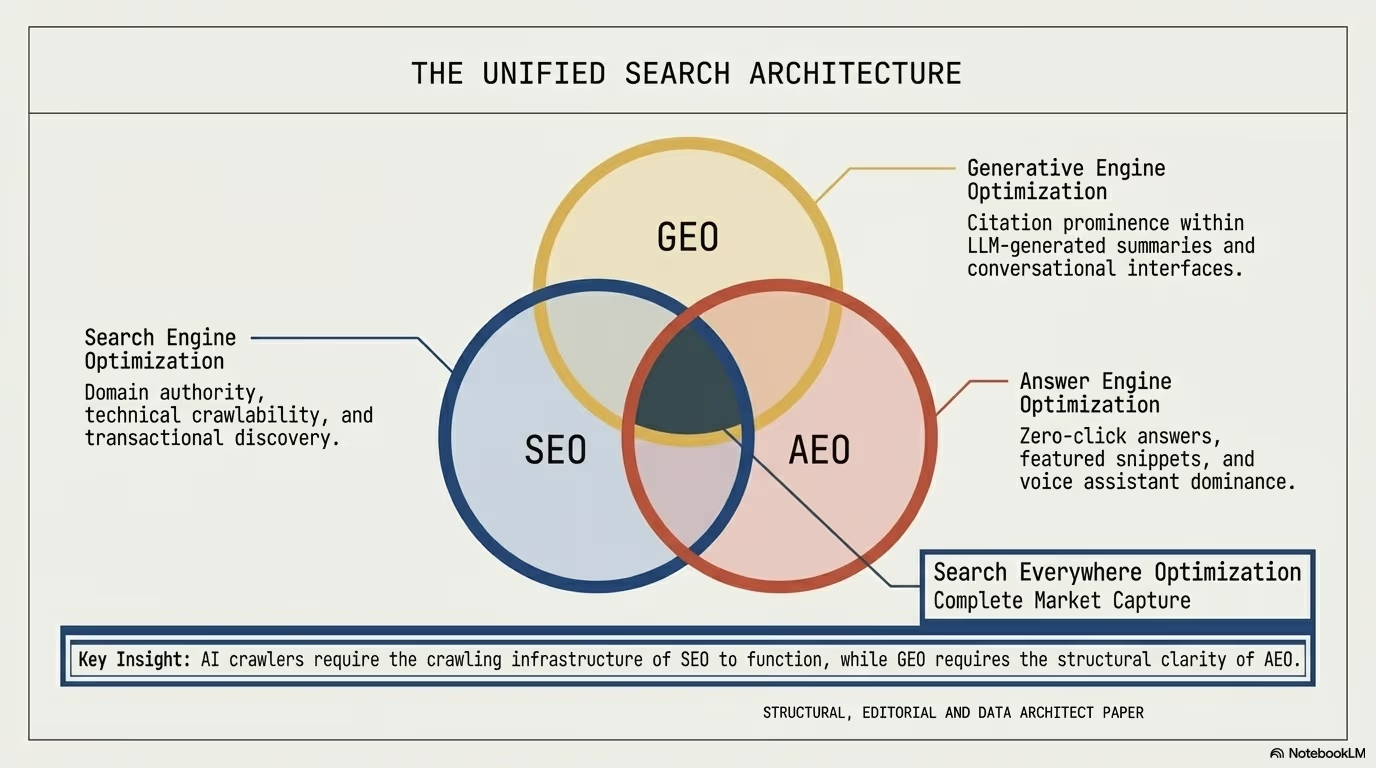
What is the difference between SEO and GEO

Two different fetches hide behind the phrase AI traffic, and separating them is the first useful thing a log does. One is the training crawl: a bulk pass that reads broadly, does not care whether anyone asked about you today, and leaves a long even sequence of requests walking the sitemap in order. The other is the inference fetch: one request, or a handful, made while a person is waiting for an answer, usually for a single URL, often for a URL that appeared in a search result seconds earlier.
The difference matters because the two have different consequences. The bulk pass shapes what a model holds in general and pays you back, if at all, months later and without attribution. The inference fetch decides whether your page sits in the context window of the answer being written right now, which is the only moment where a citation with your domain name on it can appear. They are told apart by shape rather than by name: evenly spaced requests across many paths versus a lone request for one path with no crawl neighbours around it. Once you can separate them, the question stops being whether AI sends traffic and becomes narrower and answerable: how often is this page fetched while somebody waits, and what does the fetcher get when it arrives.
The name for optimising the second case is Generative Engine Optimization (GEO), and the useful part of it is narrow. The target is not a position in a list, it is selection: which chunk of text a retrieval system pulls into the context window. The system rewrites the user question internally, scores passages against it, takes the highest scoring ones and generates from those. Your page therefore competes passage by passage against passages from other pages, which is why a modest page with one very clean paragraph gets quoted while a stronger page that reaches its answer in the ninth paragraph is skipped.
robots.txt sits above all of this and covers less than most people assume. It is a convention, addressed to clients that choose to read it, and it governs fetching rather than use. A model that already holds your text does not go back and re-consult it. A rule that blocks a training crawler does nothing to an inference fetch made under a different agent name, and the two are frequently different names from the same vendor. Blocking one and allowing the other is a real decision with two separate effects, and the only way to see which one you actually made is to grep the log for both strings a week later.
Growth figures for AI-referred traffic are quoted everywhere and sourced almost nowhere, and we are not going to add another one. The arithmetic is the reason to be careful: referrals from AI assistants start from a fraction of a percent of visits, and a fraction of a percent that triples produces a headline with almost no visitors behind it. A request count has the opposite property. It is a small number that means exactly what it says, and the method and raw counts behind ours are written up in bot traffic measured on a small site.
One test from that work is worth repeating on any site, because it costs one grep and it beats the user agent string sitting next to it. Look for the second request. A browser fetches the HTML and then, from the same address and within a second or two, the stylesheet, the fonts and the images. A text client takes the HTML and stops. That single follow-up tells you whether the visitor rendered your page or extracted it, and it keeps telling you the truth when the agent string is a lie, which for anything that is not a verifiable crawler it may well be.
So the seven takeaways below do not rest on a growth rate. They rest on what is observable in a log: the share of requests that no person made, and what those clients do with the page once they have it.
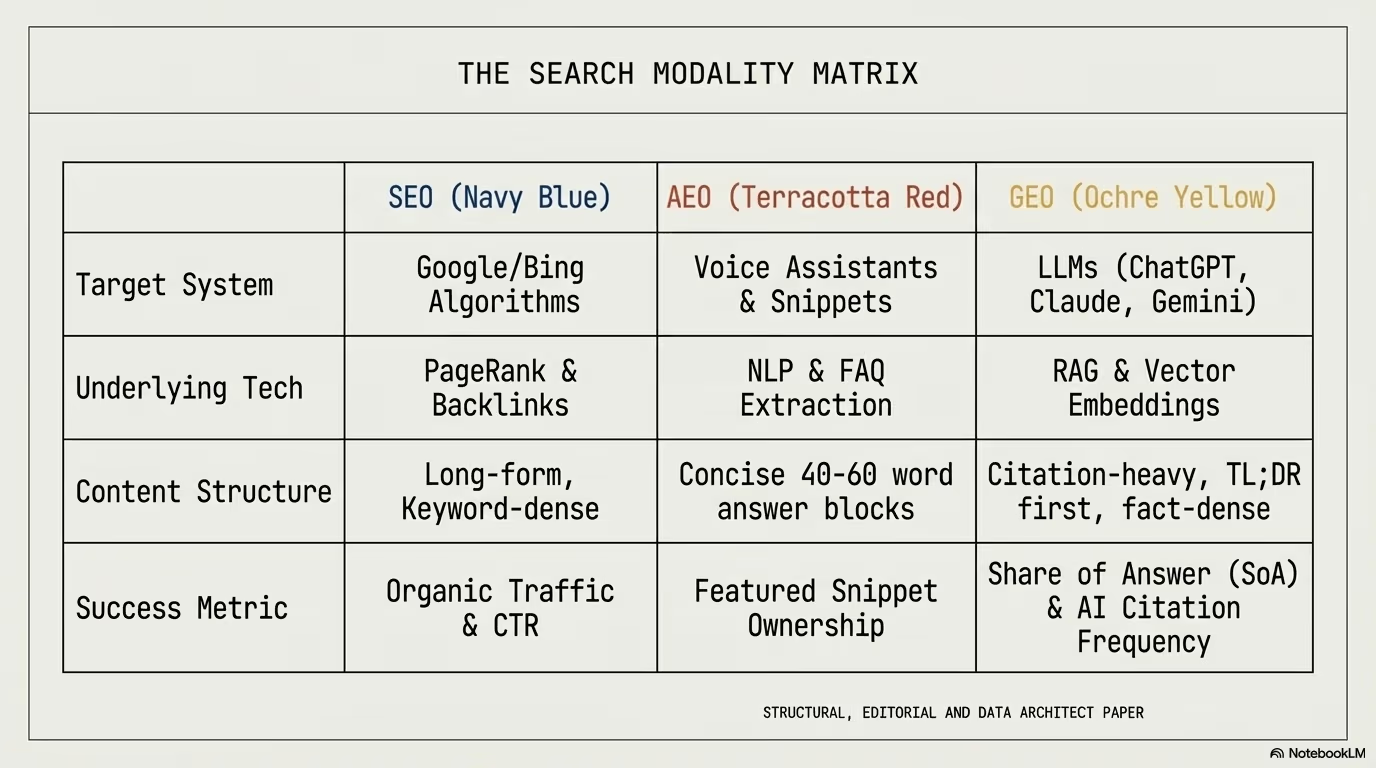
The critical difference between SEO and GEO lies in what each system rewards. SEO rewards pages that attract human clicks through compelling titles and meta descriptions. GEO rewards pages that AI systems trust enough to cite as authoritative sources. These are fundamentally different optimization targets, and treating them as the same will leave your content stranded between two paradigms.
1. Why AI cites the first 200 words of a page
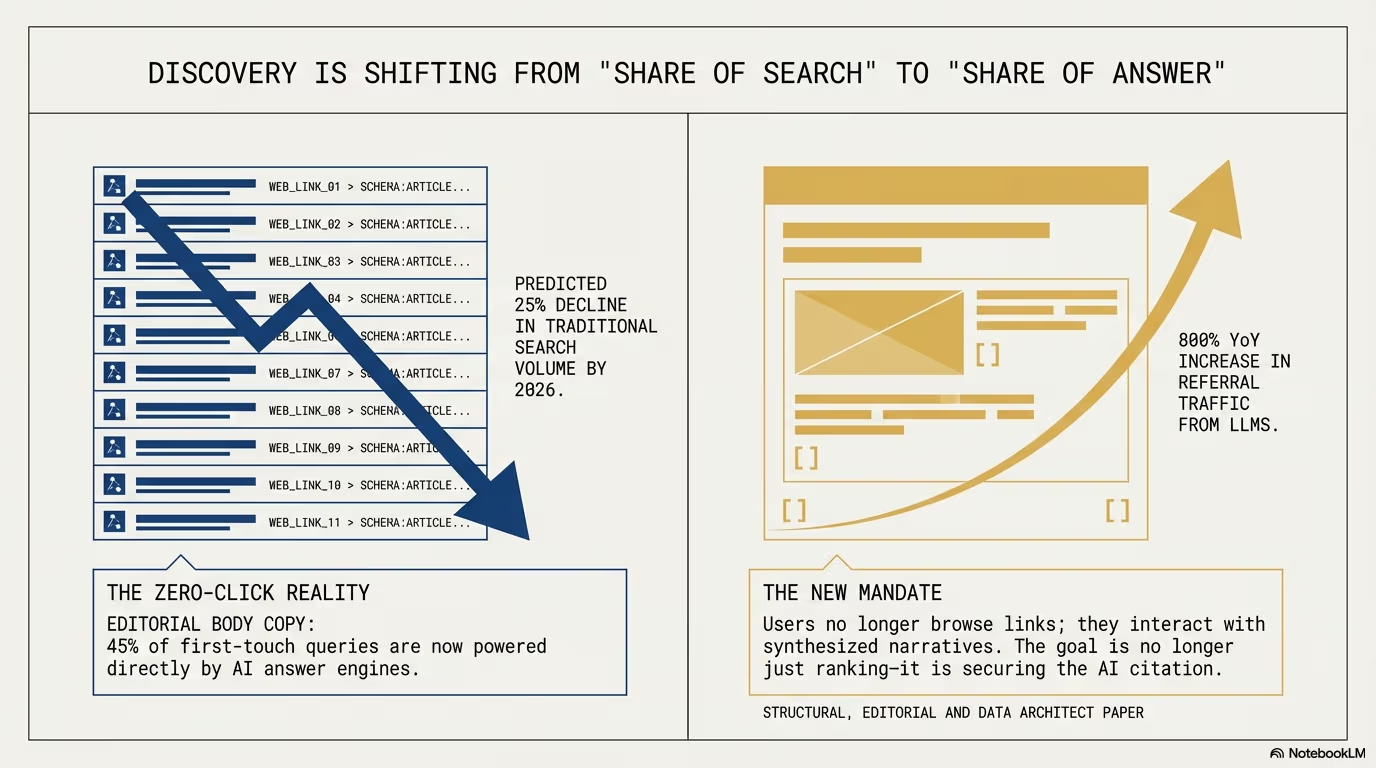
The days of burying the lead to inflate time-on-page metrics are officially dead. Modern AI retrieval systems utilize Retrieval-Augmented Generation (RAG), a process built for extreme efficiency. These systems do not read your entire article from top to bottom. They extract specific passages to feed the model context, and the extraction process heavily favors content that appears early in the document.
Kevin Indig’s analysis of 1.2 million ChatGPT answers puts 44.2% of verified LLM citations in the first 30% of a page. Read that as a description of a mechanism rather than a preference for brevity. A document is split into overlapping windows before anything is scored, and the window holding the title, the opening claim and the first named entities is the one that most often matches a standalone question. Later windows read as continuation, they presume what came before, and a scorer comparing them against a question asked cold marks them down for it.
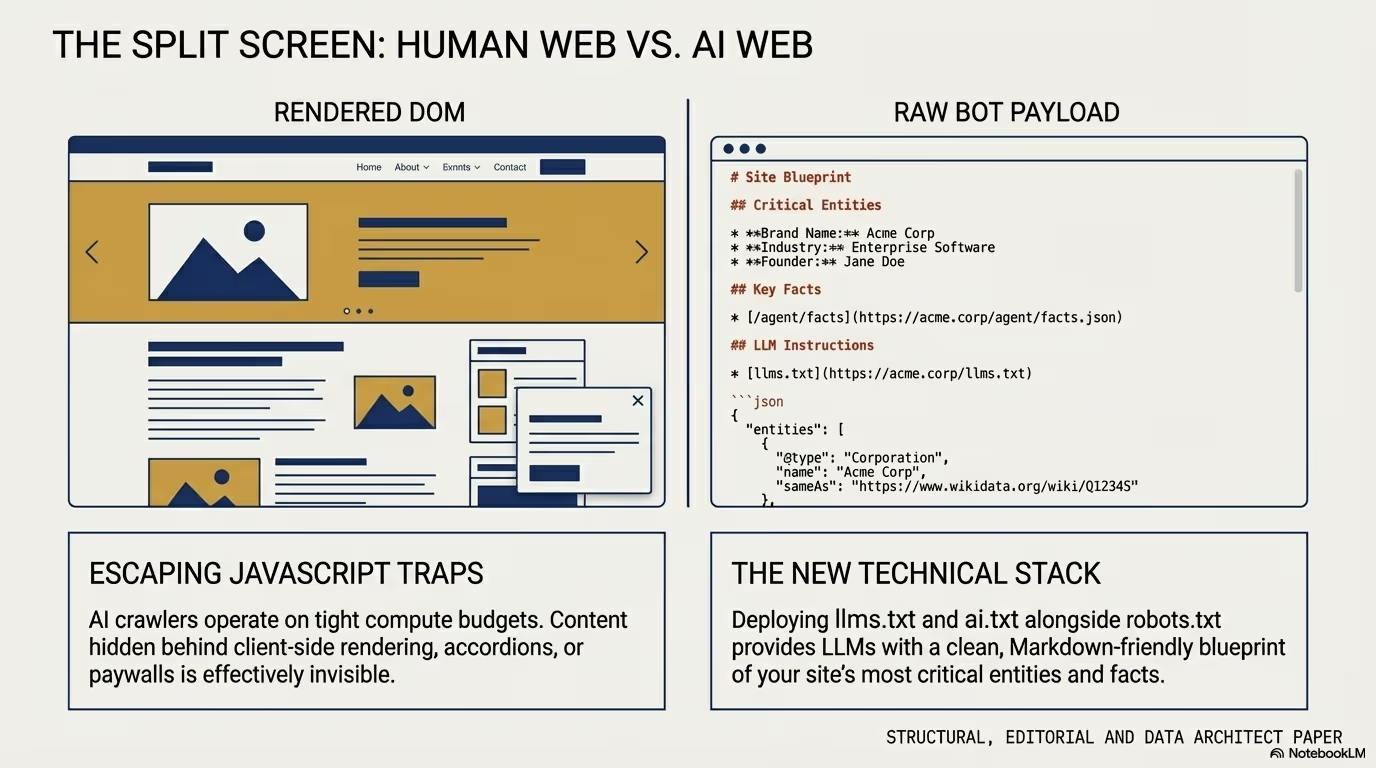
There is a second reason the opening wins, and it is about what the fetcher receives rather than what it prefers. An inference fetch usually takes one HTML response and no second pass. If your opening depends on something the browser assembles after load, a tab widget, an accordion, a client-rendered summary, the extractor gets the markup without the content and scores whatever prose happens to be in the raw response instead. Curl your own article and read the first screen of the output: that, not the rendered page, is the text competing for selection.
To win the citation, you must adopt an “answer-first” architecture: lead with a concise summary under 300 words that directly answers the primary query, then follow with data-rich nuance and supporting evidence. Think of it as writing an executive summary that a machine can extract in isolation and still deliver a complete, accurate answer to the user.
This does not mean your content should be shallow. Quite the opposite. The depth must be there, but the architecture must be inverted. Place your most citation-worthy facts, statistics, and declarative statements in the opening section. Then use the remaining content to provide the context, evidence, and nuance that builds authority.
“Answer the question first, then explain the nuances. This is how you should approach writing for AI search in general: clarity first, depth second.”
The practical implication is that every piece of content needs what might be called a “citation header”: a dense, fact-rich opening section specifically designed for RAG extraction. This section should contain your primary keyword naturally, a direct answer to the target query, and at least two supporting data points. Everything that follows builds on this foundation.
2. Why AI Overviews cite pages outside the top 10
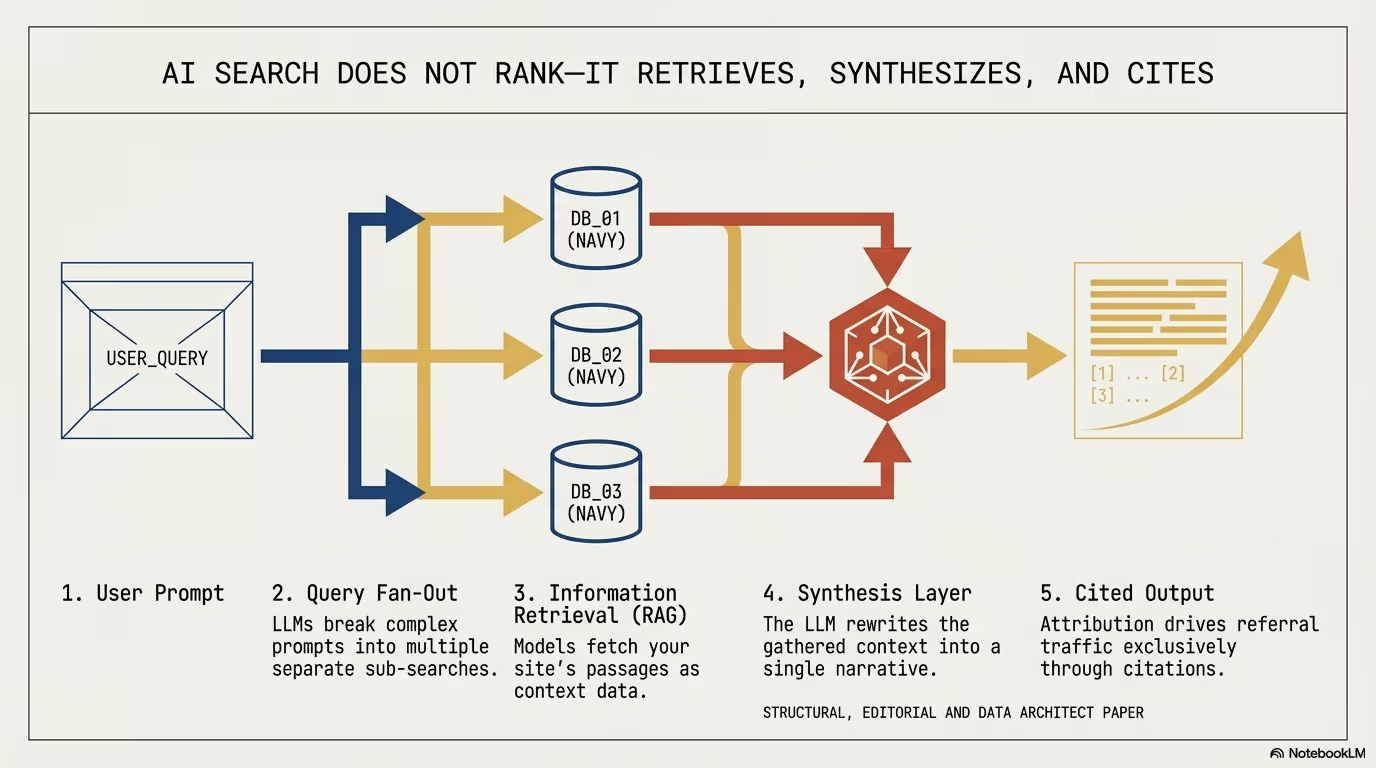
One of the most disruptive realizations for business leaders is that traditional Google rankings have decoupled from AI citations. The overlap between top-ranking Google links and the sources cited by AI engines is partial, and the two sets diverge more than most SEO planning assumes.
Digital Applied analysed 863,412 queries between October 2025 and February 2026 and found that 62% of AI Overview citations come from pages ranking eleventh or lower, or from pages absent from the top 100 entirely. That gap is structural rather than surprising. Ranking is a whole-document verdict decided partly by links pointing at the document from elsewhere. Selection is a passage-level verdict decided by how well one span of text answers one rewritten sub-question, and a passage carries no backlinks of its own. A page at position 30 with a clean definitional paragraph can beat a page at position 2 whose answer is distributed across four sections, and nothing in either system is malfunctioning when that happens.
AI models prioritize machine-extractable facts and structured clarity over the backlink-heavy signals of classic SEO. Where Google’s algorithm weighs domain authority, link equity, and user engagement metrics, AI systems evaluate how easily they can extract a verifiable fact, how clearly the content is structured, and how confident they can be in the accuracy of the information.
The gap cuts in a direction that is unusually friendly to small sites, and the reason is that the unit being compared is a paragraph. A large publisher’s page reaches its answer after the news peg, the context, the interview and the caveat, so the span that actually contains the answer competes against everything else on its own page before it ever competes with yours. A short page that states the answer in its second sentence has one span and no internal rival. None of the advantages a big domain spent years accumulating reach down to that level: the backlinks point at the document rather than at the paragraph, the traffic history is invisible to the scorer, and the brand recognition is not present in the text being compared. What does reach down there is whether the sentence holds with nothing above it, whether the entity it names is the one a reader would look up, and whether the page still says today what it said last year. Those three are within reach of anybody with an editor open, which is the whole of the opening.
Most of the work serves both channels, and it is worth knowing which parts do not, because those are the parts that have to be justified on their own. A title written to win a click from a list of ten does nothing for selection: the scorer never sees it next to its competitors, and the phrasing that makes a human choose is often the phrasing that makes a passage vague. A meta description is in the same position. Going the other way, a paragraph rewritten so that it survives being lifted out of the page tends to read flatter in a results listing, and moving the answer to the top removes the reason a reader would scroll past it. Structured data sits between the two and the two uses differ: a search engine consumes a handful of types to draw a richer result, while a retrieval system mostly takes from it the same thing a clean sentence already gave it, stated a second time in a form it does not have to parse out of prose. Freshness is the one item that pays in both, for different reasons on each side, which is why it survives every argument about budget. Judge each item against the channel it actually serves, and the ones that serve only one stop looking like neglect.
3. How topic clusters affect AI citations
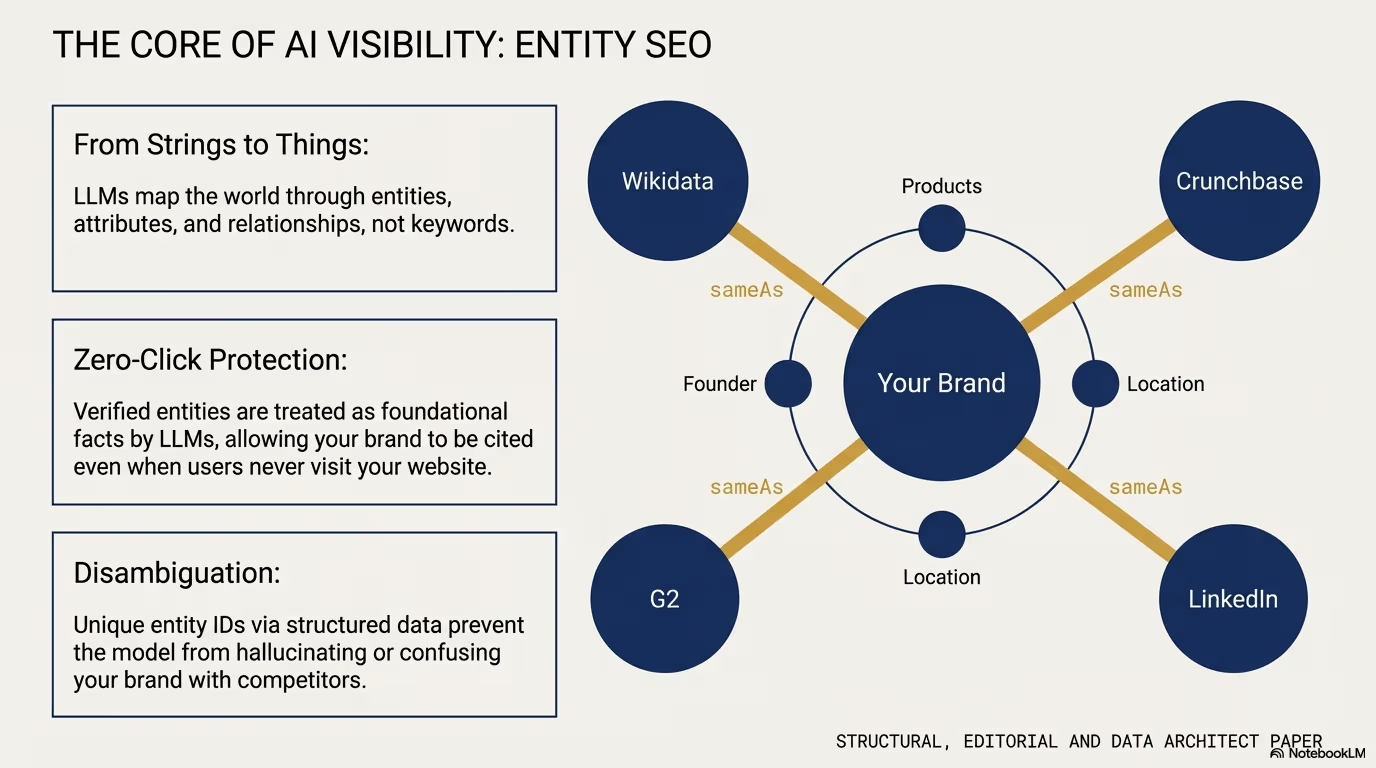
AI engines do not just look for a good page. They verify a Topical Graph Authority. The shift to an entity-first architecture is now the structural foundation of GEO, and the data supporting this is compelling.
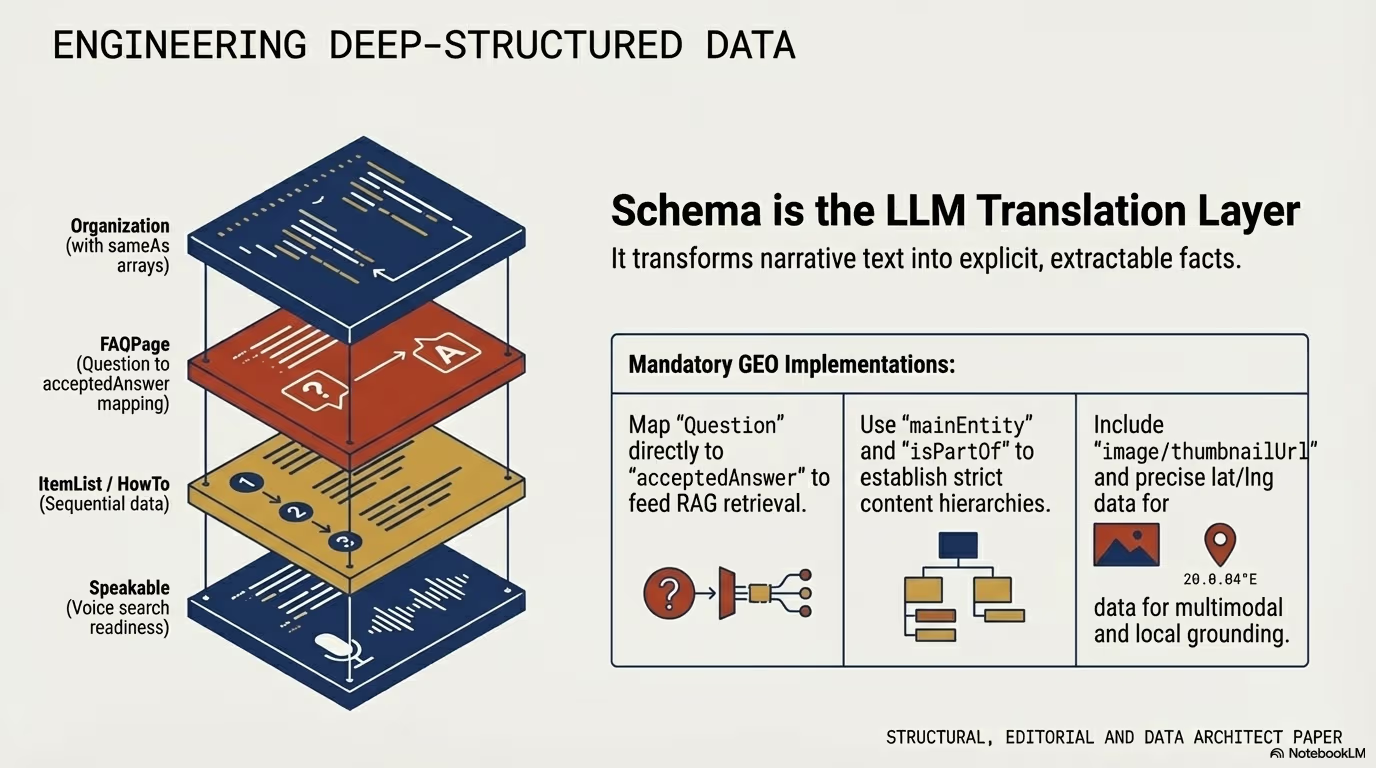
Yext analysed 6.8 million AI citations and found that 86% of citations come from sites with five or more interconnected pages on a specific topic. Isolated pages, no matter how well-written, rarely earn AI citations because the generative model cannot verify the broader authority of the source.
We have found no published study that puts a single multiplier on what a pillar-cluster architecture is worth, so we are not going to quote one. The Yext dataset supports a direction, not a coefficient: the five-page threshold is where citation share concentrates, and the sites that clear it are held together by bidirectional internal links rather than by a shared menu category. The mechanism underneath is verification. A model composing an answer has to decide whether the source it is about to name actually knows the subject or merely ranked for one phrase. A single page gives it one data point and no way to test it. A pillar with eight sub-pages, each covering a different slice of the topic and each linking back, gives it a graph it can traverse before it commits your brand name to an answer it cannot retract. Without that graph a page stays an orphan: indexed in the technical sense, unverifiable in the sense that matters.
What does this look like in practice? It means building content ecosystems, not standalone articles. A pillar page covers the broad topic comprehensively, and cluster pages dive deep into subtopics while linking back to the pillar and to each other. The internal link structure creates a semantic web that AI can traverse to verify authority.
For example, a site covering “WordPress security” as a pillar should have interconnected cluster pages on firewall configuration, malware detection, login hardening, SSL implementation, plugin vulnerability scanning, and incident response. Each page links to the others with descriptive anchor text, creating a dense knowledge graph that AI systems can navigate and trust.
The entity-first approach goes further. Every key concept on your site should be linked to its corresponding Wikidata entity, and your structured data should express entity relationships clearly. When an AI system can trace a clear entity graph across your content, it treats your site as a knowledge base rather than a collection of disconnected articles.
4. How often to update content for AI citations
Put two pages in front of a model that say different things about the same version number, and the date becomes the tiebreaker, because nothing else in the two documents settles it. The system cannot run the software, cannot ask either author which of them checked recently, and has no appetite for handing the user both answers with a shrug. What it does have is a last-modified signal, a publication date in the text, and the version numbers, product names and release years the passage mentions on its own account. It will prefer the passage whose internal furniture matches the present. That is how a page goes quiet without losing a single link: it still says the true thing it said when it was written, and a newer page now says the thing that is true today. The same mechanism explains where the effect lands hardest. Pages that name versions, prices and years in their opening lines are exactly the pages a scorer can date from the text alone, and dating them is one of the first things it does.
Content updated within 90 days achieves 2x higher citation rates compared to older material. This is not a marginal improvement. It is a binary distinction between content that gets cited and content that gets ignored.
Conversely, content that has not been touched in over 18 months is largely ignored by generative engines, regardless of its historical authority. A page that once earned thousands of backlinks and ranked number one for years can become invisible to AI systems simply because it has not been refreshed with current data and verified facts.
The static “publish and forget” model has been replaced by a mandatory quarterly refresh cycle. If your data is not fresh, the AI will simply find a competitor whose data is. This represents a fundamental shift in content economics: the cost of maintaining content is now as important as the cost of creating it.
Practical steps for maintaining freshness include updating statistics and data points quarterly, adding new sections that address emerging subtopics, refreshing publication and last-modified dates with genuine content changes, verifying that all external links still work and point to current resources, and revising any recommendations or best practices that may have changed since the last update.
A date bump and a real update leave different evidence behind, and the difference is not subtlety on the reading side, it is arithmetic. If the body text is byte-identical, the passages that get split out and scored are identical too, so whatever the metadata header now says, the text competing for selection is the same text that was competing last year. The versions it names are the old versions, the workflow it describes is the old workflow, and anything comparing it against a page that names this year’s releases has plenty to go on besides the header. A real update changes the body: a paragraph that named a deprecated setting now names its replacement, a claim resting on a source that has since been corrected either moves or goes, and a section that was true for one release says which releases it covers. That is also the version of the question you can settle yourself without guessing at anybody’s detection. Diff the file against its last published state, and if the diff sits entirely in the metadata header, nothing downstream has been given anything new to score.
5. Why ChatGPT cites Wikipedia and Reddit over brand sites
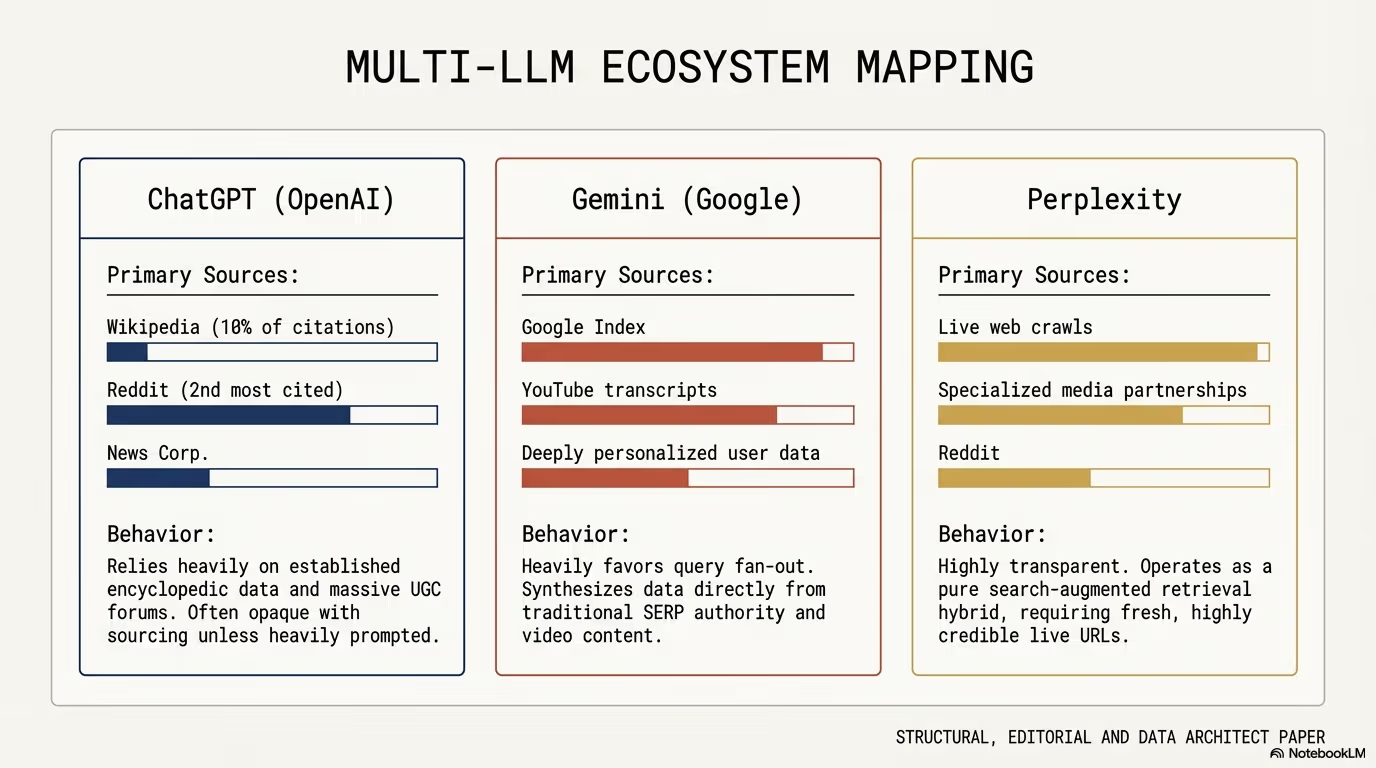
AI search engines exhibit a systematic and overwhelming bias toward earned media: third-party mentions on authoritative platforms, not brand-owned content. This is the legitimacy layer, and understanding it is crucial for any GEO strategy.
Profound’s analysis of platform citation patterns puts Wikipedia at 7.8% of all ChatGPT citations, with Reddit second and some distance behind. Both properties share three traits a retrieval system can act on: stable URLs, a predictable document shape that chunks cleanly, and an editorial process outside the subject’s own control. The third is the one a company cannot buy on its own domain, and it is why a page about you elsewhere can outrank your own page about you for the same question.
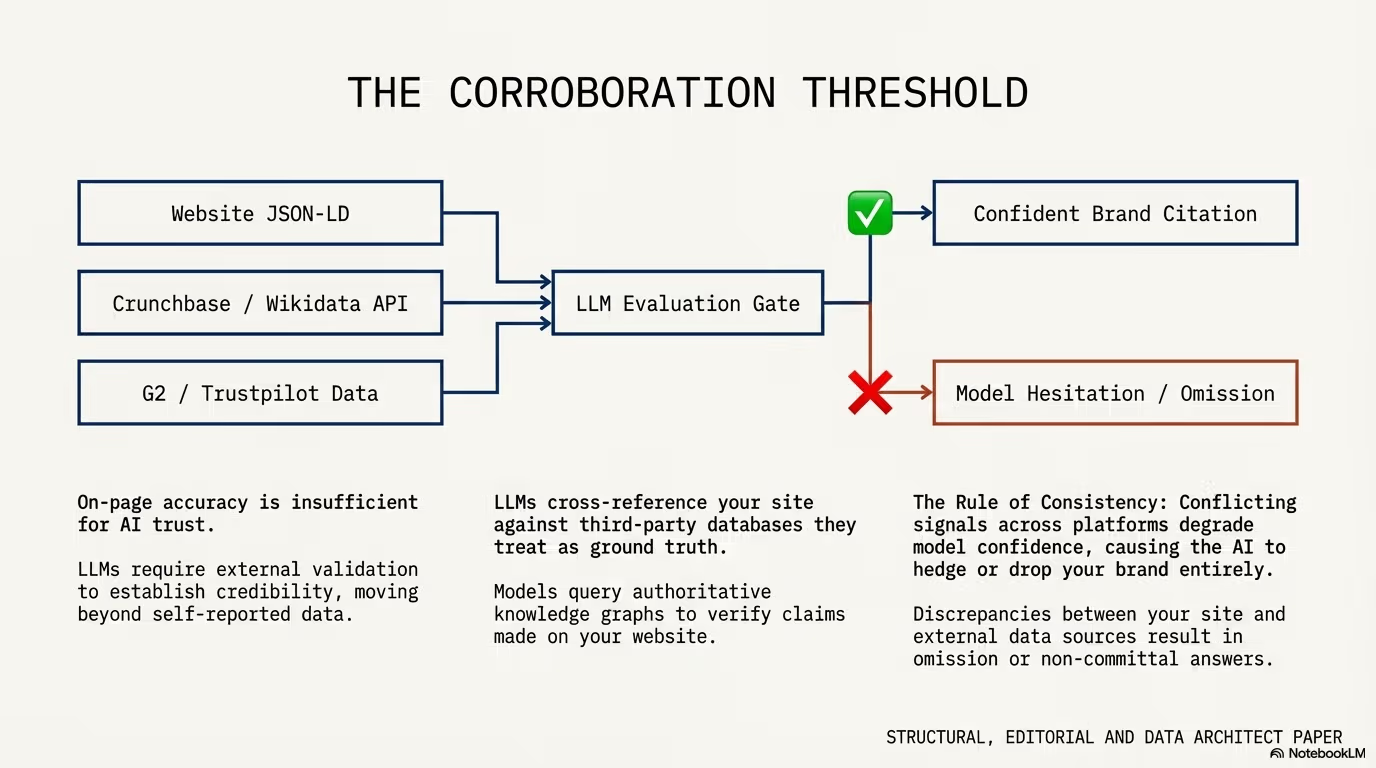
To be cited by AI on your own site, you must often first earn mentions on other sites that the AI already trusts, such as Reddit, YouTube, major news outlets, industry publications, and academic repositories. This creates a “zero-click moat” where your presence on high-authority, third-party domains acts as the trust signal required for an AI to eventually justify citing your primary domain.
The mechanism works like this: when an AI model encounters your brand mentioned positively on Wikipedia, Reddit, and industry publications, it builds an internal confidence score for your domain. Once that confidence threshold is crossed, the model becomes willing to cite content directly from your website. Without that third-party validation layer, your first-party content exists in a trust vacuum.
“Wikipedia leads ChatGPT’s citations, with a share of 7.8%, while the second most cited source, Reddit, trails far behind… it serves as a ‘legitimacy layer’ for companies.”
What a page on somebody else’s domain carries that yours cannot is the fact that you did not write it. Your own page can state what you do, and a retrieval system has nothing to test that statement against; it is a claim whose only witness is the party making it. A thread where other people describe the same work carries disagreement, dates, corrections and names attached to them, and it sits inside an editorial process you do not control. That is a different class of evidence, and it is the class a model can lean on when it has to decide whether putting your name in an answer is safe. It also outlives a rewrite of your own homepage, which is why a mention keeps working long after the campaign that produced it ended. So digital PR here is not brand-building with a fresh justification attached: it is the only way to get a sentence about you into a place your own editorial control does not reach.
The strategy requires patience. Building the legitimacy layer is a long-term investment, but the compounding returns in AI visibility make it one of the highest-ROI activities in digital marketing today.
6. What is llms.txt and does anyone read it
/llms.txt is a proposal rather than a standard, and the distinction shows up in what each file does when a client ignores it. robots.txt is read before a fetch and answers one question: may this path be requested. It is a gate, and a client that skips it is breaking a convention older than every model in this article. /llms.txt is read during a fetch, if at all, and answers a different question: given that you are already here and have room for a few thousand tokens, which pages are worth taking. It is Markdown, so nothing sits between the file and the context window the way navigation, scripts and markup sit between a page and its text. And it is curated by hand, so what goes in it is an editorial decision rather than an export of everything you published. Nothing enforces either side of that arrangement: no client has to request the path, and nothing checks that the file still describes the site it sits on. Which is why the paragraphs below end with a grep rather than with a recommendation.
This file solves the “context window” problem. AI bots often struggle to parse complex HTML, navigation menus, JavaScript-rendered content, and multi-layered page structures. When an AI agent visits your site during a live conversation, it has a limited context window and limited time to extract relevant information. A clean, machine-readable summary solves this problem elegantly.
By providing a structured /llms.txt file, you allow AI agents to ingest your expert-level information instantly during a user conversation. The file typically includes your site’s core expertise areas, key factual claims, primary content categories, and links to your most authoritative pages, all formatted in clean Markdown that any LLM can process without parsing overhead.
This machine-readable handoff is becoming as essential as the sitemap was for the previous era. Sites that want to be machine-readable are already implementing complementary files: /llms.txt for structured content summaries, /ai-sitemap.xml for AI-specific content discovery, and structured JSON feeds like /ai-training-data.json that provide machine-optimized content to any AI system that requests it.
The implementation is straightforward. Create a Markdown file at your domain root that describes your site’s expertise, lists your most important content with brief summaries, and provides clear factual statements that AI models can extract and cite. Update it whenever you publish significant new content. Think of it as your site summary for AI systems: concise, factual, and structured for machine consumption.
Be honest about its status before you invest in it. No crawler is obliged to request /llms.txt, no major vendor has committed to reading it, and claims about its effect on citation rates circulate without a study behind them, so we are not going to repeat one. Fortunately the file is the easiest thing in this article to verify: it is one path, so grep your access log for it. If nothing has requested it in a month, it is a cheap file that nobody reads, which is a fine thing to keep and a bad thing to build a strategy on. If something does request it, you now know which agent, how often, and whether the same agent comes back for the pages it lists.
7. What is query fan-out in AI search
AI is powered by Natural Language Processing (NLP), which prioritizes intent matching over keyword density. The way users search has fundamentally changed, and the data illustrates the magnitude of this shift.
The SOCi Visibility Index puts traditional typed searches at an average of 4 words and AI prompts at 23 words. A user types “best WordPress security plugins 2026.” The same user tells an AI: “I’m running a WooCommerce store on shared hosting and I’m worried about security. What plugins should I install to protect against the most common attacks without slowing down my site?”
Users now provide full situational context in their prompts. They describe their specific situation, constraints, preferences, and goals. In response, AI engines perform “query fan-out,” breaking one complex question into multiple sub-queries to find the best answer. That single 23-word question might generate five or six internal sub-queries, each searching for different aspects of the answer.
Content that sounds robotic or keyword-stuffed is penalized in this process. Writing like a real person to a real person is now a technical optimization, not just a stylistic preference. It ensures your content aligns with the semantic intent the AI is trying to satisfy during its fan-out process.
Write for the constraints, because the constraints are what the sub-queries are made of. A long prompt is not one question with padding around it. The system splits it, and the clauses a human reads as background become separate retrievals. A message that mentions shared hosting, a store and a worry about slowdown produces one retrieval about plugin overhead, one about the attacks that hit stores, and one about what shared hosting will not let you install, and your page is scored separately against each of them. A page that names the hosting tier, the platform and the tradeoff inside the same paragraph can match more than one; a page that says which plugin is best without saying who it is best for matches only the shortest and most crowded sub-query. The edit this asks for is small and unglamorous: keep the qualifying clause inside the sentence instead of moving it to a caveat at the bottom, so the sentence still holds when it is pulled out alone.
Content structured around “If you are in situation X, then the best approach is Y because Z” performs far better in AI citation than content structured around “The best approach is Y.” The situational context gives the AI confidence that your answer applies to the specific user question it is processing.
This also means long-tail, question-based content is more valuable than ever. FAQ sections, detailed how-to guides, and scenario-specific recommendations give AI systems exactly the structured, situation-aware content they need to generate accurate, cited answers.
How to plan and measure 2027 when organic clicks fall
The October 2026 issue of Growth Memo, How to plan 2027 when traffic is down and AI won’t attribute by Kevin Indig and Amanda Johnson (a Semrush-sponsored issue), puts numbers on what a server log can only hint at. Zero-click searches rose from 60.45% of US Google searches in 2024 to 68.01% in early 2026, per SparkToro and Similarweb data as cited there. The memo gives no figure for any other market, so the US number is a direction, not your baseline. The consequence for a WordPress site is plain: a 2027 target written as organic sessions starts shrinking before the year does.
Two more figures from the same issue change where the hours go. 91% of citations appear in only one of ChatGPT, Perplexity, or AI Overviews, so presence in one engine says little about the next and each has to be checked on its own. And AirOps, as cited in the memo, found that third-party signals drive 85% of brand visibility in LLMs, which is the earned-media argument from section 5 written as a budget line. We have not read the AirOps study itself; the figure is the memo’s.
The memo quotes Amanda Natividad of SparkToro on what follows from that:
“If people are increasingly getting answers without clicking, then you need to plan for the signals that happen before, or instead of, the visit.” (Amanda Natividad, SparkToro, in Growth Memo)
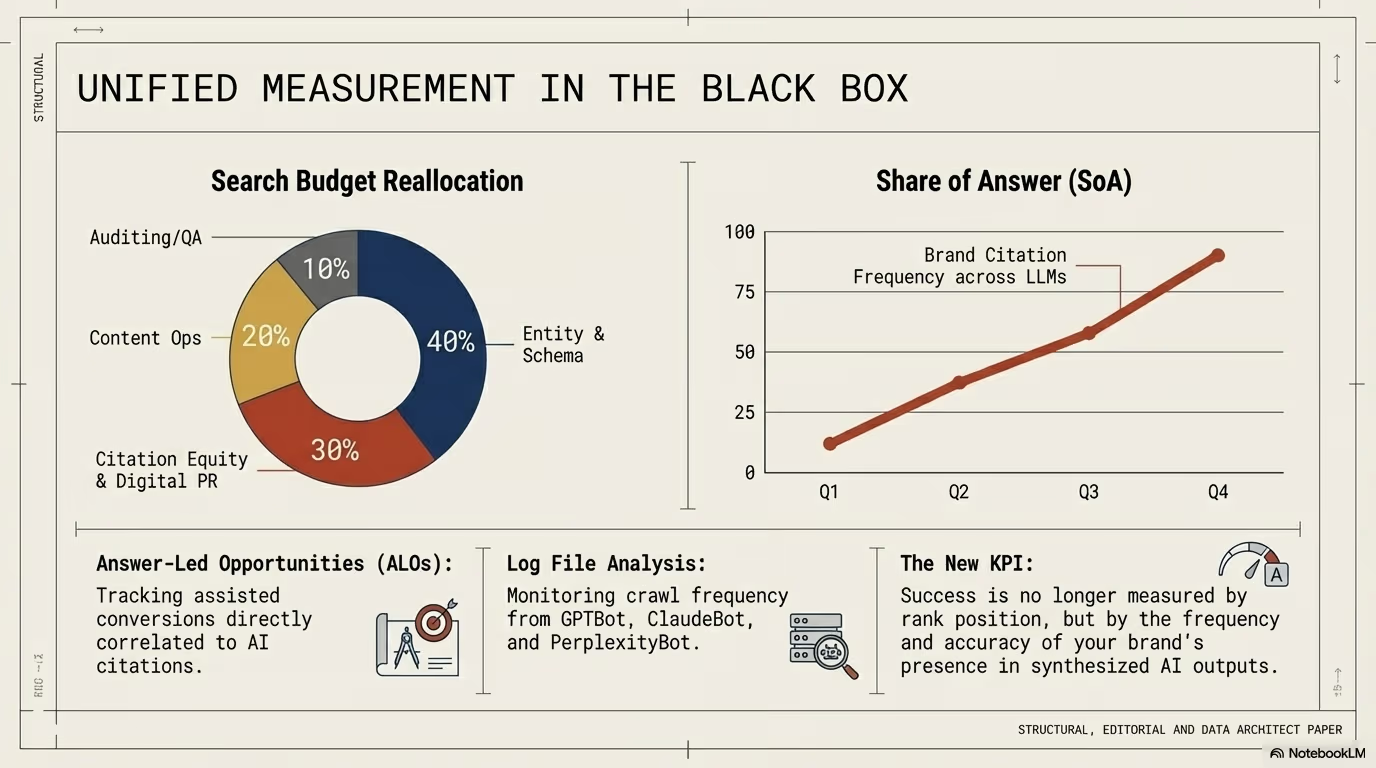
Its measurement model replaces a single traffic target with three signals that have different blind spots, “an exposure metric, a behavioral signal, and a business outcome”, reported together every month. On a typical WordPress site the instruments for all three already exist:
| Layer | What it answers | Where a WordPress owner reads it |
|---|---|---|
| Exposure | Are we named where buyers research | a fixed panel of questions asked monthly to the assistants your customers use (citation monitoring), plus mentions on third-party pages |
| Behavioral signal | Did anyone go looking for us | branded queries in Google Search Console, direct visits in Umami, GA4 or Matomo |
| Business outcome | Did it turn into work | contact form submissions, quote requests, WooCommerce orders, and a “how did you hear about us” field on the form |
The value is in reading the layers against each other. The memo lists four combinations:
- Exposure up, branded search flat: the mentions are not reaching buyers, a distribution problem.
- Branded search up, pipeline flat: people went looking and did not convert, so the landing pages, the offer or the handoff need work.
- Branded search and direct visits up, AI citations flat: something off-site is working (a podcast, an event, word of mouth) and the models have not caught up yet.
- Exposure and branded search both down: a competitor is taking the mentions.
None of the three layers proves influence alone, and the memo says so. For the budget it proposes three buckets: proven work funded in full (technical SEO, content refreshes, digital PR that already earns citations), learning work capped with one owner and a kill date, and bets funded on judgment (community, events, brand). The split gets revisited every quarter against the three layers. For a small WordPress business that comes down to a one-page report at the end of each month and one decision at the end of each quarter about which line of work gets the next block of hours. The server log from the opening of this article stays in that report; it just stops being the only number on it.
How to improve visibility in LLMs in 2026
A results page shows ten links and lets the reader choose between them. An assistant composes one answer out of a handful of passages and then lists where they came from, so the choosing happens before the reader sees anything. Appearing on that list of sources and being the passage a sentence was built from are two different outcomes, and only the second puts your wording in front of the person. The vendors do not share a retrieval stack either: ChatGPT, Gemini and Perplexity rewrite the question differently, split documents differently and cut the candidate set at different points, so the same page can be quoted by one and skipped by the next on the same query. What they have in common is narrow enough to act on and testable on your own file: a passage that answers a question asked cold, without leaning on the sentence above it, survives all three pipelines better than a passage that needs its neighbours to make sense.
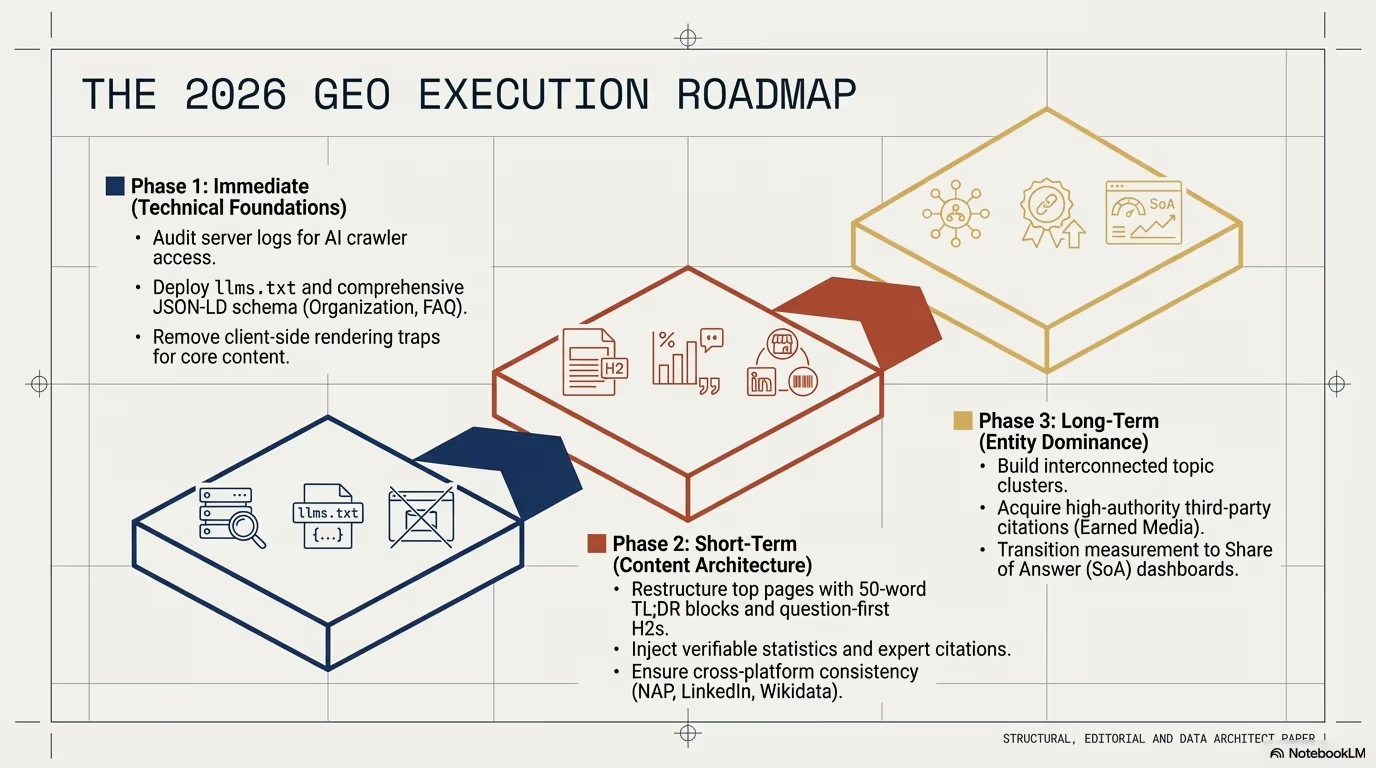
The transition to GEO changes what each team ships, and the change shows up in the artefacts rather than in the vocabulary. The writer stops holding the answer back for the third screen and puts it in a paragraph that can be lifted out and still make sense with nothing above it. The developer stops letting the opening section arrive after hydration, because the fetch that matters takes one HTML response and leaves. Whoever handles outreach stops counting links and starts counting pages on other domains that describe what you do in a sentence a model could quote without editing it. And whoever reports on all this stops opening a traffic dashboard first, because the click it counts is the one event this shift removes. What survives as measurable is narrower than what was there before: which agents requested which paths, what they received, and whether they came back.
Seven things to check, each with a place to check it:
- Structure content for extraction: Put your most citation-worthy facts in the first 200 words and build an answer-first architecture that RAG systems can efficiently process.
- Decouple your strategies: Recognize that SEO and GEO are parallel but distinct optimization targets, and invest in both.
- Build topical authority webs: Create interconnected content ecosystems with five or more pages per topic cluster, connected by bidirectional internal links and entity markup.
- Maintain a 90-day refresh cycle: Treat every piece of content as a living document that requires quarterly updates with genuine new information and verified data.
- Invest in the legitimacy layer: Build presence on third-party authoritative platforms that AI systems already trust, creating the confidence signals needed for direct citation.
- Implement the /llms.txt standard: Give AI systems a clean, structured entry point to your expertise by providing machine-optimized content summaries.
- Write for intent, not keywords: Create situation-aware content that matches the conversational, contextual queries users bring to AI systems.
As we move deeper into this AI-first era, business leaders must confront a new reality of measurement and value. If a user never clicks through to your website but gets your brand’s answer from an AI, did you still win, and how are you going to measure it?
Each metric being proposed for that gap has a collection problem worth checking before you buy a dashboard built on it. Citation frequency means asking the assistants the same questions on a schedule and recording which domains they name, which is a sampling exercise rather than a reading: the answer moves between sessions, between accounts and between one model revision and the next, so a change in the number can be your content or can be a silent change at the vendor. Sentiment in a generated response is the model paraphrasing what it read, not what anyone wrote about you. Entity confidence is not published by anybody who holds it. Answer ownership assumes a stable question set, which the fan-out behind the question does not keep stable. None of that makes the measurements worthless, but it decides how to read them: as repeated samples with a wide spread, reported alongside the date and the prompt that produced them, and never as one figure carried into a slide.
Until those metrics settle, the log remains the cheapest instrument in the building and the only one nobody is selling you. It will not tell you whether a model cited you; no server-side signal can, because generation happens on someone else’s hardware. It will tell you which agents came, which paths they asked for, what status they got, whether they came back, and whether anything ever requested the files you built for them. Three greps a month against those questions produce a shorter and more reliable picture than any dashboard assembled from vendor estimates.
That is the practical end of the click. Not a new kind of influence to believe in, but a narrower set of things you can actually observe, and the discipline to stop asserting the rest.