Who: Mariusz Szatkowski with vetted senior specialists brought in per engagement, a technology partner that designs the architecture of a digital business, not just websites.
What: Scalable e-commerce environments on WordPress: headless architecture (Astro, Next.js), ERP integrations and data ready for AI.
Where: Remotely for clients across the EU and beyond. We work as an extension of your team or as the contractor for the whole architecture.
How much: Individual quote after a goals workshop and a review of your current architecture. We start with a priority map, not a price list.
E-commerce architecture that does not limit your business
We design and build scalable environments on WordPress. We combine the performance of headless architecture (Astro, Next.js) with solid ERP integrations and prepare your data for the era of AI. One partner for the content, integration and frontend layers.
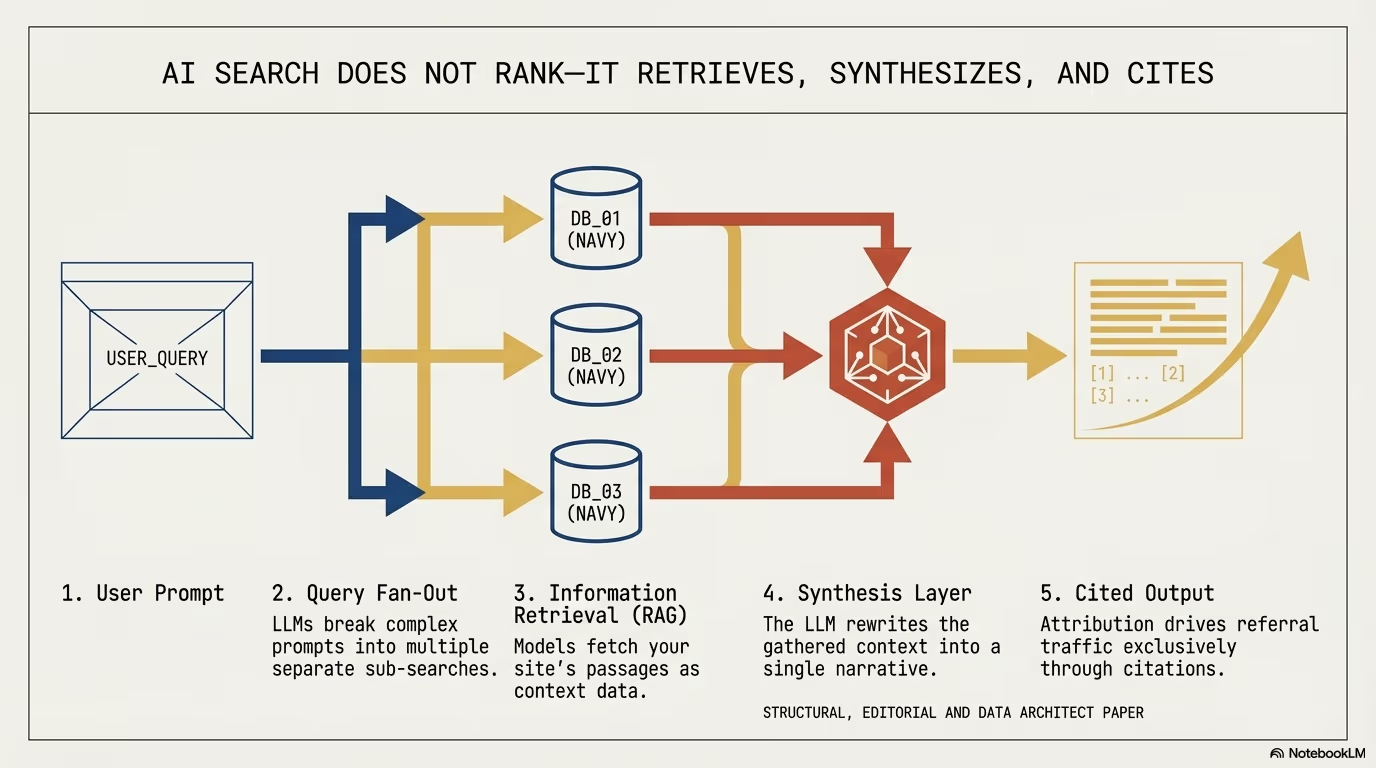
Most projects that reach us do not need another website. They need coherent architecture: a system editors run without a developer, an integration that keeps warehouse and sales in agreement, and a frontend that loads in a fraction of a second and is visible to AI search. Those three layers are usually built by three different companies. We design them as one organism.
Who you are hiring
- Shipping commercial WordPress since 2006, before Gutenberg and the REST API
- Senior-led: the engineer at discovery is the engineer at the keyboard at week six
- No offshore handoff, no PM layer billed back to you
- WordCamp Europe organiser, WordPress Foundation Credits mentor
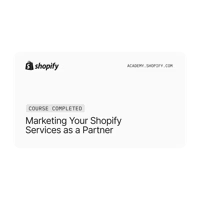
- Shopify Academy: CRO learning path plus Partner Marketing (Credly, 2025)
Shopify Academy credentials




Enterprise e-commerce architecture in three pillars
Headless and fullstack architecture
We separate the visual layer from the database. We build on Astro and Next.js. You gain load speed, a smaller attack surface and app-like flexibility.
Complex ERP and API integrations
WooCommerce and your ERP (Dynamics 365, SAP Business One, NetSuite) as one organism. We automate stock, price lists and logistics across tens of thousands of indexes.
AI-ready data (AEO / LLMO)
We prepare your architecture and product base for AI search. We implement structured data, remove cannibalisation and open your business to traffic from language models.
Pillar 1: modern architecture (headless and decoupled)
A monolithic WordPress works well at the start, but at large scale it pays to separate the backend from the frontend. WordPress stays as the content and business-logic engine editors already know, and we build the visual layer from scratch in Astro or Next.js.
What that gives you in practice:
- Security: the frontend does not connect directly to the database, which reduces the attack surface.
- Performance: statically generated pages served from a CDN load very fast, which supports conversion and Core Web Vitals.
- Omnichannel: the same backend serves data over REST API or GraphQL not only to the website but also to a mobile app or other channels.
Pillar 2: ERP integration and process automation
An ERP is the heart of a company, and re-keying data between WooCommerce and the ERP by hand throttles growth. We build dedicated integrations and middleware layers that keep sales, warehouse and accounting in sync.
The work covers designing dedicated endpoints, authentication (OAuth or JWT), parsing JSON and XML structures and scheduled synchronisation through CRON jobs. At genuinely large volumes we introduce message queues so that moving tens of thousands of indexes does not overload the server. The result is automated orders, invoices and shipping labels, dynamic recalculation of wholesaler prices and a block on selling items that are not in stock. For how this looks in a real project, see our automotive store wholesale API integration.
Pillar 3: data ecosystem and AI optimisation
Even the best architecture will not sell if nobody finds the products. Once data from company systems reaches a modern engine, it has to be exposed properly to language models. We turn raw data into structured knowledge for AI: deep schema.org (JSON-LD) integration in the code, mapping product attributes onto entities AI understands and optimisation for voice search. The architecture stays unambiguous and free of technical barriers, so AI bots reach clean data.
Headless, ERP integration and AI-ready data compared
| Area | Headless / decoupled | ERP integrations | AI-ready data (GEO) |
|---|---|---|---|
| Core problem | Slow frontend at scale | Manual stock and price re-entry | Inconsistent facts in AI answers |
| Typical outcome | Mobile LCP under 2 s, smaller attack surface | Automated order and warehouse sync | Citations in ChatGPT and AI Overviews |
| When to start | 5k+ SKU catalogue or multiple fronts | ERP is already source of truth | Premium brand with strong technical SEO |
| Related service | Headless WordPress | WooCommerce ERP integrations | GEO / LLMO optimization |
How to scope an enterprise e-commerce architecture
We start by identifying the source of truth for every important field. Product descriptions may belong to a PIM, stock to the ERP, customer status to the CRM and editorial content to WordPress. That ownership map prevents two systems from overwriting each other and exposes gaps before implementation begins.
The review also records update frequency, expected volume, access methods and failure behaviour. A price feed that runs nightly needs a different design from stock that must change within seconds. We specify which operations may be delayed, which must be rejected and which require manual reconciliation. Message queues and middleware are introduced only when those requirements justify the extra operating layer.
The output is a written system map, a prioritised risk register and an implementation backlog divided into independently releasable stages. If the existing WordPress setup can meet the requirements without headless architecture, we say so and keep the simpler system.
Delivery stages and acceptance criteria
The first stage is a narrow vertical slice: one product group, one integration path and one frontend journey connected end to end. It verifies authentication, field mapping, cache invalidation and error handling before the same pattern is applied to the full catalogue.
Each later stage has explicit acceptance checks:
- the owning system and transformation rule are documented for every exchanged field;
- repeated events do not create duplicate orders, invoices or stock movements;
- failed synchronisations are visible in logs and can be replayed safely;
- performance and accessibility budgets are checked on the actual customer journey;
- the release procedure includes data backup, a return path and named responsibility;
- operating documentation allows the client team to monitor and maintain the system.
This makes scope and risk reviewable in writing. It also gives the business a useful stopping point after every stage instead of forcing one large, irreversible rebuild.
Why hire one partner for frontend, integrations and data
When the frontend, the integrations and the data layer are built by three different companies, most of the time is lost at the seams of responsibility. Designing those layers together avoids the situation where a fast frontend has no current stock to show, and a correct integration is invisible to search. That is the difference between a website contractor and a partner who designs the architecture of a digital business.
Frequently asked questions
Questions about scope, delivery, pricing, and execution quality.
How are enterprise solutions different from a regular WordPress site?
#Do I have to change my ERP system or hosting?
#Can it be delivered in stages?
#Need an FAQ tailored to your industry and market? We can build one aligned with your business goals.
Let’s discuss