Since 1 July 2026, a parcel from outside the European Union with an intrinsic value of up to EUR 150 no longer enters duty-free. Council Regulation (EU) 2026/382 removed the old relief and, until 1 July 2028, charges EUR 3 customs duty for every item in the consignment when the goods were sold through IOSS or travel in a postal consignment. For a WooCommerce shop in the UK, the US or Asia that sells to customers in the EU, and for an Irish or other EU shop that dropships straight from China, this is an extra cost on every order. This article explains who the rule covers, how to count the items in a cart, what to expect from 1 November 2026 and how to show the duty to the customer before payment.
The article describes EU law and European Commission guidance as of the publication date, together with how the software works. It is not individual customs or tax advice for your shop.
If you run a shop inside the EU and ship from a warehouse in Ireland or another EU country where the goods are already in free circulation, this rule does not affect you. A parcel moving within the EU is not an import, so it pays no EUR 3 duty. The rest of the article is for shops whose parcels cross the EU border on the way to the customer.
What is the EU 3 euro customs duty per item from 1 July 2026?
Until 30 June 2026, goods in a consignment with an intrinsic value of up to EUR 150 were relieved from customs duty under Articles 23 and 24 of Regulation (EC) No 1186/2009. VAT has been due on these parcels since 1 July 2021, but customs duty was not. The recitals of Regulation 2026/382 explain the change: the EUR 150 threshold had been systematically abused through undervaluation and artificial splitting of consignments.
Article 1 of Regulation 2026/382 deletes Chapter V of Title II of Regulation 1186/2009, which is that relief. Article 2 puts a temporary rate in its place:
From 1 July 2026 until 1 July 2028, a customs duty of EUR 3 per item in a consignment the intrinsic value of which does not exceed a total of EUR 150 shall apply instead of the relief eliminated pursuant to Article 1 of this Regulation, where: (a) the importation of the goods is exempt from VAT in accordance with Article 143(1), point (ca), of Directive 2006/112/EC; or (b) the goods are in a postal consignment as defined in Article 1, point (24), of Delegated Regulation (EU) 2015/2446.
Source: Article 2 of Council Regulation (EU) 2026/382 of 11 February 2026, OJ L 2026/382, 18.2.2026 (EUR-Lex).
Point (a) covers goods sold through IOSS (the Import One-Stop Shop), the scheme in which the seller charges VAT at the point of sale and accounts for it in a monthly return. The import of those goods is then exempt from VAT at the border. Point (b) covers postal consignments in the new customs sense, which the section on individual cases below returns to.
Three features of the rate matter to a shop. The amount is fixed and does not depend on the value of the goods or their country of origin. It is charged per item in the consignment, so one parcel can pay EUR 3 several times. And it is temporary: the European Commission guidance of 5 October 2026 (point 3.1, PDF) says that after 1 July 2028 goods sold in distance sales are subject to the normal duty rate whatever their value. The same guidance explains that the EUR 3 rate also covers alcohol, perfumes and tobacco, which the old relief excluded.
The rate does not change the VAT rules. The guidance (points 6.1 and 9.1) states plainly that deleting Articles 23 and 24 does not affect the VAT schemes for distance sales: IOSS, the special arrangements and the standard procedure.
Who does the 3 euro customs duty apply to, and who is outside it?
The rule targets distance sales of imported goods. The guidance (point 4) describes them through the definition in the VAT Directive: a supply of goods dispatched by or on behalf of the supplier from a third country to a customer in a Member State who is not a taxable person. Point 4.1 adds four conditions. The goods must be outside the EU customs territory at the time of supply. The supplier arranges the transport, including indirectly, for example by handing it to a third party, charging the customer for shipping or passing delivery details to the carrier.
In practice this gives four groups of WooCommerce shops:
- A UK shop selling to customers in the EU. The UK has been outside the EU customs union since Brexit. A parcel from a warehouse in Manchester or Glasgow to a customer in Dublin, Lyon or Munich is an import into the EU, and if it is worth up to EUR 150 and falls under Article 2, it pays EUR 3 per item. This article makes no claims about UK customs rules for parcels going the other way.
- A US or Asian shop selling to EU consumers. The same mechanism applies to a WooCommerce store in the United States, Canada, Singapore or anywhere else outside the Union. The counting rules described below are identical.
- An Irish or other EU shop that dropships from outside the EU. The customer buys in your shop and a supplier in China sends the parcel straight to them. At the moment of sale the goods are outside the EU and they are shipped on your behalf. That is a distance sale of imported goods, so the parcel pays the EUR 3 duty if it meets the conditions of Article 2.
- A shop selling goods held in a customs warehouse. The guidance (point 4.2) says that goods sold to a consumer before they enter a customs warehouse that prepares them for distribution are treated as dispatched from a third country. The Commission is also changing the rules so that duty and the handling fee cover goods sold while they sit in such a warehouse.
Outside the scope are shops selling from stock in free circulation in the EU, sales of digital products, and orders where the customer collects the goods or arranges transport themselves without the seller’s involvement (point 4.1, last paragraph of the fourth condition).
Who pays the duty when you dropship from China to customers in the EU?
The declarant pays, meaning the person who lodges the customs declaration. The guidance (point 6.4) sets out the order that applies until 30 June 2028:
- the IOSS number holder or its indirect representative,
- where IOSS is not used: the user of the special arrangements or its indirect representative,
- in other cases: the importer’s indirect representative,
- finally any other person who has all the data needed for the declaration, including the consumer, but only in countries with a free online declaration system for citizens and only without IOSS.
A diagram in the guidance adds who looks for the representative in the third case: the holder of the goods, usually the carrier. Point 7.2 adds that under indirect representation the person on whose behalf the representative acts is also a debtor. For a parcel without IOSS, the importer is your customer.
This is where the surprises at the door come from. The customer paid your shop for the goods and the shipping, and then the courier or postal service asks for duty plus a fee for handling the declaration. The customer had no idea they were buying an import, because the shop has a local domain, prices in euro and English copy that reads like any other EU store. That kind of purchase often ends with a refused parcel or a complaint.
If you sell through IOSS, the declarant on the seller’s side pays the duty, and you decide whether to build it into the price or show it as a separate line in the cart. If you do not use IOSS, collecting the duty at checkout only makes sense when someone acting for you pays it at declaration. Otherwise the customer pays twice: once to you and once on the doorstep. Agree this arrangement with your supplier or freight forwarder before you switch on a fee at checkout.
Returns cost money too. The guidance (point 7.5) explains that for goods in consignments up to EUR 150 from distance sales, the declaration can no longer be invalidated after the goods come back. Duty can only be recovered under the general rules for repayment of customs duties.
When is the 3 euro duty due? Cases side by side
The table lists typical routes for a parcel from a WooCommerce shop. The row on courier parcels without IOSS is explained in the note below the table.
| Situation | Is EUR 3 per item charged | Why |
|---|---|---|
| Parcel up to EUR 150 from outside the EU, sold through IOSS | Yes | Article 2(a) of Regulation 2026/382; guidance point 5.4: every IOSS import, whether declared in H1, H6 or H7 |
| Postal parcel up to EUR 150 from outside the EU, no IOSS | Yes | Article 2(b); guidance point 5.3: VAT collected under the special arrangements or the standard procedure |
| Consignment above EUR 150 from outside the EU | No | The EUR 3 rate covers only consignments up to EUR 150; above that the normal customs tariff applies, and from November 2026 also the handling fee (point 3.2) |
| Shipping from an EU warehouse to an EU customer | No | Goods in free circulation in the EU, no import |
| Courier parcel up to EUR 150 without IOSS | According to the Commission guidance: yes | Guidance point 4: the duty is meant to cover all goods up to EUR 150 in distance sales, whatever the VAT scheme; see the note below the table |
| Digital product, downloadable file | No | There are no goods and no consignment; the plugin adds no line for products that do not ship |
A note on the courier row. Article 2 of the regulation names IOSS goods and postal consignments explicitly. The Commission guidance reads this broadly: point 5.3 describes a postal consignment through distance sales up to EUR 150, excluding IOSS goods and goods with preferential treatment, and point 4 says the intention of the regulation is for the EUR 3 duty to apply to all goods in consignments up to EUR 150 sold in distance sales, regardless of the VAT scheme (IOSS, special arrangements or standard VAT). So assume that a courier parcel without IOSS will also pay EUR 3 per item, and agree the details of the declaration with your carrier or customs broker.
How do you count items: tariff line or individual article?
The English text of the regulation charges EUR 3 “per item in a consignment”. The definition of an item comes from Article 5(78) of the new Union Customs Code, quoted in the guidance (point 5.2): one or more goods in a consignment sharing the same tariff classification, description and, where the declaration data require it, origin.
The guidance adds the sentence that settles the practice: because of IT limitations, the EUR 3 duty and the handling fee apply automatically per declaration line, whatever the number of articles on that line. Grouping items under the highest rate, normally allowed within one consignment, is not allowed where the EUR 3 rate applies (Article 228(1) of the Implementing Regulation as amended).
How many lines there are depends on the type of declaration. The Commission news item of 30 June 2026 (Access2Markets) and the example in the guidance give the levels of detail:
- H7, the simplified declaration for consignments up to EUR 150: HS code, 6 digits, no country of origin,
- H6: CN code, 8 digits,
- H1, the standard declaration: TARIC code, 10 digits, with country of origin.
The example in the guidance: a consignment worth EUR 140 from China, VAT collected through IOSS, containing three women’s suits made of different materials. In an H7 or H6 declaration all three fall under one code, so the duty is EUR 3. In an H1 declaration each suit has a different 10-digit TARIC code, so there are three lines and EUR 9 duty. A second example in the guidance shows that in H1 identical bicycle parts from two countries of origin form two separate lines.
Here are a few carts from a shop that dropships or ships from outside the EU. The amounts and the split into codes are illustrative and only show the mechanics:
- Three identical T-shirts, EUR 45 in total. One tariff code, one description, one line. Duty: EUR 3.
- A T-shirt, a mug and a phone case, EUR 60 in total. Three different codes, three lines. Duty: EUR 9.
- Two pairs of headphones in two colours. Same code, so usually one line. If the declarant describes them differently or enters different countries of origin in H1, there may be two.
- Ten different small accessories, EUR 80 in total. Ten codes means up to EUR 30 duty, more than a third of the value of the goods.
The last case shows who the rate costs most: shops with cheap, varied product ranges. A shop that sells single products at EUR 10 to 20 pays proportionally much more than a shop with one more expensive product per parcel. A UK gift shop that packs a candle, a card and a tea towel into one order turns one cart into three lines.
How is the EUR 150 threshold measured in a consignment?
The threshold applies to the intrinsic value of the whole consignment. The guidance (point 5.1) quotes the definition in Article 1(48) of Delegated Regulation 2015/2446: for commercial goods, the price of the goods themselves when sold for export to the EU. Transport and insurance costs are excluded unless they are included in the price and not shown separately on the invoice. Other taxes and charges are excluded too.
The definition of a consignment matters just as much (Article 5(44) of the new code, point 5.1 of the guidance). Three rules follow from it:
- goods ordered and shipped separately are separate consignments, even if they reach the customer on the same day,
- one order dispatched in several parcels is several consignments,
- orders from two different customers are always two consignments and two declarations.
For dropshipping this has a practical effect. If an order of EUR 180 is sent by two different suppliers in two parcels of EUR 90 each, each parcel is a separate consignment up to EUR 150 and each pays EUR 3 for its own items. If one supplier sends everything in one parcel, the consignment is over the threshold and pays duty at the normal tariff.
What about the handling fee from 1 November 2026?
The second cost is the Union handling fee. Its legal basis is Article 20 of the new Union Customs Code, Regulation (EU) 2026/2108. The guidance describes it as follows (points 1, 2.2, 3.2, 7.6 and 9.2):
- it is a fixed fee per item, charged by customs for handling a declaration for release for free circulation of goods sold in distance sales,
- Commission Delegated Regulation (EU) 2026/2152 sets it at EUR 2 per item, applying from 1 November 2026 (EUR-Lex),
- it also applies to consignments above EUR 150, as long as they come from distance sales,
- it is not temporary, unlike the EUR 3 rate,
- it is not refundable once the declaration is accepted, even if the goods come back or the declaration is invalidated,
- it is part of the taxable amount for VAT; with IOSS it goes into the IOSS return if the seller collects it from the customer at the time of purchase.
From 1 November 2026, declarations for goods from distance sales must contain TARIC document code Y126, which triggers the fee (point 6.3). The parcel with the T-shirt, mug and phone case from the example above will therefore pay EUR 9 duty and EUR 6 handling fee.
From the same date, 1 November 2026, the guidance (point 8.2) requires product identifiers in declarations for goods up to EUR 150 from distance sales. The first of them is assigned by the seller, shop or platform (point 8.4.1). It must be unique to a product variant and stable over time. In WooCommerce the SKU can play that role, as long as every variation has its own and you do not change it when you edit the product. A dropshipping supplier needs that identifier in the order data you send.
How do you show the customs duty in the WooCommerce cart?
WooCommerce knows nothing about tariff codes or customs duty. It has taxes and fees, but it does not know where the goods ship from or how many tariff items a cart contains. An estimate of the duty therefore needs some data and a few rules.
Tariff codes on products
The basis for counting is a tariff code assigned to each product. Without it the shop can only approximate the number of lines, for example by product category. A “T-shirts” category usually maps to one code, but an “Accessories” category can hide several. If you want a more accurate count, add the HS code to each product and to each variation that differs in material. Get the code from your supplier or from their shipping documents. It also helps when you talk to a customs broker, because you see the same codes they do.
Counting lines in the cart
The shop’s rule should mirror the declaration rule: products with the same code form one line, whatever the number of articles. The number of distinct codes times EUR 3 gives the estimated duty. The quantity in the cart makes no difference.
The threshold after discounts
The shop compares the value of the goods with the EUR 150 threshold. The question is whether to do it before or after discounts. The intrinsic value is the price of the goods themselves, so it is reasonable to use the price actually paid, after the coupon. Shipping is left out if you show it separately.
Virtual and downloadable products
A product that does not need shipping never goes into the parcel, so it creates no declaration line. A cart with an e-book and a physical product counts duty only on the physical product.
Currency
A UK shop usually prices in pounds and a US shop in dollars, while the rate and the threshold are in euro. The shop needs an exchange rate, either a fixed one from the settings or one fetched live. The rate in the cart and the rate used at declaration can differ, which is another reason to call the amount an estimate.
Classic and block checkout
New WooCommerce shops get a cart and checkout built from blocks. Code that adds a fee through the classic template hooks may not work there. The safer route is the native WooCommerce fees API, which works in both checkout types and stores the fee in the order.
How our Customs plugin does it
Customs (EU Import Duty for WooCommerce) is our plugin, available in the WordPress.org directory. It adds a separate fee with an estimate of the EU import duty in the cart and at checkout, next to VAT, through the native WooCommerce fees API. It works in the classic checkout and in the Cart and Checkout blocks, and it is compatible with HPOS.
The fee appears only when four conditions are met: the feature is enabled, the shop ships from outside the EU, the delivery address is in an EU country, and the value of the goods in the cart does not exceed the threshold. Orders within the EU and orders above the threshold stay unchanged.
The duty is the number of distinct tariff lines in the cart times the amount per line. Lines are counted from the tariff code on the product. If a product has no code, the plugin uses the product category or the product itself, depending on the tariff line basis setting (one line per category is recommended). A code on the product always takes precedence, and products sharing a code count as one line. This counting matches the definition of an item in the Commission guidance (point 5.2): goods with the same tariff classification and description are one item, whatever the number of articles.
The plugin compares the value of the goods after coupon discounts with the threshold, on the basis that the customs value is the price actually paid. Products that do not ship, meaning virtual and downloadable ones, add no lines. A developer can change the goods value with the customs/intrinsic_goods_value filter and supply a live exchange rate with the customs/eur_rate filter.
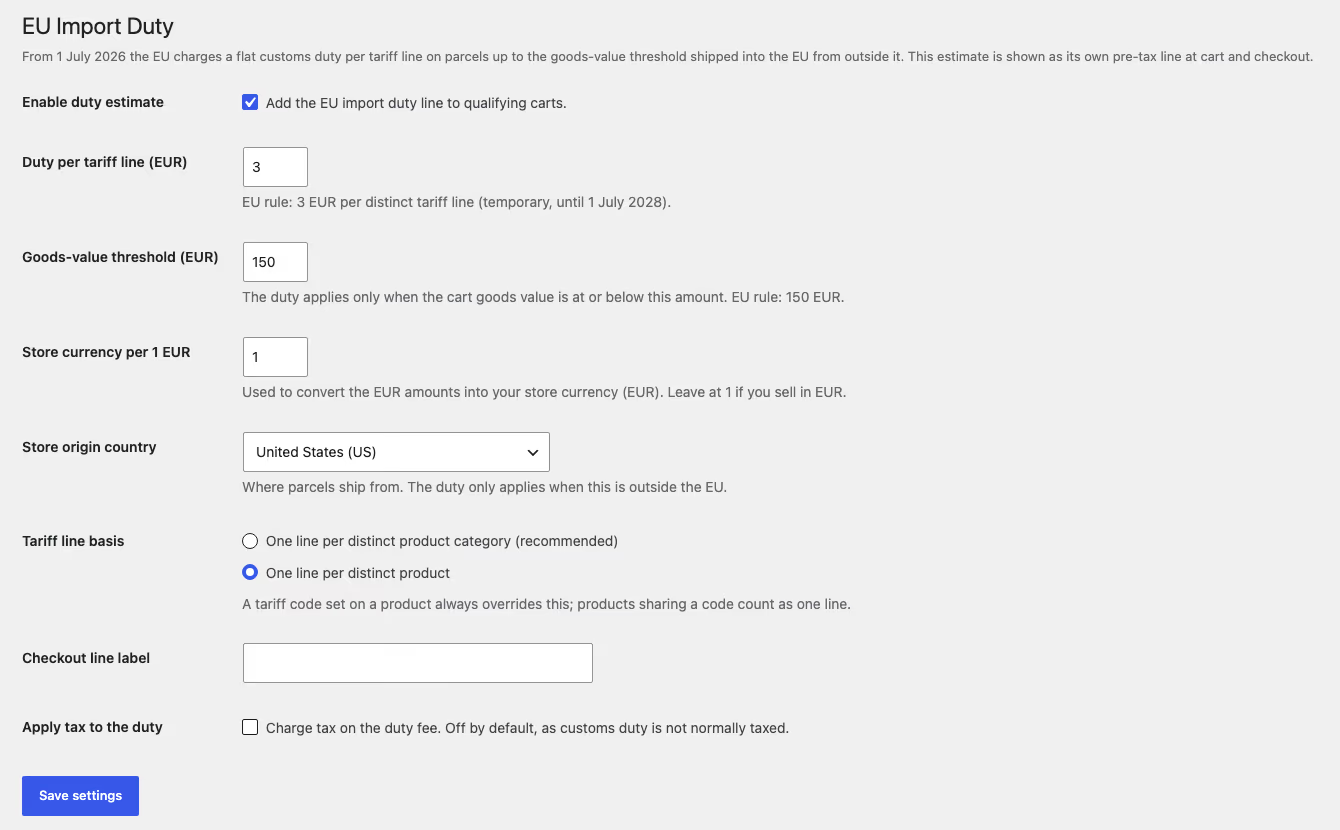
Customs plugin settings: amount per tariff line, goods value threshold, store currency per 1 EUR, the country the shop ships from, the basis for counting lines, the fee label at checkout and the switch for VAT on the duty.
You set all of these values yourself: the amount per line, the threshold, the origin country, the store currency per 1 EUR, the basis for counting lines, the fee label and whether the fee is taxable. The last option is off by default; set it after talking to your accountant. The plugin does not add the handling fee automatically; it only charges duty based on the amount per line in the settings.
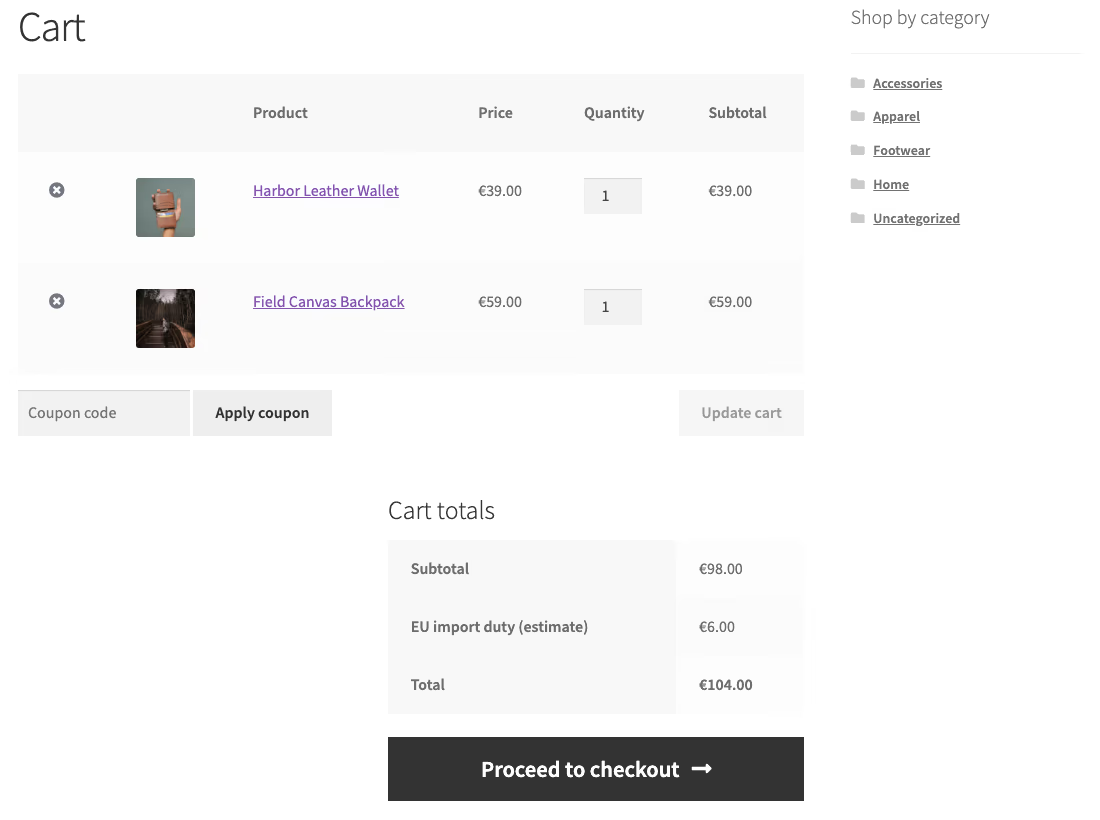
The image at the top of the article shows the cart of a test shop running the Customs plugin: a leather wallet at 39.00 EUR and a backpack at 59.00 EUR, 98.00 EUR in total. The value is within the EUR 150 threshold and the two products belong to two different tariff lines, so a separate line with the estimated EU import duty appears under the subtotal: 6.00 EUR, that is two lines at EUR 3 each. The customer pays 104.00 EUR in total and sees that amount before placing the order.
Why is the amount in the cart always an estimate?
The shop does not lodge the customs declaration. The IOSS holder, its representative, the carrier or a customs broker does, and they decide how many lines go into the declaration. The cart can drift from it for several reasons:
- Declaration type. The same cart gives one line in H7 and three in H1, as in the guidance example.
- Split parcels. The supplier may send the order in several parcels, and each is a separate consignment with its own lines.
- Description and origin. The declarant may describe two variations as different goods or give different countries of origin.
- Value. The declarant uses the value on the supplier’s invoice, which need not match the price in your shop.
- Exchange rate. The rate used at declaration may differ from the rate in the cart.
That is why the fee in the cart should have the word “estimate” or something similar in its name, and your terms of sale should say who pays any difference.
What changes after 1 July 2028?
Article 2 of the regulation applies the EUR 3 rate until 1 July 2028. According to the guidance (point 3.1), after that date goods sold in distance sales pay duty at the normal tariff rate whatever their value. The amount of duty then depends on the CN or TARIC code, the origin and the value of the goods. The handling fee stays, because it is not temporary.
From the same date, the new code provides for a customs warehouse for distance sales (Article 145, applicable from 1 July 2028 according to point 4.3 of the guidance). The handling fee for goods sold from such a warehouse is to be lower (point 2.2).
The regulation gives the Commission two review points (Article 3):
- From 1 October 2026, every month, the Commission assesses whether trade flows have been diverted. Recital 9 says what this means: a move away from IOSS into non-IOSS channels to avoid the EUR 3 rate. If such a diversion occurs, the Commission may propose that the EUR 3 rate cover all goods in consignments up to EUR 150.
- By 1 December 2027, the Commission assesses whether the central EU IT infrastructure for levying import duties on distance sales will realistically be operational by 1 July 2028. If not, it may propose extending the transitional measure.
Both the scope of the rate and its end date may still change. Your shop settings should let you change the amount, the threshold and the scope without a developer. Put the review dates in your calendar.
What product information must a shop show for goods made outside the EU (GPSR)?
Customs duty is one of two obligations for goods made outside the EU. The second comes from Regulation (EU) 2023/988 on general product safety (GPSR), whose Article 19 covers distance sales:
Where economic operators make products available on the market online or through other means of distance sales, the offer of those products shall clearly and visibly indicate at least the following information
Source: Article 19 of Regulation (EU) 2023/988 of the European Parliament and of the Council of 10 May 2023 (EUR-Lex).
For a product dropshipped from China, the product page needs:
- the manufacturer’s name with a postal and an email address,
- the name, postal and email address of the responsible person in the EU, because the manufacturer is not established in the Union,
- information that identifies the product: a picture, its type and any other product identifier,
- warnings and safety information in a language the buyer can easily understand.
A customs declaration and paid duty do not replace this information. With products sourced from marketplaces, the EU responsible person is often missing. Ask your supplier who it is before you list the product.
Two of our plugins handle this data. Shoplex has dedicated GPSR fields on each product and shop-wide defaults for every required disclosure. On the product page it shows them in a “Product safety (GPSR)” panel: the manufacturer, the responsible person and their contacts, followed by safety warnings and instructions. The barcode field is validated against the GS1 check digit.
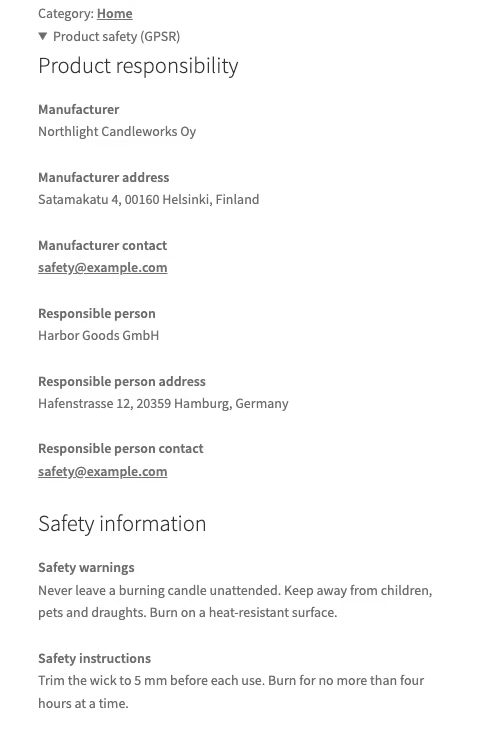
The Shoplex “Product safety (GPSR)” panel on a product page, with demo data: manufacturer and responsible person with addresses and contacts, then safety warnings and instructions.
For shops in Poland, Polski for WooCommerce offers GPSR fields for the manufacturer, the importer and the responsible person, with CSV import and export.
What should you do in your shop now?
A checklist for a WooCommerce shop whose goods ship from outside the EU:
- Check which products your suppliers ship from outside the EU and which ship from a warehouse in the EU. The duty estimate applies only to the first group.
- Agree with your supplier or freight forwarder who lodges the declaration, whether they use IOSS and which type of declaration they file (H7, H6 or H1).
- Collect HS codes from your suppliers and assign them to products and variations.
- Decide whether you collect the duty in the cart or include it in the price. Collect it separately only when someone acting for you pays it at declaration.
- Make sure every variation has a unique, stable SKU that you pass to the supplier as the product identifier.
- State in your terms and on your delivery page that imported orders may include customs duty and a handling fee, and that the amount in the cart is an estimate.
- Test the cart with three cases: identical articles, different codes, and a value just above EUR 150 before and after a discount.
If you sell to customers in several EU countries, the same rules apply across the whole Union, because the duty is an EU duty. We cover other obligations a shop has towards consumers in our articles on the lowest price of the last 30 days in WooCommerce and on the withdrawal button for online shops. For an overview of other add-ons for your shop, see our list of WooCommerce plugins.
If you want us to assign tariff codes to your catalogue, set up the duty estimate in the block checkout or match the line counting to the way your freight forwarder declares parcels, get in touch through the WooCommerce developer page. We start by reviewing a few real import orders and agree the scope of work after that.