If you sell washing machines, fridges, televisions, light bulbs, phones or tyres online, the law expects a specific element next to the price: the energy label, or a coloured arrow that opens it. Selling to Ireland and the UK means three regimes at once. Ireland applies the EU regulations directly. Northern Ireland follows the EU product rules but is enforced by UK bodies. Great Britain runs on assimilated copies of the same EU texts, frozen at different dates. This guide covers what must appear on the page in each of them, which acts say so, who checks it, and how I build it in WooCommerce and Shopify.
Which products need an energy label in an online shop?
The framework is Regulation (EU) 2017/1369. Article 5(1)(a) makes the dealer “display, in a visible manner, including for online distance selling, the label provided by the supplier” for every model covered by a product-specific delegated act. Article 5(1)(b) adds the product information sheet. The product groups are set by those delegated acts, not by the framework.
The European Commission’s product list marks these groups as carrying an energy label today:
| Group | Current label regime |
|---|---|
| Washing machines and washer-dryers | A to G, Regulation (EU) 2019/2014, from 1 March 2021 |
| Fridges and freezers | A to G, Regulation (EU) 2019/2016, from 1 March 2021 |
| Dishwashers | A to G, Regulation (EU) 2019/2017, from 1 March 2021 |
| Electronic displays (TVs, monitors) | A to G, Regulation (EU) 2019/2013, from 1 March 2021 |
| Fridges with a direct sales function | A to G, Regulation (EU) 2019/2018, from 1 March 2021 |
| Light sources | A to G, Regulation (EU) 2019/2015, from 1 September 2021 |
| Smartphones and slate tablets | A to G, Regulation (EU) 2023/1669, from 20 June 2025 |
| Tumble dryers | A to G, Regulation (EU) 2023/2534, from 1 July 2025 |
| Ovens, range hoods, air conditioners, comfort fans, local space heaters, ventilation units, solid fuel boilers, space heaters, water heaters, professional refrigerated storage cabinets | Older-scale labels under pre-2017 acts |
| Tyres | Separate regime, Regulation (EU) 2020/740 |
Hobs, vacuum cleaners and computers fall under Ecodesign only and carry no energy label, per the same Commission list.
Two points on the older groups. Their internet display rules were added by Delegated Regulation (EU) No 518/2014, which amended ten earlier labelling acts, including the ones for space and water heaters. And Article 11(5)(a) of 2017/1369 set 2 August 2026 as the target for new A to G acts for space heaters, water heaters and solid fuel boilers, “where appropriate”, with 2030 as the hard limit. I could not confirm that new heater labels were adopted by that date; the Commission’s space heater page still cites Regulation 811/2013, so I keep the current heater labels until a new act is published.
How Great Britain differs on dates
GB applies assimilated versions of these acts, and the GOV.UK guidance (last updated 8 April 2026) records where the dates split:
- Light sources were rescaled in GB from 1 October 2021, one month after the EU date of 1 September 2021.
- Tumble dryers in GB still use the assimilated Regulation 392/2012 label or a temporary DESNZ “easement” label. Northern Ireland follows 2023/2534 from 1 July 2025, like Ireland.
- For smartphones and tablets, my sources confirm the EU and Northern Ireland date (20 June 2025). I did not find a GB rule for them, so treat GB as open and ask your supplier which label they ship.
If one product feed serves all three markets, the tumble dryer row is where shops go wrong first: an Irish or Northern Irish customer must see the new A to G label, while a GB listing may legitimately show the older one.
What exactly must sit next to the price?
Each product act has an Annex VIII titled “Information to be provided in the case of distance selling through the internet”. I read it in 2019/2014 (washing machines), 2019/2015, 2019/2016, 2023/1669 and 2023/2534. The mechanism is the same in all of them. Article 4(b) of 2019/2014 points the dealer to it: “in the case of distance selling and sale through the internet, the label and product information sheet are provided in accordance with Annexes VII and VIII”.
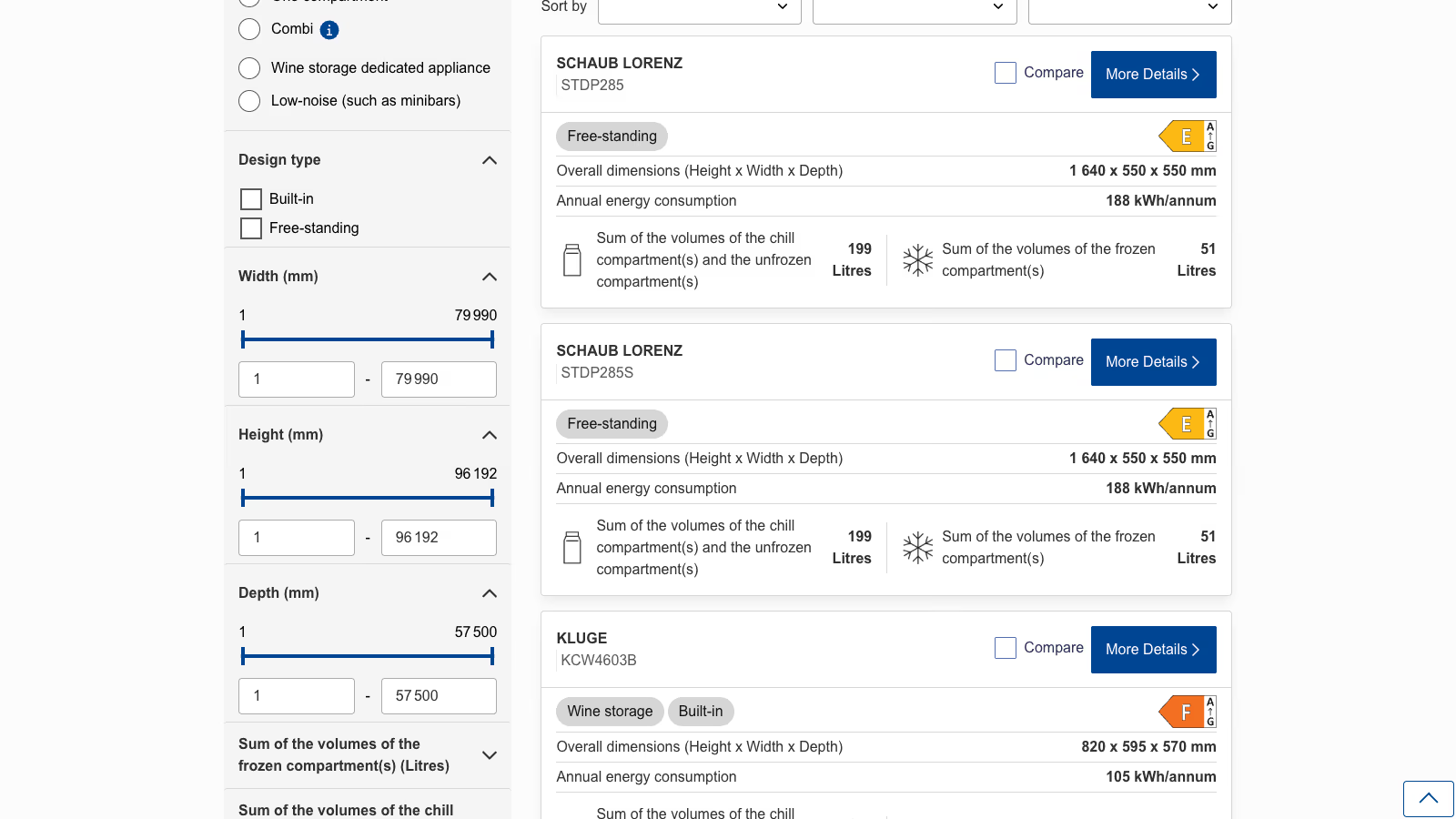
Point 1: placement and size. The label “shall be shown on the display mechanism in proximity to the price of the product”, clearly visible and legible, proportionate to the printed label size. You may use a nested display, in which case “the label shall appear on the first mouse click, mouse roll-over or tactile screen expansion on the image”.
Point 2: the arrow. The image that opens the nested label must be:
- an arrow in the colour of the product’s energy efficiency class on the label (for washer-dryers, the class of the complete cycle);
- showing the class letter “in 100 % white, Calibri Bold and in a font size equivalent to that of the price”;
- showing the range of available classes “in 100 % black”;
- in one of the permitted formats, with the letter centred and a “visible border in 100 % black”.
The 2019 acts allow a left or right arrow. The newer acts for smartphones and tablets (2023/1669) and tumble dryers (2023/2534) allow only the “Coloured left arrow”. If you build one component for all categories, build the left arrow and you satisfy both.
Point 3: behaviour. The arrow sits near the price and links to the label. The label opens on click, roll-over or tap, “by pop up, new tab, new page or inset screen display”, follows the device’s conventions for tactile magnification, and closes with “a close option or other standard closing mechanism”. If the image fails to load, the alternative text must be the energy class, “in a font size equivalent to that of the price”.
Point 4: the product information sheet. It also goes near the price. It may be nested, or it may be a link to the product database, “in which case the link … shall clearly and legibly indicate ‘Product information sheet’”, so an English shop uses exactly those words as the link text.
Tumble dryers add one case: 2023/2534 says “in proximity to the price of the product if the price is shown, and in all other cases in proximity to the name or the picture of the product”, which covers catalogue pages without prices.
For Great Britain the assimilated texts carry the same rules. Article 5 of the GB version of 2017/1369 keeps “including for online distance selling”, and there is a GB version of 2019/2014 Annex VIII. GOV.UK sums up the internet duty as “an arrow with the energy efficiency class and the range … must be provided alongside the product, and this must link to the full energy label”.
Which pages: the legal text and the Commission’s reading
Annex VIII speaks of the display “in proximity to the price”. The European Commission’s dealer guidance reads that broadly: “this obligation refers to every subpage of your webshop, i.e. frontpage, list pages, product-specific pages and also the basket page”, and it applies “even if it is impossible to ‘add the product to the cart’”. The page is Commission guidance and does not bind GB. In practice I put the arrow wherever the price of a labelled product appears, because that is the reading an EU authority starts from and it costs little once the component exists.
Product information sheet and EPREL: where do the files come from?
You do not design the label. Article 3(2) of 2017/1369 makes the supplier deliver it free of charge within five working days, and Article 5(2) and 5(3) tell the dealer to ask for the label and the sheet when they are missing. In the EU, Article 5(3) also lets the dealer download the sheet from the product database “if those functions are available”. In the GB text, that downloading wording was removed from 31 December 2020, so a GB shop relies on the supplier.
The database is EPREL, set up under Article 12 of 2017/1369 with a public part that gives consumers the labels and sheets. Implementing Regulation (EU) 2024/994 adds two duties that land on shops in Ireland and Northern Ireland:
- Article 14(1): “suppliers shall communicate the EPREL model registration number to dealers or to distributors”, explicitly to support display “including in online distance selling”.
- Article 14(2): “the dealer or the distributor shall ensure that the QR code is readable when putting a product model or tyre in display for sale.”
The second one matters online. If your theme shrinks the label to a thumbnail or compresses it until the QR code turns to noise, the label is on the page while the duty is not met. I serve the label at a size where the code scans from a phone held up to the screen.
GOV.UK adds that labels for the Northern Ireland market must carry the EPREL QR code. I found no EPREL duty for products placed only on the GB market, so I do not ask GB-only shops for EPREL numbers. The Commission guidance also notes that shops can fetch label and nested-arrow images from EPREL “via an API” using the registration number, which is the cleanest data source if your supplier gives you the numbers.
Does the class have to appear in adverts and Google Shopping?
Article 6(a) of 2017/1369 requires suppliers and dealers to “make reference to the energy efficiency class of the product and the range of the efficiency classes available on the label in visual advertisements or technical promotional material for a specific model”. A banner, a social post with a specific washing machine or a Shopping ad all count as visual advertisements for that model. Article 6(c) to (e) also bans marks that imitate or could be confused with the energy label, so “eco” badges in label colours are risky.
Google Merchant Center splits by target country:
| Target country | Attribute | Source |
|---|---|---|
| United Kingdom | energy_efficiency_class, with min_energy_efficiency_class and max_energy_efficiency_class | Google help 7562785 |
| Ireland and other EU countries | certification with EC:EPREL:<registration number> | Google help 13528839 |
Google’s note: “Starting April 2025, the [energy_efficiency_class] attributes are only available for products that target Switzerland, Norway, or the United Kingdom.” For EU targets it points to the certification attribute, which “references the necessary graphical energy efficiency source data from the EU through the EPREL database”. Google may add certification data itself from GTIN and MPN, but I would not rely on that for products where the label is a legal duty. A feed that serves both the UK and Ireland needs both attributes.
Do tyres need the same arrow next to the price?
Tyres sit under Regulation (EU) 2020/740, which applies from 1 May 2021 and uses “distributor” instead of “dealer”. Article 6(7): “For tyres sold or offered for sale on the internet, distributors shall ensure that the tyre label is displayed close to the price indication and that the product information sheet can be accessed.” The label must be proportionate to the size in Annex II, and the distributor “may make the tyre label for a specific tyre type available in a nested display”.
The difference from appliances: there is no arrow annex. The default is the full tyre label, with classes A to E for fuel efficiency and wet grip and its own QR code. Article 6(2) also requires the label in any visual advertisement for a specific tyre type, close to the price if one is shown. Article 8 makes hosting platforms enable the label and sheet display and inform the distributor.
This is the EU regime, so it applies in Ireland and Northern Ireland. I did not research GB tyre law for this article, so I make no claim about it.
Who checks it and what does a breach cost in Ireland and the UK?
| Ireland | Northern Ireland | England, Wales, Scotland | |
|---|---|---|---|
| Rules on the page | EU acts directly | EU product acts | Assimilated acts |
| Enforcer for shops | SEAI | Department for the Economy | Local weights and measures authority (Trading Standards) |
| Enforcer for suppliers | SEAI | OPSS | OPSS |
| Penalty | Class A fine on summary conviction, up to EUR 250,000 on indictment | Fine up to the statutory maximum on summary conviction, a fine on indictment | Unlimited fine on summary conviction in England and Wales, statutory maximum in Scotland, a fine on indictment; civil sanctions |
Ireland. S.I. No. 669/2022, the European Union (Energy Labelling) Regulations 2022. Regulation 3(1): SEAI “has been designated the Market Surveillance Authority”. Regulation 4(2): a dealer who contravenes Article 5 or 6 of the framework regulation “shall be guilty of an offence”. Regulation 5 lets SEAI recover its costs of dealing with non-compliance. Regulation 15(2) sets a class A fine on summary conviction and up to EUR 250,000 on indictment. The class A amount is set in the Fines Act 2010, which I did not check, and I found no role for the CCPC in these instruments.
United Kingdom. The Energy Information Regulations 2011. In the England, Wales and Scotland version, regulation 4(1) gives the local weights and measures authority enforcement of Article 5 (dealers), Article 6 as it applies to dealers, and Article 11B, the duties when labels are rescaled. Regulation 4(2) gives the Secretary of State the supplier duties. In the Northern Ireland version the Department for the Economy enforces the dealer duties. Regulation 11(2) sets the criminal penalties, and Schedule 4 adds civil sanctions. GOV.UK names OPSS as the market surveillance authority for suppliers in GB and Northern Ireland and says local authorities enforce against dealers.
For an online shop, “dealer” is you. The supplier’s failure to send a label does not excuse a missing one: Article 5(2) tells you to request it.
How do I set it up in WooCommerce?
WooCommerce has no energy label field. I store five pieces of data per product and render them from the theme or a plugin:
| Data | Where I keep it | Used for |
|---|---|---|
| Energy class (letter) | Global attribute (Products > Attributes) or product meta | Arrow letter, arrow colour, alt text, Google feed |
| Class range (e.g. A to G) | Product meta, or derived from the category | Range text on the arrow, feed min and max |
| Label image | Media library, ID in product meta | Nested label |
| Product information sheet | PDF in the media library, or the EPREL link | ”Product information sheet” link |
| EPREL registration number | Product meta | Feed certification, EPREL lookups (IE and NI) |
The WooCommerce docs on product taxonomies explain the difference that matters here: attributes defined under Products > Attributes are global and “easy to update across the entire store”, while “attributes created on the product page are not available for global use”. For the class letter I use a global attribute, because it gives one controlled list of values and lets filters and feeds read the same field.
The rendering is a small template part hooked next to the price on the single product page and in the loop for archive and search pages. The arrow is an inline SVG coloured from a map of class to colour, with the letter as live text in the price’s font size, an alt or accessible label equal to the class, and a link or button that opens the label image in a dialog. The sheet link sits beneath it. Tumble dryers without a visible price need the same block next to the product title.
My free plugins have this as a module, if you prefer not to write it. Polski (from version 1.45.0) and Shoplex (from 1.7.0), both released on 5 November 2026, add an arrow in the class colour next to the price that opens or links to the label, plus a link to the product information sheet. In Polski the module is off until you enable it. A theme template part does the same job if you would rather keep it in your own code.
If you are still working through other price-display rules, the Omnibus lowest-price guide covers the other element that usually ends up beside the price.
How do I set it up in Shopify?
Shopify has no built-in energy label either. The pattern is product metafields plus a theme snippet. You create metafield definitions for the product resource, choosing types from the list of metafield data types:
- class letter and range:
single_line_text_field; - label image and sheet PDF:
file_reference; - EPREL link:
url; - EPREL registration number:
number_integeror text.
In Liquid you read them as {{ product.metafields.namespace.key }}, using .value for the stored value (metafield object). A snippet rendered next to the price in the product template and the product card draws the coloured arrow and the sheet link from those values. Shopify’s help says most metafields can be connected through the theme editor if the theme supports dynamic sources, which is enough for the sheet link, but the coloured arrow with the class letter at price size needs code in the snippet.
On marketplaces and platforms the delegated acts also bind the host: Article 5 of 2019/2014 requires hosting service providers that allow direct selling to “enable the showing of the electronic label and electronic product information sheet” and to inform the dealer. That rule is aimed at the platform; your theme still has to render the label.
Checklist before you go live
| Check | IE | NI | GB |
|---|---|---|---|
| Arrow in class colour next to every price of a labelled product | Yes | Yes | Yes |
| White Calibri Bold letter at price size, black range, black border | Yes | Yes | Yes |
| Left arrow for smartphones, tablets, tumble dryers | Yes | Yes | Check the GB act |
| Label opens on click, roll-over or tap, closes cleanly | Yes | Yes | Yes |
| Alt text equals the class | Yes | Yes | Yes |
| ”Product information sheet” link near the price | Yes | Yes | Yes |
| QR code on the label readable on screen | Yes | Yes | Not confirmed |
| EPREL registration number stored | Yes | Yes | Not required by my sources |
| Google feed attribute | certification | certification for EU targets, energy_efficiency_class for UK targets | energy_efficiency_class |
| Class and range in visual adverts | Yes | Yes | Yes |
What mistakes do shops make with the energy label?
These follow directly from the rules above:
- Label only in the gallery. The label image is the fourth slide in the product carousel. Annex VIII wants it near the price and opened from the arrow, where every customer sees it.
- Arrow in the wrong colour. A generic green badge for every product, or a colour taken from the brand palette. The arrow must take the colour of the product’s class on the label.
- Old A+++ labels on rescaled groups. Washing machines, fridges, dishwashers, displays and light sources moved to A to G in 2021. Article 11(13)(c) of 2017/1369 required dealers to replace old labels “both in shops and online” within 14 working days of the date set in the act. Tumble dryer listings for Ireland and Northern Ireland have needed the new label since July 2025.
- No sheet link. The label is present but the “Product information sheet” link is missing, or it is labelled “Specs” or “Download”.
- Class missing from Shopping ads. The feed has no
energy_efficiency_classfor the UK or nocertificationfor Ireland, so the ad shows a product without the class Article 6(a) requires in visual advertising. - Thumbnail labels. The label is shown so small that neither the text nor the QR code can be read.
Next step
Pull a list of every product in a labelled group, check which ones have a class, a label image, a sheet and (for Ireland and Northern Ireland) an EPREL number, and fill the gaps with your suppliers before touching the template. If you want the arrow and the feed attributes built into your shop, see how I work on WooCommerce development or on Shopify development.