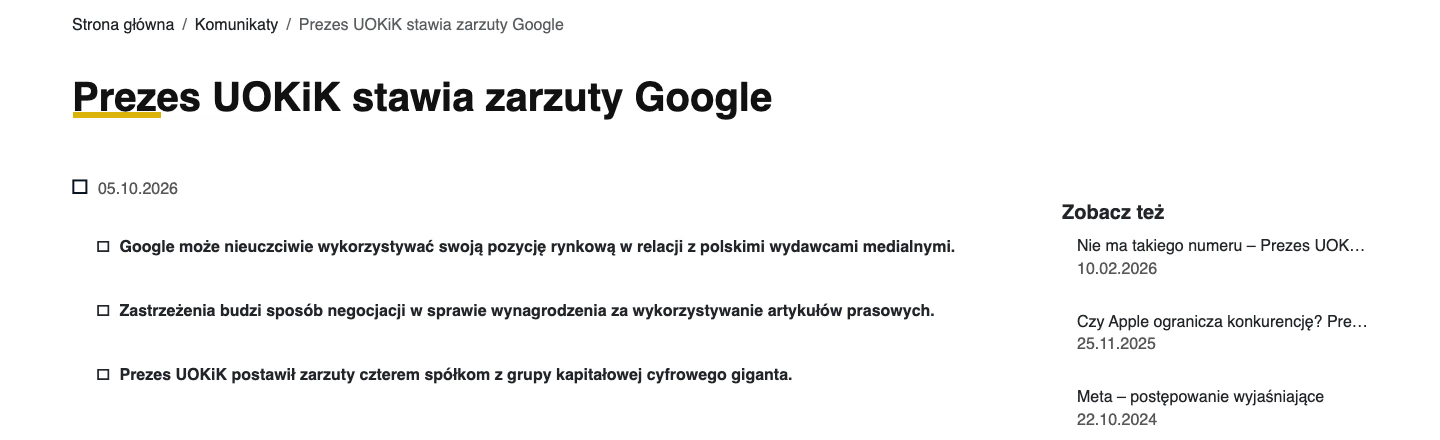
Three settings get mixed up when a site owner says “I want out of AI”. One sits in Search Console, one in robots.txt under the token Google-Extended, one in robots.txt as a Content-Signal line. They answer different questions, and none of them is a general AI off switch.
Google’s pages draw the lines clearly enough. The trouble is that the lines are spread over four pages. This post puts them side by side, quotes each page where it matters, and ends with a table for picking one. Every quote was read on 6 October 2026.
wppoland.com is a useful test case because it is awkward: six locale subfolders, each verified as its own URL-prefix property under one domain property, and a robots.txt that already carries a Content-Signal line. We have not measured any traffic effect of these switches, and nothing below claims one.
Which Google switch removes my site from AI Overviews and AI Mode
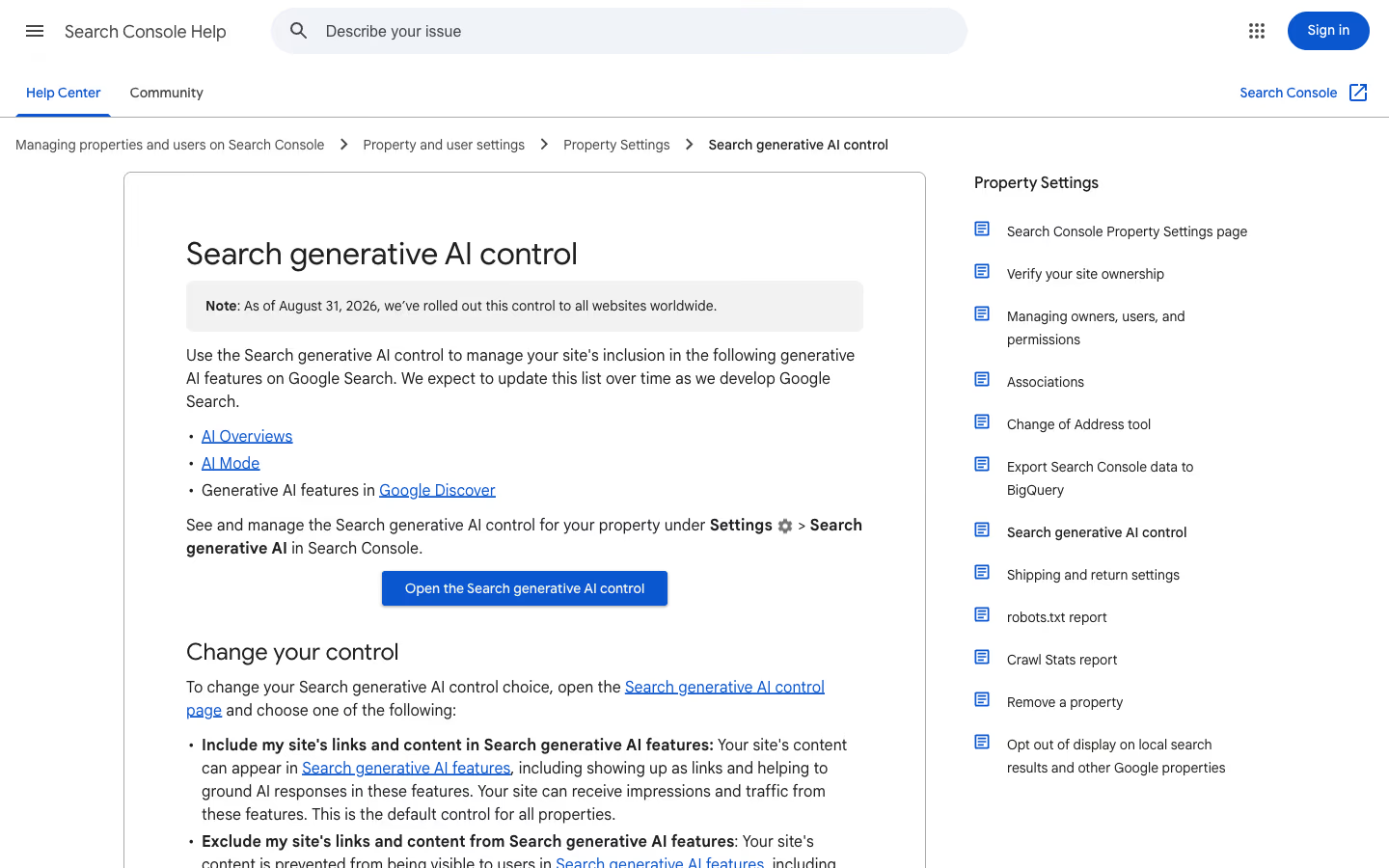
The Search generative AI control in Search Console. In the English interface it sits under Settings, then Search generative AI. Google’s help page lists what it manages: AI Overviews, AI Mode and generative AI features in Google Discover, and says it expects to update that list over time. On the rollout:
“As of August 31, 2026, we’ve rolled out this control to all websites worldwide.”
You choose between include, exclude and inherit from parent. Include is the default control for all properties, and inherit is the default for a property that has a parent. What exclude does:
“If you exclude your site, links to your site and your site’s content won’t appear in Search generative AI features. Content from other sites will still be available in those features, and it may appear similar to yours. Content crawled from your site won’t be eligible to be used as an input to generate an AI response or preview in Search generative AI features.”
Two details matter. The links go too, not only the text, so this is not a way to be mentioned without being clicked. And grounding input is covered, so excluded content is not used to build an answer in these features.
Google also spells out what the control is not:
“This control only affects whether your content can appear in certain Search generative AI features; this control isn’t used as a ranking or inclusion signal affecting other parts of Search.”
“This control doesn’t affect AI training; to limit training of the models used to generate responses in Search generative AI features, use Google-Extended. To block your content from appearing in Google Search completely, use noindex.”
On timing, the page says a change generally takes a few days, with content excluded within 1-2 days after the control goes live and some of it later because of caching and propagation.
Does Google-Extended remove my site from AI Overviews
No. Google-Extended is documented on the crawler overview page, and the product areas it names are Gemini and Vertex AI, not Search:
“Google-Extended is a standalone product token that web publishers can use to manage whether content Google crawls from their sites may be used for training future generations of Gemini models that power Gemini Apps and Vertex AI API for Gemini and for grounding (providing content from the Google Search index to the model at prompt time to improve factuality and relevancy) in Gemini Apps and Grounding with Google Search on Vertex AI.”
“Google-Extended does not impact a site’s inclusion in Google Search nor is it used as a ranking signal in Google Search.”
Read together with the previous section, the two pages split the work. The Search control manages grounding and display inside Search features. Google-Extended manages training and the grounding done by Gemini Apps and Vertex AI. Neither page claims to cover the other’s area, and the Search control page points to Google-Extended for training.
One practical consequence follows from how the token works:
“Google-Extended doesn’t have a separate HTTP request user agent string. Crawling is done with existing Google user agent strings; the robots.txt user-agent token is used in a control capacity.”
Our reading: there is no Google-Extended line in your access logs to look for, so the robots.txt group is the only place the choice exists.
What does Content-Signal in robots.txt do for Google
Content-Signal is a different kind of thing. It is a robots.txt directive published by Cloudflare, with three signals. The site defines ai-input like this:
“Inputting content into one or more AI models (e.g., retrieval augmented generation, grounding, or other real-time taking of content for generative AI search answers).”
And ai-train in one line:
“Training or fine-tuning AI models.”
The third signal, search, covers building a search index and returning links and short excerpts, and the site notes that it “does not include providing AI-generated search summaries”. The same site is blunt about the limits:
“The Content-Signal directive works by signaling your preference of either allowing (yes) or disallowing (no) certain categories of AI actions. Not all automated systems honor robots.txt files, and some may ignore these Content-Signal directives.”
“robots.txt files express your preferences. They do not, however, prevent crawler operators from taking your content at a technical level.”
Neither the Search Console help page nor the Google crawler documentation quoted here mentions Content-Signal. We searched the text of both pages and found no occurrence. That is a statement about those two pages, not about what any Google system does. For planning, it means a Content-Signal line is a declaration addressed to every crawler, and it is not a Google control. How the line behaves inside robots.txt groups is covered in our post on the Content-Signal scope bug.
Do noindex and nosnippet block AI Overviews
Both work, both are blunt, and they are not the same kind of blunt.
noindex takes the page out of Google Search, which the Search control page itself names as the way to do that. The cost is the obvious one: the page loses its organic results as well.
nosnippet is narrower, and Google’s robots meta documentation says it reaches the AI features:
“Do not show a text snippet or video preview in the search results for this page. A static image thumbnail (if available) may still be visible, when it results in a better user experience. This applies to all forms of search results (at Google: web search, Google Images, Discover, AI Overviews, AI Mode) and will also prevent the content from being used as a direct input for AI Overviews and AI Mode.”
The catch is in the first sentence. nosnippet strips the snippet from ordinary blue-link results too, and it is set per page, so it can cost clicks that the Search control would not. That second part is our inference from the two pages, not a measurement.
There is one more trap, and it bites sites that combine tools. Google writes:
“Keep in mind that these settings can be read and followed only if crawlers are allowed to access the pages that include these settings.”
A Disallow in robots.txt on a page that carries noindex or nosnippet cancels the tag. Our own robots.txt has a comment about exactly this for taxonomy archives, which is why we do not disallow them.
Which switch fits which goal
| Goal | Switch | What it blocks | What it does not block |
|---|---|---|---|
| Out of AI Overviews, AI Mode and Discover generative features, still in Search | Search generative AI control set to exclude | Links and content in those features, grounding input for them, traffic and impressions from them | AI training, the rest of Search, ranking, Merchant Center and Google Ads participation |
| Out of Gemini training and Gemini grounding, still in Search and in AI Overviews | Google-Extended with a Disallow in robots.txt | Use of crawled content for training future Gemini models and for grounding in Gemini Apps and Vertex AI | Inclusion in Google Search, ranking, and what the Search control manages |
| Tell every crawler your policy in one place | Content-Signal line in each robots.txt group | Nothing technically | Anything. It is a declaration, and Google’s pages do not mention it |
| No AI text from specific pages, page still listed | nosnippet | Text snippet and video preview everywhere, including AI Overviews and AI Mode as direct input | The page listing itself, possibly a static thumbnail; it also trims ordinary snippets |
| Out of Google Search entirely | noindex | The page in Google Search results | Not applicable, the page leaves the results; the crawler must still be able to fetch the page to see the tag |
The two goals from the start of this post map like this. Out of AI Overviews but not out of Search: the Search control, or nosnippet on single pages. Out of training but not out of AI answers: Google-Extended for Google, a Content-Signal line for the rest, and the Search control left on include.
What happens when a locale subfolder overrides the domain property
Inheritance is where a multi-property site gets a surprise. Google’s rule:
“By default, a property inherits its Search generative AI control from its closest parent that has changed its control to stop inheriting.”
For wppoland.com that means the domain property sits at the top, and each of /pl/, /en/, /de/, /nb/, /pt-pt/ and /es/ is a child. Set the domain property once and all six follow. Because each folder is its own property, one locale can also be excluded while the other five stay included. Google says so for child properties:
“Owners of a child property can choose to follow its parent property’s Search generative AI control or change it for the specific child property and its subpages.”
The new part is the notification. Barry Schwartz reported on 6 October 2026 that Google had added a line to the help page, and the line reads:
“Owners of the top-level domain property will see a notification on the Search generative AI control page when one of their child properties overrides the parent setting.”
Google Search Console Help, reported in Search Engine Roundtable
That is useful here, because it is how the person who owns the domain property would learn that someone changed the setting for one folder, without opening six pages. We have not seen the notification fire. Schwartz writes that he does not have a screenshot of it either, so treat it as documented, not as observed.
What does the wppoland.com robots.txt say today
The star group and the Google-Extended group in public/robots.txt read, exactly:
User-agent: *
Content-Signal: search=yes, ai-input=yes, ai-train=no
Allow: /
Disallow: /cdn-cgi/
# Google-Extended - Gemini grounding + training corpus
User-agent: Google-Extended
Content-Signal: search=yes, ai-input=yes, ai-train=no
Allow: /Two readings. First, the set matches what we want: in search, in AI answers, out of training. It also means the Search control and the file have to move together. A robots.txt that says ai-input=yes and a Search Console setting of exclude would contradict each other.
Second, the Google-Extended group is the weaker half. Google documents that token through allow and disallow lines, and its own example uses both. Our group says Allow: /. Read literally against Google’s page, the token is open for Gemini training and grounding on our site, and ai-train=no beside it is a statement that neither Google page quoted here mentions. So for Google specifically, our training preference is declared but not carried by a mechanism Google documents.
Closing that is a separate decision. A Disallow: / in that group would also give up the grounding use in Gemini Apps, because the token covers both. The comment at the top of the file also calls any restriction expressed through content signals an express reservation of rights under Article 4 of the EU copyright directive 2019/790. Whether that holds is a question for a lawyer, not for the person editing robots.txt.
How to measure the effect before changing a setting
We have no result to report, and the order matters. Google points to a report for this:
“To measure how your content is performing in Search generative AI features, use the Generative AI performance report. This can help you get an idea of how changing your control may impact traffic to your site.”
The plan is short. Record the report for the domain property first. Change one property and nothing else. Wait out the days Google names. Compare against the baseline. Changing the Search control, Google-Extended and a nosnippet rollout in the same week would leave a number nobody can attribute. The same discipline applies to the zero-click pattern covered in our post on expanded AI Overviews, and the reasons we want to be cited in answers at all are in the LLMO strategic summary.
Checklist
- Decide the goal first: out of Search features, out of training, or both.
- Pick the switch from the table. One goal, one switch.
- Set the Search control at the domain property, then check each locale property for an override.
- Keep robots.txt and Search Console consistent:
ai-input=yesand an excluded property contradict each other. - Do not combine a robots.txt
Disallowwithnoindexornosnippeton the same page. - Use Google-Extended only if you accept that it also covers Gemini grounding.
- Baseline the Generative AI performance report before the change, and change one thing at a time.