Search engines are transitioning from passive directories of hyperlinks into active execution engines. Google AI Mode, initially launched within Search Labs in March 2025 and recognized by Sundar Pichai at Google I/O 2026 as the most significant upgrade in the history of Google Search, has officially crossed 1 billion monthly active users. Rather than merely presenting ten blue links, AI Mode deploys autonomous reasoning agents that deconstruct user questions, execute multiple parallel searches across diverse web sources, generate grounded answers, and execute end-to-end commercial transactions without sending visitors to destination websites.
For digital marketers, technical SEO architects, and e-commerce leaders, this shift requires a complete reimagining of acquisition models. Traditional keyword targeting collapses when confronted with algorithmic query fan-out, and organic click-through rates experience sharp declines. This analysis examines the system architecture of Google AI Mode, reviews data from large-scale industry benchmarks, demystifies the new Search Console Generative AI report, and outlines concrete engineering practices required to prepare enterprise stores for autonomous commerce.
What is Google AI Mode and how does it reshape search
Google AI Mode represents a full-fledged conversational search interface. In traditional search, a user enters a query, receives a list of indexed web pages, and navigates between different sites to compile information. In AI Mode, search operations execute behind the scenes. The user submits a natural-language prompt, and the platform delivers a synthesized response grounded by direct citations, accompanied by conversational follow-ups and interactive components.
The default reasoning engine powering AI Mode globally is Gemini 3.5 Flash, engineered for low latency and high factual accuracy. For users subscribing to Google AI Pro and Ultra tiers, Google deploys Gemini 4 Argon, designed for complex multi-step reasoning, mathematical modeling, and multi-step technical synthesis.
The capabilities of AI Mode extend far beyond standard chat boxes:
- Multimodal inputs: users can submit queries via voice, uploaded photographs, PDF documents, active Chrome browser tabs, or pasted page URLs for instant document dissection.
- Search Live: two-way interactive conversations utilizing live video camera feeds and streaming voice within the Google mobile app.
- Generative UI: real-time compilation of interactive components, including loan calculators, comparative product matrices, and interactive charts rendered directly in the search feed.
- Information monitoring: background tracking tasks where the model observes specific topics across the open web and delivers proactive alerts upon detecting critical changes.
- Agentic booking and automated voice calls: autonomous scheduling of appointments, table reservations, and local service quotes, with AI calling businesses directly to verify availability.
- Conversational shopping and Universal Cart: integration with Google Shopping Graph containing over 60 billion product listings, connected to Universal Cart launched in October 2026, which enables unified cart checkout across disparate stores via Google Pay.
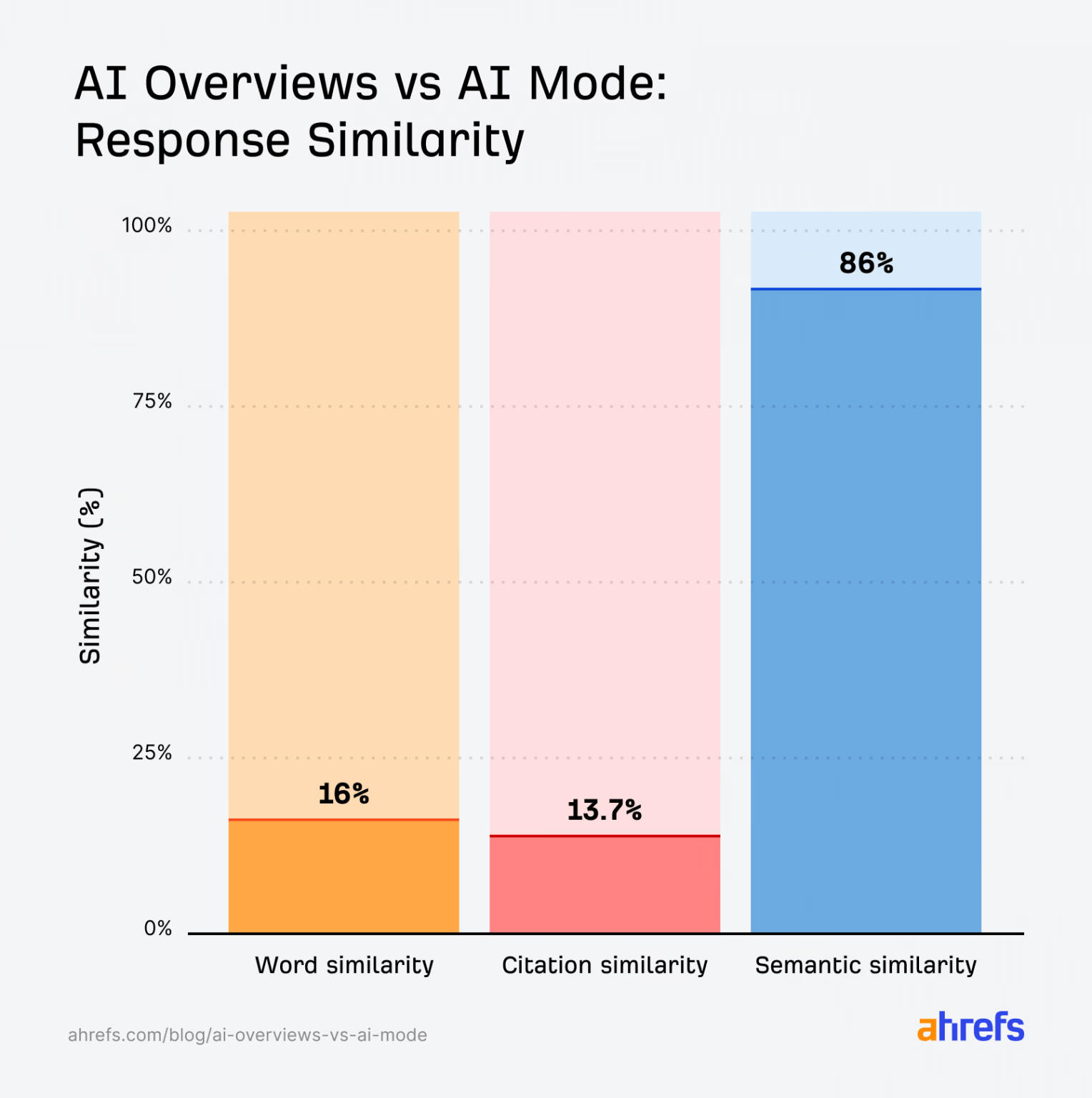 Ahrefs study of 730,000 queries reveals only a 13.7% overlap in cited URLs between AI Overviews and AI Mode, despite an 86% semantic similarity in overall answers.
Why appearing in AI Overviews does not guarantee citations in AI Mode
A widespread misconception among digital marketing teams is treating AI Overviews and AI Mode as interchangeable systems. While Google I/O 2026 introduced interface bridges that allow searchers to transition smoothly from an organic result page into an ongoing conversation, the underlying retrieval pipelines operate independently.
Google official documentation confirms that AI Overviews and AI Mode may utilize different underlying models, distinct grounding constraints, and separate ranking filters. Consequently, the URLs selected to support an answer vary significantly. A landmark investigation by Ahrefs evaluating 730,000 queries demonstrated remarkable divergence:
- The exact URL overlap between citations in AI Overviews and AI Mode was only 13.7%.
- Semantic similarity of the final generated responses stood at 86%.
- Domain-level overlap across both search modes remained below 20%.
Google’s generative engines can reach the same factual conclusions and still cite different supporting evidence. A prominent reference link in an AI Overview at the top of a desktop search page does not mean your content will be cited once the user opens a follow-up in AI Mode. AI Overview summaries also refresh their wording roughly every 48 hours, with 45.5% of reference URLs rotating between updates.
How the new Search Console Generative AI report measures performance
Historically, impressions occurring within AI features were mixed into standard organic metrics, leaving site owners unable to quantify generative visibility. On August 31, 2026, Google introduced the dedicated Generative AI performance report inside Google Search Console.
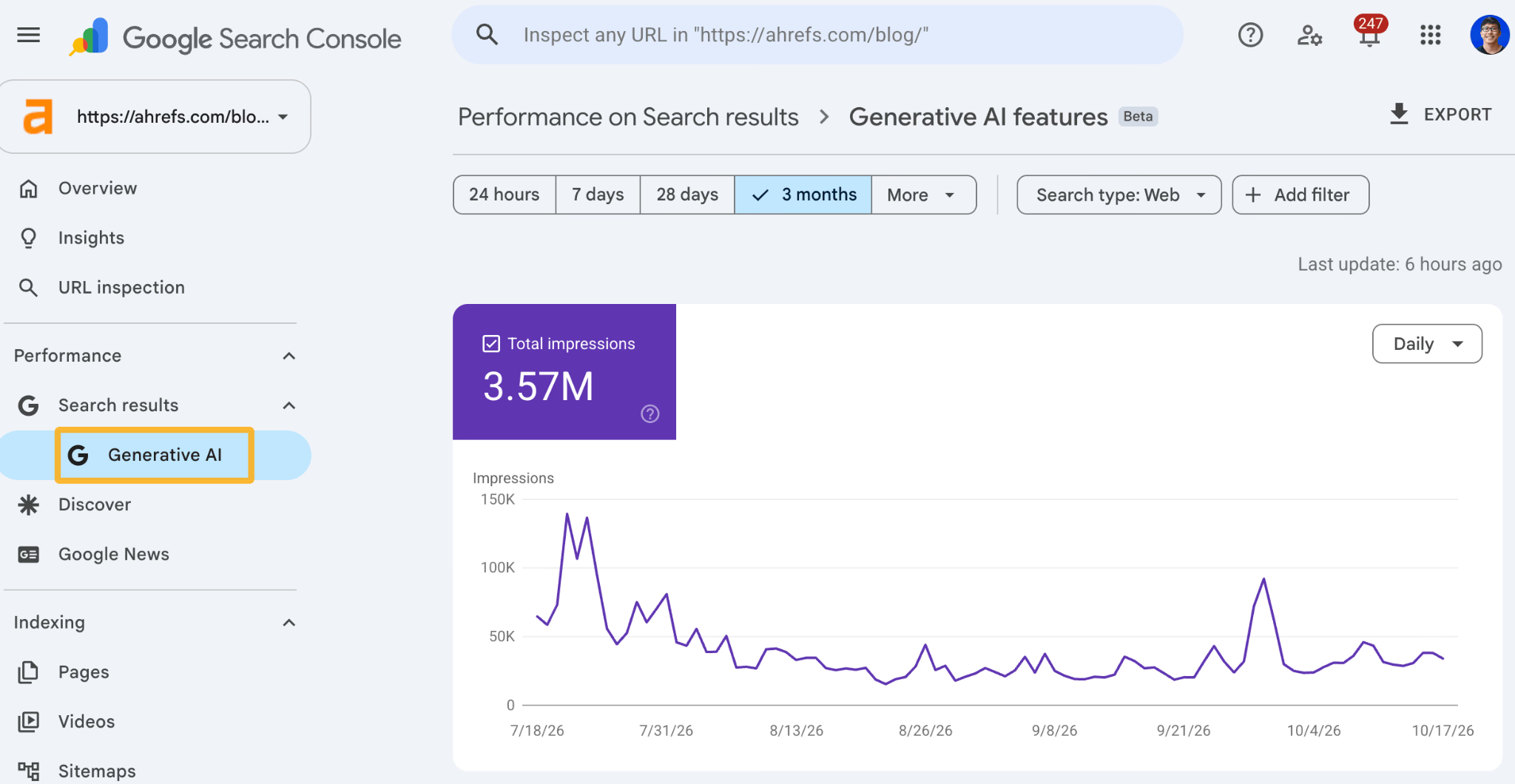 The Generative AI performance dashboard in Google Search Console displaying impression trends across AI Overviews and AI Mode.
To interpret this dashboard accurately, engineering and marketing teams must understand its technical constraints:
- The report tracks impressions only. An impression is counted whenever an outbound link pointing to your domain is visible in an AI Overview or AI Mode block, regardless of user interaction.
- The report bundles AI Overviews and AI Mode into a single composite metric. The current interface does not allow filtering between the two modalities.
- Impressions are non-additive. They represent a subset of your existing Web search performance metrics. If your main performance report records 100,000 impressions and the generative report indicates 20,000, exactly one fifth of your organic impressions originated from AI modules. Your total exposure remains 100,000, not 120,000.
- Dimensions include landing page URLs, user countries, dates, devices, and a toggle separating standard text search from visual queries through Google Lens and Circle to Search.
- Crucially, the report omits click counts, click-through rates, average position, and the underlying user prompts that triggered the response.
From an architectural standpoint, Google documentation clarifies that every follow-up question entered in AI Mode is logged as a brand-new user query. All subsequent impressions and clicks generated by extended conversations are attributed to this new session state.
For enterprises evaluating content governance, Google Search Console includes the Search Generative AI Control setting:
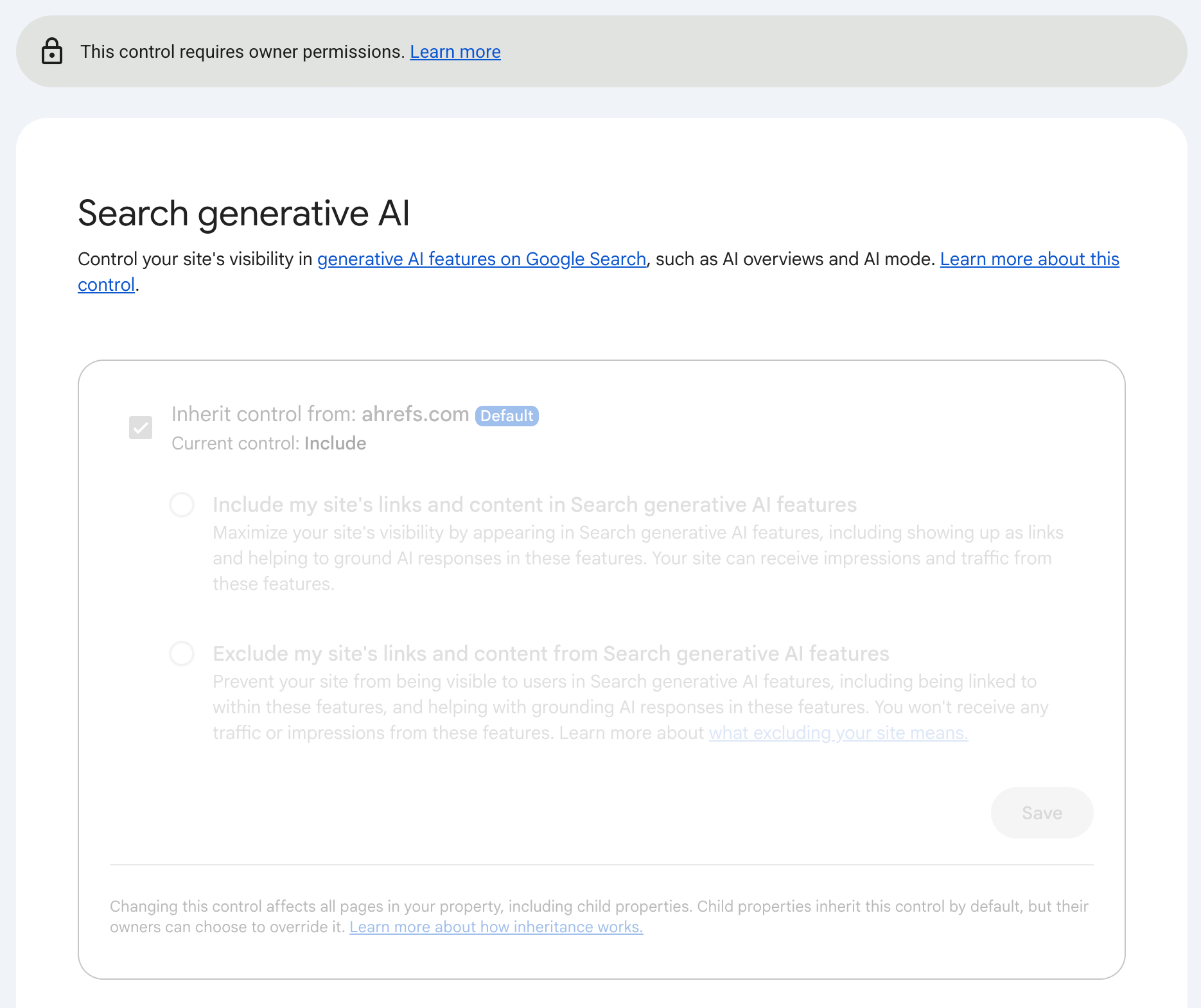 The Search generative AI control panel in Google Search Console offering options to include or exclude site content from generative features.
This setting provides three options:
- Include: default configuration permitting content to ground AI answers.
- Exclude: removes the property from AI Overviews, AI Mode, and Discover AI summaries. Crucially, opting out does not hurt conventional organic rankings, but it also does not prevent Google from ingesting pages for model training (training prevention requires the Google-Extended directive in robots.txt).
- Inherit from parent: applies parent property rules across subdirectory prefixes.
For mainstream commercial sites, opting out of AI Mode surrender visibility to competitors. However, paywalled publishers and specialized subscription portals often use this control to protect content value when synthetic summaries satisfy reader intent without generating referral traffic.
Understanding query fan-out mechanics and the death of traditional long-tail keywords
The fundamental mechanism determining source retrieval in Google AI Mode is algorithmic query fan-out. In traditional search architectures, an index matches documents directly against tokens entered into a search box. In AI Mode, the user input is first passed to an orchestrator model that decomposes the prompt into multiple granular sub-queries and executes them simultaneously across different index shards.
Consider a multi-attribute prompt such as: “What are the best wireless over-ear headphones for office work with long battery life and rapid USB-C charging?” The fan-out pipeline immediately branches into targeted inquiries:
- Top-rated wireless over-ear noise-cancelling headphones for open office environments.
- Battery endurance benchmark over-ear headphones exceeding 40 hours playtime.
- Fastest charging USB-C over-ear wireless headphones minutes per hour.
- Ergonomic comfort testing wireless headphones eight-hour continuous wear.
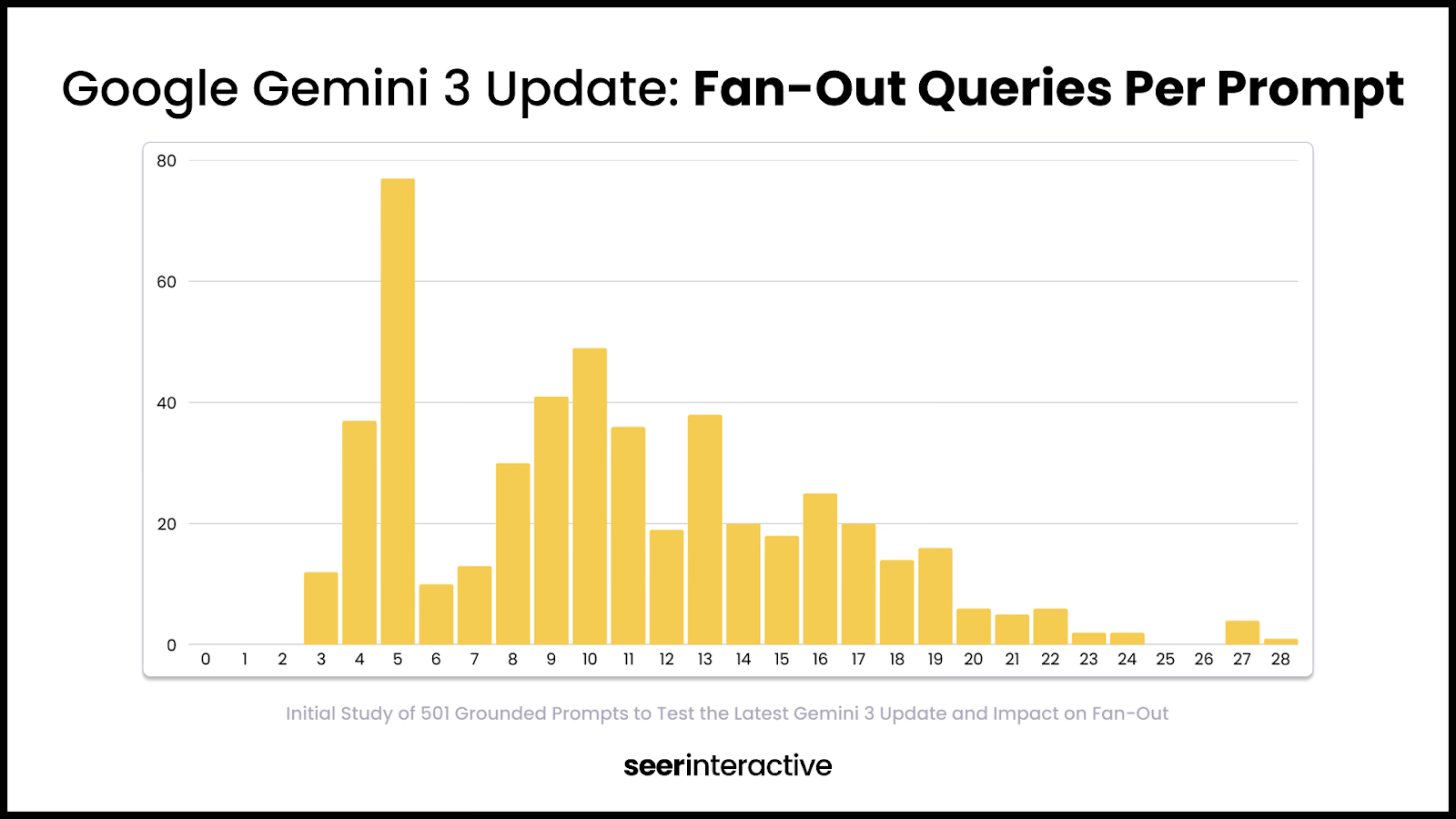 Research by Seer Interactive and Nectiv demonstrates that prompts in AI Mode generate between 9 and 11 fan-out queries on average, reaching up to 28 parallel executions for complex tasks.
Empirical measurements conducted by Seer Interactive and Nectiv show that an average prompt triggers 9 to 11 fan-out queries, with complex inquiries fanning out into as many as 28 simultaneous searches.
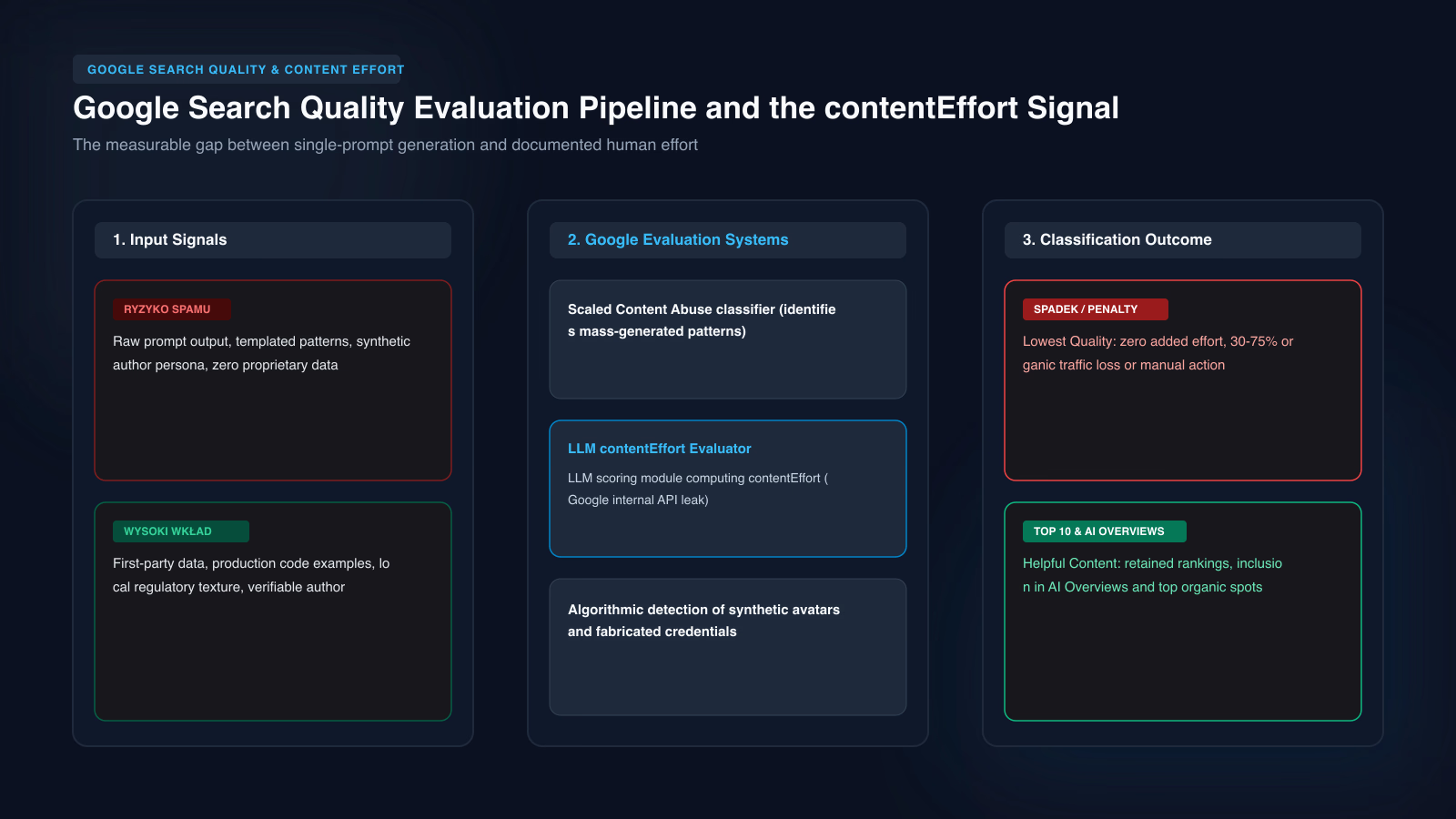
The strategic implication for SEO is profound: more than 95% of queries generated during fan-out exhibit zero recorded search volume in conventional keyword databases. You cannot discover these phrases through legacy keyword research tools, nor can you construct isolated landing pages targeting every permutation. Attempting to programmatically churn out thousands of thin pages targeting minor phrasing variants violates Google updated Scaled Content Abuse policies and invites algorithmic demotion.
To succeed under query fan-out, content must offer dense factual depth, structured comparison data, and clear answers to nuanced technical questions within full topical pillars.
Which websites dominate citations in Google AI Mode
A research study conducted by Moz analyzing approximately 40,000 queries revealed that only 1 in 10 AI Mode citations matches a URL ranked in Google top 10 organic search results for the primary query. Ranking first in conventional search results no longer guarantees inclusion in the AI answer if the page lacks structured evidence directly answering the fan-out sub-queries.
At the same time, studies by SE Ranking indicate that total organic domain visibility remains the single most reliable predictor of citation frequency. Google models prioritize factual reliability and consistently select citations from domains possessing strong topical authority and broad organic footprint.
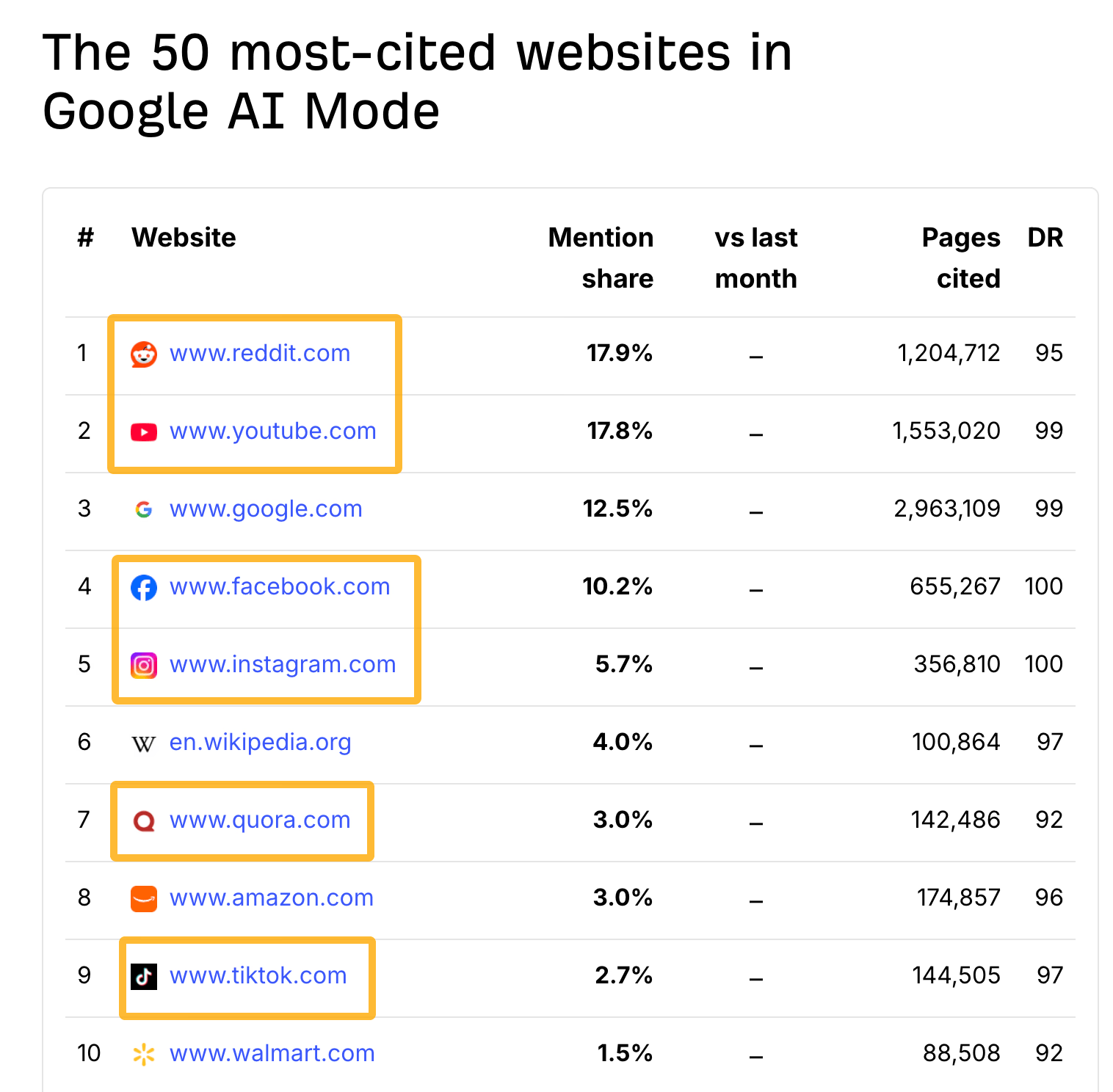 Rankings of the most cited domains in Google AI Mode illustrate that user-generated discussion forums and video platforms represent over half of the top citations.
AI Mode prefers user-generated content (UGC). In aggregations of the top 10 cited domains, Reddit, YouTube, Facebook, Instagram, Quora and TikTok account for more than 50% of source citations. In Ahrefs brand visibility studies, YouTube mentions showed the strongest positive correlation with AI citation share across the channels measured.
For businesses, visibility in AI Mode necessitates an integrated digital footprint. In addition to technical excellence on your core web infrastructure, brands must maintain active participation in community discussions, publish high-utility video tutorials, and collect authentic user reviews across trusted review aggregators.
Site owners should use the Preferred Sources feature introduced in May 2026. Signed-in searchers can designate specific publishers as preferred sources. Outbound citations from these websites display a prominent badge, and users demonstrate double the click engagement compared to unbadged sources. Nurturing an engaged subscriber base and encouraging audience members to tag your brand as a preferred source builds enduring search equity.
Quantifying the impact of AI Mode on organic click-through rates
The rise of conversational search introduces irreversible pressure on organic traffic volume. Ahrefs benchmark studies demonstrated that the insertion of a standard AI Overview reduces click-through rates to the top organic result by an average of 58%.
In Google AI Mode, traffic erosion is significantly more severe. Behavioral tracking data published by Similarweb shows that AI Mode generates referral clicks to external websites on only 1.6% to 2.5% of total search sessions. By contrast, conventional Google organic SERPs consistently deliver click-through rates between 17% and 19%.
This shift stems from user behavior: searchers receive full syntheses directly on screen, engage in follow-up questioning within the chat window, and conclude their research without ever navigating away from the Google environment. The assertion by search engine representatives that AI-driven traffic offers superior conversion intent does not offset the substantial reduction in top-of-funnel informational traffic.
Enterprises must pivot their measurement frameworks from gross organic session volume toward generative brand impression share and direct transaction velocity through integrated shopping protocols.
How Shopping Graph and autonomous agents execute headless transactions
The most disruptive capability of Google AI Mode within e-commerce is its transactional layer, powered by Google Shopping Graph. This infrastructure processes live catalog data across more than 60 billion product listings, including inventory availability, regional pricing, merchant terms, and verified reviews.
On October 15, 2026, Google introduced Universal Cart across the United States. This feature enables shoppers to assemble products from multiple independent retailers into a single checkout cart residing directly inside Google Search and the Gemini application. Rather than clicking through to individual storefronts, consumers authorize purchases in one step using Google Pay biometrics.
Simultaneously, Google is expanding Business Agent, an enterprise conversational representative that interacts with shoppers directly on search result pages, alongside the Universal Commerce Protocol, which standardizes machine-readable order transmission, dynamic inventory verification, and returns processing between AI agents and modern e-commerce platforms.
For merchants operating on WooCommerce, the entire customer acquisition and conversion journey can occur without the consumer ever landing on your website. Cart construction, specification comparison, shipping selection, and payment processing are handled by Google conversational agents.
Preparing e-commerce architecture for agentic shopping and UCP
To participate in Google agentic shopping network and receive orders originated by AI Mode, technical teams must maintain rigorous data architecture standards.
First, product catalogs must be synchronized continuously with Google Merchant Center. Required fields include exact Global Trade Item Numbers (GTINs), Manufacturer Part Numbers (MPNs), brand designations, live inventory counts, and granular shipping calculations. Inconsistencies between data feed attributes and destination page content trigger immediate merchant suspension from agentic cart recommendations.
Second, web platforms must ensure instantaneous crawlability. Googlebot and verification agents must parse catalog pages without relying on client-side JavaScript execution. Modern e-commerce brands are transitioning toward headless WordPress architectures utilizing static site generators and edge delivery platforms such as Astro. This architecture achieves server response times (TTFB) below 150 ms and provides fully rendered semantic HTML.
Third, product templates must include Schema.org structured data, including Product, Offer, MerchantReturnPolicy, and ShippingDetails specifications:
{
  "@context": "https://schema.org",
  "@type": "Product",
  "name": "Ergonomic Office Chair Pro",
  "image": "https://yourdomain.com/images/chair-pro.jpg",
  "description": "Commercial-grade ergonomic chair with dynamic lumbar support and breathable mesh.",
  "sku": "CHR-PRO-2026",
  "gtin13": "5391234567890",
  "brand": {
    "@type": "Brand",
    "name": "OfficeErgo"
  },
  "offers": {
    "@type": "Offer",
    "url": "https://yourdomain.com/products/chair-pro/",
    "priceCurrency": "EUR",
    "price": "349.00",
    "priceValidUntil": "2026-12-31",
    "availability": "https://schema.org/InStock",
    "itemCondition": "https://schema.org/NewCondition",
    "hasMerchantReturnPolicy": {
      "@type": "MerchantReturnPolicy",
      "applicableCountry": "IE",
      "returnPolicyCategory": "https://schema.org/MerchantReturnFiniteReturnWindow",
      "merchantReturnDays": 14,
      "returnMethod": "https://schema.org/ReturnByMail",
      "returnFees": "https://schema.org/FreeReturn"
    },
    "shippingDetails": {
      "@type": "OfferShippingDetails",
      "shippingRate": {
        "@type": "MonetaryAmount",
        "value": "0.00",
        "currency": "EUR"
      },
      "deliveryTime": {
        "@type": "ShippingDeliveryTime",
        "handlingTime": {
          "@type": "QuantitativeValue",
          "minValue": 0,
          "maxValue": 1,
          "unitCode": "DAY"
        },
        "transitTime": {
          "@type": "QuantitativeValue",
          "minValue": 1,
          "maxValue": 2,
          "unitCode": "DAY"
        }
      }
    }
  }
}
Embedding structured JSON-LD data into the initial HTML response allows Google agents to extract transaction parameters instantly. I deliver these technical implementations through GEO and LLMO optimization and enterprise WooCommerce development.
Statutory consumer disclosure obligations for AI agent sales
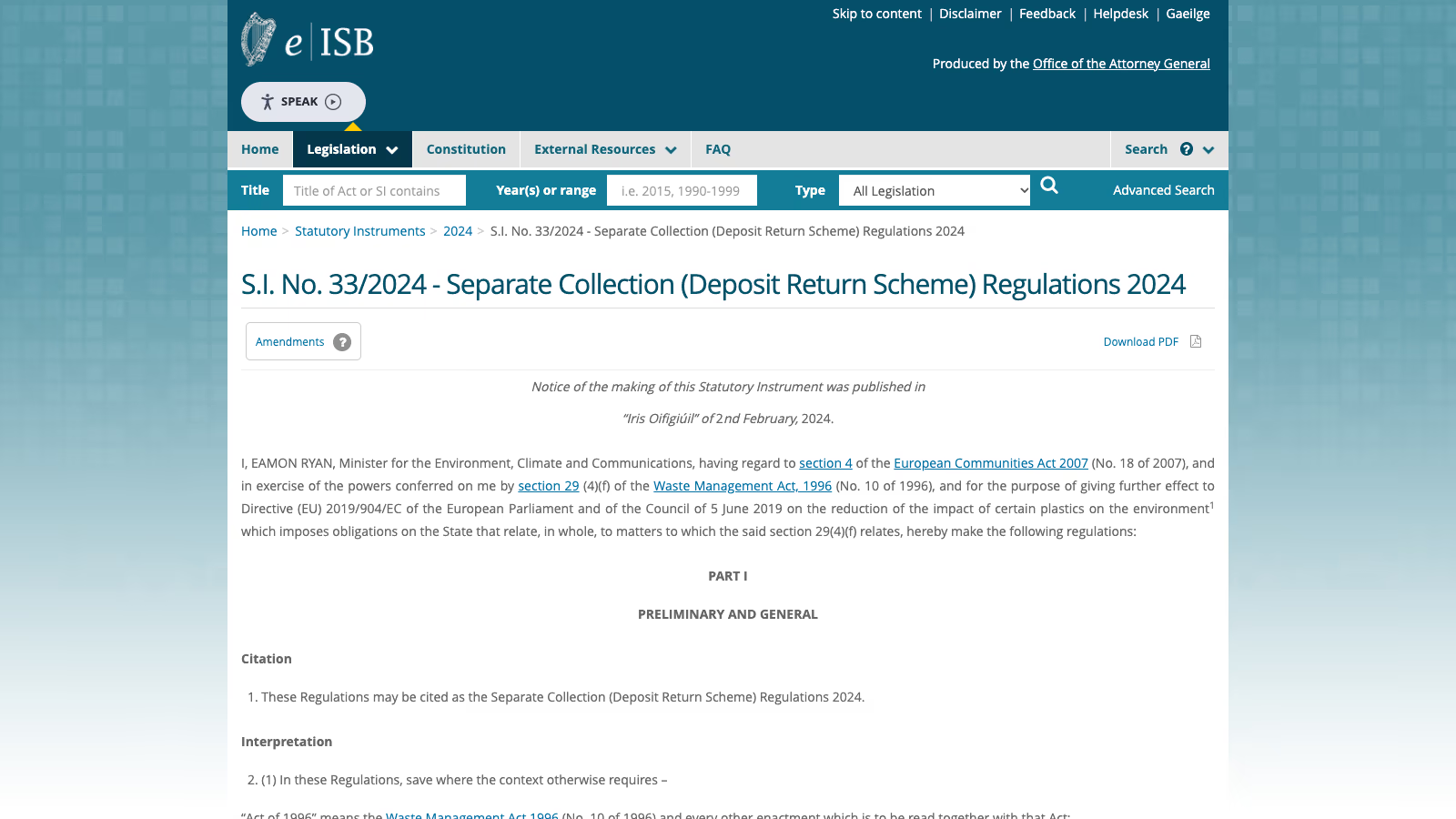
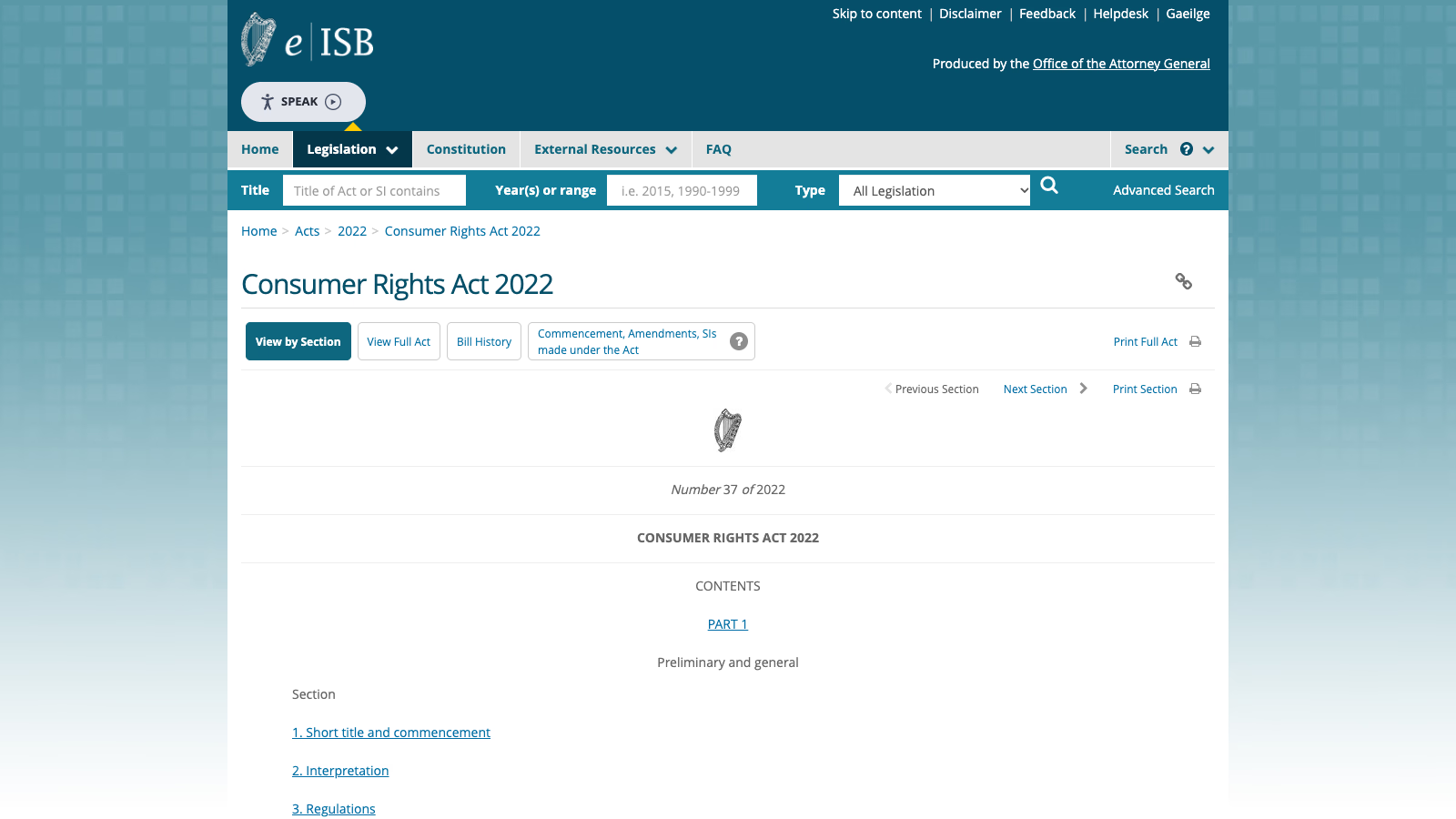
Executing transactions within conversational interfaces does not exempt merchants from mandatory consumer protection regulations. In Ireland and across the European Union, e-commerce transactions executed via artificial intelligence are subject to the Consumer Rights Act 2022, the European Union (Consumer Information, Cancellation and Other Rights) Regulations, the Digital Markets, Competition and Consumers Act 2024 (DMCC Act in the UK), and the overarching statutory principles of the Rome I Regulation (Regulation EC No 593/2008).
When commercial transactions are conducted through AI search agents, legal compliance requires adherence to key standards:
- Search ranking transparency: Under Section 75 of the Consumer Rights Act 2022 (transposing Directive (EU) 2019/2161), any search facility provided to consumers must clearly display the main parameters determining the ranking of products presented in response to a search query. Recommendations formulated by an AI agent must not conceal sponsored placements or prioritize listings based on undisclosed commission arrangements without transparent disclosures.
- Pre-contractual disclosure mandates: Under Part 3 of the Consumer Rights Act 2022, before a consumer is bound by a distance contract, the trader must provide clear information regarding the commercial identity of the merchant, geographical address, full pricing inclusive of all taxes, ancillary delivery expenses, and complaint handling protocols. When checkout occurs inside Universal Cart, this information must be accessible directly within the conversational interface prior to transaction authorization.
- Statutory 14-day cancellation rights: Consumers entering into contracts through AI agents maintain an absolute statutory right to cancel distance contracts within 14 days without giving reasons (Section 112, Consumer Rights Act 2022). Retailers cannot curtail this right by alleging that the transaction was automated or executed by an autonomous assistant.
- Profiling and automated decision-making: The deployment of Personal Intelligence systems analyzing user browsing and purchasing history to deliver dynamic product pricing or selective recommendations triggers General Data Protection Regulation (GDPR) requirements overseen by the Data Protection Commission (DPC). Automated profiling having legal or significant effects on consumers requires transparent legal bases and safeguards against unfair commercial discrimination.
Failure to fulfill pre-contractual information requirements exposes merchants to statutory enforcement action by the Competition and Consumer Protection Commission (CCPC) and potential civil liability for unfair commercial practices.
Proven optimization strategies to secure citations in Google AI Mode
Given the mechanics of Gemini 3.5 Flash and Gemini 4 Argon, an effective Generative Engine Optimization (GEO) strategy must focus on building content assets that statistical language models cannot synthesize independently.
Technical implementations should follow four core principles:
1. Publish non-commodity content enriched with proprietary data
Google guidelines draw a firm distinction between commodity information and original expertise. Commodity articles summarizing generic concepts are absorbed into model pre-training and generate zero ongoing citations. To earn citations in AI Mode, pages must supply primary empirical data, including proprietary industry benchmarks, laboratory stress tests, financial modeling, or documentation of hands-on physical implementations.
2. Implement answer-first inverted pyramid information hierarchy
Language models operate under strict computational and token budget constraints. Placing a direct, factual answer immediately beneath the section heading ensures rapid semantic extraction during query fan-out. Verbose introductory commentary, rhetorical fluff, and delayed conclusions lower information density and hinder automated extraction algorithms.
3. Maintain continuous publication freshness
Ahrefs research analyzing 17 million AI citations demonstrates that generative models heavily favor recently updated information over aging documentation. In Gemini citations, the average elapsed time since last page modification was 216 days fresher than equivalent organic search rankings. Regularly auditing performance data, refreshing factual figures, and updating Schema.org dateModified timestamps are essential for sustained generative visibility.
4. Faster crawl rendering and edge delivery
AI Mode retrieves sources exclusively from Google core search index. Any server-side latency, improper HTTP status codes, firewall blocking, or heavy client-side JavaScript rendering cycles that impede Googlebot prevent inclusion in generative answers. Deploying lightweight static HTML via global Edge CDNs guarantees that crawlers extract content without delay.
Why llms.txt files and synthetic AI schemas fail in Google AI Mode
The emergence of AI search has spawned numerous technical myths that divert engineering resources away from impactful optimizations.
First, the belief that deploying an llms.txt file enhances AI citation frequency is demonstrably false. Google Search relations teams have repeatedly stated that indexing algorithms do not read or process llms.txt files. Ahrefs empirical server log analysis revealed that over 97% of deployed llms.txt files receive zero crawl hits from search engines. Maintaining this file yields no competitive advantage in Google AI Mode.
Second, implementing invented “AI schemas” or fragmenting content into artificial micro-chunks offers no measurable benefit. Empirical benchmarks by Ahrefs and Moz show zero citation lift from proprietary markup hacks. Google relies on standard Schema.org vocabularies and its general search index to locate supporting documentation.
Third, purchasing sponsored brand mentions across syndicated listicles is ineffective. Modern language models perform cross-verification against authoritative entity graphs, easily discounting synthetic link schemes and low-quality promotional directories.
Strategic recommendations for enterprise brands
The expansion of Google AI Mode past one billion active users and the rollout of Universal Cart indicate that e-commerce has entered the era of autonomous search commerce. With organic click-through rates dropping below 3% in conversational experiences, organizations must recalibrate their performance benchmarks: long-term success is measured not merely by total web sessions, but by generative AI Share of Voice and conversion volume executed through automated platforms.
To build sustainable search resilience, enterprise teams should adopt the following action plan:
- Track brand visibility trends systematically using the Google Search Console Generative AI report alongside dedicated AI monitoring platforms.
- Audit Google Merchant Center product feeds to ensure absolute data fidelity across inventory counts, pricing, and shipping terms.
- Migrate critical web properties toward performant server-rendered architectures (such as Astro or headless WordPress) to eliminate indexing bottlenecks.
- Focus editorial resources on original research, field testing, and interactive tools that models cannot replicate.
- Review digital checkout workflows against European consumer protection standards to ensure statutory compliance across automated sales channels.