Short answer: since 7 May 2026 Google no longer shows FAQ rich results, the expandable questions under a search result. Most WordPress and WooCommerce sites lost nothing visible that day, because since August 2023 only government and health websites were getting them. Keep your FAQ section if it answers questions customers really ask. You can keep the FAQPage markup if it matches the visible content, but stop promising anything in Google on the strength of it. Then go through the plugins, proposals and reports that still talk about “FAQs in the search results”.
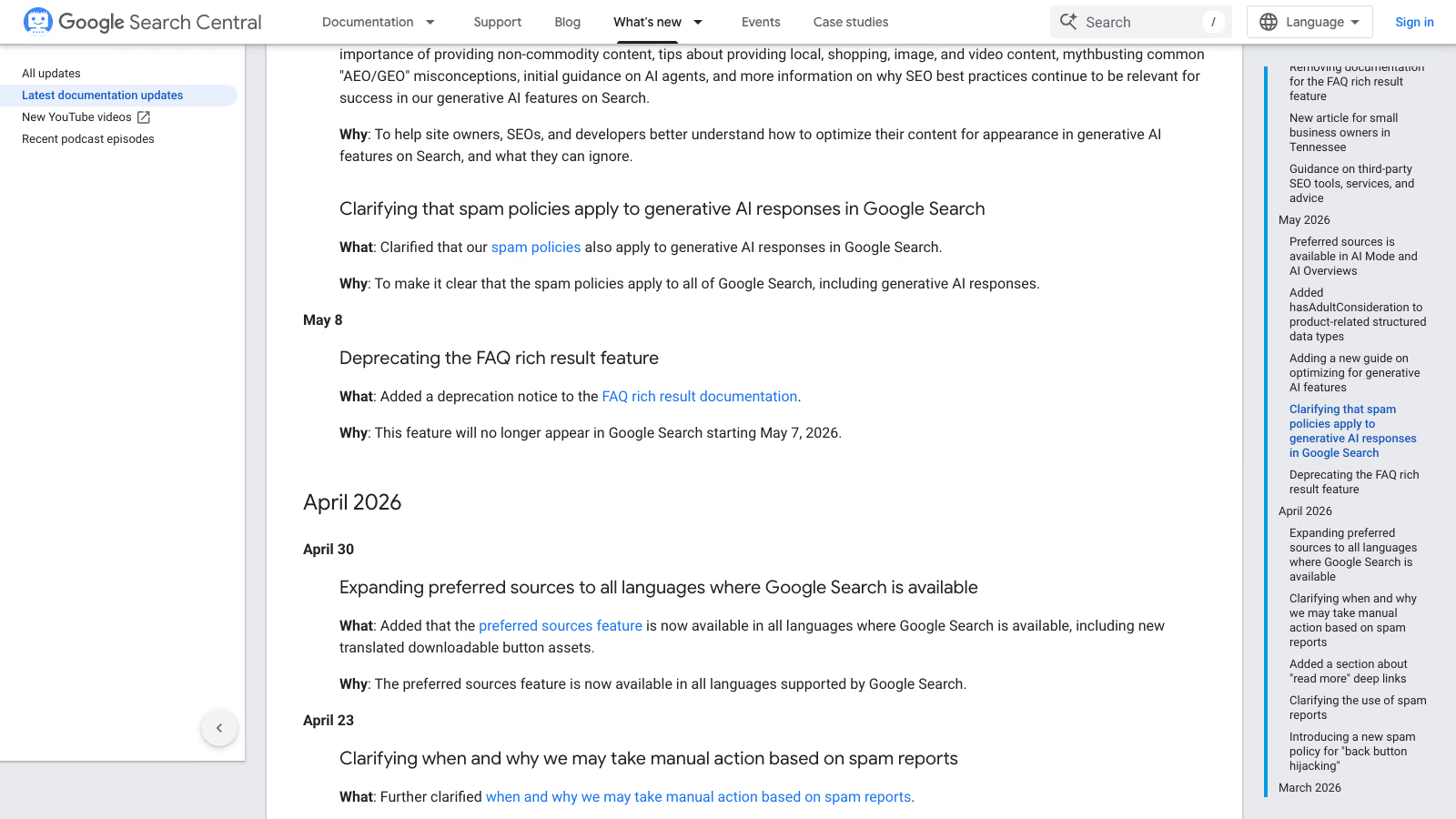 The 8 May 2026 entry in the Google Search Central documentation changelog. Source: developers.google.com, screenshot taken on 28 November 2026.
This guide is for the owner of a website or shop and for whoever maintains it. It covers what exactly Google switched off, what that does not change, how Yoast and Rank Math handle it, what to look at in Search Console and what to do about HowTo, which has been dead even longer. It ends with the checklist I worked through on my own site.
Did Google remove FAQ rich results?
Yes. On 8 May 2026 Google added an entry titled “Deprecating the FAQ rich result feature” to its documentation changelog, with this reason: “This feature will no longer appear in Google Search starting May 7, 2026.” (Google Search Central, documentation updates). On 15 June 2026 a second entry followed: “Removed documentation for the FAQ rich result feature.” The old FAQ documentation URL now redirects to the changelog.
The notice that sat at the top of the FAQ documentation in May survives in the Internet Archive copy of 23 May 2026. It reads in full:
“As of May 7, 2026, FAQ rich results are no longer appearing in Google Search. We will be dropping the FAQ search appearance, rich result report, and support in the Rich results test in June 2026. To allow time for adjusting your API calls, support for the FAQ rich result in the Search Console API will be removed in August 2026.”
| Date | What happened | Source |
|---|---|---|
| 8 August 2023 | FAQ limited to well-known government and health websites, HowTo desktop only | Google Search Central blog |
| 14 September 2023 | HowTo disappears on desktop too, feature deprecated | same post, update |
| 7 May 2026 | FAQ rich results stop appearing | changelog |
| June 2026 | FAQ search appearance, rich result report and Rich Results Test support dropped (announced) | archived documentation |
| 15 June 2026 | FAQ rich result documentation removed | changelog |
| August 2026 | FAQ support in the Search Console API ends (announced) | archived documentation |
Why most sites saw no change at all
Because they had already lost it. In August 2023 John Mueller announced on the Google blog that FAQ rich results “will only be shown for well-known, authoritative government and health websites. For all other sites, this rich result will no longer be shown regularly.” (Google Search Central blog).
For a typical service business on WordPress, a blog or a WooCommerce shop, May 2026 therefore changed nothing about how its results looked. The expandable questions had vanished from those results almost three years earlier. If traffic on such a site dropped in May 2026, look for the cause somewhere else: an algorithm update, changes in AI Overviews, seasonality or the site itself.
The people who really felt the May 2026 change were public authorities, hospitals and health publishers that still had expandable questions. For everyone else it is the formal end of the story and a cue to clean up promises that have been out of date since 2023 anyway.
Should you remove FAQPage schema?
You do not have to. When Google restricted FAQ results in 2023, it wrote: “While you can drop this structured data from your site, there’s no need to proactively remove it.” (Google Search Central blog). FAQPage is still an ordinary type in the schema.org vocabulary, defined as “A FAQPage is a WebPage presenting one or more “Frequently asked questions"" (schema.org/FAQPage). Nobody deprecated it. What Google retired is one way of displaying results.
Google’s general structured data guidelines still apply, though. The two that matter most for FAQs: “Don’t mark up content that is not visible to readers of the page.” and “Your structured data must be a true representation of the page content.” (Google structured data guidelines). The same guidelines explain that a structured data manual action removes a page’s eligibility for rich results, but “doesn’t affect how the page ranks in Google web search.”
Joost de Valk, co-creator of the schema implementation in Yoast SEO, goes further. In a post of 11 May 2026 he puts it bluntly: “Strip it. Where the page genuinely is an FAQ, keep the markup.” (joost.blog). His example is hard to argue with: “A 2,000-word essay with three FAQs at the bottom should never have had FAQPage on it.” He also writes: “Bing still rewards it, and Google itself isn’t asking you to remove it.” The Bing part is his assessment; I have not confirmed it in Bing’s documentation.
For a WordPress site, the practical decision looks like this:
| Situation | What to do |
|---|---|
| The whole page is a list of questions and answers (help, delivery terms) | Keep the section and FAQPage |
| A few questions under an article or on a product page, visible to readers | Keep the section; keep or drop FAQPage, rankings will not change |
| The questions exist only in JSON-LD and are not visible on the page | Remove the markup or show the content on the page |
| Mass-generated questions, identical across dozens of pages | Remove the questions and the markup, write answers only where they are needed |
| Two plugins, or a theme and a plugin, output FAQPage on the same page | Keep a single source |
Does FAQPage schema help in AI Overviews?
Not as such. Google’s page on AI features in Search says: “You don’t need to create new machine readable files, AI text files, or markup to appear in these features. There’s also no special schema.org structured data that you need to add.” (Google, AI features and your website). The AI optimization guide adds: “Structured data isn’t required for generative AI search, and there’s no special schema.org markup you need to add. However, it’s a good idea to continue using it as part of your overall SEO strategy, as it helps with being eligible for rich results on Google Search.” (Google, AI optimization guide).
The same documentation lists one best practice that applies to FAQs directly: “Making sure your structured data matches the visible text on the page”. So the only route by which an FAQ can help a page in AI answers is the text itself. If the question and the answer are on the page, short, specific and about what people actually ask, the model has something to quote. Markup cannot stand in for that content.
Some plugins and agencies have moved the old rich result argument over to AI: “add FAQ schema and AI will cite you”. Yoast’s FAQ block page says the block gives AI systems “an unambiguous question-and-answer pair to work from”. I found no Google documentation that confirms this. I go into what actually works for AI visibility and what is myth in the post on GEO myths on WordPress, and into which schema types still make sense in the guide to Schema.org and AI search.
When an FAQ section is still worth having
An FAQ section earns its place when it answers questions people really ask before they buy or get in touch. Rich results were never a good reason to write one, and now they are no reason at all.
The best sources of questions are already in your hands:
- emails and messages from customers over the last few months,
- Search Console queries containing “how”, “can”, “how much”, “when”,
- questions your sales or support staff keep answering on the phone,
- the reasons behind returns and complaints in your shop.
On a WooCommerce product page these questions are usually about dimensions, compatibility with other equipment, delivery time and returns. The answer about returns has to match your shop’s terms and conditions exactly on deadlines and conditions, because customers will read the FAQ as a promise. When you change the terms, change the FAQ too.
Remove questions that exist only for the search engine: “What is WordPress?” on a service page aimed at businesses, generic lines repeated on every city or product page, answers along the lines of “Of course, just get in touch”. Blocks like these help neither people nor AI answers.
How the Yoast and Rank Math FAQ blocks behave now
Both major SEO plugins for WordPress still output FAQPage from their FAQ blocks.
Yoast SEO. The FAQ block page on yoast.com states that “Google retired the FAQ rich result from Search in May 2026” and that the block still adds valid FAQPage schema (Yoast, FAQ block). Yoast now positions the block mainly as a way to help search engines and AI tools understand the content.
Rank Math. The Rank Math knowledge base says that “Google reduced support for the FAQ Schema in 2023 and ended support for it in 2026” and that the Rich Results Test “has also removed the FAQ Schema report” (Rank Math, FAQ block). I checked the code of version 1.0.283 from the WordPress.org plugin directory: the file includes/modules/schema/blocks/faq/class-block-faq.php still sets '@type' => 'FAQPage'. Rank Math can also nest the FAQ inside other schema types on the page.
The add-ons, themes and page builders matter more than the SEO plugins themselves. Many of them ship their own “FAQ with schema” block or widget, often with a description like “get expandable questions in Google”. If a site runs Yoast or Rank Math alongside a page builder FAQ widget, a single page can send two FAQPage blocks with different content. You can check this without any plugin:
curl -s https://example.com/page-url/ | grep -o '"@type":"FAQPage"' | wc -lA result above 1 means more than one FAQPage source. Some plugins write JSON-LD with a space after the colon, so if you get zero, also try "@type": "FAQPage" or simply search the page source for FAQPage. On a site with many templates, check one page of each type: the home page, a post, a service page, a product page, a category.
What to tell clients instead of rich snippets
For several years “FAQ schema for rich snippets” was a fixed line item in SEO proposals and audits. From August 2023 that promise held only for public bodies and health websites; since May 2026 it holds for nobody.
I checked my own site. In November 2026 I found 43 pages on wppoland.com that still described FAQ rich results as a working Google feature. They were in several languages, and none was out of date on purpose. Nobody had gone back to a sentence written while the feature still worked. If you run an SEO blog or keep ready-made templates for proposals, reports and audits, you probably have the same problem.
What to fix:
- proposals and contracts: drop “FAQ schema implementation for rich snippets” as a deliverable; if an FAQ section stays in scope, describe it as content that answers customer questions,
- reports and audits: a missing FAQPage is no longer a defect to flag, and having one is no achievement,
- blog posts and service pages: sentences like “your FAQ will appear directly in Google’s results” need rewriting or removing,
- descriptions of plugins and themes you develop yourself: promising FAQ rich results today misleads your users.
One sentence is enough for a client: since May 2026 Google no longer shows expandable questions in its results, so the FAQ stays where it answers real buyer questions, and it is judged by whether it cuts support queries and helps people decide, not by how it looks in Google.
Checking the FAQ change in Search Console
For years the “Search appearance” dimension in the Search Console Performance report had a row for FAQ results. Google announced its removal for June 2026, together with the FAQ rich result report in the enhancements section and support in the Rich Results Test. So do not expect to read your FAQ history from the interface today.
What you can still do:
- If you have an export from before June 2026 (from the interface, the API or Looker Studio), compare clicks and impressions with the FAQ appearance in 2023 and in 2026. Unless the site is a government or health site, expect the drop in autumn 2023, not in May 2026.
- Compare pages with an FAQ section against pages without one over the 28 days before 7 May and the 28 days after. Use the page filter in the Performance report. If both groups moved in a similar way, the FAQ is not the cause.
- Check scripts and dashboards that query the Search Console API for the FAQ appearance. Google announced the end of that support for August 2026, so queries with an FAQ filter may return empty data or an error, depending on the tool. An empty chart in a client report looks like an outage when it is really a change on Google’s side.
- Measure traffic from AI features separately. Google points to the Generative AI performance report in Search Console for that (Google, AI optimization guide). Keep it out of your FAQ assessment.
If the site is on an ongoing care plan, add this review to the next monthly report. That is how I handle it in WordPress website maintenance: a change on Google’s side goes into the report with a one-sentence explanation before the client spots the empty chart on their own.
What about HowTo structured data
HowTo left the results before FAQ did. In August 2023 Google limited it to desktop, and on 14 September 2023 it added: “Google Search no longer shows How-to rich results on desktop, which means this result type is now deprecated.” (Google Search Central blog). The HowTo documentation was removed from Search Central in September 2023, and the same announcement said the How-to search appearance, its report and Rich Results Test support would be dropped after 30 days.
On WordPress sites HowTo usually lingers in three places: the Yoast SEO “How-to” block, the similar Rank Math block and tutorial templates in themes. The rule is the same as for FAQ. The markup does no harm if it describes steps that are visible on the page. It also gets you nothing in Google, so there is no reason to add it to new content or to promise it to clients. A step-by-step guide with a numbered list and screenshots is still good content, because readers need it.
How I handle FAQs on wppoland.com
On this site the FAQ is a visible section at the bottom of a post, built from <details> elements, so an answer opens without JavaScript. The questions come from the faq field in the post’s frontmatter, and the section renders only when a post has its own questions. I removed a shared default FAQ for all posts earlier, because it repeated the same answers on hundreds of pages.
In JSON-LD the section is described as a WebPageElement with the questions in hasPart, in line with Joost de Valk’s point that an FAQ added to an article should not pretend the whole page is an FAQ page. Next to it I kept a separate FAQPage block with the same questions, meant for search engines other than Google. Both blocks are built from the same source as the text visible on the page, so they cannot drift apart. I do not assume that either of them earns a post a place in Google or in an AI answer. I judge the FAQ by whether the questions make sense to the reader.
If you would like me to review your site or shop from this angle, together with the rest of its structured data and its Search Console reports, write to me through the contact form as part of WordPress website maintenance.
Last updated: 28 November 2026.