Expanded and up-to-date version of this topic: Universal Commerce Protocol: how AI agents are reshaping online shopping.
In October 2026, Google executed one of the most structural updates to online retail since the emergence of mobile search: the official rollout of Universal Cart in Google Search and Gemini across the United States. This update is not an incremental adjustment to Sponsored Shopping tiles. It fundamentally rebuilds how digital buyers interact with retail catalogs.
Instead of directing shoppers to external storefronts to navigate disparate checkouts, Google Universal Cart enables consumers to combine products from multiple independent retailers into a single checkout flow directly inside Google Search and Gemini. The underlying technical infrastructure enabling this shift is the Universal Commerce Protocol (UCP): an open, standardized framework governing data exchange, inventory verification, and transactional handshakes between autonomous AI agents and commerce backends.
For technical leads, architects, and merchants running WooCommerce, this development creates an urgent operational imperative. Stores that rely exclusively on visual web pages designed for human navigation will become opaque to conversational agents. Conversely, stores that expose typed, deterministic data layers will capture a growing stream of high-intent, agentic transactions. This guide provides a detailed architectural breakdown of UCP and an actionable roadmap for implementing it within WordPress and WooCommerce.
From referral links to machine transactions: the death of the click
For more than two decades, search engine retail followed an unchanged pattern:
- A consumer submitted a search query (such as men waterproof trail running shoes size 10).
- The search engine rendered organic snippets and sponsored Product Listing Ads (Google Merchant Center).
- The consumer clicked an outbound link, landing on an external merchant website.
- On the retailer’s domain, the shopper reviewed product details, selected sizes, dealt with consent banners, and manually completed the checkout form.
With the proliferation of multimodal AI assistants and autonomous browser-operating models (including OpenAI Operator, Claude Computer Use, and Google Gemini), buyer behavior is shifting. Users no longer wish to manually inspect dozens of distinct websites, navigate inconsistent cart systems, or re-enter payment credentials on every domain. Instead, a prompt is issued: Find black waterproof trail running shoes in size 10 with Gore-Tex delivered before Friday under 150 dollars, and purchase them.
To fulfill this instruction autonomously, an AI agent requires:
- High-speed discovery across catalogs matching explicit technical parameters.
- Instant, programmatic verification of real-time inventory and total price including shipping.
- A deterministic checkout interface that completes the order without human visual intervention.
This is the exact challenge solved by the Universal Commerce Protocol. Rather than treating an e-commerce website as an HTML page to be scraped, UCP frames the storefront as an accessible database accompanied by stateful transactional APIs.
Architecture of the Universal Commerce Protocol
Universal Commerce Protocol establishes an open, vendor-neutral protocol designed to unify agent-to-merchant commerce. The UCP specification is organized into three distinct tiers:
1. Semantic discovery and capabilities layer
This tier allows an e-commerce storefront to declare its identity, supported features, and commercial rules. The merchant serves a manifest file from a standardized location: /.well-known/ucp.json
This file informs querying AI agents about supported interaction modes (such as direct inquiry, B2B quotation, native wallet checkout, or hosted iframe flows), currency support, and API endpoint locations.
2. Structured catalog knowledge layer
UCP extends Schema.org standards in JSON-LD. Basic product markup is insufficient; UCP demands precise, unambiguous data points:
ItemAvailability: Granular stock flags differentiating immediate dispatch, backorder, and discontinued items.PriceSpecification: Explicit breakdowns of net price, gross price, currency, tax rates, and tiered volume thresholds.hasMerchantReturnPolicy: Machine-readable return terms, including return windows, restocking fees, and shipping responsibility.DeliveryTimeSpecification: Transit and handling timelines calculated based on buyer geography.
3. Stateful transaction protocol
Unlike traditional RSS or XML feeds, UCP incorporates a secure, bidirectional protocol that coordinates checkout:
- Cart Session Creation: The agent transmits SKU identifiers, selected variants, and destination addresses.
- Inventory Hold Lock: The merchant system places a temporary reservation on the stock (e.g., for 15 minutes) associated with a unique idempotency key.
- Tax and Shipping Calculation: The store provides guaranteed total costs for buyer authorization.
- Payment Handshake: Executed either natively (via tokenized digital wallets such as Google Pay) or through a cryptographically secured iframe modal.
Merchant center XML vs Universal Commerce Protocol
A frequent point of confusion is how UCP relates to existing Google Merchant Center feeds. The two systems serve different functions:
| Dimension | Google Merchant Center (GMC) | Universal Commerce Protocol (UCP) |
|---|---|---|
| Primary Objective | Advertising display and product indexing | Autonomous, programmatic transaction execution |
| Data Flow | Batch synchronization (typically daily) | Real-time bi-directional API queries |
| Purchase Location | External retailer storefront | Directly inside Search / Gemini (Universal Cart) |
| Inventory State | Latent (prone to out-of-stock discrepancies) | Instant temporary lock (Hold Lock pattern) |
| Agent Capability | Can only generate referral clicks | Can configure variants and authorize payment |
| Attribution | Query parameters (UTM / GCLID) | Agent transaction tokens and referrer headers |
A Merchant Center feed provides Google with an initial index. However, when an agent initiates a purchase in Gemini, it directly pings the merchant’s UCP endpoints to guarantee that pricing, taxes, and availability remain current at that exact second.
Implementation guide: preparing WooCommerce for UCP
WooCommerce provides an extensible foundation for UCP through its native REST API (/wp-json/wc/v3/). However, out-of-the-box configurations require targeted optimization to satisfy agentic performance criteria.
Step 1: deploying the /.well-known/UCP.json manifest
Every participating merchant domain must expose a machine-readable manifest at its root. In WordPress, this can be served via edge routing (Cloudflare Workers) or a lightweight rewrite rule:
{
  "version": "1.0",
  "name": "Acme Retail Store",
  "domain": "acmeretail.com",
  "capabilities": {
    "supportsCart": true,
    "supportsInstantHold": true,
    "supportsQuote": true,
    "checkoutModes": ["native", "iframe"]
  },
  "endpoints": {
    "catalog": "https://acmeretail.com/wp-json/wc/v3/products",
    "availability": "https://acmeretail.com/wp-json/ucp/v1/availability",
    "cart": "https://acmeretail.com/wp-json/ucp/v1/cart",
    "returnPolicy": "https://acmeretail.com/en/returns/"
  },
  "supportedCurrencies": ["USD", "EUR", "GBP"],
  "contactEmail": "[email protected]"
}
This manifest provides AI agents with instant operational context before they attempt to interact with individual product pages.
Step 2: injecting complete logistics attributes into Schema.org
Standard SEO plugins frequently omit structured return policies and transit time matrices. UCP agents require these properties to rank and recommend products.
Here is an architectural PHP snippet augmenting the WooCommerce JSON-LD payload:
add_filter('woocommerce_structured_data_product_offer', function($offer, $product) {
    if (!$product instanceof WC_Product) {
        return $offer;
    }

    $offer['priceSpecification'] = [
        '@type' => 'PriceSpecification',
        'price' => wc_format_decimal($product->get_price(), 2),
        'priceCurrency' => get_woocommerce_currency(),
        'valueAddedTaxIncluded' => wc_prices_include_tax() ? 'true' : 'false'
    ];

    $offer['hasMerchantReturnPolicy'] = [
        '@type' => 'MerchantReturnPolicy',
        'applicableCountry' => 'US',
        'returnPolicyCategory' => 'https://schema.org/MerchantReturnFiniteReturnWindow',
        'merchantReturnDays' => 30,
        'returnMethod' => 'https://schema.org/ReturnByMail',
        'returnFees' => 'https://schema.org/FreeReturn'
    ];

    $offer['shippingDetails'] = [
        '@type' => 'OfferShippingDetails',
        'shippingRate' => [
            '@type' => 'MonetaryAmount',
            'value' => '0.00',
            'currency' => get_woocommerce_currency()
        ],
        'shippingDestination' => [
            '@type' => 'DefinedRegion',
            'addressCountry' => 'US'
        ],
        'deliveryTime' => [
            '@type' => 'ShippingDeliveryTime',
            'handlingTime' => [
                '@type' => 'QuantitativeValue',
                'minValue' => 0,
                'maxValue' => 1,
                'unitCode' => 'DAY'
            ],
            'transitTime' => [
                '@type' => 'QuantitativeValue',
                'minValue' => 2,
                'maxValue' => 4,
                'unitCode' => 'DAY'
            ]
        ]
    ];

    return $offer;
}, 10, 2);Step 3: lightweight endpoints for real-time inventory checks
Standard WooCommerce checkout workflows load significant PHP overhead (session handlers, customer cart calculations, coupon validations). Querying AI agents demand responses within 150 milliseconds.
We recommend deploying a specialized, bypass REST controller:
add_action('rest_api_init', function () {
    register_rest_route('ucp/v1', '/availability', [
        'methods' => 'POST',
        'callback' => 'handle_ucp_fast_availability',
        'permission_callback' => '__return_true',
    ]);
});

function handle_ucp_fast_availability(WP_REST_Request $request) {
    $sku = sanitize_text_field($request->get_param('sku'));
    $quantity = max(1, intval($request->get_param('quantity')));

    $product_id = wc_get_product_id_by_sku($sku);
    if (!$product_id) {
        return new WP_Error('not_found', 'Product not found', ['status' => 404]);
    }

    $product = wc_get_product($product_id);
    $in_stock = $product->is_in_stock();
    $stock_qty = $product->get_stock_quantity();

    $is_available = $in_stock && ($stock_qty === null || $stock_qty >= $quantity);

    return rest_ensure_response([
        'sku' => $sku,
        'available' => $is_available,
        'stockQuantity' => $stock_qty,
        'price' => wc_format_decimal($product->get_price(), 2),
        'currency' => get_woocommerce_currency(),
        'holdDurationSeconds' => 900 // 15-minute guarantee
    ]);
}Step 4: ensuring transactional idempotency
Autonomous agent operations face network variability and automated retries. If an AI agent attempts to create a cart hold and experiences a brief timeout, it will replay the identical request.
Without idempotency protections, the backend risks double-booking inventory or charging multiple authorizations:
- Every stateful request must include an
X-Idempotency-KeyHTTP header containing a unique UUIDv4. - The WooCommerce handler checks an object cache (such as Redis) for the key. If found, it returns the cached response immediately.
- If the key is new, the mutation proceeds and stores the output under that key for 24 hours.
Navigating the UTM stripping challenge in AI search
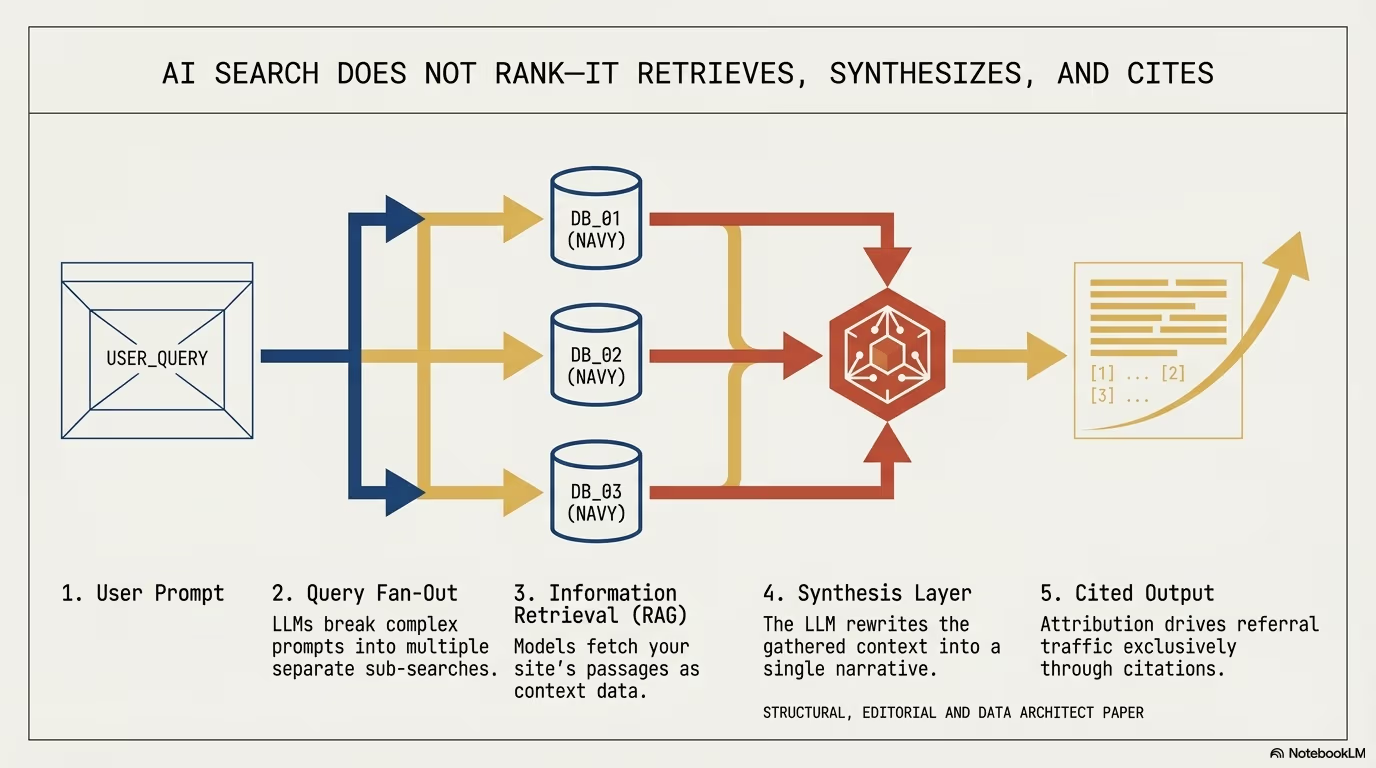
A critical finding in recent search analytics research is the deliberate stripping of tracking parameters by generative AI engines.
Analyses of platforms such as ChatGPT, SearchGPT, and Perplexity reveal that outbound citations frequently strip query parameters, including utm_source, utm_medium, and utm_campaign. AI systems remove these tags to enhance user privacy and streamline shared URLs.
The operational consequence for merchants is severe:
- Standard analytics configurations misclassify high-converting AI recommendations as direct traffic.
- Marketers underestimate the commercial ROI generated by Generative Engine Optimization (GEO).
Solution: resilient referral capture via document.referrer
When URL query strings are removed, the browser’s HTTP Referer header remains the primary trustworthy signal.
Modern tracking implementations must inspect document.referrer upon initial page load:
- Referrals from
chatgpt.com,chat.openai.com, or mobile app identifiers likeandroid-app://com.openai.chatgptshould map dynamically tosource: ai:chatgptandmedium: ai-referral. - Inflows from
perplexity.ai,claude.ai, orgemini.google.comshould receive similar structured classification.
Crucially, this classification must be saved to first-touch session storage. When a buyer explores your catalog and converts across subsequent pages, the attribution remains preserved.
The intersection: UCP, Anthropic MCP, and WordPress
Technical discussions in the WordPress ecosystem often reference both UCP and MCP (Model Context Protocol). Understanding their complementary roles is vital:
- Model Context Protocol (MCP): An open standard released by Anthropic in November 2024. MCP provides typed tool-calling interfaces, enabling models to query databases, read documentation, and manipulate server objects. It defines how models interact with capabilities.
- Universal Commerce Protocol (UCP): A domain-specific protocol governing commerce. It establishes the transactional grammar of commerce: cart state machines, inventory locks, payment compliance, and return policies.
In high-performance architectures, the two work in tandem. A WordPress store can run an MCP server for exploratory catalog questions, while handing off transactional authorization to specialized UCP endpoints.
Automattic’s public stance highlighting WordPress as a foundational platform for the agentic web reinforces this approach. An open, sovereign CMS gives store owners full control over their transaction terms, free from the rent-extraction of centralized marketplace platforms.
Strategic action items for store owners
The launch of Google Universal Cart signals that agent-mediated commerce is moving into the mainstream. To protect and grow your search revenue:
- Conduct a Schema Audit: Verify that all product variations output complete price, return policy, and delivery specifications in JSON-LD.
- Publish the UCP Manifest: Add a compliant
/.well-known/ucp.jsonfile to your server root. - Streamline REST Performance: Isolate stock verification and cart hold routes from frontend template overhead, ensuring response times under 150ms.
- Harden Analytics: Implement referrer-based attribution to capture AI engine traffic that arrives without UTM parameters.
To discuss architecture, audits, or implementation for your store, explore our specialized Universal Commerce Protocol services and AI WordPress integration. Contact our senior engineering team via our contact form to review your store readiness.