From 27 September 2026 a shop that sells goods online to consumers in Ireland has to remind them of the legal guarantee of conformity using a fixed EU design, the harmonised notice. Where the producer offers a durability guarantee of more than two years, a second element joins it: the GARAN label. Ireland wrote both into the Consumer Rights Act 2022 through S.I. No. 124/2026, and the Irish text adds one rule that affects the WooCommerce checkout directly. This guide covers what has to appear, where, from when, and how to build it in WooCommerce, including the block checkout and the order emails.
I build and maintain WooCommerce shops. I am not a solicitor, so this guide quotes the statutory text and leaves legal advice to someone qualified to give it.
What is the harmonised notice on the legal guarantee?
The legal guarantee of conformity is the trader’s liability for goods that do not match the contract. In Ireland it sits in Part 2 of the Consumer Rights Act 2022, which implements the Sale of Goods Directive, Directive (EU) 2019/771. Directive (EU) 2024/825 amended the Consumer Rights Directive, 2011/83/EU, so that the pre-contract information for distance sales must include:
a reminder of the existence of the legal guarantee of conformity for goods and its main elements, including its minimum duration of two years as provided in Directive (EU) 2019/771, in a prominent manner, using the harmonised notice referred to in Article 22a of this Directive
(Directive (EU) 2024/825, Article 6(1)(l) of Directive 2011/83/EU as amended, EUR-Lex)
The design comes from Brussels. Commission Implementing Regulation (EU) 2025/1960, Article 1, says the notice “shall comply with the design and content set out in Annex I”. The first note in Annex I reads “None of the elements of the harmonised notice can be edited.” A line such as “All our products come with a 2-year guarantee” therefore does not meet the duty, even when every word of it is true. The shop displays the Commission’s notice as published, in the right language, and adds nothing to it.
Annex I adds practical constraints that matter for a web page. For distance contracts concluded through an online interface, the notice must be in colour (RGB). It carries a QR code that leads to the legal guarantee section of the Your Europe portal, and that code has to be scannable on a standard mobile device. In a product template, render it as a proper image with alt text at a size where the QR code still scans, and keep it out of a stylesheet background.
The notice covers goods. Directive 2011/83/EU, as amended, has a separate point (lb) for a reminder about digital content and digital services, and the Irish transposition mirrors that split in clauses (hb) and (qb) of the Act’s schedules. A shop that sells only downloads or subscriptions has a different duty, and a mixed shop has both.
Has Ireland transposed the Empowering Consumers Directive?
Yes, on time. The instrument is S.I. No. 124/2026, the European Union (Empowering Consumers for the Green Transition) Regulations 2026. The facts from the Irish Statute Book:
| Item | What the instrument says |
|---|---|
| Made by | Peter Burke, Minister for Enterprise, Tourism and Employment |
| Legal basis | Section 3 of the European Communities Act 1972 |
| Purpose | Gives effect to Directive (EU) 2024/825 and further effect to Implementing Regulation (EU) 2025/1960 |
| Signed | 27 March 2026 |
| Notice of making | Iris Oifigiúil of 3 April 2026 |
| Commencement | Regulation 1(2): in operation on 27 September 2026 |
| Acts amended | Consumer Protection Act 2007 (Part 2) and Consumer Rights Act 2022 (Part 3) |
Part 2 handles the greenwashing side: new misleading practices in sections 44B and 44C of the 2007 Act and new entries on the blacklist in section 55. Part 3 is the one a shop builder cares about. It amends the information duties in the Consumer Rights Act 2022 and inserts a new section 125A that defines the harmonised notice and the harmonised label for Irish law.
Ireland met the transposition deadline in Article 4(1) of Directive 2024/825, which reads “By 27 March 2026, Member States shall adopt and publish the measures necessary to comply with this Directive”. The instrument was signed on the deadline day and applies from the same date the directive sets for application.
When does the harmonised notice apply in Ireland?
Three texts set the dates, and for Ireland they line up.
| Text | What it fixes | Date |
|---|---|---|
| Directive (EU) 2024/825, Article 4(1) | Member States adopt and publish their measures | By 27 March 2026 |
| Directive (EU) 2024/825, Article 4(1) | Member States apply those measures | From 27 September 2026 |
| Implementing Regulation (EU) 2025/1960, Article 3 | Design of the notice (Annex I) and the label (Annex II) | Applies from 27 September 2026 |
| S.I. No. 124/2026, Regulation 1(2) | Irish amendments to the 2007 and 2022 Acts | In operation on 27 September 2026 |
The Irish rules were already in force on the day this guide was published. A shop selling to Irish consumers that has not added the notice yet is behind, and the gap is easy to show: anyone can open a product page and see whether the Commission’s design is there.
How long is the legal guarantee in Ireland?
The new section 125A(1) of the Consumer Rights Act 2022 says the harmonised notice shall contain:
(a) the main elements of the legal obligation on the trader to supply goods that are in conformity with the contract, including the minimum duration of that obligation of two years, in accordance with the Sale of Goods Directive, and (b) a general reference to the possibility that, under section 11(1) of the Statute of Limitations 1957 (No. 6 of 1957), the duration of the legal obligation referred to in paragraph (a) is for a period exceeding two years.
(Consumer Rights Act 2022, section 125A(1), inserted by regulation 13 of S.I. No. 124/2026)
Section 11(1) of the Statute of Limitations 1957 says actions “founded on simple contract” cannot be brought “after the expiration of six years from the date on which the cause of action accrued”. So an Irish consumer’s claim on a faulty product is not cut off at two years. The EU notice already contains a general line saying national law may give a longer period (recital 5 of Regulation 2025/1960 asks for exactly that), and section 125A ties that line to the Irish limitation period. Annex I still forbids edits, so the shop does not paste “six years” into the image. The six-year rule matters for your returns policy and your support scripts, which must not tell customers their rights end at 24 months.
The other parts of the Irish legal guarantee that your customer service will meet, all from the Consumer Rights Act 2022:
| Section | Rule |
|---|---|
| Section 21 | The trader is liable for any lack of conformity that exists at the relevant time |
| Section 22(1) | A fault that becomes apparent within 12 months of the relevant time is presumed to have existed then, unless the contrary is proven |
| Section 22(4) | The consumer can still exercise a remedy after those 12 months |
| Section 23 | Remedies: the short-term right to terminate, then repair or replacement |
| Section 24(2) | The short-term right to terminate runs for 30 days, from delivery or from completed installation where the trader installs the goods |
A WooCommerce shop does not show any of this on the product page. It belongs in the terms and conditions and in the returns workflow. The harmonised notice on the page is the reminder, and the Act behind it is what your staff apply when a customer emails about a broken product in year three.
Do UK shops selling to Ireland need the harmonised notice?
The Department of Enterprise, Tourism and Employment states on its page on the directive:
The requirements will apply to all EU/ EEA traders, and non-EU companies selling products to EU/EEA consumers.
A WooCommerce shop run from Great Britain that ships to Irish consumers falls under that sentence for its Irish sales. The practical consequence is in the shop configuration. If the shop serves Irish and British customers from one storefront, the notice has to be on the pages and in the emails Irish customers see. Showing it to everyone is the simpler build, because geolocation rules in a cached product page are fragile. Irish is one of the official EU languages, and the Commission publishes the annexes in all of them, so an Irish-language storefront can use the Irish version of the notice.
Where does the notice have to appear in a WooCommerce shop?
The Irish route for an online sale runs through three provisions. Section 106(1)(a) of the Consumer Rights Act 2022 requires the trader to give the consumer the Schedule 3 information before a distance contract binds them. Schedule 3 clause (q), as substituted by regulation 15 of S.I. No. 124/2026, is the existence of the legal guarantee, its main elements and its two-year minimum. Section 125A(2) then says the harmonised notice “shall be used for the provision of the information under … clause (q) of Schedule 3”, and section 125A(5)(c) requires it to be “displayed in a prominent manner”.
Section 109 adds the after-sale side. A trader who concludes a distance contract provides confirmation “on a durable medium”, and that confirmation includes all Schedule 3 information, unless the trader already provided it on a durable medium before the contract. In a WooCommerce shop the order email is that confirmation.
| Place | Irish provision | Where in WooCommerce |
|---|---|---|
| Product page | Section 106(1)(a), Schedule 3 clause (q), section 125A(2) and (5)(c) | Single product template, before the add-to-cart button (hook woocommerce_before_add_to_cart_button) |
| Classic checkout | Pre-contract information, shown before the order binds the consumer | Before the place order button (hook woocommerce_review_order_before_submit) |
| Block checkout | The same information | A checkout block extension, because the classic PHP hooks do not run inside the block checkout |
| Order email | Section 109: confirmation on a durable medium with the Schedule 3 information | Processing and on-hold emails, after the order table (hook woocommerce_email_after_order_table) |
All three hooks live in the WooCommerce templates: single-product/add-to-cart/simple.php, checkout/payment.php and emails/email-order-details.php. If your theme overrides any of them, open the copy in the theme and confirm it still calls the hook. An outdated template override is the most common reason a notice works on a default theme and vanishes on the live shop.
“Prominent” rules out a footer link, a line in the terms and conditions or a collapsed accordion at the bottom of the product description. The product page is where the consumer meets the goods, so that is where the notice has to be visible without hunting for it.
What is the GARAN label and when is it required?
The GARAN label covers a different promise: the producer’s commercial guarantee of durability, a commitment that the good keeps its functions and performance through normal use for a set period. Article 6(1)(la) of Directive 2011/83/EU, as amended, applies “where the producer offers the consumer a commercial guarantee of durability at no additional cost, covering the entire good and with a duration of more than two years, and makes that information available to the trader”.
Ireland copied those conditions into Schedule 3 clause (qa) of the Consumer Rights Act 2022: the guarantee is offered “at no additional cost, covering the entire good, for a period exceeding two years”, and the producer “makes that information available to the trader”. All four conditions must hold. A paid extended warranty fails the first, a battery-only guarantee fails the second, and a two-year producer warranty fails the third. In each of those cases the product does not get the label. Section 125A(3) and (4) then require the harmonised label from Annex II to Regulation 2025/1960 for the clause (qa) information.
Annex II spells out what the shop may and may not change:
| Element | Editable? |
|---|---|
| Title GARAN, the reminder of the legal guarantee, the QR code to Your Europe, the calendar symbol, the translations of “producer guarantee in years” | No |
| ”XX”, replaced by the number of years of the producer’s guarantee | Yes |
| ”Brand/Trademark”, replaced by the producer’s name | Yes |
| ”Model identifier”, replaced by the model the guarantee covers | Yes |
For online sales the label must be in colour and set in Inter (Regular, SemiBold and ExtraBold). Annex II also allows a nested display online: a small version on the page, with the full label appearing “in its entirety on the first mouse click, mouse roll-over or tactile screen expansion”. On a product page with a busy summary that is the cleaner layout.
The model identifier field deserves care. A WooCommerce SKU is the shop’s own stock code. The model identifier is the producer’s designation of the model the guarantee applies to, the one printed on the rating plate and in the producer’s documentation. When the two differ, the label must carry the producer’s identifier.
Does the GARAN label have to appear at checkout in Ireland?
Section 108 of the Consumer Rights Act 2022 covers distance contracts concluded by electronic means, which includes every WooCommerce order. Its subsection (3), as amended by regulation 12 of S.I. No. 124/2026, reads:
If a contract places a consumer under an obligation to pay, the trader shall make the consumer aware in a clear and prominent manner, and directly before the consumer places his or her order, of the information specified in clauses (a), (f) to (h), (qa), (t) and (u) of Schedule 3.
(Consumer Rights Act 2022, section 108(3), with “(qa)” inserted by S.I. No. 124/2026)
Clause (qa) is the durability guarantee information, and section 125A(4) says the harmonised label is used to provide it. So for a product with a qualifying producer guarantee, the Irish text puts that information on the checkout review step, right above the button. Clause (q), the legal guarantee notice itself, is not on the section 108(3) list. Showing the notice at checkout is still good practice, and I build it in because it costs nothing extra once the template work is done.
In WooCommerce terms that means a loop over the cart items at the checkout review step: for each item with producer guarantee data, render that item’s label or a nested version of it before the place order button. In the classic checkout the hook woocommerce_review_order_before_submit gives you the spot. In the block checkout you need a block extension that reads the same product meta. A breach of section 108(3) is an offence under section 108(7).
How do I add the notice to WooCommerce without a plugin?
You need three things: the official notice file from Annex I in the shop’s language, a place in the templates, and a test run. Do the work in a child theme or a small site-specific plugin so a theme update does not wipe it.
- Download the annexes from the Commission’s page for the harmonised notice and label and take the language version your storefront uses.
- Store the notice image locally, with alt text that reproduces its message, so the page does not depend on a remote host.
- Hook a function into
woocommerce_before_add_to_cart_buttonthat prints the notice on products that are goods. Skip downloads and services with a product meta flag of your own. - Hook the same output into
woocommerce_review_order_before_submitfor the classic checkout, and add the GARAN output per cart item there for Irish orders (see the previous section). - For the block checkout, register a checkout block extension following the WooCommerce documentation for the version you run.
- Add the notice to the processing and on-hold emails with
woocommerce_email_after_order_table, checking$sent_to_adminso the admin copy stays clean.
The manual route gives you full control and one ongoing cost: you own the templates, the language files and the test plan every time WooCommerce ships a major release. For a shop with forty products and one language that is a short job. For a catalogue of several thousand products in several languages, one source of truth (a plugin or an in-house module) is easier to keep correct.
What does Durabix 1.2.0 do?
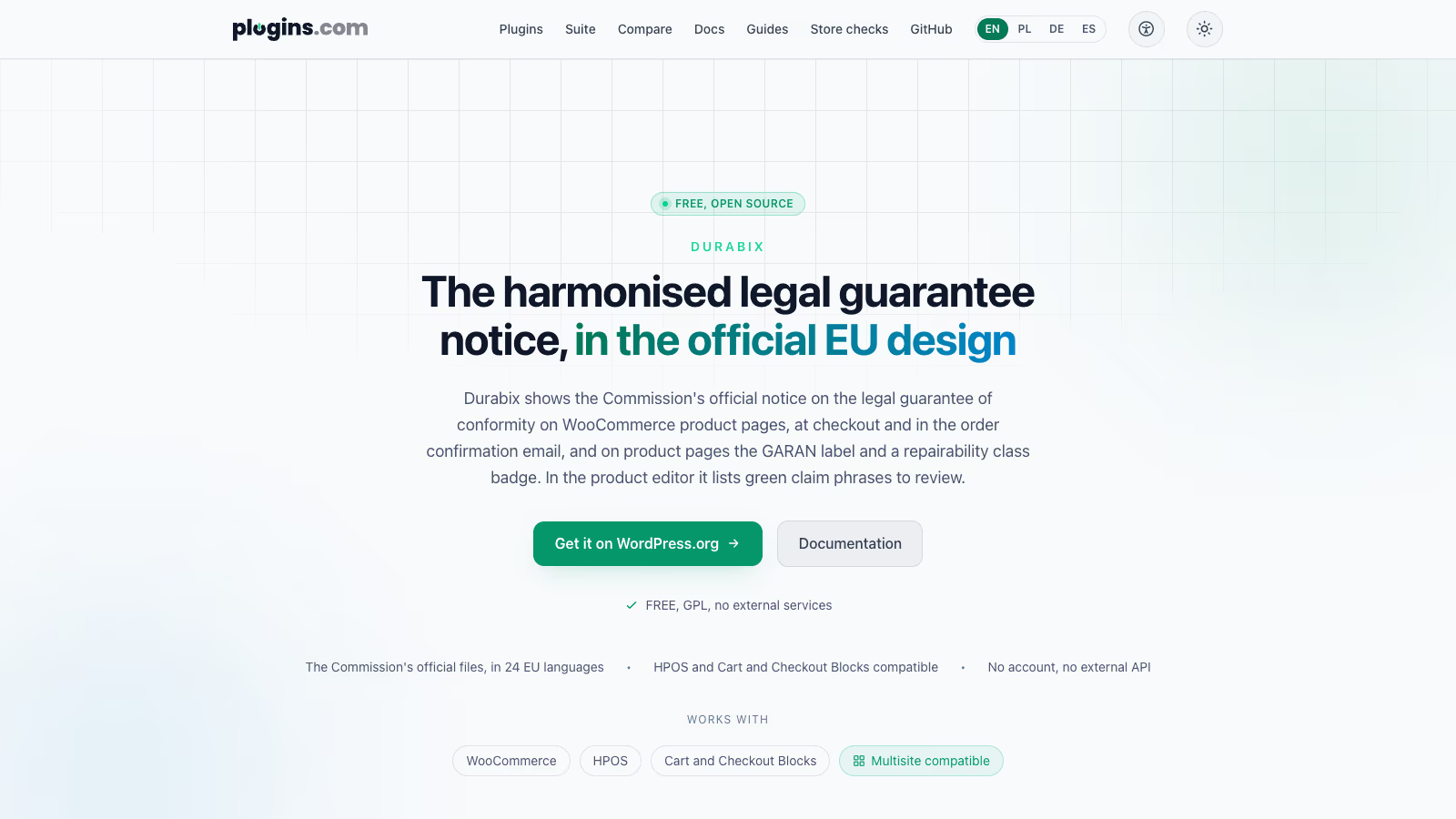
Durabix is my own plugin, free on WordPress.org as “Durabix: EU Legal Guarantee Notice for WooCommerce”. What follows is what its WordPress.org page and changelog state for version 1.2.0, released on 8 November 2026.
| Feature | What 1.2.0 does |
|---|---|
| Harmonised notice | The Commission’s colour notice from Annex I, in the site language; all 24 official EU languages ship with the plugin, English for any other language |
| Product page | A short “Your legal guarantee rights” line that opens the full, unedited notice on the first click, with a link to the Your Europe page the QR code leads to |
| Checkout | The same line above the place order button on the classic and the block checkout, shown when at least one item is a good |
| Emails | The notice in the processing and on-hold order emails to the customer |
| GARAN label | Nested label on the product page, filled with the years, the producer and the model identifier (the SKU when that field is empty), shown when the producer guarantee is over two years |
| Placement | Under the product summary near the price and add-to-cart button, or in a “Guarantee & Durability” tab |
| Per-product switch | A checkbox that hides the notice on a product that is not a good |
| Repairability class | A colour-coded A to E badge for smartphones and slate tablets |
| Green claims check | Flags phrases such as “climate neutral” or “eco-friendly” in English, Polish, German and Spanish in the product editor, for review |
The plugin requires WordPress 6.5, PHP 8.1 and WooCommerce 8.0 or newer, and it declares compatibility with HPOS and the Cart and Checkout Blocks. The notice images, the label and the Inter font load from your own site, and the plugin makes no external calls.
The readme lists what the plugin does not do, and for an Irish shop two of those lines need action. Durabix “does not show the GARAN label at checkout or in emails”, while section 108(3) puts the clause (qa) information directly before the order button. If you sell products with a qualifying producer guarantee to Irish consumers, add the label at checkout yourself with the hook from the previous section, or wait for a release that covers it. The readme also states that the separate reminder for digital content and digital services under Article 6(1)(lb) is not shown, which in Irish law is clause (qb) of Schedule 3. A shop selling software licences or streaming access next to physical goods needs its own text for that.
The other limits: no per-variation label fields, and no check that the producer’s guarantee meets Article 17 of Directive 2019/771. The plugin displays what you enter. Whether the producer’s promise qualifies is a question for the producer’s documentation.
What can the CCPC do if the notice is missing?
The Department of Enterprise, Tourism and Employment describes enforcement on its directive page:
As the Empowering Consumers Directive amends the UCPD and the CRD, the enforcement regime is already in place. The Competition and Consumer Protection Commission (CCPC) is responsible for addressing non-compliance and may issue compliance notices, issue fixed payment notices and apply to the Court for prohibition orders. There is also the potential application of fines up to 4% of turnover or €2 million for widespread infringements.
The Consumer Rights Act 2022 also makes the information duties offences in their own right. Section 106(11) covers a trader who contravenes the pre-contract information duty for distance contracts, and section 108(7) covers the “directly before the order” rule in subsection (3).
Which mistakes break the harmonised notice in WooCommerce?
Own wording. The shop writes “Every product carries a two-year guarantee” in the description and treats the duty as done. Section 125A requires the Annex I design, and Annex I allows no edits.
Advertising the legal guarantee as a selling point. S.I. No. 124/2026 adds paragraph (pa) to section 55(1) of the Consumer Protection Act 2007, which bans “presenting requirements imposed by any enactment or otherwise imposed by law on all products within the relevant product category on the European Union market as a distinctive feature of the trader’s offer”. The Department’s own example is “advertising a warranty of 2 years, which is mandatory by law anyway”. A “2-year guarantee” badge in the product gallery or a banner that sells the legal guarantee as a perk falls under that paragraph.
Hiding it. A link in the footer, a clause in the terms or a closed tab does not meet “prominent”.
A block checkout with no notice. The developer adds the notice through a classic hook, the shop runs the block checkout, and nobody sees the output because the PHP hook never fires there.
No GARAN information before the order button on qualifying products. For Irish orders this is the section 108(3) gap described above.
Emails nobody touched. The notice reaches the product page and checkout, and the order email still comes from an unmodified template, or from a transactional email plugin that builds its own layout and skips the WooCommerce hooks.
GARAN on products without a qualifying producer guarantee. A shop’s own extended warranty, a paid plan or a two-year producer warranty does not get the label.
The SKU as the model identifier. When the shop’s code and the producer’s model designation differ, the label carries the wrong one.
Why is the notice not showing on my WooCommerce site?
Not on the product page: check whether the product is flagged as not a good, then check the theme’s override of the single product template for a missing hook call.
Not at checkout: check that the cart holds at least one physical product. Durabix shows the checkout line only when at least one item is a good, and a hand-built solution should follow the same logic. Then check which checkout the shop actually runs, because a classic hook does nothing on the block checkout.
Not in the email: check the order status. The notice goes into the processing and on-hold emails. If the shop sends a custom status email or uses an email builder plugin, add the notice to that template too.
No GARAN label: check that the product has the guarantee years and the producer’s name filled in. Durabix needs both, and its years field takes 3 or more.
Caching: a page cache or a CDN may serve a product page from before the change. Purge it and test in a private window.
How do I check that the implementation is complete?
Run this list on a staging copy before calling the job finished:
- The notice image comes from the Commission’s published annex in the storefront language, not from a copy found on another shop.
- The product page shows the notice without a click on a tab.
- The classic and the block checkout show the same notice in the same language.
- Products with a qualifying producer guarantee show their GARAN information directly before the place order button for Irish orders.
- The processing and on-hold emails contain the notice.
- The GARAN label appears only on products whose producer guarantee meets all four clause (qa) conditions.
- The model identifier field holds the producer’s model designation.
- Test orders cover a physical product, a qualifying product, a digital-only cart and a mixed cart, in both checkouts.
- No banner or badge advertises the legal guarantee as a feature of the offer.
Point 4 comes from section 108(3) of the Irish Act, so a checklist written for another market may not include it.
How do I keep evidence of the implementation?
Save dated screenshots of a product page, the checkout review step and a test order email, along with the versions of WordPress, WooCommerce, the theme and any plugin involved. That set shows what the shop displayed on a given day. Once the theme changes, you cannot rebuild that state, and in a dispute about what a consumer saw, those screenshots are the record. Take a new set before each major theme or WooCommerce update and keep it outside the shop, with the rest of your compliance file.
What to do next
If your shop already shows the notice, place a test order in both checkouts with a product that carries a producer durability guarantee and check what appears above the button. If it does not show the notice yet, start with the product page and the checkout, because those two carry the duties a consumer or the CCPC can verify in a minute.
The same shops usually carry other product disclosures with fixed EU designs. I cover one of them in the guide to the EU energy label in an online shop. For a larger catalogue it is simpler to handle all of these together in a WooCommerce EU compliance review. Template work, block checkout extensions and custom email layouts are what I do as a WooCommerce developer, and keeping them working through WooCommerce updates is part of WordPress website maintenance. You can reach me through the contact page.