Website & application migration in Barcelona
I migrate sites from WordPress, Joomla, Drupal, Angular, Vue and other technologies to Astro and Next.js. I plan each migration to keep SEO, content and features intact and switch over in an agreed window. I work alone and have years of experience with both legacy and modern stacks.
- I have had a wordpress.org account since 2006.
- I contributed to WordPress core for versions 7.0 and 7.1.
- I maintain 30 plugins on wordpress.org.
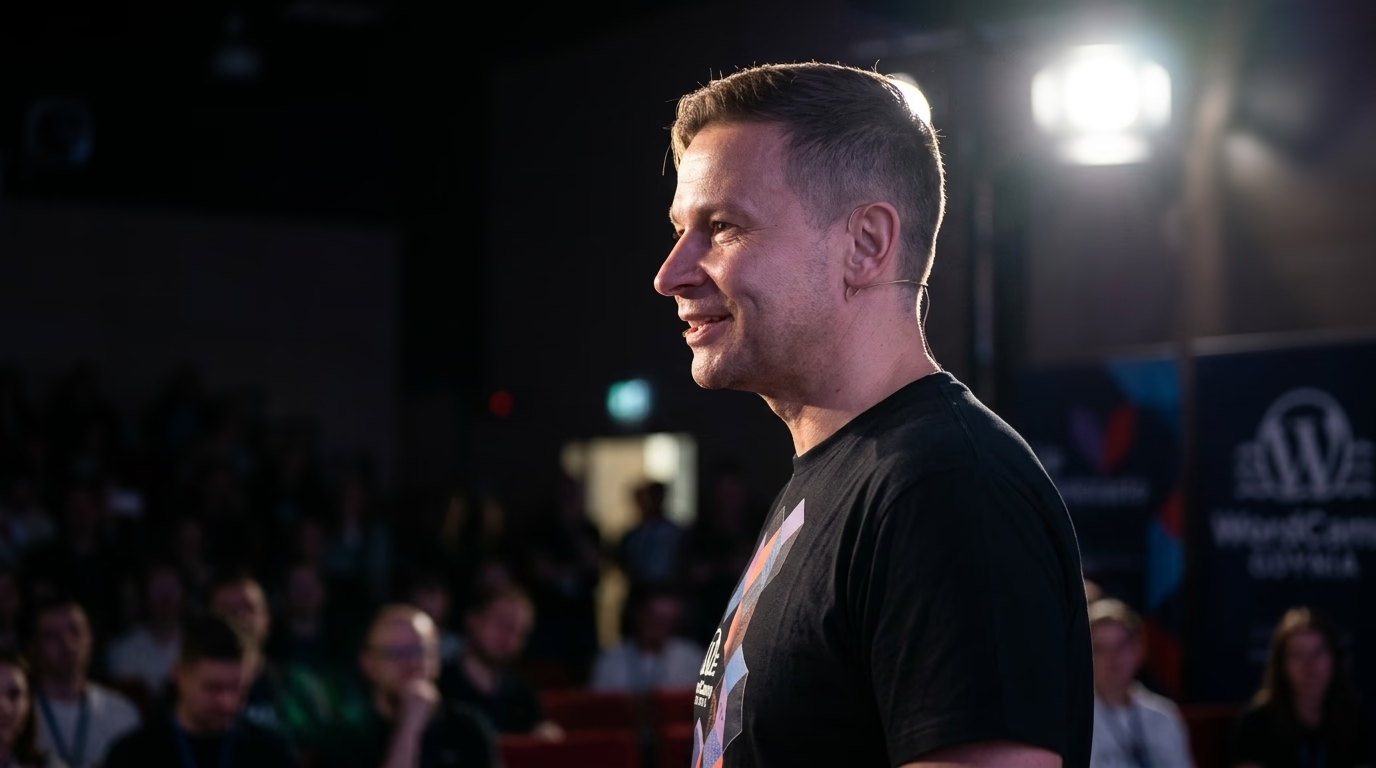
- I organise and speak at WordCamps.
- I have attended every WordCamp Europe from 2017 to 2026.
- Local WordPress meetup: WordPress Barcelona
A Barcelona company usually asks about Astro or Next.js when its current site has become harder to run than the business it supports: a WordPress install with forty plugins, a Joomla 3 site that nobody dares to update, a Drupal 7 build past its end of life, or an old custom framework only one former contractor understood. I take that site, map everything search engines and customers already know about it, and rebuild it on a lighter frontend without throwing away the rankings, links and language versions you have earned.
What does a migration to Astro or Next.js actually involve?
The work is mostly inventory and checking, not rewriting templates. In order:
- Crawl and export. I crawl the live site and pull the list of URLs from the sitemap, Search Console and server logs where available. Each URL gets a row: status, title, canonical, language, incoming internal links and whether it brings organic clicks.
- Content model. Posts, pages, products, categories, authors and custom fields become typed collections. In Astro that means content collections with a schema, so a missing title or a broken date fails the build instead of shipping. Content can stay in WordPress as a headless CMS or move into Markdown in a Git repository; that choice depends on who edits and how often.
- URL map and 301s. Every old URL either keeps its exact address or points to one new address with a single 301. No chains, no blanket redirects to the homepage. The map is a spreadsheet you can read and approve before anything goes live.
- Metadata and structured data. Titles, meta descriptions, canonicals, Open Graph tags and JSON-LD (Organization, Product, Article, BreadcrumbList, FAQPage where it is real) are generated from the content model, not typed by hand per page.
- Staging and parity checks. The new build runs on a staging address blocked from indexing. I compare old and new page by page: same title, same canonical, same main heading, same language pair, and no page that quietly lost its body text.
- Cutover. Small sites switch in one go; larger ones move section by section behind the same domain.
- After launch. I submit the new sitemap, watch Search Console coverage, the 404 report and Core Web Vitals, and fix the redirects that real traffic reveals I missed.
Astro fits content sites, brochures, documentation and catalogues: pages are built as static HTML and ship little or no JavaScript. Next.js fits sites with logged-in areas, live stock, booking flows or heavy personalisation, where server rendering and API routes earn their extra complexity. If neither is needed, I will say so and suggest cleaning up the current CMS instead.
How do Catalan and Spanish versions survive the move?
Barcelona is the capital of Catalonia and, with about 1.7 million residents, the second largest municipality in Spain. Article 6 of the Statute of Autonomy of Catalonia makes Catalan the official language of Catalonia and Castilian official as well, and Aranese (Occitan) is also official in Catalonia. In practice a Barcelona site often runs in Catalan and Spanish, and many add English for visitors and international buyers.
That is where migrations quietly break. Multilingual plugins such as WPML or Polylang store translation links in their own tables, and a naive export loses them. I export the translation groups explicitly, rebuild them as one content entry with several language files, and generate the hreflang tags from that group, using ca, es and en plus an x-default. Before launch I check on the built HTML that every page points to its siblings and that each sibling points back. A Catalan page that links to a Spanish page that does not link back is ignored by Google, and that error is invisible in the browser.
Language-specific slugs stay as they are. If your Catalan URL says /ca/serveis/ and the Spanish one /es/servicios/, the new site keeps both rather than flattening them into one pattern.
Which Spanish rules does the new site have to keep meeting?
A new frontend does not change your legal position, but it is the moment where things get dropped by accident.
- LSSI, Article 10. Ley 34/2002 on information society services requires the provider to make its legal name, address, a direct email, registry details and tax number (NIF) available on the website. The legal notice page moves with the site, and I check it is still linked from every template.
- Cookies, Article 22.2 LSSI. Storage on the user’s device needs consent after clear information, except for what is strictly necessary for the service the user asked for. On a rebuilt frontend I load analytics and marketing scripts only after consent, and I remove trackers you no longer use instead of copying them across.
- Data protection authorities. The Spanish authority is the AEPD (Agencia Española de Protección de Datos). In Catalonia there is also the Autoritat Catalana de Protecció de Dades, based in Barcelona, which has, for example, audited cookie use on local council websites. If your hosting or forms move to new providers, the processing records and the privacy notice need updating too.
- Accessibility. Ley 11/2023 transposes the European Accessibility Act (Directive (EU) 2019/882). E-commerce services are in its scope, the requirements apply from 28 June 2025, and microenterprises providing services are exempt. I build the new templates with correct heading order, form labels, visible focus and sufficient contrast, then test with a keyboard and an automated checker.
What can go wrong, and how do I check for it?
- Lost pages. Old URLs with backlinks that nobody listed. I cross-check the URL map against Search Console and backlink data, and the 404 log after launch.
- Redirect chains. A 301 that points to another 301 left from a previous redesign. I resolve every chain to its final target.
- Thin rebuilds. A template that renders the title but drops a custom field holding half the page. The parity check compares word counts per page between old and new.
- Broken hreflang. Covered above; it is checked on the built HTML, not in the CMS.
- Forms and integrations. Contact forms, newsletter sign-ups, booking widgets and payment links are listed and tested one by one on staging, with real submissions arriving where they should.
What do you get at the end?
You keep the Git repository, the deploy pipeline, the environment variables and a written record of the URL map and every decision about changed addresses. I review indexing and performance in the weeks after launch and fix what the data shows.
For the broader method, see my Next.js and Astro migration page, and if the content should stay in WordPress behind a new frontend, the headless CMS development page.
How do I get a written scope for my site?
Send me the current site address, the CMS and version it runs on, the language versions you publish, and where your traffic comes from (organic search, ads, newsletter, marketplaces). I reply with a written scope: what moves, what changes address, which framework fits, and what I need from you before work starts.
FAQ
Why are Barcelona technology and design firms migrating to Astro or Next.js?
Barcelona is southern Europe’s leading startup and design hub, hosting major international scale-ups in 22@, mobile innovation leaders, and global e-commerce brands. Outdated WordPress or Drupal monoliths create heavy server overhead, vulnerability risks, and sluggish mobile page speeds. Migrating to Astro removes unnecessary JavaScript from the critical rendering path, ensuring sub-second load times, total data security, and flawless Core Web Vitals on mobile and desktop.
How do you protect Catalan and Spanish SEO rankings during the replatforming?
We crawl and index every existing URL across both language trees before touching any template code. Each route is mapped into an explicit 1:1 permanent 301 redirection rule or kept at its exact canonical address. Reciprocal hreflang tags for Catalan (ca), Spanish (es), and English (en) are generated and programmatically tested directly on the built HTML to prevent translation disconnects.
Can our marketing team continue using their WordPress editorial panel?
Yes. We can decouple your website by turning WordPress into a Headless CMS. Editors create and revise articles in the familiar WordPress backend, while Astro queries content via REST or GraphQL APIs during automated build routines to generate blazing-fast static pages delivered over global Edge CDN nodes.
What Spanish and European digital regulations are addressed during the migration?
All implementations comply strictly with the EU GDPR under Agencia Española de Protección de Datos (AEPD) and Autoritat Catalana de Protecció de Dades (APDCAT) supervision, Article 10 of Ley 34/2002 (LSSI-CE), and European Accessibility Act mandates under Ley 11/2023 (WCAG 2.2 AA). Fonts and assets are self-hosted locally to prevent unconsented cross-border telemetry leakage.
What is the expected delivery timeframe for a website migration in Barcelona?
A mid-sized corporate migration covering 20 to 50 unique page templates, multilingual archives, and dynamic forms is typically delivered within 3 to 5 business weeks from architectural audit to production cutover.
Selected projects
Examples of my work.
Airhelp - WordPress Project | WPPoland
AirHelp was founded in 2013 as a start-up and has grown to become the global leader in defending air passenger rights, helping over 13 million people underst...
alextg.pl - WordPress Project | WPPoland
alextg.pl is a WordPress website for a company that helps customers obtain financing. The project focused on clear service presentation, contact flow and stable technical upkeep...
Andergrant.com - Historic Website for Olsztyn's Premier Club (2009)
The andergrant.com project was created in 2009 as a website for the largest club in Olsztyn, utilizing project-specific technical choices of that era including PHP 5, MySQL, jQuery, and Flash multimedia.
WordPress support & development in Barcelona
Need this service: Next.js / Astro migration in Barcelona?
Describe your project by e-mail. I reply within 48 hours.
Describe your projectExplore other WordPress services and knowledge base
Migration to Astro, Next.js, and headless WordPress.
WooCommerce sync with ERP and wholesale systems.
Business process automation around WordPress and company systems.
Library of concrete automation use cases.
Headless WordPress, Sanity, Strapi, and Contentful with Astro or Next.js.
Astro, MDX, edge delivery, and Core Web Vitals measured on real traffic.
Custom WordPress engineering and architecture.
Scalable headless, ERP, and AI architecture for enterprise.
Related categories
Supporting articles
Six to sixteen weeks for typical engagements, with a four-phase shape: discovery, scoping, build and cutover, tuning. The variables are catalogue size, integration count, URL preservation, and editorial team readiness, not framework choice.
A definitive 4-year Total Cost of Ownership (TCO) analysis, real-world Core Web Vitals benchmarks, Astro 7 GraphQL APQ architecture, and a 10-point executive decision matrix for choosing between decoupled and traditional WordPress.

The Shopify Plus vs WooCommerce headless decision in 2026 is no longer a binary "platform vs custom" trade-off. Both can run headless, both integrate AI, both ship at the edge. The real axes are control, total cost over five years, and exit strategy. This article walks the matrix with confirmed platform facts.