Website & application migration in Basel
I migrate sites from WordPress, Joomla, Drupal, Angular, Vue and other technologies to Astro and Next.js. I plan each migration to keep SEO, content and features intact and switch over in an agreed window. I work alone and have years of experience with both legacy and modern stacks.
- I have had a wordpress.org account since 2006.
- I contributed to WordPress core for versions 7.0 and 7.1.
- I maintain 30 plugins on wordpress.org.
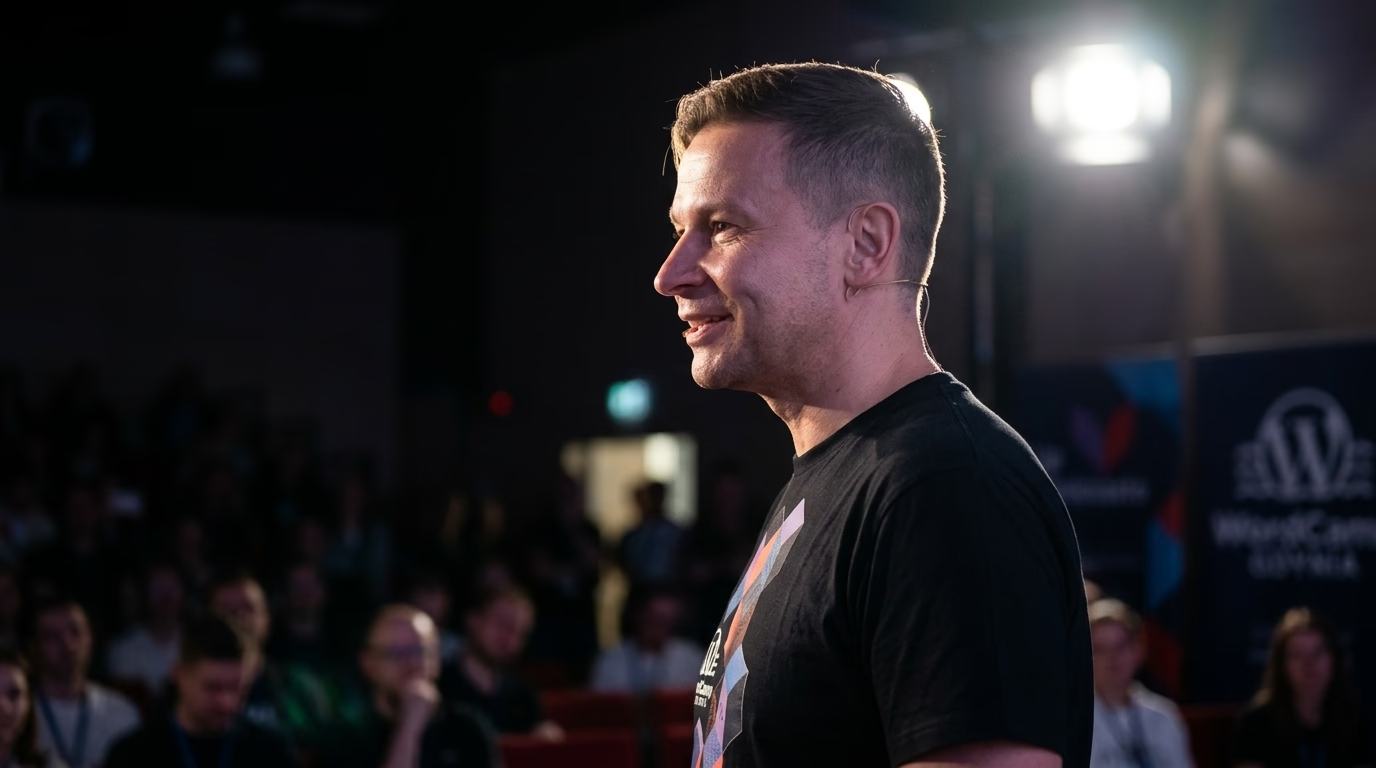
- I organise and speak at WordCamps.
- I have attended every WordCamp Europe from 2017 to 2026.
Migration to Next.js & Astro in Basel
I migrate sites from monolithic WordPress, Joomla, Drupal and other CMSs to modern Headless architecture powered by Astro or Next.js. In Basel I execute zero-downtime migrations, your site stays live throughout the entire process.
I migrate applications from Angular, Vue, legacy React, jQuery, PHP and static generators (Hugo, Jekyll, Gatsby) to Astro or Next.js. You gain better performance, SEO and easier long-term development.
A migration to Astro or Next.js in Basel reaches PageSpeed 95-100 and a sharply lower TTFB, because pages are served from the edge rather than assembled per request. A static front-end eliminates common attack vectors and drastically lowers hosting costs.
Every migration includes full URL mapping, 301 redirects, meta tag and structured data transfer. Your Google rankings don't just hold, they typically improve thanks to better Core Web Vitals.
Teams in Basel usually ask about Astro or Next.js when a WordPress, Joomla or Drupal site has become slow to load, slow to edit or risky to update. I handle the whole move as one person: the URL map, the new frontend, the redirects, the structured data, the language versions and the checks in Search Console after launch.
Is migrating to Astro or Next.js worth it for a Basel company website?
Not always. If the problem is a heavy page builder, an outdated theme or a dozen plugins loading scripts on every page, a cleanup of the existing CMS is cheaper and I will say so in the scope. A migration pays off when the template layer itself is the bottleneck, when the admin is slower than the public site, when nobody dares to run updates, or when the same content has to feed a website, a portal and a newsletter.
The choice between the two frameworks depends on the routes, not on fashion. Astro fits content sites: service pages, publications, job listings, documentation. It ships static HTML and adds JavaScript only to the components that need it. Next.js fits sections with logins, personalised data, search with filters or anything rendered per request.
How do you keep Google rankings when the URLs change?
Every old URL gets a decision in writing: keep the path, redirect it, or retire it on purpose. I build that list from four places at once, the current sitemap, a full crawl, the analytics landing page report and the server or CDN logs, because each one shows URLs the others miss. Google’s own site move guidance lists the same sources for mapping old URLs.
The rules I apply follow that guidance:
- Each old URL gets a server-side permanent redirect (301 or 308) straight to its final new address, with no chains.
- Old pages are not dumped onto the home page; a page without an equivalent gets a 410 or a redirect to the closest topic.
- Redirects stay in place for at least a year, which Google names as the general minimum.
- The new sitemap goes into Search Console on launch day; the Change of Address tool is used only if the domain itself changes.
Before cutover I run the whole redirect list against the staging build and compare titles, meta descriptions, canonicals, headings and structured data between old and new pages. Differences are fixed or signed off by you, not discovered later in rankings.
What changes for German and English versions of a Basel site?
The official language of Basel is German, and the city sits where the Swiss, French and German borders meet, so its audience often searches from three countries. If you run German and English versions, each needs correct hreflang annotations. Google accepts language codes with an optional region, such as de-CH, and requires that each language version lists itself and every other version; if two pages do not point to each other, the annotations are ignored.
In practice this is where migrations quietly lose traffic. The old CMS often generated hreflang through a plugin, the new frontend does not, and nobody notices until the Swiss German pages drop out for searches from Germany. I generate hreflang from the content model itself, so a page without a translation simply has no tag instead of a broken one, and I add an x-default only where a language selector or a sensible fallback exists.
What does the Swiss Data Protection Act mean for the new stack?
The revised Federal Act on Data Protection (FADP, SR 235.1) has been in force since 1 September 2023. A migration touches it in three places.
First, Art. 7 requires data protection by design and by default. On a new frontend that means forms that collect only the fields you need, no third-party scripts loading before consent where consent is required, and analytics configured before launch rather than copied over from the old site.
Second, Art. 19 requires you to inform visitors when you collect personal data, including the recipients of that data and, if it goes abroad, the country it goes to. A headless setup often introduces new recipients: a hosting platform, an edge network, a form or email service. I give you the list of every service the new site sends data to and where it is located, so your privacy notice can be updated before launch, not after.
Third, Art. 24 requires notifying the Federal Data Protection and Information Commissioner (FDPIC) of a data security breach likely to cause a high risk to the people affected. A static Astro frontend removes the public admin login and the database from the request path, which narrows what can be attacked, but the backend still needs updates and access control.
Which Basel businesses usually need this kind of migration?
The canton of Basel-Stadt describes Basel as a top European location for life sciences and healthcare. If your site publishes scientific or product content that has to be approved before it goes live, a frontend built from versioned content, with a preview build for every change, gives reviewers an exact copy of the page before it is published.
How does the cutover work without downtime?
- Inventory: URLs, redirects already in place, forms, integrations, structured data and pages that bring traffic.
- Content model: types, fields and relations, so the new templates and the JSON-LD come from the same data.
- Staging: the new site on a protected preview address, blocked from indexing, with the redirect list tested against it.
- Staged switch: one section at a time behind edge rules, or a single switch for small sites.
- Launch checks: live redirect test, sitemap submission, URL inspection of the key pages in each language.
- Follow-up: Search Console coverage, rankings by language and Core Web Vitals over the following weeks, with redirect gaps fixed as they appear in the 404 log.
What can go wrong, and how do I check for it?
The usual failures are predictable: redirect chains left over from earlier relaunches, staging pages indexed because the noindex was left on or forgotten, PDFs and image URLs missing from the map, forms that silently stop sending, and structured data that disappears because it lived in a plugin. Each one has a check on my list before and after launch, and the results go to you in writing.
For background, see my overview of Next.js and Astro migration and the page on headless CMS development.
What should you send for a written scope?
Send me the current URL, the CMS and its version, the language versions you run, and where your traffic comes from (organic search, ads, newsletters, referrals). If you can, add a Search Console export or read access. I reply with a written scope: what moves, what stays, the framework I recommend for each part of the site, and what I need from your side.
FAQ
Why are Basel pharmaceutical and life sciences enterprises migrating to Astro?
Basel is Europe’s premier life sciences and pharmaceutical capital, hosting global headquarters (such as Novartis and Roche) and specialized biotech scale-ups along the tri-national Rhine border. Traditional CMS platforms burdened by plugin bloat expose corporate portals to security risks and slow Time to First Byte. Migrating to Astro replaces vulnerable dynamic backends with pre-compiled, static HTML and isolated islands of interactivity, delivering sub-second page loads, absolute security against SQL injection, and top-tier Core Web Vitals.
How do you protect German, English, and French SEO rankings during migration?
I perform an exhaustive crawl of every existing URL, metadata tag, canonical link, and image asset before modifying any template code. Each historical route is either retained at its original slug or redirected using permanent HTTP 301 rules compiled directly into edge routing tables. Reciprocal hreflang tags (such as de-CH, fr-CH, and en) are generated and programmatically tested directly on the built HTML to prevent translation drops.
How can our Basel editorial team publish new articles following the transition?
Yes. Your organization can maintain familiar authoring tools by transforming WordPress, Strapi, or Sanity into a headless editorial hub. Content editors continue creating and publishing drafts as usual, while Astro queries published records via REST or GraphQL APIs to generate production-ready static pages within seconds.
What Swiss and European regulations are incorporated into the migration?
Every migration strictly complies with the revised Swiss Federal Act on Data Protection (revFADP / DSG), Swiss Code of Obligations (OR) transparency requirements, and European Accessibility Act mandates (EN 301 549 / WCAG 2.2 AA). Fonts, stylesheets, and media assets are self-hosted within secure Swiss and EU data centers to prevent third-party IP leakage across foreign borders.
What is the expected delivery timeframe for a Basel website migration?
A typical Swiss corporate replatforming covering 15 to 45 unique page templates, multilingual translations (German, French, English), and custom forms spans approximately 3 to 5 working weeks from initial crawl analysis to production cutover. This includes complete component testing on staging, accessibility auditing, and post-launch index verification.
Map of Basel and surrounding area
Selected projects
Examples of my work.
Real Estate Platform: predko.pl
predko.pl is a modern website dedicated to the life and career of rally driver Krzysztof Predko. The site was designed with fans of motorsports and anyone in...
Real Estate Platform: rezydencjapark.pl
Rezydencja Park Mielno is a complex of boutique apartments by the sea, created with the idea of harmony with the surrounding nature and providing a family at...
Real Estate Platform: sportostroda.pl
Sportostroda.pl is one of the interesting projects in my portfolio as a WordPress developer, realised as a local sports portal dedicated to the residents of ...
WordPress support & development in Basel
Methodology guides (SEO, GEO, compliance)
How I approach AI citations, WooCommerce B2B modernization, and NIS2-aligned operational resilience on WordPress. These guides apply to every client location.
What makes Basel unique
Local expertise:
- Migration to Astro & Next.js in Basel, Switzerland
- From WordPress, Joomla, Drupal and legacy frameworks
- Staged migrations with redirect mapping and SEO checks
I work remotely for businesses in Basel.
Need this service: Next.js / Astro migration in Basel?
Describe your project by e-mail. I reply within 48 hours.
Describe your projectFAQ - Next.js / Astro migration Basel
Can my German and English Basel pages keep their rankings after the move?
Yes, if every old URL gets a direct 301 to its new equivalent and the hreflang pairs are rebuilt so each language version lists itself and all others. I compare the redirect map against the crawl, the sitemap and the analytics export before cutover, then watch Search Console per language.
Does moving to a headless setup change my FADP obligations?
The obligations stay the same, but the list of providers usually changes: a new host, a form service, an edge network. Under Art. 19 FADP your privacy notice has to name the recipients and, if data goes abroad, the countries involved, so I hand you that list before launch.
Should the content stay in WordPress?
Often yes. If your editors know WordPress, it can stay as the content source over the REST API and only the public frontend changes. I suggest moving the content elsewhere only when editing, not the frontend, is the problem.
Do you migrate everything at once or incrementally?
Incremental by default. The new frontend takes over one section at a time while the rest keeps running on the old system, with edge rules splitting the traffic. A single cutover only makes sense on small sites, where running two stacks in parallel costs more than one clean switch.
Explore other WordPress services and knowledge base
Migration to Astro, Next.js, and headless WordPress.
WooCommerce sync with ERP and wholesale systems.
Business process automation around WordPress and company systems.
Library of concrete automation use cases.
Headless WordPress, Sanity, Strapi, and Contentful with Astro or Next.js.
Astro, MDX, edge delivery, and Core Web Vitals measured on real traffic.
Custom WordPress engineering and architecture.
Scalable headless, ERP, and AI architecture for enterprise.
Related categories
Supporting articles
Six to sixteen weeks for typical engagements, with a four-phase shape: discovery, scoping, build and cutover, tuning. The variables are catalogue size, integration count, URL preservation, and editorial team readiness, not framework choice.
A definitive 4-year Total Cost of Ownership (TCO) analysis, real-world Core Web Vitals benchmarks, Astro 7 GraphQL APQ architecture, and a 10-point executive decision matrix for choosing between decoupled and traditional WordPress.

The Shopify Plus vs WooCommerce headless decision in 2026 is no longer a binary "platform vs custom" trade-off. Both can run headless, both integrate AI, both ship at the edge. The real axes are control, total cost over five years, and exit strategy. This article walks the matrix with confirmed platform facts.