Website & application migration in Brno
I migrate sites from WordPress, Joomla, Drupal, Angular, Vue and other technologies to Astro and Next.js. I plan each migration to keep SEO, content and features intact and switch over in an agreed window. I work alone and have years of experience with both legacy and modern stacks.
- I have had a wordpress.org account since 2006.
- I contributed to WordPress core for versions 7.0 and 7.1.
- I maintain 30 plugins on wordpress.org.
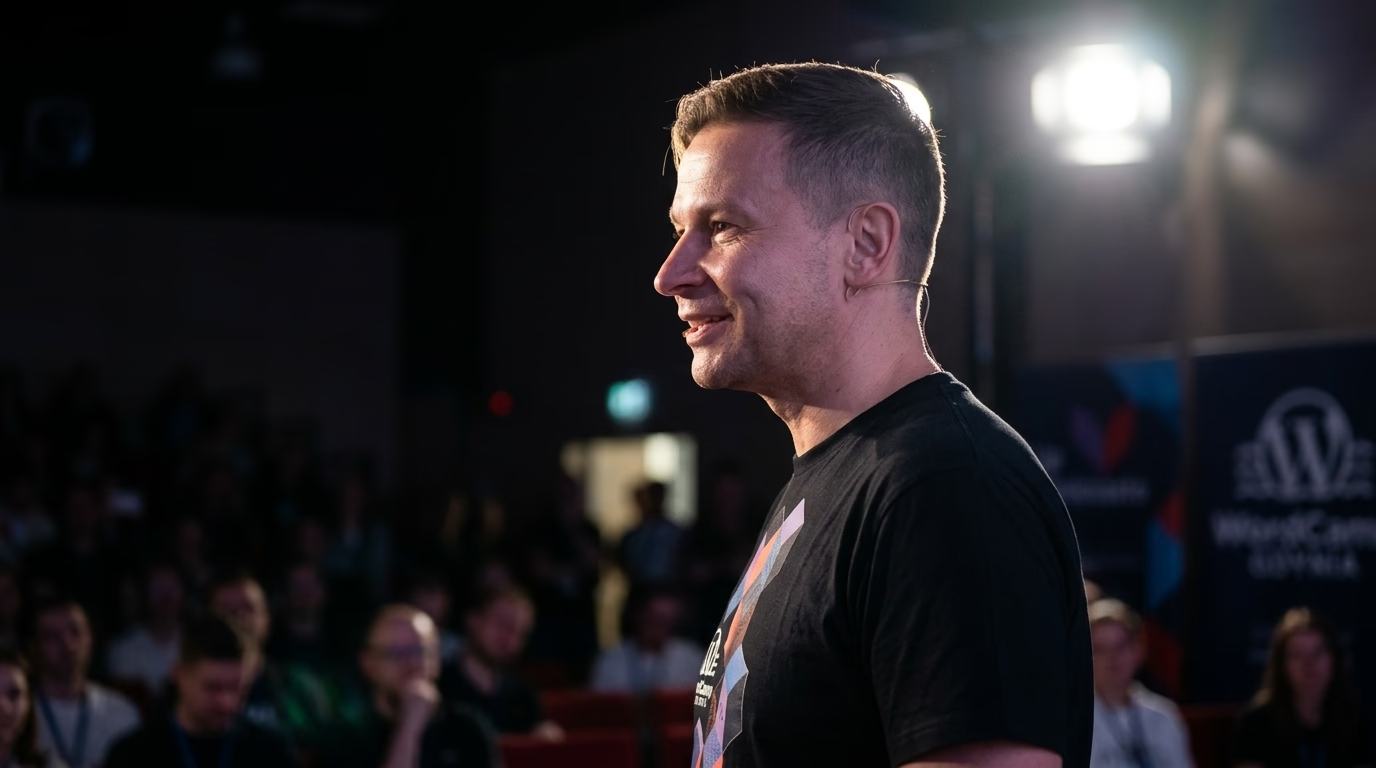
- I organise and speak at WordCamps.
- I have attended every WordCamp Europe from 2017 to 2026.
- Local WordPress meetup: WordPress Brno Community
Brno stands as Central Europe’s dynamic silicon basin and the primary technological capital of the Czech Republic. Driven by world-class academic institutions such as Masaryk University and Brno University of Technology, the sprawling technological hub of the South Moravian Innovation Centre (JIC), and a dense concentration of multinational software development centers, cyber-security firms, and precision industrial exporters, Brno companies operate in highly competitive international markets. Yet many established organizations across the South Moravian region continue to rely on obsolete monolithic CMS setups in WordPress, Joomla, or Drupal, suffering from high cloud maintenance overhead, plugin vulnerabilities, and slow web vitals.
As an independent software engineer, I guide commercial enterprises through zero-loss technical migrations to modern decoupled architectures utilizing Astro and Next.js. My work centers on eliminating web technical debt, engineering sub-second page loads, and strictly preserving existing search engine visibility through forensic redirect engineering. I work remotely from Gdynia, Poland, operating smoothly in the Central European Time zone (CET) alongside Czech engineering and marketing teams with predictable milestones and transparent B2B collaboration.
Strategic drivers for replacing legacy CMS monoliths in Brno
Decades ago, coupling a content management system directly to a live web server and database was the only practical way to run a website. In today’s digital climate, however, running a monolithic stack introduces operational liabilities for ambitious Czech businesses:
First, recurring security risks and ongoing patch management. Monolithic installations require constant maintenance of the core engine, themes, and dozens of third-party plugins. A single unpatched plugin can open security holes, leading to automated SQL injections or malware defacements. By adopting an Astro static architecture, the public website consists entirely of compiled, static HTML, CSS, and media files distributed across edge networks. Without an executable backend server or connected database in the delivery layer, the external attack surface is completely eliminated.
Second, web performance degradation and mobile drop-off. Complex legacy CMS themes inject hundreds of kilobytes of unoptimized scripts, render-blocking CSS, and bloated database queries, resulting in poor Time to First Byte (TTFB) and high Interaction to Next Paint (INP) latency. Astro solves this through its revolutionary Islands Architecture: content is delivered as pure static HTML by default, and client-side JavaScript is loaded exclusively for specific interactive components where necessary.
Third, infrastructure cost reduction and extreme scalability. Managing traditional monolithic websites during marketing campaigns or product releases often demands expensive auto-scaling cloud instances and Redis caching layers. Static and hybrid architectures can be hosted on highly efficient global edge CDNs, handling major traffic surges with near-zero latency and minimal infrastructure cost.
The seven-step technical migration framework
A seamless migration requires disciplined execution to ensure that no business operations are disrupted and no valuable search rankings are compromised. I apply a proven seven-phase engineering process:
1. Forensic URL crawling and asset inventory
The process begins with an in-depth extraction of your entire current website structure. Using automated web crawlers alongside Google Search Console performance data and server access logs, I construct an inventory of all public URLs, downloadable technical sheets, media files, and legacy redirect rules. Content assets with strong historical backlinks are flagged for dedicated monitoring.
2. Structured data extraction and markup sanitization
Content residing in legacy databases is extracted using automated scripts that strip out obsolete visual builder artifacts (such as Elementor, Divi, or Visual Composer shortcodes) and inline styling. The text is structured into clean, type-safe Content Collections in Astro or accessible JSON schemas, preserving all authors, dates, taxonomy categories, and localized metadata.
3. Comprehensive 301 permanent redirect mapping
Retaining organic traffic hinges on precise URL management. I design an exhaustive redirect matrix where every historical URL that changes structure is given a direct, permanent HTTP 301 redirect pointing to its exact new destination. Blanket redirects to the homepage are avoided, as search engine algorithms treat them as soft-404 errors, causing organic authority to dissipate.
4. Preservation of SEO tags, OpenGraph, and JSON-LD schema
All title tags, meta descriptions, canonical URLs, and social OpenGraph tags are systematically mapped. Furthermore, I implement modern Schema.org structured data tailored to Czech technology companies and manufacturers (such as Organization, SoftwareApplication, TechArticle, Product, and FAQPage schemas), ensuring maximum discoverability in both traditional search engines and AI generative models.
5. Staging deployment and automated validation
Before any production traffic is rerouted, the new frontend is deployed to an authenticated, non-indexed staging environment. In this phase, I run thorough automated test suites:
- Comprehensive HTTP status validation across all mapped URLs to eliminate 404 errors.
- Automated accessibility validation meeting WCAG 2.2 AA standards (including keyboard focus states and accessible contrast ratios).
- Performance benchmarking under simulated mobile network throttling to confirm optimal image optimization in modern WebP and AVIF formats.
- Complete functional verification of technical inquiry forms and integrations with third-party CRM systems.
6. Controlled production switchover
The cutover takes place during an agreed low-traffic window, preceded by lowering DNS TTL values to facilitate immediate global propagation. Once live traffic routes smoothly to the new frontend, staging noindex barriers are removed, and robots.txt files and sitemaps are verified.
7. Post-launch search console monitoring
Over the month following deployment, I actively review indexation and coverage metrics within Google Search Console. Any emerging crawl discrepancies or unanticipated query patterns are swiftly investigated and resolved.
Architectural comparison: Astro vs. Next.js for your project
Choosing the correct frontend framework depends directly on the functional nature of your web portal:
| Architectural Metric | Astro (Static First & Island Architecture) | Next.js (App Router & Server Components) |
|---|---|---|
| Optimal Project Fit | Corporate marketing sites, tech docs, product catalogs | SaaS web apps, dynamic customer portals, intranets |
| Rendering Strategy | Static Site Generation (SSG) with selective hydration | Server-Side Rendering (SSR) and dynamic streaming |
| Client-Side JavaScript | Zero kilobytes by default on informational pages | Bundles React runtime across client-rendered components |
| Interaction Latency (INP) | Outstanding (commonly below 25 milliseconds) | Highly responsive when bundle sizes are kept lean |
| Hosting Complexity | Extremely simple (edge CDN or static object storage) | Requires Node.js application server or serverless compute |
For the majority of Brno manufacturing suppliers, software consultancies, and B2B corporate platforms, Astro represents the fastest, most secure, and most cost-effective solution. If your platform demands authenticated client dashboards or real-time data calculations, I build the frontend using Next.js.
Regulatory compliance and digital standards in the Czech Republic
Modernizing your frontend provides an ideal opportunity to align with European and Czech digital legal requirements:
European Accessibility Act and Czech Act No. 424/2023 Coll.
The European Accessibility Act has been transposed into Czech law under Act No. 424/2023 Coll., coming into full effect for digital services and consumer e-commerce on 28 June 2025. It mandates that digital interfaces be accessible to all users, adhering to European standard EN 301 549 and WCAG 2.2 Level AA. I implement accessible code at the structural level: fully navigable keyboard interfaces, semantic landmarks, high-contrast visual hierarchies, and clear form labels.
GDPR and cookie consent under the Electronic Communications Act
In accordance with Act No. 127/2005 Coll. (Electronic Communications Act) and the General Data Protection Regulation (GDPR), non-essential cookies and analytics trackers require prior, opt-in consent from website visitors. By deploying Astro, we remove unnecessary third-party tracking dependencies, host all typography locally, and provide lightweight consent management compliant with the Office for Personal Data Protection (ÚOOÚ).
Mandatory business disclosures
Czech commercial law requires businesses operating online to provide transparent identification details on their website: company legal name, registered seat, identification number (IČO), tax identification number (DIČ), and registration details with the regional commercial court (such as the Regional Court in Brno).
Begin your platform migration
If your organization in Brno is seeking to retire an aging, vulnerable CMS and transition to an ultra-fast, modern web architecture, reach out with your website URL and project goals. I will provide a technical assessment and a clear migration plan tailored to your technical requirements.
Selected projects
Examples of my work.
Corporate Website: osemka.pl - Banner
A package of various special banners for the osemka.pl website
Corporate Website: osemka.pl - bannery
A package of various special banners for the osemka.pl website
Corporate Website: strefapremium.pl
The website strefapremium.pl has been designed as a modern premium portal, dedicated to users seeking exclusive content and services. The site combines high-...
WordPress support & development in Brno
See also in Czech Republic
Need this service: Next.js / Astro migration in Brno?
Describe your project by e-mail. I reply within 48 hours.
Describe your projectExplore other WordPress services and knowledge base
Migration to Astro, Next.js, and headless WordPress.
WooCommerce sync with ERP and wholesale systems.
Business process automation around WordPress and company systems.
Library of concrete automation use cases.
Headless WordPress, Sanity, Strapi, and Contentful with Astro or Next.js.
Astro, MDX, edge delivery, and Core Web Vitals measured on real traffic.
Custom WordPress engineering and architecture.
Scalable headless, ERP, and AI architecture for enterprise.
Related categories
Supporting articles
Six to sixteen weeks for typical engagements, with a four-phase shape: discovery, scoping, build and cutover, tuning. The variables are catalogue size, integration count, URL preservation, and editorial team readiness, not framework choice.
A definitive 4-year Total Cost of Ownership (TCO) analysis, real-world Core Web Vitals benchmarks, Astro 7 GraphQL APQ architecture, and a 10-point executive decision matrix for choosing between decoupled and traditional WordPress.

The Shopify Plus vs WooCommerce headless decision in 2026 is no longer a binary "platform vs custom" trade-off. Both can run headless, both integrate AI, both ship at the edge. The real axes are control, total cost over five years, and exit strategy. This article walks the matrix with confirmed platform facts.