Website & application migration in Gdańsk
I migrate sites from WordPress, Joomla, Drupal, Angular, Vue and other technologies to Astro and Next.js. I plan each migration to keep SEO, content and features intact and switch over in an agreed window. I work alone and have years of experience with both legacy and modern stacks.
- I have had a wordpress.org account since 2006.
- I contributed to WordPress core for versions 7.0 and 7.1.
- I maintain 30 plugins on wordpress.org.
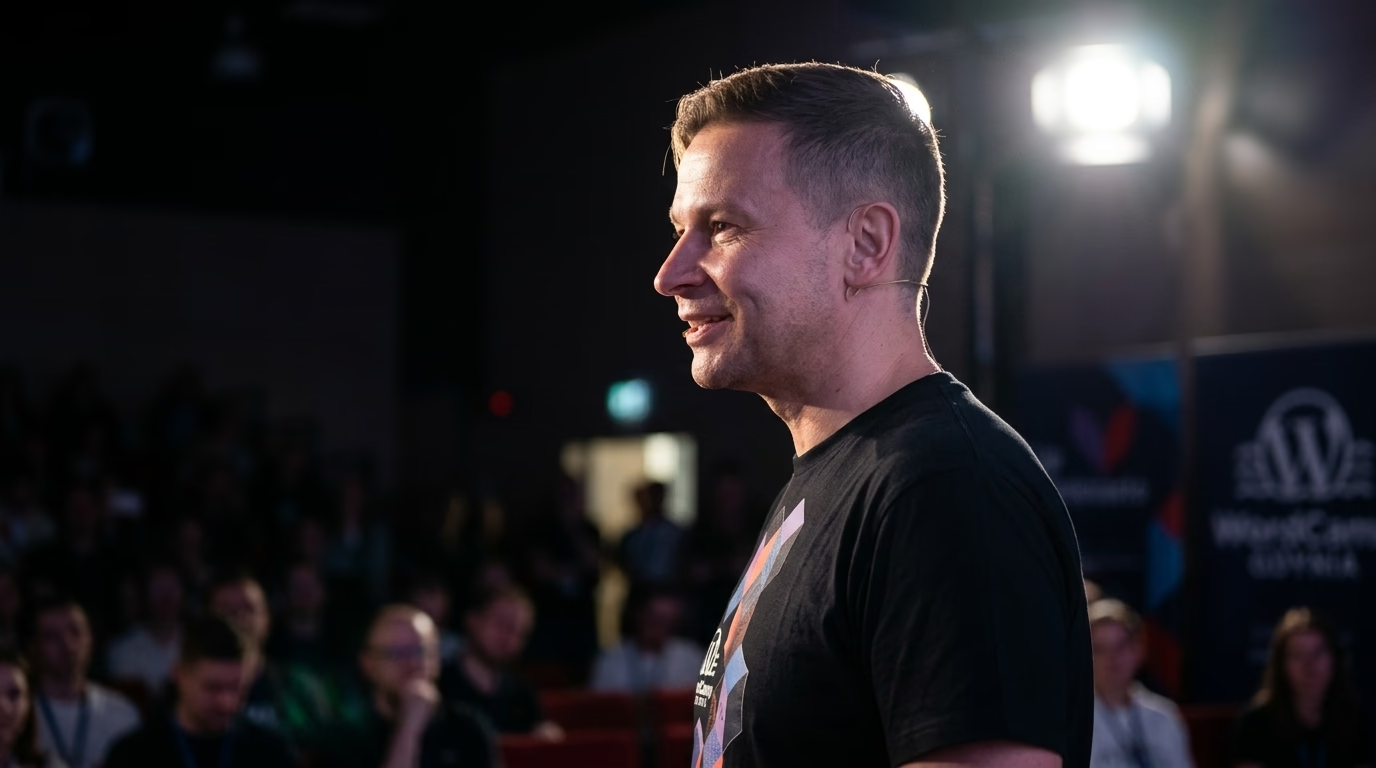
- I organise and speak at WordCamps.
- I have attended every WordCamp Europe from 2017 to 2026.
- Local WordPress meetup: WordUp Trójmiasto
Gdańsk is the capital of the Pomeranian Voivodeship and, with Gdynia and Sopot, forms the Tricity metropolitan area of roughly 1.5 million residents. Companies across the Pomeranian coast sell to domestic customers across Poland and international trade partners throughout Scandinavia, Western Europe, and global sea freight lanes. When corporate portals rely on monolithic legacy architectures where every layout change threatens server stability, shifting frontend presentation to Astro or Next.js eliminates maintenance headaches while slashing cloud expenditure. As an independent engineer operating from Gdynia across Central European Time, I direct every migration personally, from raw log audits through reverse-proxy verification and long-term search indexing defense.
When is moving to Astro or Next.js worth it for a Gdańsk enterprise?
Rebuilding a web presence makes commercial sense when legacy infrastructure actively impedes operational velocity, brand reputation, or editorial productivity. Typical triggers include legacy monoliths collapsing under marketing campaign traffic spikes, bloated administrative panels that freeze during inventory updates, and technical debt that turns routine software updates into costly firefighting drills.
When a database cleanup, cache tuning, or PHP version modernization can resolve systemic bottlenecks, I advise keeping the current system. Replatforming must justify its operational footprint through tangible improvements in latency, resilience, and workflow autonomy.
Astro provides an exceptional foundation for content-heavy architectures including corporate marketing platforms, multilingual export directories, maritime logistics documentation, and educational hubs. By pre-rendering clean static HTML and shipping zero client-side JavaScript by default, Astro ensures instantaneous page transitions and eliminates server render overhead. Next.js complements dynamic transactional segments, such as authenticated partner extranets, live cargo tracking portals, and interactive product configurators requiring server-side rendering or edge-computed session logic. Combining both frameworks on a single domain via reverse proxy allows enterprises to deliver static performance on public tiers while isolating dynamic applications.
How do I keep my Google rankings during the migration?
Unplanned organic search drops during replatforming almost always stem from incomplete URL inventories and carelessly executed redirects. Standard web crawlers only capture pages that currently possess active internal links, missing historical landing pages that still collect valuable backlinks. Search console exports highlight query impressions but miss unranked technical assets. Real server access logs expose the true footprint of external traffic, including deep bookmarks, legacy PDF downloads, email campaign targets, and external trade citations. I synthesize all three data streams into a unified migration ledger before architecting DNS routing.
Every indexed address receives an unambiguous assignment within an immutable redirect matrix:
- Retain existing URL structures wherever technically feasible.
- Route merged editorial pages to their closest thematic counterpart using a direct 301 header, barring intermediary redirect chains.
- Mark retired services and legacy announcements with explicit HTTP 404 or 410 headers rather than executing generic homepage bounces.
Beyond redirect execution, I run rigorous cross-platform validations comparing title tags, meta descriptions, canonical URLs, robots directives, Open Graph cards, and schema hierarchies. Structured data schemas such as Organization, Article, LocalBusiness, and BreadcrumbList frequently live inside legacy CMS plugins, vanishing without warning unless recreated explicitly in template components. For multilingual export sites serving Polish, English, German, or Scandinavian buyers, I verify that alternate hreflang tags match bidirectionally and point accurately to respective self-referencing canonical targets.
Prior to DNS modification, automated test suites query representative sample URLs across staging and production environments, inspecting status codes, response headers, caching directives, and core textual content. A secondary verification pass traverses the complete redirect map to eliminate recursive forwarding loops and unnecessary hops.
What happens to the content and the editors?
Adopting headless architecture does not require retraining editorial personnel on unfamiliar backends. WordPress can remain your authoritative content hub, handling media libraries, editorial drafts, review permissions, and publishing calendars, while Astro or Next.js consumes structured payloads via the REST API or WPGraphQL. Sites migrating away from outdated installations of Joomla or Drupal can either import historic archives into a clean WordPress core or transition to a headless repository tailored to corporate requirements.
Decoupling presentation from storage forces structured data governance. Page titles, promotional hooks, executive bios, technical specs, downloadable schematics, and SEO metadata transform into typed fields rather than unmaintainable page-builder blobs. Every component implements an explicit contract specifying mandatory properties, layout variations, and fallback behavior when optional imagery or links are omitted. On multilingual platforms, language exists as an explicit schema attribute linked across translations, preventing localized catalogs from falling out of synchronization.
Editorial teams maintain standard publication schedules while new frontend systems are engineered against staging endpoints. Content freezes are restricted to short intervals during cutover only when database migrations demand transactional locks.
How does the cutover work, and what if something breaks?
Every cutover plan begins with comprehensive baseline benchmarks: real-user Core Web Vitals across mobile and desktop connections, time-to-first-byte metrics, conversion completion rates, organic keyword rankings, and Google Search Console index counts categorized by template group.
Migration cutovers follow an incremental, phased deployment strategy. Rather than executing an all-or-nothing switch, an edge proxy routes individual URL segments such as blogs, service sections, or regional microsites to the new Astro deployment while legacy systems service remainder traffic. Rollback triggers are documented beforehand with unambiguous, measurable thresholds: broken lead capture endpoints, customer authorization failures, unwanted noindex tags, or malfunctioning analytics tracking. The legacy hosting cluster remains synchronized and ready for rapid rollback throughout the cutover observation period.
Following DNS migration, I maintain active surveillance over 404 logs, edge cache hit rates, serverless error traces, and Google Search Console indexing reports to resolve crawler anomalies before they influence search distribution.
What do data protection rules mean for a site hosted in Gdańsk?
Static architectures substantially reduce exposure to common web exploits like SQL injection and cross-site scripting, but they do not exempt site owners from data governance compliance. Lead forms, newsletter signups, analytical trackers, session recording tools, and job applicant submissions handle personal data subject to European Union General Data Protection Regulation and Polish national statutory frameworks. In Poland, data privacy enforcement is administered by the Personal Data Protection Office (Urzad Ochrony Danych Osobowych - UODO) alongside electronic communication standards under the Telecommunications Law and upcoming Electronic Communications Law (PKE).
A frontend migration offers an ideal opportunity to map every third-party integration and verify data processing agreements. For every script and endpoint, I document processing purposes, recipient identities, data retention periods, and storage territories. Consent banners are configured so that non-essential tracking pixels and external marketing tags remain blocked until visitors provide explicit, affirmative opt-in consent. Administrative portals are isolated behind independent subdomains, strict IP filtering, and multi-factor authentication, segregating sensitive business management from public edge networks.
Which Gdańsk businesses benefit most?
The Pomeranian economy combines historic maritime strength with modern technical innovation. Gdańsk hosts major shipping terminals, including the Deepwater Container Terminal (DCT / Baltic Hub), advanced shipbuilding yards, petrochemical refining complexes, and engineering consultancies. Alongside these traditional sectors, the Tricity has evolved into an international technology hub centered around office complexes like Olivia Centre and Alchemia, housing software houses, telecommunications providers, fintech ventures, and international business service centers.
Enterprises in maritime logistics, offshore wind energy, precision manufacturing, and corporate B2B services frequently operate sprawling multilingual portals, technical documentation repositories, and heavy integration layers connecting with ERP systems or custom order registries. These platforms gain enormous value from headless Astro frontends that eliminate database bloat, reduce server infrastructure overhead, and preserve mission-critical SEO rankings across international borders.
Independent professional practices and smaller service businesses operating regional portfolios rarely require complex Next.js infrastructure. For these organizations, an ultra-lean Astro build deployed on a modern edge network provides superior loading speeds and zero maintenance overhead at minimal monthly cost.
Deliverables and final project handover
Upon project completion, your internal technical team receives complete ownership of Git repositories, deployment workflows, reverse-proxy configurations, redirect manifests, and architectural documentation detailing component boundaries and integration endpoints. Because the stack utilizes standard, modern frameworks, any competent TypeScript developer can maintain and extend the platform without vendor lock-in. Additional architectural details are available on the Next.js and Astro migration documentation and the headless CMS development overview.
How do I start?
Initiating an architectural evaluation is straightforward. Provide your current website URL, current CMS version, high-priority integrations (CRM endpoints, contact forms, marketing trackers, or customer portals), and a summary of current performance challenges, along with Search Console read permissions if available. I provide a structured technical proposal covering migration scope, architectural options, migration risk registers, and verification milestones within 48 hours.
Stack fit in Gdańsk
Meetup: WordUp Trójmiasto (https://www.meetup.com/gdynia-wordpress-meetup/).
Selected projects
Examples of my work.
E-commerce Development: VECTOR GROUP
The project for VECTOR Group, a dynamically growing technology consortium operating on global markets in the field of access network infrastructure and data ...
E-commerce Development: VECTOR SMART DATA
Vectorsmartdata.net is a website created for VECTOR Group, a provider of advanced telemetry solutions enabling real-time data monitoring and management. As ...
E-commerce Development: wyposazenie-szkol.com
The website wyposazenie-szkol.com was designed to comprehensively present the offer of educational facility supplies. The main goal of the site is to showcas...
WordPress support & development in Gdańsk
Need this service: Next.js / Astro migration in Gdańsk?
Describe your project by e-mail. I reply within 48 hours.
Describe your projectExplore other WordPress services and knowledge base
Migration to Astro, Next.js, and headless WordPress.
WooCommerce sync with ERP and wholesale systems.
Business process automation around WordPress and company systems.
Library of concrete automation use cases.
Headless WordPress, Sanity, Strapi, and Contentful with Astro or Next.js.
Astro, MDX, edge delivery, and Core Web Vitals measured on real traffic.
Custom WordPress engineering and architecture.
Scalable headless, ERP, and AI architecture for enterprise.
Related categories
Supporting articles
Six to sixteen weeks for typical engagements, with a four-phase shape: discovery, scoping, build and cutover, tuning. The variables are catalogue size, integration count, URL preservation, and editorial team readiness, not framework choice.
A definitive 4-year Total Cost of Ownership (TCO) analysis, real-world Core Web Vitals benchmarks, Astro 7 GraphQL APQ architecture, and a 10-point executive decision matrix for choosing between decoupled and traditional WordPress.
The Shopify Plus vs WooCommerce headless decision in 2026 is no longer a binary "platform vs custom" trade-off. Both can run headless, both integrate AI, both ship at the edge. The real axes are control, total cost over five years, and exit strategy. This article walks the matrix with confirmed platform facts.