Website & application migration in Ghent
I migrate sites from WordPress, Joomla, Drupal, Angular, Vue and other technologies to Astro and Next.js. I plan each migration to keep SEO, content and features intact and switch over in an agreed window. I work alone and have years of experience with both legacy and modern stacks.
- I have had a wordpress.org account since 2006.
- I contributed to WordPress core for versions 7.0 and 7.1.
- I maintain 30 plugins on wordpress.org.
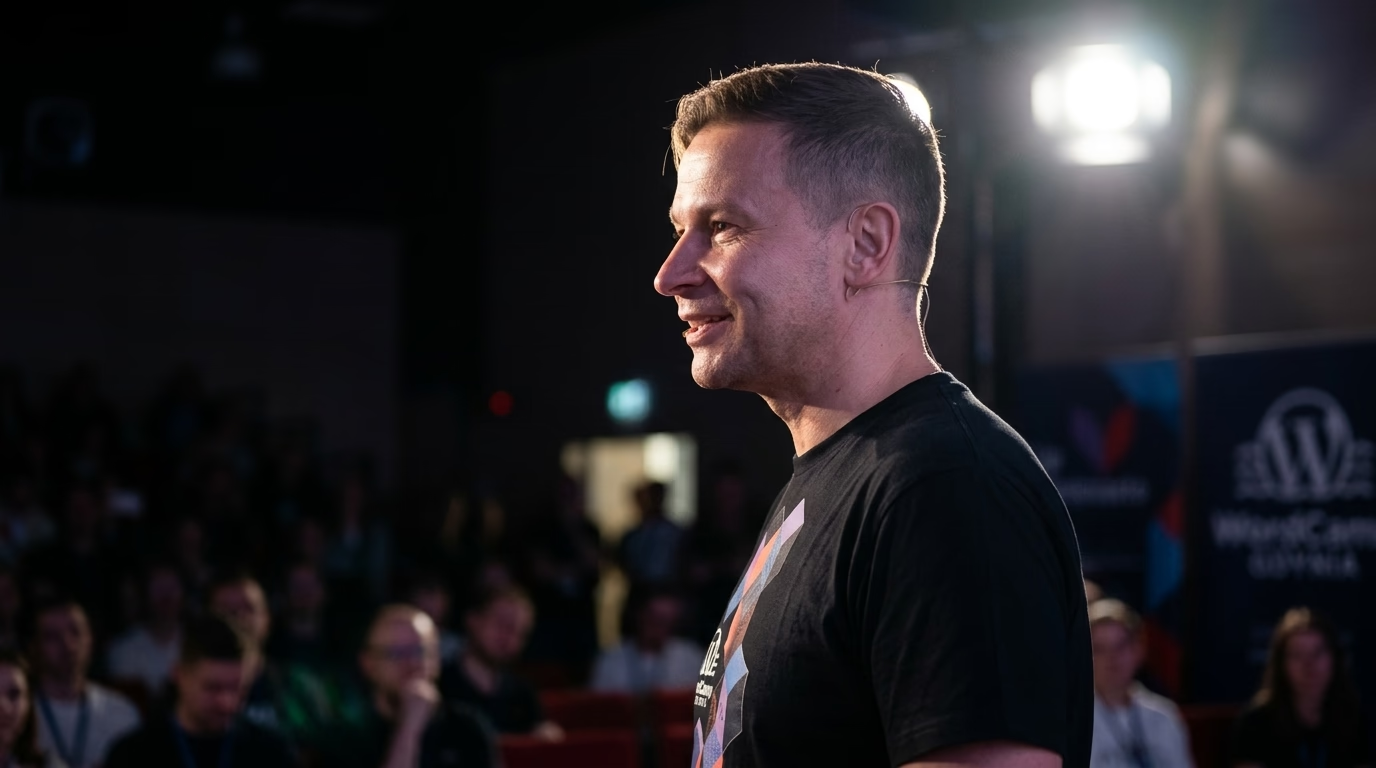
- I organise and speak at WordCamps.
- I have attended every WordCamp Europe from 2017 to 2026.
Ghent is the capital of East Flanders and, with more than 270,000 residents, the second-largest municipality in Belgium. As a thriving academic, industrial, and technological hub, Ghent brings together historic commerce, world-class research through Ghent University (UGent) and VIB (Flanders Institute for Biotechnology), dynamic maritime logistics centered on North Sea Port, and a rapidly expanding cluster of digital and software enterprises around tech campuses like Dok Noord and The Loop. Operating as an independent full-stack developer based in Gdynia and collaborating across Central European Time, I manage frontend and CMS replatforming projects directly, preserving organic search authority, tightening data compliance, and transitioning overloaded monolithic websites into decoupled architectures built on Astro or Next.js.
Should a Ghent enterprise migrate, or just fix the current site?
I always begin by testing whether an existing installation can be rescued economically. If page rendering lag originates from poorly optimized templates, uncompressed media assets, obsolete plugins, or missing server-side cache layers, remediating those bottlenecks within your existing CMS is far more cost-effective than undertaking a platform rewrite. When that is the case, I document the exact remediation steps rather than proposing a premature replatforming project.
A migration to Astro or Next.js becomes commercially justified when systemic architecture boundaries constrain operational growth:
- routine software updates are skipped because core updates routinely break custom plugins or fragile visual page builders,
- editorial contributors avoid the administrative dashboard because publishing simple articles causes interface timeouts,
- mostly static pages, such as corporate service profiles and compliance disclosures, trigger redundant database queries on every HTTP request,
- engineering teams need to deploy modern client applications, such as specialized research data visualizers, B2B procurement portals, or interactive booking modules, which monolithic systems accommodate poorly.
Astro provides an exceptional foundation for content-driven architectures, including multilingual academic portals, manufacturing catalogs, logistics service sheets, and corporate marketing websites. By pre-rendering pure static HTML at build time and delivering zero unnecessary JavaScript to the browser, Astro ensures near-instantaneous page delivery. Next.js excels where authenticated sessions, real-time user state, or complex serverless compute are required, such as gated customer portals or transactional configurators. Both frameworks can consume structured content from headless CMS backends, Git repositories, or existing WordPress REST endpoints during transitional phases.
Protecting organic Google search visibility during path changes
Constructing an authoritative URL redirect inventory precedes any frontend coding work. I harvest legacy URLs from sitemaps, server access logs, web analytics platforms, Google Search Console query logs, and underlying database tables. In Ghent’s research, manufacturing, and port sectors, legacy PDF datasheets, technical whitepapers, and academic publications frequently hold substantial backlink equity from universities and international trade partners, making direct document mapping essential.
Every historical address receives an unambiguous assignment within an immutable redirect ledger:
- Maintain legacy URL paths wherever feasible.
- Direct replaced or consolidated articles to their closest modern equivalent using direct HTTP 301 headers, strictly barring multi-hop redirect chains.
- Serve explicit HTTP 404 or 410 headers for permanently retired content, rather than bouncing visitors indiscriminately to the root domain.
Google guidelines recommend preserving 301 redirects for a minimum of one year and ideally indefinitely. I configure permanent redirect maps at edge proxy layers so they persist transparently without degrading origin application performance. When migrations involve domain or subdomain modifications, I submit formal Change of Address directives within Google Search Console for all registered site properties, including www and non-www protocols.
What structural elements move besides visible pages?
- Content schemas and relationships. Monolithic post types, taxonomy terms, custom meta fields, and multi-tier navigation trees become strictly typed data schemas. This extraction isolates legacy liabilities, such as visual page builder shortcodes, unescaped HTML fragments, and plugin-dependent translation records.
- Semantic structured data. Organization, BreadcrumbList, Article, Event, and FAQ schemas are synthesized directly from component fields, guaranteeing that search engine metadata reflects visible on-page content identically.
- Metadata parity auditing. Automated staging crawls compare legacy and target endpoints across page titles, meta descriptions, canonical declarations, primary headings, schema markup, and internal link distributions, resolving unintended discrepancies before production release.
- Third-party integrations and event trackers. Contact forms, demo booking schedules, newsletter subscriptions, and conversion trackers are cataloged and tested with authentic test payloads on staging environments prior to production cutover.
Managing Dutch, French, and English multilingual requirements in Flanders
Ghent is situated in the Flemish Region where Dutch represents the sole official administrative language. However, Belgian commerce routinely spans linguistic borders, requiring Dutch, French, and German communication across national markets, alongside English for international trade, maritime logistics, and academic collaboration.
Designing language architecture occurs before migrating content: determining directory patterns, localized slug schemes, locale switchers, and hreflang tag hierarchies. Google requires that every language edition references both its own canonical URL and all reciprocal language versions; asymmetric or missing return tags frequently result in search engines disregarding international annotations entirely. When addressing specific Belgian regional audiences, correct language-region codes such as nl-BE and fr-BE must be deployed, whereas a standalone “be” token represents an invalid syntax error. An x-default declaration directs international visitors whose language does not match configured locales. I construct these relationships directly within frontend component logic and validate bidirectional reciprocity on pre-rendered HTML files.
Belgian data privacy governance and regulatory compliance
Form submissions, analytic tracking scripts, newsletter registrations, and recruitment pipelines handle personal identifiable information subject to the European Union General Data Protection Regulation and Belgian statutory privacy laws. In Belgium, privacy oversight is governed by the Data Protection Authority (Gegevensbeschermingsautoriteit / Autorite de protection des donnees - GBA/APD). Decoupling the frontend provides an opportune moment to audit tracking inventories: identifying scripts executing on each page, evaluating cookie lifetimes, and verifying where form payloads are transmitted. Obsolete marketing pixels and unverified tracking libraries are excluded from the new build.
Infrastructure deployment requires strategic evaluation. Static Astro outputs can be distributed across global CDN edges, while dynamic Next.js services run in containerized or serverless runtimes. Where corporate governance or enterprise client agreements necessitate European Union data localization, I configure hosting endpoints in designated European regions and document data flows within the handover documentation.
How does the cutover work, and what do I watch afterwards?
For expansive corporate architectures, migrations proceed incrementally. An edge routing layer directs designated sub-paths, such as technical blogs, product catalogs, or documentation hubs, to the new Astro deployment while the legacy CMS continues serving legacy services, isolating risks and preventing platform-wide disruptions. Compact corporate sites transition via a unified cutover, eliminating the overhead of managing synchronized dual-stack infrastructure.
Post-launch verification includes submitting refreshed sitemaps, monitoring Search Console indexing coverage, auditing server log response distributions, and testing legacy URL redirects against live endpoints. Any isolated 404 occurrences or redirect hops are resolved immediately. Real-user Core Web Vitals metrics are monitored continuously as field data aggregates.
Clients retain full ownership of Git source repositories, deployment pipelines, edge proxy configurations, and administrative workflow documentation. Webmaster tools, domain registrars, and analytics accounts remain securely held under direct client control throughout the project lifecycle.
Further details on my approach are available on the Next.js and Astro migration overview and the Astro development guide.
What do I need from you to scope the work?
To prepare a concrete architectural plan, send your current website URL, CMS framework and version, active language editions, and key traffic acquisition channels (organic search, pay-per-click, partner referrals, or direct academic links). Search Console read access is helpful but not mandatory for initial assessments. I provide a written assessment outlining migration boundaries, URL redirect strategies, editorial workflow options, and technical risk mitigations within 48 hours.
Selected projects
Examples of my work.
E-commerce Development: led-lumina.pl
led-lumina.pl is a professional online store that presents a comprehensive range of innovative LED solutions for both individual and business customers. The ...
E-commerce Development: like2slide.com
like2slide.com is a website for the ski, snowboard, and wakeboard community, built for inspiration, publishing, and stable operation.
E-commerce Development: marcoaldany.pl
marcoaldany.pl is a WordPress website built to present personalised services to show how this system can support companies offering personalised services or...
WordPress support & development in Ghent
Need this service: Next.js / Astro migration in Ghent?
Describe your project by e-mail. I reply within 48 hours.
Describe your projectExplore other WordPress services and knowledge base
Migration to Astro, Next.js, and headless WordPress.
WooCommerce sync with ERP and wholesale systems.
Business process automation around WordPress and company systems.
Library of concrete automation use cases.
Headless WordPress, Sanity, Strapi, and Contentful with Astro or Next.js.
Astro, MDX, edge delivery, and Core Web Vitals measured on real traffic.
Custom WordPress engineering and architecture.
Scalable headless, ERP, and AI architecture for enterprise.
Related categories
Supporting articles
Six to sixteen weeks for typical engagements, with a four-phase shape: discovery, scoping, build and cutover, tuning. The variables are catalogue size, integration count, URL preservation, and editorial team readiness, not framework choice.
A definitive 4-year Total Cost of Ownership (TCO) analysis, real-world Core Web Vitals benchmarks, Astro 7 GraphQL APQ architecture, and a 10-point executive decision matrix for choosing between decoupled and traditional WordPress.

The Shopify Plus vs WooCommerce headless decision in 2026 is no longer a binary "platform vs custom" trade-off. Both can run headless, both integrate AI, both ship at the edge. The real axes are control, total cost over five years, and exit strategy. This article walks the matrix with confirmed platform facts.