Website & application migration in Helsinki
I migrate sites from WordPress, Joomla, Drupal, Angular, Vue and other technologies to Astro and Next.js. I plan each migration to keep SEO, content and features intact and switch over in an agreed window. I work alone and have years of experience with both legacy and modern stacks.
- I have had a wordpress.org account since 2006.
- I contributed to WordPress core for versions 7.0 and 7.1.
- I maintain 30 plugins on wordpress.org.
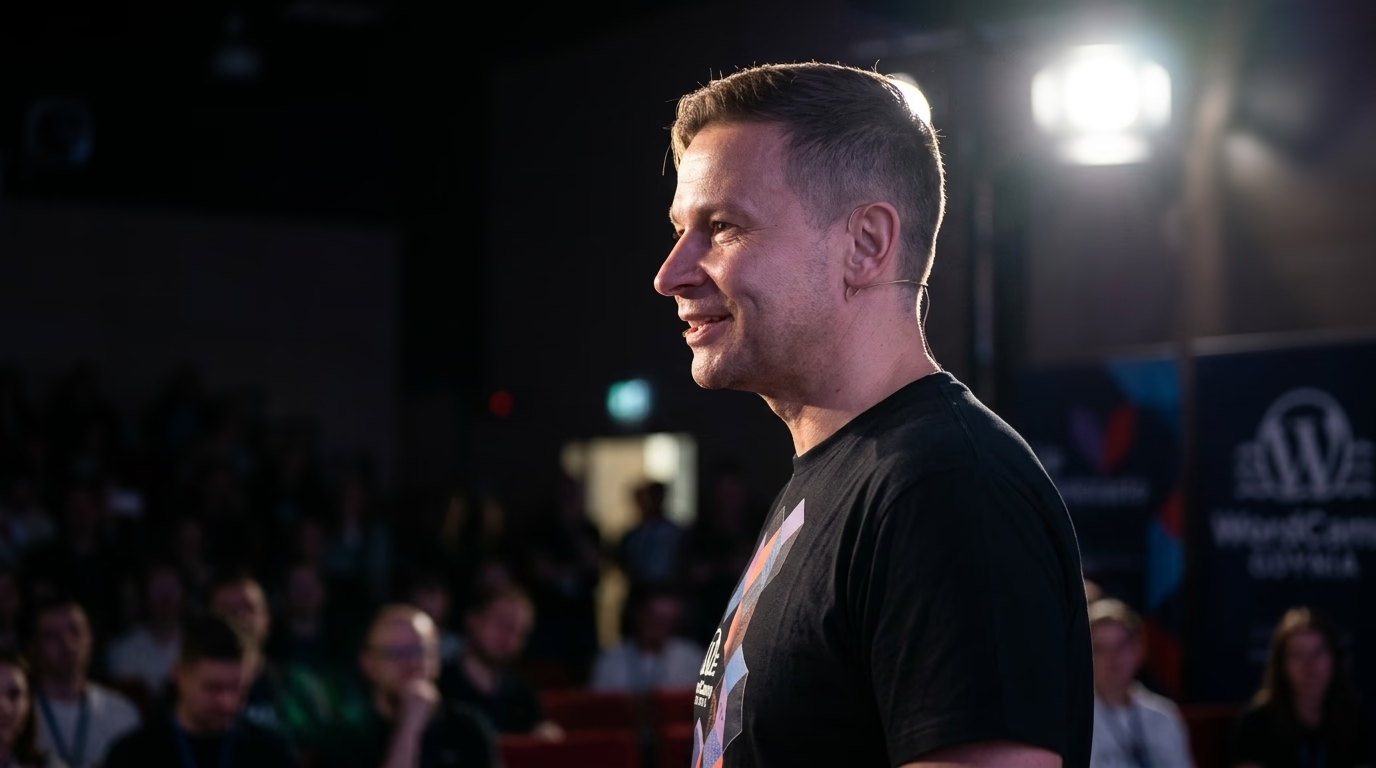
- I organise and speak at WordCamps.
- I have attended every WordCamp Europe from 2017 to 2026.
- Local WordPress meetup: WordPress Helsinki
Companies across Helsinki and the Uusimaa capital region (including Espoo and Vantaa) move off WordPress, Joomla, Drupal or an ageing custom framework when the site has become slow to load, slow to edit and risky to update. Operating as an independent developer working remotely and in writing from Gdynia, I rebuild the frontend in Astro or Next.js, preserve your content and organic search rankings, and switch over in stages so the existing platform keeps serving visitors until the new architecture is verified. This page covers what the work involves, what is specific to a Finnish trilingual website (fi, sv, en), and how to request a written scope.
When is moving to Astro or Next.js worth it for a Helsinki company?
Replatforming makes sense when the bottleneck sits inside the underlying CMS architecture rather than in a single plugin you could deactivate. Typical symptoms include pages that require a bloated visual builder to render basic text, an administrative dashboard that responds slower than the public frontend, core updates postponed indefinitely before major B2B trade shows or Slush launches, and rising cloud hosting bills caused by stacking cache layers over unoptimised database queries.
If removing obsolete plugins, tuning object caching and cleaning up templates on your existing WordPress installation would resolve the issue, I state that clearly in my review and advise against a migration.
As an architectural boundary, Astro fits content-driven platforms: corporate service sites, technical documentation hubs, investor relations portals, and multilingual marketing sites where pages can be pre-rendered into static HTML ahead of time. By stripping unnecessary client-side JavaScript by default, Astro makes it straightforward to stay well within Google’s official Core Web Vitals thresholds (Largest Contentful Paint up to 2.5 s, Interaction to Next Paint up to 200 ms, Cumulative Layout Shift up to 0.1). Next.js fits routes that behave like software applications: authenticated customer portals, live telemetry dashboards, per-user pricing engines, and complex server-side filtering. Both frameworks can coexist under one domain, and more detail on choosing between them is on my Astro and Next.js migration page.
How does the Helsinki migration run, step by step?
- Inventory. I crawl the live site, export every indexable URL, pull the XML sitemaps and read the top landing pages from Search Console and your analytics. Pages that bring traffic or backlinks get priority, including technical whitepapers and PDF spec sheets; pages that bring nothing are candidates to merge or drop, and that decision is yours, in writing.
- URL map. Every old address gets one row: keep, change with a 301 to a named target, or retire with an explicit 410. One redirect per URL, straight to the final page, no chains. Google advises keeping redirects for at least a year; I configure them to remain permanently.
- Content model. Posts, pages, custom post types, Drupal nodes or Joomla articles become typed collections with required fields. Shortcodes, page builder blocks and embedded HTML are converted or flagged by hand, because they are where content silently breaks.
- Metadata parity. Page titles, meta descriptions, canonical links, Open Graph social properties and structured data schemas are carried over for every individual address. I compare the old and new values per URL across all language editions, not on a small sample.
- Staging. The new site runs on a separate address blocked from indexing. I run the redirect map against it, check status codes, render key templates and test forms and integrations.
- Staged cutover. Edge rules send one section at a time to the new frontend while the rest stays on the old CMS. A single switch is reserved for compact sites where dual routing adds no value.
- After launch. I submit the new sitemaps, watch indexing and traffic in Search Console, and read server logs for Googlebot hitting unexpected 404s or 5xx errors.
Helsinki’s tech, industrial and maritime sectors: where decoupled frontends excel
Organizations across the Greater Helsinki metropolitan area operate digital platforms that must balance international B2B reach with strict technical reliability:
- Enterprise SaaS, Cybersecurity and Gaming (Ruoholahti, Keilaniemi, Kalasatama): Software vendors, cloud infrastructure providers and studios clustered around Ruoholahti and Espoo’s Otaniemi/Keilaniemi corridor maintain extensive developer documentation, API changelogs, and release notes. Migrating these sections to Astro with Markdown or MDX collections allows engineering and product teams to publish updates via Git pull requests while marketing editors retain a headless CMS for landing pages.
- Cleantech, Energy and Marine Engineering: Industrial exporters and maritime technology suppliers in Helsinki publish multi-language product catalogues, compliance certificates, and downloadable technical drawings. A static Astro build serves these pages from global edge nodes without hitting a database on every visitor request.
- Life Sciences, Health Tech and Research Spin-outs: Organizations collaborating with the University of Helsinki or Aalto University frequently maintain trilingual project portals in Finnish, Swedish and English that must comply with strict accessibility and data protection standards long after active grant phases conclude.
Which languages does a Helsinki site have to handle?
Helsinki is an officially bilingual municipality under Finland’s Language Act (Kielilaki 423/2003), with Finnish (suomi) and Swedish (svenska) as official national languages, while English serves as the primary working language for international trade and technology. For a Helsinki business or public-facing organization, that routinely means running Finnish (fi or fi-FI), Swedish (sv or sv-FI), and English (en) editions side by side.
That trilingual structure makes hreflang one of the riskiest parts of a CMS migration. Google’s rules are strict: every language version must list itself and all its siblings, codes must follow ISO 639-1 (fi, sv, en, with optional ISO 3166-1 Alpha 2 region codes such as fi-FI and sv-FI), and links must point both ways or Google ignores the annotations entirely. Legacy WordPress and Drupal sites frequently rely on translation plugins whose link tables have drifted over the years, leaving orphaned Finnish or Swedish pages and pointing hreflang tags at 301-redirected URLs. I rebuild the annotations directly from the typed content model, where each translation group shares an explicit identifier, and add an x-default declaration where an international fallback route exists.
Which Finnish rules and authorities does the new site have to meet?
Three regulatory areas matter most when rebuilding a commercial website in Finland:
Accessibility (Laki digitaalisten palvelujen tarjoamisesta 306/2019). Finland’s Act on the Provision of Digital Services sets mandatory accessibility standards, and the Finnish Transport and Communications Agency (Liikenne- ja viestintävirasto, Traficom) supervises compliance through its digital accessibility unit (saavutettavuusvaatimukset.fi). Since 28 June 2025, consumer e-commerce services and several private-sector digital services fall under the Act’s service-specific requirements transposing the European Accessibility Act: covered services must meet EN 301 549 / WCAG 2.1 Level AA criteria, provide information on how the service meets accessibility obligations, and publish a compliant accessibility statement (saavutettavuusseloste). Rebuilding templates in Astro or Next.js is the most cost-effective moment to establish semantic heading hierarchies, sufficient colour contrast, visible keyboard focus states, and properly labelled form controls.
Cookies and electronic communications (Sähköisen viestinnän palvelulaki 917/2014). Under Section 205 of the Act on Electronic Communications Services, supervised by Traficom, storing cookies or reading data from a user’s terminal device requires the user’s prior consent, except for storage that is strictly necessary solely to enable transmission of a communication or to provide a service explicitly requested by the subscriber or user. Traficom’s official cookie guidance emphasizes that analytics cookies are not considered strictly necessary by default, and that refusing non-essential cookies must be as easy as accepting them.
Personal data and corporate disclosures (Tietosuojalaki 1050/2018 & Osakeyhtiölaki 624/2006). The Office of the Data Protection Ombudsman (Tietosuojavaltuutetun toimisto) oversees GDPR and the Finnish Data Protection Act. During a migration I catalogue every form endpoint, CRM webhook, and third-party script so your privacy notice (tietosuojaseloste) reflects actual data flows. In addition, for a Finnish limited liability company (osakeyhtiö, Oy), I verify that statutory company identification details, including the Business ID (Y-tunnus) registered in the Finnish Business Information System (YTJ) and the Trade Register (Kaupparekisteri), remain clearly visible across footer templates.
Pre-cutover verification table for Helsinki migrations
| Verification step | How I check it before switching production traffic |
|---|---|
| Complete URL & asset map | Every indexed URL and PDF from Search Console, sitemaps and server logs returns HTTP 200 or a single 301 |
Trilingual hreflang (fi, sv, en) | Bidirectional return tags and self-referencing canonicals validated on built HTML across all three locales |
| Traficom cookie compliance | Network inspection confirms zero analytics or marketing scripts execute before affirmative opt-in |
| Digital Services Act (306/2019) | Keyboard navigation, landmark regions, form labels and saavutettavuusseloste links verified on staging |
| Schema.org JSON-LD parity | Organization, BreadcrumbList, Article, Product and FAQPage schemas validated against legacy output |
| Y-tunnus & footer disclosures | Statutory company name, Y-tunnus and privacy policy links verified across Finnish, Swedish and English layouts |
What can go wrong, and how do I check for it?
- Lost URLs. A page missing from the map turns into a 404 along with its external backlinks. I diff the crawl of the old site against the new staging build and against the edge redirect file before each cutover step.
- Redirect chains and loops. Legacy redirects pointing at addresses that now redirect a second time. I flatten every chain to its final destination and test the entire redirect map with an automated script.
- Broken hreflang pairs. Missing return links, invalid language codes, or translation tags pointing at redirected URLs. I validate the compiled HTML output directly rather than trusting CMS database fields.
- Dropped structured data. Organization, breadcrumb or product markup that previously came from a WordPress plugin and disappeared during template conversion. I compare JSON-LD output per template family.
- Forms and backend integrations. Contact forms, CRM webhooks, newsletter sign-ups and payment flows receive an end-to-end test on staging and immediately after each cutover phase.
- Post-launch indexing lag. Search Console coverage reports and raw server access logs are monitored in the weeks following launch to catch any crawler anomalies early.
Project deliverables at handover
Your team receives full ownership of the Git repository, the automated deployment pipeline, documented environment variables, the complete URL map and edge redirect configuration, and a concise written guide for editors explaining how content is authored and published in the new setup. If you prefer to keep WordPress purely as a headless editing backend and replace only the public frontend, the same handover applies; more on that architecture is on my Astro developer page.
How to request a written scope for a Helsinki migration
Send me the current site URL, the CMS and its version, the languages the site runs in (fi, sv, en or others), and where your traffic comes from (organic search, paid campaigns, newsletters, partner referrals) via the contact page. If you can share read-only Search Console access, the URL inventory is even more exact. I reply in writing on working days with a free initial estimate and scope covering what moves, what changes, what I recommend retiring, and how the cutover is staged.
Selected projects
Examples of my work.
E-commerce Development: AMBIENT SYSTEM
Ambient System has been providing specific implementation choices in the fire safety industry for over 20 years, specializing in the design, production, and distribution ...
E-commerce Development: aspirodesign.pl
aspirodesign.pl is a website for a creative design business, focused on portfolio presentation, performance, and simple content management.
E-commerce Development: autogaz.olsztyn.pl
autogaz.olsztyn.pl is a website for a workshop in Olsztyn installing car gas systems, with service information and simple contact.
WordPress support & development in Helsinki
Need this service: Next.js / Astro migration in Helsinki?
Describe your project by e-mail. I reply within 48 hours.
Describe your projectExplore other WordPress services and knowledge base
Migration to Astro, Next.js, and headless WordPress.
WooCommerce sync with ERP and wholesale systems.
Business process automation around WordPress and company systems.
Library of concrete automation use cases.
Headless WordPress, Sanity, Strapi, and Contentful with Astro or Next.js.
Astro, MDX, edge delivery, and Core Web Vitals measured on real traffic.
Custom WordPress engineering and architecture.
Scalable headless, ERP, and AI architecture for enterprise.
Related categories
Supporting articles
Six to sixteen weeks for typical engagements, with a four-phase shape: discovery, scoping, build and cutover, tuning. The variables are catalogue size, integration count, URL preservation, and editorial team readiness, not framework choice.
A definitive 4-year Total Cost of Ownership (TCO) analysis, real-world Core Web Vitals benchmarks, Astro 7 GraphQL APQ architecture, and a 10-point executive decision matrix for choosing between decoupled and traditional WordPress.

The Shopify Plus vs WooCommerce headless decision in 2026 is no longer a binary "platform vs custom" trade-off. Both can run headless, both integrate AI, both ship at the edge. The real axes are control, total cost over five years, and exit strategy. This article walks the matrix with confirmed platform facts.