Website & application migration in Kraków
I migrate sites from WordPress, Joomla, Drupal, Angular, Vue and other technologies to Astro and Next.js. I plan each migration to keep SEO, content and features intact and switch over in an agreed window. I work alone and have years of experience with both legacy and modern stacks.
- I have had a wordpress.org account since 2006.
- I contributed to WordPress core for versions 7.0 and 7.1.
- I maintain 30 plugins on wordpress.org.
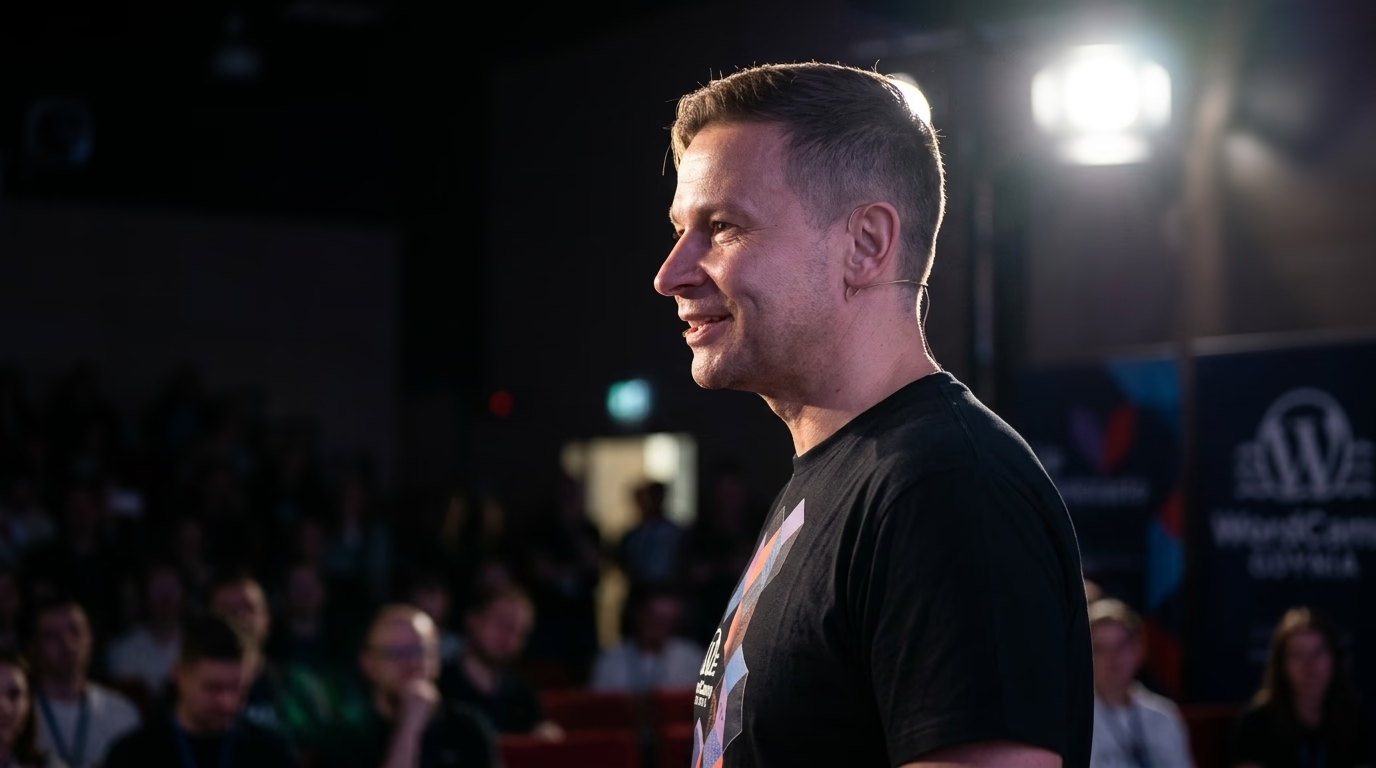
- I organise and speak at WordCamps.
- I have attended every WordCamp Europe from 2017 to 2026.
- Local WordPress meetup: WordUp Kraków
Kraków is the second-largest city in Poland and the capital of the Lesser Poland Voivodeship (Małopolska), with roughly 800,000 residents in the municipality and a major concentration of software engineering centres, global business services, and export-oriented companies. Businesses across Kraków that run their websites on WordPress, Joomla, Drupal or an ageing PHP framework often reach the same inflection point: the public site loads sluggishly, every plugin update feels like a production risk, and marketing editors hesitate to publish new landing pages ahead of product launches or hiring drives. Moving the public presentation layer to Astro or Next.js resolves the frontend bottleneck, provided that organic search visibility, lead forms, and analytics survive the transition intact. Operating as an independent developer working remotely and in writing from Gdynia, I execute that migration step by step and verify every route before and after cutover.
Is a migration worth it for a Kraków company, or is a cleanup enough?
Rebuilding a frontend pays off when the underlying CMS architecture holds back performance, security, or editorial autonomy. If deactivating redundant plugins, configuring server-level page caching, and optimising image delivery on your existing WordPress installation would solve the problem, I state that plainly in my initial review and the project ends there.
Typical indicators that a move to Astro or Next.js makes commercial sense:
- server Time to First Byte remains high even with caching enabled,
- the administrative dashboard responds slower than the public-facing website,
- template releases happen without automated checks or an isolated staging environment,
- a legacy theme or custom PHP framework version has reached end of life and nobody wants to touch it,
- Core Web Vitals fail to stay within Google’s official thresholds (Largest Contentful Paint up to 2.5 s, Interaction to Next Paint up to 200 ms, Cumulative Layout Shift up to 0.1) on key landing templates that cannot be refactored without breaking the rest of the site.
Astro suits content-heavy platforms (corporate websites, engineering blogs, technical documentation, product catalogues, and career hubs) because it compiles clean static HTML at build time and ships almost no client-side JavaScript by default. Next.js fits applications with authenticated customer areas, dynamic multi-facet filtering, or per-request server logic. Many Kraków companies keep their existing CMS purely as an editorial backend and replace only the public frontend.
How do I protect Google rankings when moving a Kraków site to Astro or Next.js?
Search rankings attach to specific URLs and the signals they carry. Every migration I run is engineered around the URL ledger first, rather than treating redirects as an afterthought after building new templates.
- Crawl and URL inventory. I crawl the live site, export indexed pages and top landing pages from Google Search Console, and extract historical URLs from server access logs and analytics that still receive external backlinks, referral traffic, or PDF downloads. The output is a single master spreadsheet of every address that matters.
- Written URL map. Each legacy URL is assigned an explicit outcome: retain the exact path, redirect via a single-hop HTTP 301 to its closest semantic successor, or return a deliberate HTTP 410 for obsolete pages you want permanently de-indexed. Nothing is left to wildcard guesswork, and campaign query parameters (
utm_*,gclid) are preserved across redirects. - Typed content model. Posts, pages, job listings, case studies, categories, author profiles, and custom fields are mapped into strictly typed collections in the new repository or headless CMS. Legacy shortcodes and visual page-builder layouts are converted into clean components so markup never arrives broken.
- Field-by-field metadata parity. Page titles, meta descriptions, canonical URLs, robots directives, and Open Graph cards move with each route. I run an automated diff comparing old and new HTML head elements across the URL inventory.
- Structured data reconstruction. Organization, BreadcrumbList, Article, JobPosting, Product, and FAQPage JSON-LD schemas are generated directly from the typed content model rather than relying on third-party plugins, and validated before launch.
- Multilingual hreflang verification. For Kraków companies publishing in Polish (
pl), English (en), German (de), or additional export languages, every language variant must reference itself and all sibling translations bidirectionally. Missing return links or hreflang tags pointing at redirected URLs are caught on the built HTML before cutover.
Kraków’s technology, B2B and R&D landscape: where decoupled architectures fit best
Kraków’s economy combines a dense software and R&D sector with global shared services and industrial technology across districts such as Zabłocie, Czyżyny (Krakow Technology Park / Krakowski Park Technologiczny), Podgórze, and the Czerwone Maki campus corridor:
- SaaS Vendors, AI Spin-outs and Software Houses (Zabłocie, Podgórze, Czerwone Maki): Technology companies selling globally in English alongside Polish recruitment pages often outgrow monolithic WordPress themes stuffed with marketing scripts. Moving documentation, product changelogs, and marketing pages to Astro allows engineering teams to maintain technical docs in MDX while marketing editors manage campaigns without JavaScript bloat.
- BPO, SSC and Employer Branding Portals (Quattro Business Park, High5ive, Bonarka4Business): Large service centres and R&D hubs in Kraków run high-volume career portals integrated with applicant tracking systems (ATS) such as Greenhouse, Lever, or Workday. A hybrid Astro or Next.js frontend fetches live job openings at build time or via edge revalidation, emitting valid
JobPostingstructured data while keeping candidate application forms fast on mobile networks. - Industrial Engineering, Medtech and Special Economic Zone Exporters: Manufacturers and life-science firms connected to the Krakow Technology Park publish multilingual product catalogues, ISO certificates, and downloadable technical datasheets. Serving these assets from an edge CDN eliminates database queries on public traffic and isolates the administrative backend from automated bot scans.
What does a staged cutover look like in practice?
I never flip an entire corporate domain blindly on a Friday afternoon. The cutover sequence follows observable checkpoints:
- Isolated staging build deployed on a preview domain blocked from search indexing (
X-Robots-Tag: noindex), populated with real migrated content. - Automated redirect verification: a script requests every legacy URL from the inventory against the staging environment and confirms that each resolves to its intended destination in a single hop with HTTP 200.
- Template parity audit: titles, H1-H3 headings, canonical tags, hreflang pairs, and JSON-LD blocks are compared between the live site and staging across every template family.
- Forms, ATS webhooks and consent states: every enquiry form and CRM integration is tested with real submissions, and consent state transitions are verified in the browser network tab.
- Phased or low-traffic cutover: on larger domains, edge routing switches one directory or section at a time; on smaller sites, DNS switches during a low-traffic window while the legacy server remains running read-only as an instant rollback target.
- Post-launch Search Console monitoring: updated XML sitemaps are submitted, while the legacy URL list is monitored so Googlebot processes the 301 redirects cleanly.
Pre-cutover verification table for Kraków migrations
| Check category | What I verify on staging before production cutover |
|---|---|
| 301 redirect map & PDFs | Zero redirect chains, zero unintended 404s across Search Console exports and linked PDF files |
Multilingual hreflang (pl, en, de) | Reciprocal return links and self-referencing canonical tags validated on compiled HTML |
| Core Web Vitals baseline | Templates verified against official web.dev thresholds (LCP up to 2.5 s, INP up to 200 ms, CLS up to 0.1) |
| UODO & PKE privacy rules | Zero non-essential tracking scripts or marketing cookies firing before explicit user consent |
| PAD / EAA accessibility | Semantic landmarks, keyboard focus order, form labels and WCAG 2.1 AA contrast checked across layouts |
| Polish statutory disclosures | KRS, NIP, REGON, registered seat and share capital (for sp. z o.o. / S.A.) present in footer templates |
Polish legal, privacy and accessibility requirements for a Kraków website
Rebuilding the frontend changes how your website handles visitor data, cookies, accessibility, and statutory corporate disclosures under Polish and EU law:
Personal data and UODO oversight. Every contact form, recruitment upload, newsletter signup, and analytics script processes personal data under the GDPR (RODO) and the Polish Personal Data Protection Act (Ustawa z dnia 10 maja 2018 r. o ochronie danych osobowych, ISAP Dz.U.), supervised by the President of the Personal Data Protection Office (Prezes Urzędu Ochrony Danych Osobowych, UODO). Before cutover, I compile an exact inventory of every external service the new stack communicates with (edge host, form processor, CRM, analytics) and which region stores the data, so your privacy policy and data processing agreements (umowy powierzenia przetwarzania danych) match reality.
Cookies and electronic communications (PKE & UŚUDE). Storing or accessing cookies and similar identifiers on a user’s device is governed by the Polish Electronic Communications Law (Prawo komunikacji elektronicznej, PKE, Dz.U. 2024 poz. 1221), including Article 399 on terminal equipment storage and Article 398 on commercial communications consent, alongside the consolidated Act on Providing Services by Electronic Means (Ustawa o świadczeniu usług drogą elektroniczną, Dz.U. 2024 poz. 1513). In the new Astro or Next.js build, non-essential analytics and marketing scripts remain completely unexecuted until the visitor gives prior, affirmative consent.
Accessibility (Polski Akt o Dostępności). The Polish Accessibility Act (Ustawa z dnia 26 kwietnia 2024 r. o zapewnianiu spełniania wymagań dostępności niektórych produktów i usług przez podmioty gospodarcze, Dz.U. 2024 poz. 731), which has applied since 28 June 2025, requires covered e-commerce and consumer services to meet functional accessibility standards aligned with EN 301 549 / WCAG 2.1 AA. Building new Astro or Next.js templates from scratch is the cleanest moment to implement proper heading hierarchy, keyboard navigation, accessible form error messages, and screen-reader labels.
Commercial company disclosures (Kodeks spółek handlowych). Under Article 206 (for a spółka z ograniczoną odpowiedzialnością) and Article 374 (for a spółka akcyjna or prostej spółki akcyjnej) of the Polish Commercial Companies Code (KSH), commercial websites and electronic correspondence must display the company’s full registered name, registered seat and address, registry court and KRS number, NIP tax identification number, and share capital (kapitał zakładowy). I ensure these required disclosures remain intact across all language footers.
What can go wrong, and how do I prevent it?
- Redirect chains or loops. Legacy
.htaccessor plugin redirects stacked on top of new migration rules. I flatten every path into a single 301 hop and test the entire map automatically. - Orphaned landing pages. Campaign pages, job archives, or tag views that drove organic traffic or held backlinks but were missing from the XML sitemap. Merging Search Console exports with raw server logs catches these before launch.
- Trailing slash duplication. Serving both
/pageand/page/with HTTP 200 dilutes canonical signals. One canonical URL format is enforced across the build and edge router. - Broken editorial workflows. If your marketing team cannot publish an article or update a job listing without asking a developer, the migration has failed operationally. The editorial flow (whether headless WordPress, another headless CMS, or Git-backed MDX) is agreed in the written scope and tested with your editors before cutover.
What do you receive at project handover?
You receive full ownership of the Git repository, documented environment variables, the automated build and deploy pipeline, the complete URL redirect map as an editable file, and a clear written guide for publishing content and deploying changes. After launch I monitor Search Console indexing and real-user performance metrics and resolve any migration issues that surface during the transition window.
More detail on the technical methodology is on my Next.js and Astro migration page, and on headless CMS development if you want to retain your existing CMS as the editorial backend.
How to start a Kraków migration project
Send me your current site URL, the CMS or framework it runs on, the languages you publish in, and where your traffic comes from (organic search, paid campaigns, newsletters, partner referrals) via the contact page. I reply in writing on working days with a free initial estimate and written scope covering what moves, what is retired, which URLs change, and how the cutover is staged.
Selected projects
Examples of my work.
Real Estate Platform: surfuje.pl
surfuje.pl is a website for surfers and watersports enthusiasts, with clear content, simple publishing, and stable technical operation.
Real Estate Platform: zamki-szkocji.com
zamki-szkocji.com is a comprehensive information portal dedicated to the castles of Scotland, combining rich historical content, interactive maps, photo gall...
Scalac.io - Big Data and Business Scaling Solutions Platform
scalac.io is an international platform founded in 2014 to meet the challenges associated with big data management and business operations scaling, specializing in Scala, distributed systems, and cryptography solutions.
WordPress support & development in Kraków
Need this service: Next.js / Astro migration in Kraków?
Describe your project by e-mail. I reply within 48 hours.
Describe your projectExplore other WordPress services and knowledge base
Migration to Astro, Next.js, and headless WordPress.
WooCommerce sync with ERP and wholesale systems.
Business process automation around WordPress and company systems.
Library of concrete automation use cases.
Headless WordPress, Sanity, Strapi, and Contentful with Astro or Next.js.
Astro, MDX, edge delivery, and Core Web Vitals measured on real traffic.
Custom WordPress engineering and architecture.
Scalable headless, ERP, and AI architecture for enterprise.
Related categories
Supporting articles
Six to sixteen weeks for typical engagements, with a four-phase shape: discovery, scoping, build and cutover, tuning. The variables are catalogue size, integration count, URL preservation, and editorial team readiness, not framework choice.
A definitive 4-year Total Cost of Ownership (TCO) analysis, real-world Core Web Vitals benchmarks, Astro 7 GraphQL APQ architecture, and a 10-point executive decision matrix for choosing between decoupled and traditional WordPress.
The Shopify Plus vs WooCommerce headless decision in 2026 is no longer a binary "platform vs custom" trade-off. Both can run headless, both integrate AI, both ship at the edge. The real axes are control, total cost over five years, and exit strategy. This article walks the matrix with confirmed platform facts.