Website & application migration in Łódź
I migrate sites from WordPress, Joomla, Drupal, Angular, Vue and other technologies to Astro and Next.js. I plan each migration to keep SEO, content and features intact and switch over in an agreed window. I work alone and have years of experience with both legacy and modern stacks.
- I have had a wordpress.org account since 2006.
- I contributed to WordPress core for versions 7.0 and 7.1.
- I maintain 30 plugins on wordpress.org.
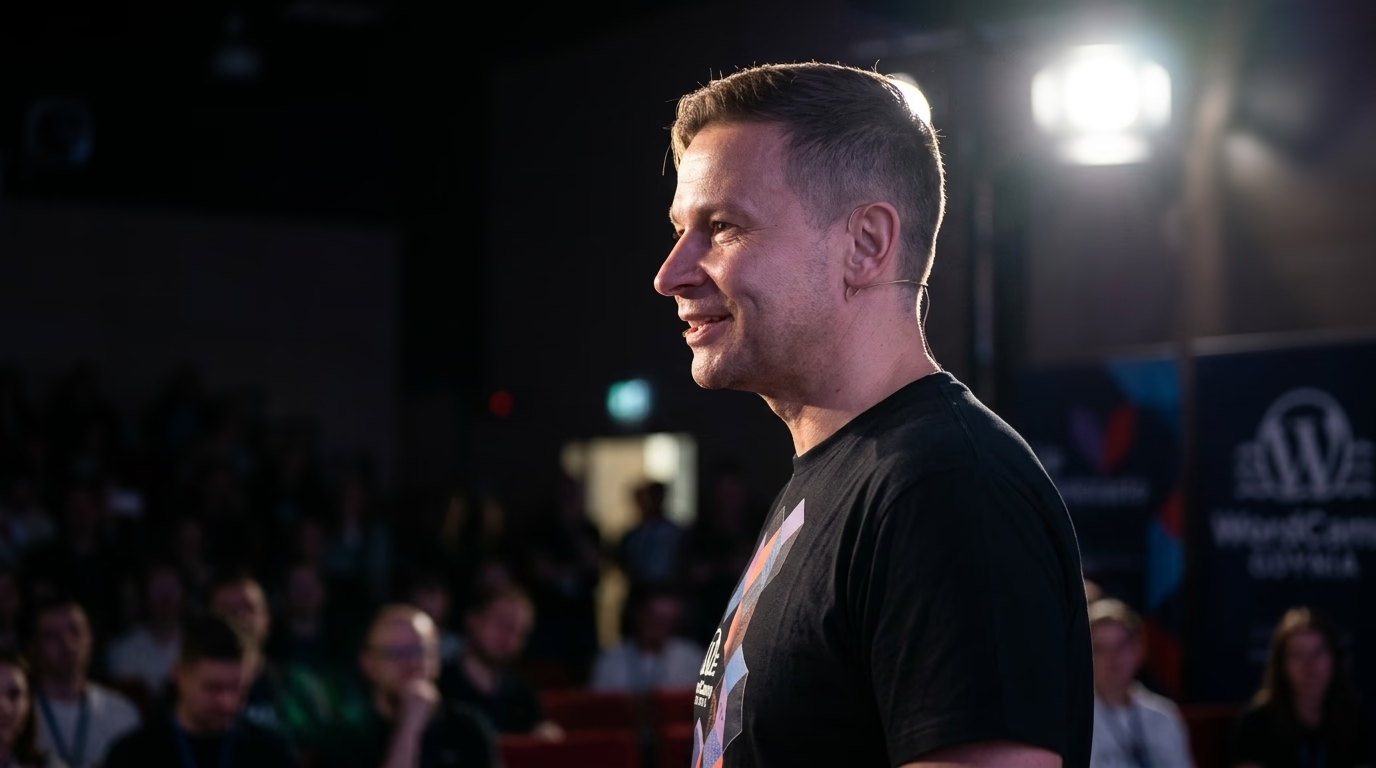
- I organise and speak at WordCamps.
- I have attended every WordCamp Europe from 2017 to 2026.
Companies across Łódź and central Poland leave WordPress, Joomla, Drupal, or an ageing custom framework when the old stack costs more in lost speed and maintenance risk than it returns: sluggish pages on shared or overloaded servers, a long plugin list nobody dares to update before a campaign, and editors who wait seconds for the admin dashboard to save a draft. Working solo, remotely and in writing from Gdynia, I rebuild the public frontend in Astro or Next.js and migrate the content, URLs, and structured search signals across without losing the rankings your domain has already earned. The general engineering process is covered on my Next.js and Astro migration page; this page explains how it applies specifically to a business in Łódź.
Which businesses in Łódź actually benefit from a migration?
Łódź is the capital of the Łódź Voivodeship, situated at the motorway intersection of the A1 (north-south) and A2 (east-west) corridors roughly 120 km southwest of Warsaw, and is Poland’s fourth-largest city, with 639,890 residents at the end of 2025. Invest in Łódź identifies four core pillars driving the local economy: modern business services (BPO/SSC/IT), advanced manufacturing and home appliances, logistics and distribution hubs across Central Poland, and life sciences and biotechnology, alongside a strong design and fashion heritage around Nowe Centrum Łodzi and the Łódź Special Economic Zone (ŁSSE).
That commercial mix produces three recurring website profiles where moving to Astro or Next.js pays off:
- Employer branding and recruitment portals for BPO, SSC and IT centres: With over 130 business service and R&D centres in Łódź competing for multilingual specialists and software engineers, career pages and job listings change every week. When an overloaded WordPress theme slows mobile landing pages or breaks ATS embeds, moving the public portal to Astro keeps pages within Google’s official Core Web Vitals thresholds (Largest Contentful Paint up to 2.5 s, Interaction to Next Paint up to 200 ms, Cumulative Layout Shift up to 0.1) while pulling live roles from your recruitment system.
- Industrial manufacturer, home-appliance supplier and logistics catalogues: Factories and European distribution hubs operating within the Łódź Special Economic Zone (ŁSSE) or along the Stryków and Rzgów logistics corridors maintain hundreds of technical specification pages, PDF datasheets, and compliance certificates in Polish, English, and German. Migrating these libraries from an outdated Joomla, Drupal, or WordPress install into typed Astro collections removes database queries from public traffic and ensures language variants stay synchronised.
- Consumer brands, textiles, fashion and cosmetics showcases: Łódź companies selling across European markets rely on fast lookbooks, product catalogues, and clean
ProductandOrganizationstructured data. Decoupling the presentation layer eliminates render-blocking plugin scripts without forcing editors to abandon their familiar backend.
If your website does not suffer from structural platform limits and would run well after removing redundant plugins and enabling proper server-side caching, I will tell you so in the written review and recommend keeping your current stack.
Astro or Next.js: which framework fits a Łódź company site?
Astro is built for content-centric websites: corporate service pages, B2B product catalogues, technical documentation, news archives, and recruitment portals. It compiles pages into static HTML at build time and ships zero client-side JavaScript by default, loading interactive scripts only on the specific components (islands) that need them.
Next.js is built for web applications that depend on continuous runtime state: authenticated distributor portals, live warehouse or shipment dashboards, complex multi-attribute search filters, or personalised B2B pricing views rendered per request. Both frameworks can even run under the same domain via edge routing rules, with Astro serving the public marketing and catalogue pages and Next.js handling the logged-in portal.
In either architecture, your editorial team keeps a clean CMS workflow. That can be your existing WordPress installation isolated on a private subdomain as a headless source, or a dedicated headless CMS if the legacy backend itself is being retired. I cover those backend patterns in detail on the headless CMS developer page.
How does the Łódź migration process run, step by step?
- Complete URL and asset inventory. I crawl the live website and export every indexable URL, existing redirect, page title, meta description, canonical tag,
hreflangannotation, and JSON-LD block. I merge that crawl with Google Search Console landing page exports and raw server access logs, because a standard crawler misses orphaned campaign pages and linked PDF datasheets that still carry external backlinks. - Typed content model. I map legacy post types, custom fields, and taxonomies into explicit TypeScript/Zod schemas. Joomla categories, Drupal content types, and visual page-builder shortcodes are converted into clean, maintainable components rather than copying brittle HTML blobs.
- Written 301 redirect map. Every historical URL receives an explicit destination in a version-controlled redirect ledger. Where a path remains identical, nothing changes; where a slug changes or thin pages are consolidated, a single-hop HTTP 301 points directly to the final destination URL, never through a redirect chain and never dumped onto the homepage.
- Staging build and parity audit. The new frontend runs on a non-indexed staging address. I compare titles, meta descriptions, heading hierarchies, canonicals, and structured data page by page against the live site, and execute an automated test suite against every row in the redirect map.
- Phased or low-traffic cutover. Compact corporate sites switch in one coordinated window with the legacy server kept warm as a fallback. Larger portals migrate section by section behind edge routing rules, allowing the blog or documentation hub to launch on Astro first while legacy routes remain on the old system until ready.
- Post-launch Search Console verification. I submit updated XML sitemaps, retain the old URL list for monitoring redirect uptake, and track Search Console coverage and Core Web Vitals field data over the following weeks.
Pre-cutover verification table for Łódź migrations
| Verification area | What I check before switching production traffic |
|---|---|
| URL & PDF redirect ledger | Every indexed URL and linked PDF in Search Console and server logs returns HTTP 200 or a single 301 hop |
Export hreflang (pl, en, de) | Bidirectional return links and self-referencing canonicals verified on built HTML across all locales |
| Core Web Vitals thresholds | Templates verified against official web.dev thresholds (LCP up to 2.5 s, INP up to 200 ms, CLS up to 0.1) |
| UODO & PKE privacy compliance | Zero non-essential analytics or marketing cookies firing before explicit opt-in consent |
| PAD / EAA accessibility | Semantic HTML landmarks, keyboard navigation, form labels and WCAG 2.1 AA contrast checked across layouts |
| KSH statutory disclosures | KRS, NIP, REGON, registered office in Łódź and share capital verified across footer templates |
What can go wrong during a rebuild, and how do I prevent it?
- Lost long-tail URLs. An unmapped product sheet or archive page returns HTTP 404 and loses its search equity. I test the entire legacy URL inventory against staging before cutover and against production immediately after launch, requiring an HTTP 200 or a single 301 for every entry.
- Broken multilingual hreflang. Industrial and B2B exporters in Łódź frequently publish in Polish (
pl), English (en), and German (de). Google ignoreshreflangannotations whenever two translated pages fail to link back to each other reciprocally or point at redirected URLs. I generate and validate all language pairs directly on the built HTML. - Silently dropped structured data. Organization, BreadcrumbList, Product, JobPosting, and FAQPage markup often lived inside a WordPress SEO plugin and vanishes during a custom rebuild unless explicitly re-implemented. I diff the JSON-LD output per template family.
- Unclear post-launch ranking fluctuations. Google notes that temporary fluctuations are normal while Googlebot recrawls a moved site over several weeks. Recording a pre-cutover baseline in Search Console lets us distinguish normal recrawl movement from any technical issue that needs a fix.
Polish legal, privacy and accessibility rules for a Łódź company website
Moving from a monolithic CMS to Astro or Next.js is the best moment to verify that data flows, cookies, accessibility, and company footer disclosures comply with Polish and EU law:
Personal data and UODO supervision. Contact forms, recruitment CV uploads, newsletter sign-ups, and analytics scripts on a Polish company’s website fall under the GDPR (RODO) and the Polish Personal Data Protection Act of 10 May 2018 (Ustawa o ochronie danych osobowych, ISAP Dz.U.), supervised by the President of the Personal Data Protection Office (Prezes Urzędu Ochrony Danych Osobowych, UODO). Because a headless migration changes how form payloads are transmitted and stored, I document every external processor (edge host, form endpoint, ATS/CRM webhook, analytics tool) and its storage region before launch so your RODO privacy notice and processor agreements remain accurate.
Cookie storage and electronic communications under Polish PKE. Storing cookies or reading identifiers from a visitor’s terminal device is governed by the Polish Electronic Communications Law (Prawo komunikacji elektronicznej, PKE, Dz.U. 2024 poz. 1221, including Article 399 on terminal storage and Article 398 on commercial communications consent), alongside the consolidated Act on Providing Services by Electronic Means (Ustawa o świadczeniu usług drogą elektroniczną, Dz.U. 2024 poz. 1513). In the rebuilt frontend, I list every script from the legacy site, drop forgotten campaign trackers, and ensure zero non-essential scripts run before affirmative consent.
Digital accessibility under Polski Akt o Dostępności. Under the Polish Accessibility Act of 26 April 2024 (Ustawa o zapewnianiu spełniania wymagań dostępności niektórych produktów i usług przez podmioty gospodarcze, Dz.U. 2024 poz. 731, in force since 28 June 2025), covered e-commerce and consumer digital services must meet accessibility requirements aligned with EN 301 549 / WCAG 2.1 Level AA. Rebuilding templates in Astro or Next.js is the cheapest time to fix heading hierarchy, colour contrast, keyboard focus states, and form labels.
Statutory company footer details (Kodeks spółek handlowych). Under Articles 206 and 374 of the Polish Commercial Companies Code (KSH), websites of Polish commercial companies (such as a sp. z o.o. or S.A. registered with the District Court for Łódź-Śródmieście, XX Commercial Division of the National Court Register) must display the full company name, registered seat and address, registry court and KRS number, NIP tax identification number, and share capital (kapitał zakładowy). I verify that these statutory details are preserved across all language versions of the footer.
How to request a written scope for your Łódź website
Send me your current website URL, the CMS and version it runs on, the languages it publishes in, and where your traffic comes from (organic search, paid campaigns, direct or referral) via the contact page. I reply in writing on working days with a free initial estimate and written scope covering what moves, what changes, which URLs receive redirects, and whether a full migration or a simpler cleanup is the right call for your site.
Selected projects
Examples of my work.
merkam.eu - WordPress Project | WPPoland
The merkam.eu website was designed for a manufacturer of kitchen countertops made from granite, conglomerate, and marble. The site's purpose is to showcase the product offering, gallery of completed projects, and generate inquiries from clients interested in modern kitchen solutions.
Native mobile apps using JavaScript - Tabris.js
Tabris.js is a modern framework that enables the creation of native mobile apps from a single codebase using JavaScript or TypeScript. This solution allows d...
olshtyn.com - WordPress Project | WPPoland
The olshtyn.com website is a modern information portal created with the residents and tourists of Olsztyn in mind. This project combines functionality with a...
WordPress support & development in Łódź
Need this service: Next.js / Astro migration in Łódź?
Describe your project by e-mail. I reply within 48 hours.
Describe your projectExplore other WordPress services and knowledge base
Migration to Astro, Next.js, and headless WordPress.
WooCommerce sync with ERP and wholesale systems.
Business process automation around WordPress and company systems.
Library of concrete automation use cases.
Headless WordPress, Sanity, Strapi, and Contentful with Astro or Next.js.
Astro, MDX, edge delivery, and Core Web Vitals measured on real traffic.
Custom WordPress engineering and architecture.
Scalable headless, ERP, and AI architecture for enterprise.
Related categories
Supporting articles
Six to sixteen weeks for typical engagements, with a four-phase shape: discovery, scoping, build and cutover, tuning. The variables are catalogue size, integration count, URL preservation, and editorial team readiness, not framework choice.
A definitive 4-year Total Cost of Ownership (TCO) analysis, real-world Core Web Vitals benchmarks, Astro 7 GraphQL APQ architecture, and a 10-point executive decision matrix for choosing between decoupled and traditional WordPress.
The Shopify Plus vs WooCommerce headless decision in 2026 is no longer a binary "platform vs custom" trade-off. Both can run headless, both integrate AI, both ship at the edge. The real axes are control, total cost over five years, and exit strategy. This article walks the matrix with confirmed platform facts.