Website & application migration in Lyon
I migrate sites from WordPress, Joomla, Drupal, Angular, Vue and other technologies to Astro and Next.js. I plan each migration to keep SEO, content and features intact and switch over in an agreed window. I work alone and have years of experience with both legacy and modern stacks.
- I have had a wordpress.org account since 2006.
- I contributed to WordPress core for versions 7.0 and 7.1.
- I maintain 30 plugins on wordpress.org.
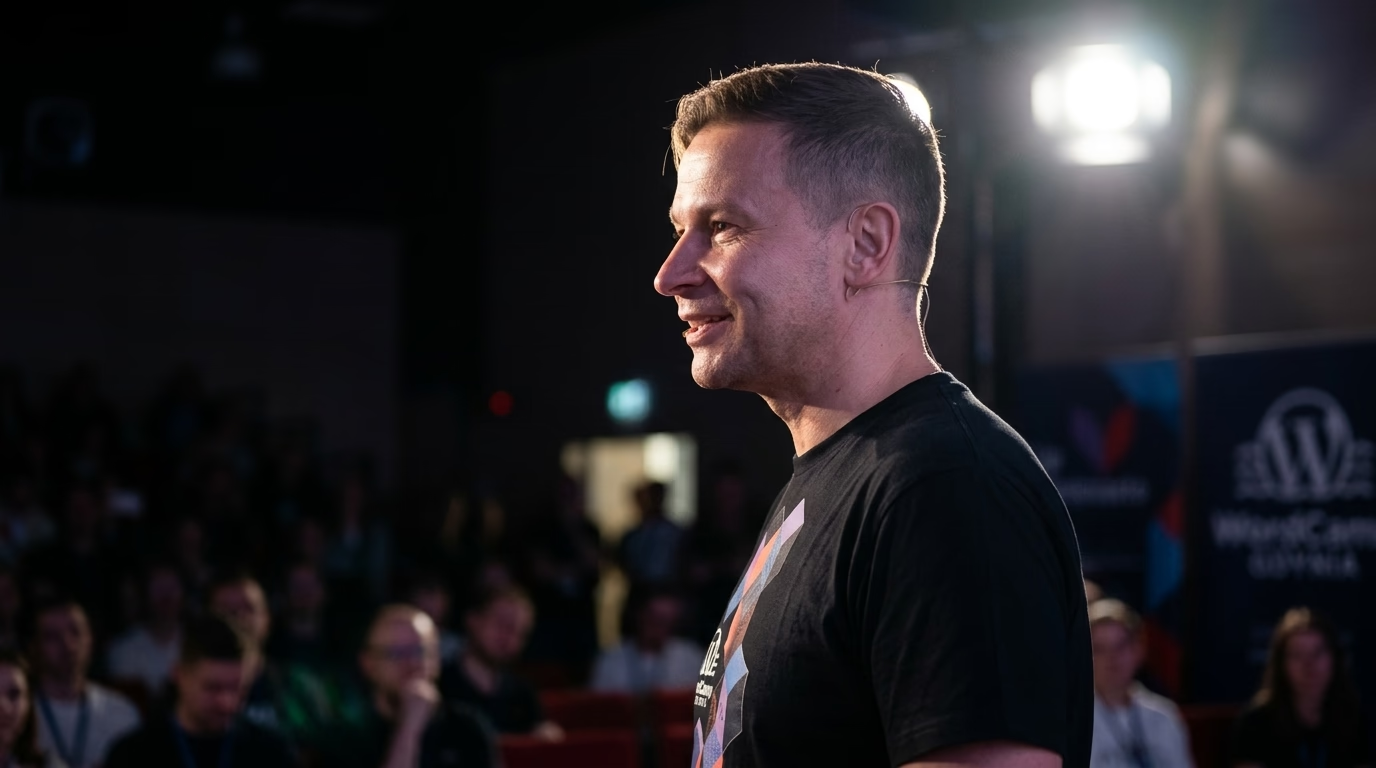
- I organise and speak at WordCamps.
- I have attended every WordCamp Europe from 2017 to 2026.
Companies across Lyon and the Auvergne-Rhône-Alpes region move off WordPress, Joomla, Drupal, or an ageing custom PHP framework onto an Astro or Next.js frontend when the old stack becomes slow on mobile, fragile during updates, or risky to keep patched. Working solo, remotely and in writing from Gdynia in the same Central European Time zone, I execute these migrations directly from the initial URL inventory and redirect map through to post-launch Google Search Console checks.
Should I migrate my Lyon website, or fix the one I already have?
If the slowness comes from a handful of bloated plugins, uncompressed images, and missing page caching, cleaning up your existing CMS is cheaper, and I will tell you so in my written review. A migration to Astro or Next.js pays off when the problems are structural: a custom theme nobody can update without breaking templates, a Joomla or Drupal version past its security support window, editors who avoid publishing before a trade show because something breaks every time, or a frontend that ships far more client-side JavaScript than the content requires.
Astro fits content-led websites: corporate service pages, industrial product catalogues, multilingual B2B sites, news archives, and technical documentation. By compiling clean static HTML at build time and loading JavaScript only on interactive islands, Astro makes it straightforward to stay well within Google’s official Core Web Vitals thresholds (Largest Contentful Paint up to 2.5 s, Interaction to Next Paint up to 200 ms, Cumulative Layout Shift up to 0.1). Next.js fits platforms that behave like software applications: logged-in customer portals, distributor extranets, personalised pricing views, or heavy per-request server logic. My Astro and Next.js migration service page compares the two frameworks in more depth.
Lyon and Auvergne-Rhône-Alpes sectors: where decoupled frontends deliver the clearest return
Lyon is the prefecture of the Auvergne-Rhône-Alpes region and the seat of the Métropole de Lyon, with 519,127 residents in the city and 2,338,789 in the metropolitan area. Across business districts such as La Part-Dieu, Confluence, Gerland, and Vaise, Lyon combines major industrial and life-science clusters with software and digital entertainment:
- Pharmaceuticals, Biotechnology and Medtech (Gerland Biodistrict, Lyonbiopôle): Global vaccine manufacturers, clinical diagnostics companies, and biotech spin-outs in Gerland publish regulatory documentation, clinical publication libraries, and multilingual partner portals (
fr,en,de). Moving public content from a vulnerable monolithic CMS to a typed Astro build ensures fast global delivery, strict schema consistency, and isolation of administrative logins. - Chemicals, Cleantech and Industrial Engineering (Vallée de la Chimie, Axelera Cluster, Minalogic): Specialty chemical producers, energy suppliers, and industrial equipment manufacturers south of Lyon maintain thousands of safety data sheets (FDS / SDS), technical specifications, and ISO compliance documents. An Astro frontend paired with a structured document index keeps every PDF and product URL mapped 1:1 while allowing Next.js to power authenticated distributor portals on a separate path.
- Software, SaaS and Video Game Studios (Vaise, Confluence, La Part-Dieu): Digital businesses and B2B software vendors operating out of Lyon often pair French commercial pages with international English documentation. Replacing a slow page-builder theme with Git-backed MDX or a headless CMS lets product teams ship documentation updates cleanly without risking broken layouts.
What happens, step by step, in an Astro or Next.js migration?
- Comprehensive URL inventory. I crawl the live site and collect every indexable URL, every existing server redirect, the XML sitemaps, the page templates, and the structured data each template outputs. I merge that crawl with a Google Search Console export and server access logs, so pages with impressions or external backlinks but no internal links are never lost. I also inventory PDFs and technical data sheets (
fiches techniques), which rarely appear in XML sitemaps but frequently hold valuable B2B links. - Written URL map. Every legacy URL receives an explicit destination: keep the exact path wherever possible, issue a single-hop HTTP 301 redirect where old paths are consolidated, or return a deliberate HTTP 410 for obsolete pages that should leave the index. The redirect map lives in version control and is delivered as a readable spreadsheet.
- Typed content model. Pages, posts, products, case studies, and custom fields become strictly typed collections. Legacy shortcodes, visual page-builder markup, and inline styles are converted into clean Astro or React components rather than copied over as raw HTML blobs.
- Metadata and structured data parity. Page titles, meta descriptions, canonical tags, Open Graph properties, and Schema.org JSON-LD (
Organization,BreadcrumbList,Article,Product,FAQPage) are generated from the typed content fields and checked template by template against the legacy output. - Staging and automated parity checks. The rebuilt site runs on a protected staging address blocked from indexing. I run the complete historical URL list against it and compare status codes, titles, canonicals, headings, and
hreflanglinks between old and new. - Staged cutover. Section by section behind an edge proxy on larger domains, or in a single coordinated switch during a low-traffic window on smaller sites, with the legacy server kept warm as an immediate fallback.
- Post-launch Search Console monitoring. I watch Search Console for crawl errors, unexpected 404s, coverage shifts, and Core Web Vitals field data over the weeks following launch, fixing any anomaly that appears.
How do I protect Google rankings through the move?
Google’s documentation on site moves with URL changes recommends permanent server-side redirects (HTTP 301 or 308), warns against redirecting many old URLs to an irrelevant destination such as the homepage, and advises keeping redirects active for at least a year, or indefinitely from a visitor’s perspective. I configure them to remain permanently at the network edge, because links inside external articles, trade directories, and downloaded PDFs never expire. The Change of Address tool in Search Console is only used when the domain or subdomain itself changes, not when replacing the frontend on the same domain.
Google also notes that a small to medium-sized website can take a few weeks for most pages to settle in the index after a move. Monitoring coverage by directory and template group lets us distinguish normal recrawl movement from a missing redirect.
How do I handle French (fr-FR), Swiss French (fr-CH) and English (en) versions?
Because Lyon sits close to French-speaking Switzerland (Geneva and Lausanne) and Northern Italy, many Lyon enterprises run a French site alongside English, German, or Italian, and sometimes maintain distinct commercial pages for France (fr-FR) and Switzerland (fr-CH). Each language edition keeps its own URL hierarchy, and the hreflang set moves with it. Google ignores hreflang annotations whenever two pages fail to point back to each other reciprocally, and each language version must list itself as well as all sibling variants using valid ISO 639-1 language codes and ISO 3166-1 Alpha 2 region codes. A language selector or international fallback route gets x-default. Before and after cutover, I verify on the compiled HTML that no hreflang tag points at a 301-redirected URL and no canonical tag crosses languages.
For companies selling in France, French is also a statutory requirement. Article 2 of Law no. 94-665 of 4 August 1994 (Loi Toubon relative à l’emploi de la langue française) makes the use of French mandatory in the designation, offer, presentation, user instructions, and warranty terms of goods, products, and services, as well as in written, spoken, or audiovisual advertising. In practice, I structure French as the primary reference locale in the content schema so mandatory disclosures and product descriptions are never left untranslated.
Pre-cutover verification table for Lyon migrations
| Verification area | What I check before switching production traffic |
|---|---|
| URL & PDF redirect ledger | Every indexed URL and linked PDF in Search Console and server logs returns HTTP 200 or a single 301 hop |
Multilingual hreflang (fr, en) | Bidirectional return links and self-referencing canonicals verified on compiled HTML across all locales |
| Core Web Vitals thresholds | Templates verified against official web.dev thresholds (LCP up to 2.5 s, INP up to 200 ms, CLS up to 0.1) |
| CNIL cookie & tracker rules | Zero non-exempt trackers firing before consent; refusal as simple as acceptance (“Tout refuser”) |
| RGAA / EN 301 549 accessibility | Semantic HTML landmarks, keyboard navigation, form labels and WCAG 2.1 AA contrast checked across layouts |
| LCEN Mentions légales | SIRET/SIREN, RCS Lyon, TVA intracommunautaire, directeur de la publication and host details verified |
Which French legal and regulatory rules affect the rebuilt site?
Rebuilding a commercial website in France is the cleanest moment to align cookies, personal data, accessibility, and mandatory legal notices with French law:
Cookies and trackers (CNIL & Loi Informatique et Libertés Art. 82). Under Article 82 of the French Data Protection Act (Loi n° 78-17 du 6 janvier 1978 modifiée) and the guidelines enforced by the CNIL (Commission Nationale de l’Informatique et des Libertés), storing or reading non-essential trackers on a user’s device requires prior, free, specific, and informed consent. The CNIL explicitly requires that refusing cookies must be as easy as accepting them (for example, a visible “Tout refuser” or “Continuer sans accepter” action on the first layer alongside “Tout accepter”), and states that accepting general terms of use does not constitute valid consent. Strictly necessary trackers (such as storing the user’s consent choice, authentication sessions, or shopping cart contents) and certain strictly configured first-party audience measurement tools are exempt under CNIL criteria. In the new Astro or Next.js build, I inspect the browser network tab on staging to verify that zero non-exempt scripts fire before consent.
Mandatory legal notices (LCEN Article 6 & Code de commerce). Under Law no. 2004-575 of 21 June 2004 (Loi pour la confiance dans l’économie numérique, LCEN) and Articles R. 123-237 and R. 123-238 of the French Commercial Code, every commercial website must publish clear, permanently accessible Mentions légales including the company’s legal name (dénomination sociale), legal form (SAS, SARL, SA, etc.), share capital (capital social), registered office address, RCS registration number (such as RCS Lyon) and SIREN/SIRET, intracommunity VAT number (numéro de TVA intracommunautaire), the name of the publication director (directeur de la publication), and the identity, address, and contact details of the web hosting provider (hébergeur). Because a migration often changes the public hosting layer, I make sure the Mentions légales template is updated with the exact new host details before launch.
Digital accessibility (Article 47 of Law 2005-102, RGAA & European Accessibility Act). In France, Article 47 of Law no. 2005-102 (as amended to transpose the European Accessibility Act from 28 June 2025, alongside Decree 2019-768 and the Référentiel général d’amélioration de l’accessibilité, RGAA 4.1 / EN 301 549) imposes digital accessibility obligations on public bodies, companies exceeding the statutory turnover threshold in France (250 million euros average annual turnover under Article 47), and covered consumer e-commerce and digital services. Even for B2B SMEs below those thresholds, building semantic Astro or Next.js templates with proper heading order, labelled form fields, keyboard focus indicators, and WCAG 2.1 AA contrast avoids costly retrofits later.
Common migration risks on a Lyon site and how I test for them
- Lost long-tail pages. Old category, tag, and pagination URLs are easy to overlook in a manual list. Combining the live site crawl with Search Console exports and server logs catches them before launch.
- Redirect chains and loops. Legacy
.htaccessredirects pointing to URLs that now redirect a second time. I flatten every chain to a single hop and test the entire redirect table automatically so every legacy URL returns HTTP 200 or exactly one 301 to a 200. - Structured data gaps. A product, event, or article template that loses its JSON-LD during the frontend rewrite. I validate representative pages from every template family, not just the homepage.
- Forms and conversion tracking. Enquiry forms posting to dead endpoints or conversion events that stop firing after removing WordPress plugins. I test every form on staging with a real submission.
Project deliverables at handover
Your company receives full ownership of the Git repository, documented environment variables, the automated build and deployment pipeline, the complete redirect map as a versioned file, and a concise written runbook for your editors and developers. If you want a headless setup beyond the migration itself, my headless CMS developer page covers the backend options.
How to request a written scope for your Lyon website
Send me your current website URL, the CMS and version it runs on, the languages it serves (fr, en or others), and where your traffic comes from (organic search, paid campaigns, newsletters, trade fairs) via the contact page. I reply in writing on working days with a free initial estimate and written scope covering what moves, what gets redirected, what I recommend retiring, and the order of work.
Selected projects
Examples of my work.
E-commerce Development: metal-meble.pl
metal-meble.pl is a WordPress website for a company offering metal furniture and constructions, with a clear catalogue, fast contact path, and simple administration.
E-commerce Development: mochola.com
mochola.com is a modern e-commerce platform based on WooCommerce, which I developed as a programmer, specializing in the sale of car parts. The store is aime...
E-commerce Development: nehrebeccy.pl
nehrebeccy.pl is a modern artistic agency that combines expertise in organising cultural events with a rich presentation of artistic offerings. The site was ...
WordPress support & development in Lyon
See also in France
Need this service: Next.js / Astro migration in Lyon?
Describe your project by e-mail. I reply within 48 hours.
Describe your projectExplore other WordPress services and knowledge base
Migration to Astro, Next.js, and headless WordPress.
WooCommerce sync with ERP and wholesale systems.
Business process automation around WordPress and company systems.
Library of concrete automation use cases.
Headless WordPress, Sanity, Strapi, and Contentful with Astro or Next.js.
Astro, MDX, edge delivery, and Core Web Vitals measured on real traffic.
Custom WordPress engineering and architecture.
Scalable headless, ERP, and AI architecture for enterprise.
Related categories
Supporting articles
Six to sixteen weeks for typical engagements, with a four-phase shape: discovery, scoping, build and cutover, tuning. The variables are catalogue size, integration count, URL preservation, and editorial team readiness, not framework choice.
A definitive 4-year Total Cost of Ownership (TCO) analysis, real-world Core Web Vitals benchmarks, Astro 7 GraphQL APQ architecture, and a 10-point executive decision matrix for choosing between decoupled and traditional WordPress.

The Shopify Plus vs WooCommerce headless decision in 2026 is no longer a binary "platform vs custom" trade-off. Both can run headless, both integrate AI, both ship at the edge. The real axes are control, total cost over five years, and exit strategy. This article walks the matrix with confirmed platform facts.