Website & application migration in Paris
I migrate sites from WordPress, Joomla, Drupal, Angular, Vue and other technologies to Astro and Next.js. I plan each migration to keep SEO, content and features intact and switch over in an agreed window. I work alone and have years of experience with both legacy and modern stacks.
- I have had a wordpress.org account since 2006.
- I contributed to WordPress core for versions 7.0 and 7.1.
- I maintain 30 plugins on wordpress.org.
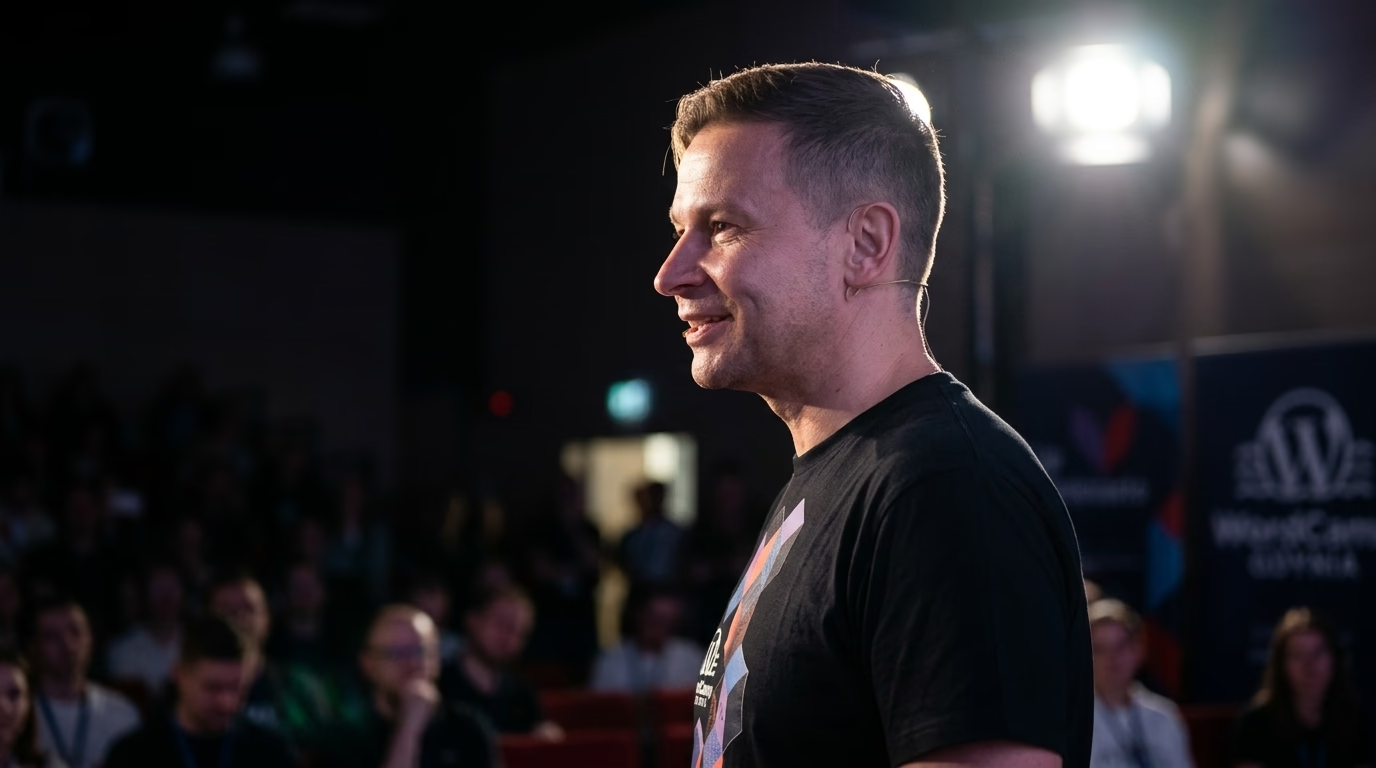
- I organise and speak at WordCamps.
- I have attended every WordCamp Europe from 2017 to 2026.
Paris has about 2.05 million residents within the municipality and sits at the heart of the Île-de-France metropolitan region of over 12 million people, so a website for a Paris business usually serves French-speaking buyers and clients first and an international audience second. Many of those websites grew over a decade on WordPress, Joomla, Drupal, or a bespoke PHP framework, with an English edition bolted on later. When that legacy stack becomes slow on mobile, fragile during updates, or risky to patch, moving the public frontend to Astro or Next.js solves the bottleneck. Working solo, remotely and in writing from Gdynia in the same Central European Time zone, I execute that migration step by step so your organic search visibility, lead forms, and multilingual routing survive the transition intact.
When does a migration to Astro or Next.js make sense for a Paris company?
Replatforming makes sense when the CMS architecture itself is the problem rather than a single slow plugin or an underpowered hosting plan. Typical symptoms include pages that execute database queries on every visitor request for content that changes once a month, an administrative dashboard that editors avoid, plugin updates that break custom layout templates, or a security patch schedule nobody dares to run before a major campaign or Paris trade show. If deactivating unused plugins and adding a proper server-level page cache would fix the issue, I state that plainly in my written review and the migration does not happen.
When a new frontend is justified, I select the framework according to what each route family on your site actually does:
- Astro fits content-driven platforms: corporate service pages, luxury and design showcases, editorial blogs, technical documentation, and B2B brochure sites with enquiry forms. It compiles clean static HTML at build time and ships client-side JavaScript only to the interactive components (islands) that explicitly need it, making it straightforward to stay well within Google’s official Core Web Vitals thresholds (Largest Contentful Paint up to 2.5 s, Interaction to Next Paint up to 200 ms, Cumulative Layout Shift up to 0.1).
- Next.js fits platforms with authenticated client portals, personalised user dashboards, server-side rendering per request, or heavy client-side state. Your editors can keep WordPress on a private subdomain as a headless backend or move to Git-backed Markdown/MDX or another headless CMS, depending on who edits and how often.
Paris and Île-de-France business sectors: where decoupled frontends excel
Across business districts from La Défense, the Central Business District (Opéra, Saint-Lazare, Champs-Élysées, Bourse) and Sentier (“Silicon Sentier”) to Station F in the 13th arrondissement and the Saclay scientific plateau, Paris companies operate web platforms with distinct engineering demands:
- SaaS Scaleups, AI Ventures and Fintech (Sentier, Station F, Opéra, Bourse): Technology companies selling across France, Europe, and North America maintain bilingual or multilingual sites (
fr,en,de) that combine product marketing, security compliance hubs, and API documentation. Moving from a bloated WordPress theme to Astro allows product teams to manage technical docs in version-controlled MDX while marketing teams publish campaign landing pages without shipping megabytes of blocking scripts. - Corporate Headquarters, Banking, Consulting and Legal Advisory (La Défense, Paris 8e, Neuilly-sur-Seine): Listed groups, investment funds, and corporate law firms publish investor relations reports, regulatory disclosures, ESG documentation, and career portals. A static Astro frontend eliminates public PHP and database vulnerabilities while preserving strict URL and PDF permanence for financial and legal documents.
- Luxury, Fashion, Architecture and Cultural Brands (Triangle d’Or, Le Marais, Saint-Germain-des-Prés): Visual brands rely on high-resolution lookbooks, press rooms, and international store locators. Astro’s build-time image pipeline generates responsive AVIF and WebP assets with reserved dimensions, eliminating layout shifts (
CLS) on mobile devices without sacrificing visual quality.
How do I protect your Google rankings during a Paris site move?
Search rankings survive a migration when every historical address has an explicit new destination and Googlebot can verify that relationship immediately. My order of work:
- Crawl and URL inventory. I crawl the live site, pull every address from the XML sitemaps, and export the pages and PDF documents that earn clicks, impressions, or external backlinks from Google Search Console and raw server access logs.
- Written URL map. A version-controlled spreadsheet with one row per legacy URL: retain path, redirect via HTTP 301, consolidate, or retire with HTTP 410. Every changed URL receives a single-hop 301 straight to its final destination. Google recommends avoiding multi-hop redirect chains, so I flatten any legacy redirect chains your old server or WordPress plugin accumulated over the years.
- Typed content model. Pages, posts, case studies, categories, author profiles, media assets, and custom fields become strictly typed collections. Legacy shortcodes and visual page-builder markup are converted into clean Astro or React components rather than copied over as raw HTML.
- Field-by-field metadata parity. Page titles, meta descriptions, canonical tags, Open Graph cards, and Schema.org JSON-LD (
Organization,BreadcrumbList,Article,Product,FAQPage) are generated from the content schema and compared per URL by an automated script. - Protected staging verification. The rebuilt site runs on a non-indexed staging domain (
noindex), and I execute the entire redirect map against it before switching production traffic.
Google’s site move documentation advises keeping permanent redirects active for at least a year; I keep them permanently at the network edge because links in older press articles, newsletters, and downloaded PDFs continue sending visitors for years.
How are French (fr-FR), international French and English (en) versions paired?
On the rebuilt site, every language edition lists itself and all of its sibling translations in hreflang annotations, and every pair must link reciprocally in both directions. I generate these tags directly from a shared translation identifier in the content model, so a French article published without an English counterpart simply omits an English alternate rather than emitting a broken or 404 link. Where your company serves French speakers in France, Belgium, and Switzerland with distinct legal or commercial pages, regional codes (fr-FR, fr-BE, fr-CH, en) plus x-default are used; where a single French edition serves all Francophone visitors alongside English, fr and en are paired cleanly. Google’s documentation explicitly requires updating hreflang references to point directly at the final canonical URLs during a site move, and I verify that on the compiled HTML before cutover.
Pre-cutover verification table for Paris migrations
| Verification area | What I check before switching production traffic |
|---|---|
| URL & PDF redirect ledger | Every indexed URL and linked PDF in Search Console and server logs returns HTTP 200 or a single 301 hop |
| Francophone & English hreflang | Bidirectional return links (fr, en) and self-referencing canonicals verified on built HTML |
| Core Web Vitals thresholds | Templates verified against official web.dev thresholds (LCP up to 2.5 s, INP up to 200 ms, CLS up to 0.1) |
| CNIL cookie & tracker rules | Zero non-exempt trackers before consent; first-layer “Tout refuser” equal in prominence to “Tout accepter” |
| RGAA 4.1.2 & EAA accessibility | Semantic HTML landmarks, heading hierarchy, form labels, focus order and WCAG 2.1 AA contrast checked |
| LCEN Mentions légales | SIREN/SIRET, RCS Paris, TVA intracommunautaire, directeur de la publication and new host details verified |
Which French laws and regulatory rules affect a Paris website rebuild?
Rebuilding a commercial website in France requires attention to language law, data protection, digital accessibility, and statutory corporate disclosures:
French language mandate (Loi Toubon, Law no. 94-665 of 4 August 1994). Article 2 of Law 94-665 makes the use of French mandatory in the designation, offer, presentation, user instructions, and warranty conditions of goods, products, and services offered in France, as well as in written, spoken, or audiovisual advertising. In practice, this means the French edition must be the complete reference version of your commercial offer, forms, and legal terms, while the English version operates alongside it via hreflang rather than replacing French pages for buyers in France.
Cookies, trackers and GDPR (CNIL & Loi Informatique et Libertés Art. 82). France’s data protection authority, the CNIL (Commission Nationale de l’Informatique et des Libertés, headquartered at Place de Fontenoy in Paris 7e), enforces strict rules under Article 82 of the French Data Protection Act on cookies and other trackers (traceurs). Non-essential trackers may not read from or write to a visitor’s terminal before prior informed consent is given; continuing to scroll or browse never counts as consent; refusing trackers must be as simple as accepting them on the first layer of the banner (“Tout refuser” or “Continuer sans accepter”); visitors must be able to withdraw consent easily at any time; and the site operator must be able to demonstrate valid consent. Trackers strictly necessary for the service requested by the user (or qualifying exempt audience measurement configurations under CNIL rules) are separated from marketing scripts. During a migration, I wire third-party scripts so nothing non-exempt executes before the user accepts.
Digital accessibility (RGAA 4.1.2, DINUM & Article 47 of Law 2005-102). France’s interministerial digital directorate (DINUM) maintains the Référentiel général d’amélioration de l’accessibilité (RGAA 4.1.2, comprising 106 test criteria aligned with EN 301 549 / WCAG 2.1 AA). Under Article 47 of Law no. 2005-102 (as amended to include European Accessibility Act obligations for covered consumer e-commerce and digital services from 28 June 2025, alongside public bodies and private enterprises exceeding 250 million euros in average annual turnover in France), covered websites must meet accessibility requirements and publish an accessibility statement (déclaration d'accessibilité) and multi-year scheme where applicable. Building new Astro or Next.js components from scratch is the most economical moment to implement semantic headings, form labels, keyboard focus order, contrast ratios, and text alternatives cleanly.
Statutory Mentions légales on a Paris website (LCEN Article 6 & Code de commerce). Under Law no. 2004-575 of 21 June 2004 (Loi pour la confiance dans l’économie numérique, LCEN) and the French Commercial Code, every commercial website must maintain a permanently linked Mentions légales page stating the company’s legal name (dénomination sociale), legal form (SAS, SARL, SA, etc.), share capital (capital social), registered office address, registration number with the Greffe du Tribunal de Commerce (such as RCS Paris and SIREN/SIRET), intracommunity VAT number, the name of the publication director (directeur de la publication), and the name, corporate form, address, and phone number of the hosting provider (hébergeur). Because migrating to Astro or Next.js usually changes the public hosting infrastructure, I provide the exact new hosting details so your Mentions légales stay accurate on launch day.
Typical migration pitfalls on a Paris domain and how I prevent them
- Forgotten long-tail URLs. An older landing page or PDF brochure that ranked in Google or held external backlinks but was absent from the XML sitemap returns HTTP 404. I test every legacy URL from the crawl, Search Console export, and server logs against the live redirects on launch day and again in the first week.
- Redirect loops and multi-hop chains. Legacy
.htaccessor Nginx rules from the previous CMS can stack on top of new migration rules. I run an automated script that follows every redirect and verifies a single hop to HTTP 200. - Silently dropped structured data. Product, Article, BreadcrumbList, or Organization JSON-LD that an old WordPress SEO plugin emitted automatically can vanish during a template rewrite. I diff the JSON-LD per template before cutover.
- Post-launch indexing shifts. In Search Console I monitor the Page Indexing report, crawl stats, and clicks on top landing pages, distinguishing normal recrawl settling from template bugs.
- Forms and conversion tracking. Enquiry forms, CRM webhooks, and conversion events are tested end to end on staging with consent both accepted and refused.
How is the cutover staged, and what do you receive at handover?
For larger Paris websites, the new Astro or Next.js frontend takes over one section at a time (for example, the blog or documentation hub first, then corporate service pages) while edge routing rules send remaining paths to the legacy system. Smaller sites switch in a single coordinated window with the old server kept ready for instant rollback.
At handover, your company owns the Git repository, the automated deployment pipeline, documented environment variables, the complete redirect map, and a concise written guide explaining how to publish pages, add redirects, and roll back a release. More detail on the engineering workflow is on my Next.js and Astro migration page, and if your editors want to keep a back-office CMS, see headless CMS development.
How to request a written scope for your Paris website
Send me your current website URL, the CMS and version it runs on (or the custom framework), the languages it publishes in (fr, en or others), and where your traffic comes from today (organic search, paid ads, newsletters, partner links) via the contact page. I reply in writing on working days with a free initial estimate and written scope listing what moves, what changes, what gets retired, and how I verify each step before any code is touched.
Selected projects
Examples of my work.
E-commerce Development: autogaz.olsztyn.pl
autogaz.olsztyn.pl is a website for a workshop in Olsztyn installing car gas systems, with service information and simple contact.
E-commerce Development: capslock.pl
capslock.pl was a WooCommerce store for computer parts, built in 2013 with product catalogue, AB wholesaler integration, external marketplace exports, payments and performance optimisation.
E-commerce Development: car-mechanic-huntington.co.uk
The website project car-mechanic-huntington.co.uk was created with the aim of professionally presenting the services of a car workshop. The primary goal of t...
WordPress support & development in Paris
See also in France
Need this service: Next.js / Astro migration in Paris?
Describe your project by e-mail. I reply within 48 hours.
Describe your projectExplore other WordPress services and knowledge base
Migration to Astro, Next.js, and headless WordPress.
WooCommerce sync with ERP and wholesale systems.
Business process automation around WordPress and company systems.
Library of concrete automation use cases.
Headless WordPress, Sanity, Strapi, and Contentful with Astro or Next.js.
Astro, MDX, edge delivery, and Core Web Vitals measured on real traffic.
Custom WordPress engineering and architecture.
Scalable headless, ERP, and AI architecture for enterprise.
Related categories
Supporting articles
Six to sixteen weeks for typical engagements, with a four-phase shape: discovery, scoping, build and cutover, tuning. The variables are catalogue size, integration count, URL preservation, and editorial team readiness, not framework choice.
A definitive 4-year Total Cost of Ownership (TCO) analysis, real-world Core Web Vitals benchmarks, Astro 7 GraphQL APQ architecture, and a 10-point executive decision matrix for choosing between decoupled and traditional WordPress.

The Shopify Plus vs WooCommerce headless decision in 2026 is no longer a binary "platform vs custom" trade-off. Both can run headless, both integrate AI, both ship at the edge. The real axes are control, total cost over five years, and exit strategy. This article walks the matrix with confirmed platform facts.