Website & application migration in Vienna
We specialize in migrating from WordPress, Joomla, Drupal, Angular, Vue and other technologies to Astro and Next.js. Every project is executed with zero downtime, full SEO preservation, content integrity and feature parity. Our team has years of experience across both legacy and modern tech stacks.
Specific context: International organization compliance, formal data security standards, and multi-lingual corporate communications.
- Member of Vienna WordPress Meetup
Connecting with fellow developers in the Vienna region.
Join us at the next event →
Migration to Next.js & Astro in Vienna
We migrate sites from monolithic WordPress, Joomla, Drupal and other CMSs to modern Headless architecture powered by Astro or Next.js. In Vienna we execute zero-downtime migrations, your site stays live throughout the entire process.
We migrate applications from Angular, Vue, legacy React, jQuery, PHP and static generators (Hugo, Jekyll, Gatsby) to Astro or Next.js. You gain better performance, SEO and easier long-term development.
A migration to Astro or Next.js in Vienna reaches PageSpeed 95-100 and a sharply lower TTFB, because pages are served from the edge rather than assembled per request. A static front-end eliminates common attack vectors and drastically lowers hosting costs.
Every migration includes full URL mapping, 301 redirects, meta tag and structured data transfer. Your Google rankings don't just hold, they typically improve thanks to better Core Web Vitals.
Enterprise organizations, research institutes, trade associations, and technology scale-ups across Vienna frequently reach a pivotal juncture with their digital platforms. An established international agency headquartered in the Innere Stadt finds that their tenured TYPO3 installation has become an unmaintainable legacy silo that no modern front-end developer can extend without risk. A B2B manufacturing conglomerate in Favoriten or Floridsdorf struggles with sluggish mobile Core Web Vitals caused by a decade of accumulated WordPress plugins and bulky page builders. A financial consultancy or health-tech venture near the Donau City must satisfy rigorous compliance and data residency audits that require total isolation between the public presentation tier and internal content databases.
Platform age alone is never an argument for rewriting software. WPPoland approaches headless CMS migration with engineering rigor and commercial realism. We do not promote headless architectures as a fashion statement; we treat migration as an operational risk-reduction initiative that protects accumulated search authority, enhances editorial productivity across Austrian German (DE-AT) and English (EN), and establishes a resilient digital delivery pipeline.
Our engineering methodology decouples the presentation tier from backend administration while safeguarding critical business logic, multi-lingual search rankings, and European regulatory compliance. We provide Vienna enterprises with a deterministic path to Astro and Next.js, backed by automated validation suites and a practiced zero-downtime cutover strategy.
Migrate or modernize within your existing platform
Before allocating capital and developer resources to an architectural shift toward headless Astro or Next.js, organizational leadership must evaluate whether a full architectural migration is required, or whether targeted refactoring of the current platform delivers the necessary commercial results.

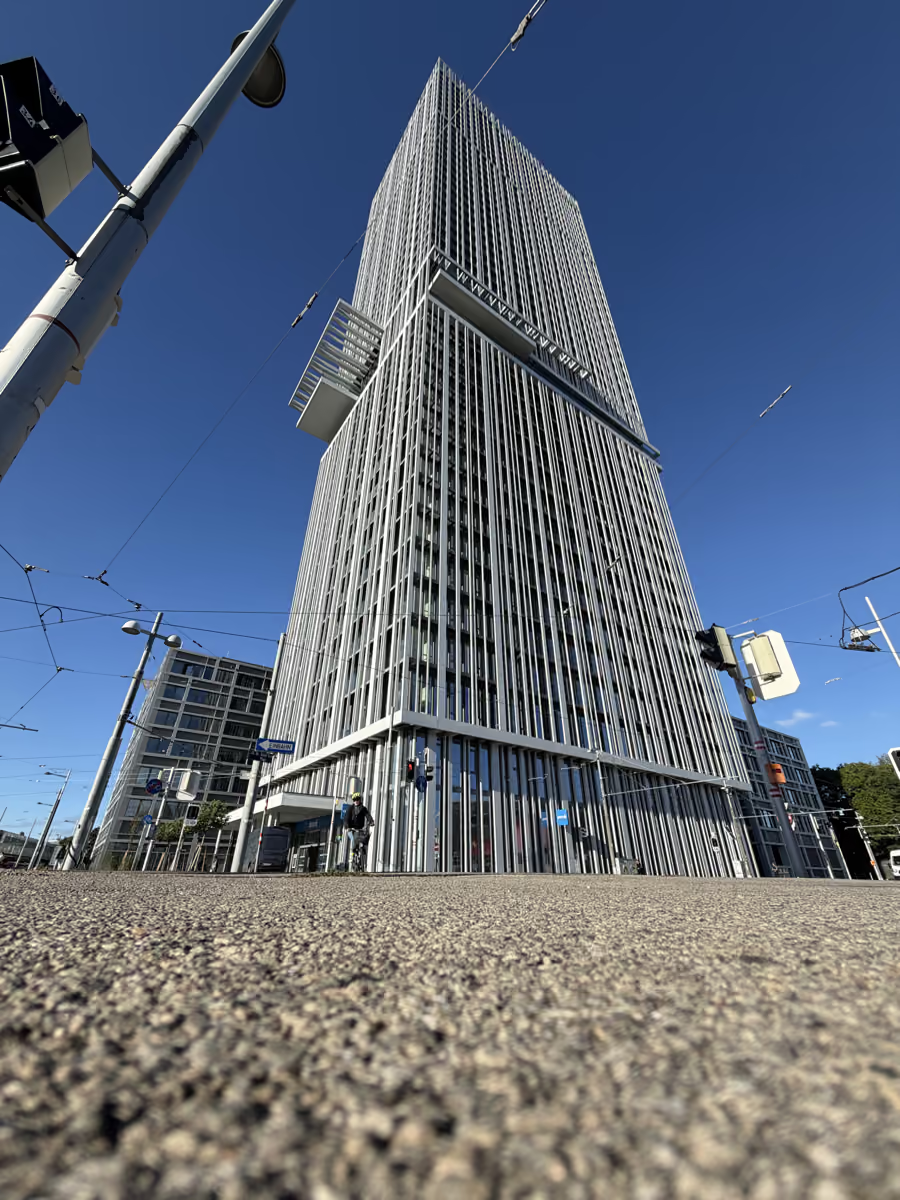
My own photos from Vienna, September 2026. I work remotely and am also in the city in person.
A modernization or relaunch preserves the monolithic CMS runtime while streamlining templates, information architecture, and asset delivery. A headless migration fundamentally re-architects the delivery mechanism, severing the tight coupling between content storage and browser rendering.
A headless migration to Astro or Next.js is the correct technical choice under specific constraints:
- Frontend performance ceilings in monolithic architectures: When existing WordPress or TYPO3 themes carry deep layerings of legacy CSS, jQuery plugins, and render-blocking scripts that cannot be resolved through server caching or asset minification, degrading Interaction to Next Paint (INP) and Largest Contentful Paint (LCP) across mobile devices.
- Security isolation for sensitive institutional environments: For Vienna entities operating under strict governance, keeping the content management system and database completely inaccessible from the public internet - shielded within a private corporate network - while serving pre-rendered static HTML or serverless edge functions eliminates SQL injection, brute-force admin targeting, and plugin exploit vectors.
- Omnichannel and multi-application publishing: When corporate editorial teams must broadcast announcements, technical documentation, and product catalogs simultaneously to public web portals, client extranets, mobile applications, and partner syndication endpoints via a single typed API.
- Developer velocity and talent acquisition: Recruiting top-tier frontend talent in Vienna and the broader DACH region to maintain bespoke TYPO3 TypoScript or legacy PHP theme files is increasingly difficult. Migrating to modern TypeScript, Astro, and React component ecosystems unlocks higher developer satisfaction and rapid product iteration.
Conversely, maintaining an optimized monolithic WordPress installation is the preferable strategy when the website functions primarily as a standard marketing brochure without complex integrations, where local performance bottlenecks can be eliminated by removing visual page builders, implementing block themes, and placing the site behind an optimized Cloudflare or Nginx micro-cache. WPPoland conducts a transparent discovery audit: if your performance and business objectives can be achieved within monolithic WordPress, we recommend that route over unnecessary headless complexity.
Architectural trade-offs: Astro versus Next.js by route family
Modern web engineering abandons the dogma that an entire domain must adhere to a single monolithic rendering paradigm. In enterprise web delivery, different sections of a digital estate have vastly divergent performance, caching, and state requirements. WPPoland evaluates our clients’ route matrices and pairs each URL group with its optimal rendering engine.
+-------------------------------------------------------------------------+
| VIENNA WEB DOMAIN |
| |
| +-----------------------------------+ +----------------------------+ |
| | Astro Edge Routes | | Next.js Dynamic Engine | |
| | | | | |
| | * Corporate Home & About | | * Client Portal / Extranet| |
| | * Research Papers & Publications | | * Interactive Calculators | |
| | * Service Offerings & Case Studies| | * Member Directory & Login| |
| | * Zero-JS Pre-Rendered HTML | | * Session Auth & SSR | |
| +-----------------+-----------------+ +--------------+-------------+ |
| | | |
| +-----------------+-----------------+ |
| | |
| v |
| +-----------------------------------+ |
| | Decoupled Headless Backend | |
| | WordPress REST / WPGraphQL | |
| +-----------------------------------+ |
+-------------------------------------------------------------------------+When Astro is the superior choice
Astro is purpose-built for content-rich performance. By default, Astro compiles templates into pristine, zero-JavaScript HTML at build time. Client-side JavaScript is shipped only to isolated “islands” that explicitly require user interactivity.
For Vienna organizations, Astro is the premier choice for:
- Corporate websites, institutional homepages, and municipal information portals.
- Multilingual research repositories, whitepaper hubs, and policy documentation centers.
- B2B product catalogs, consulting practice landing pages, and event conference sites.
- High-traffic press release sections where unexpected viral traffic must not overwhelm server infrastructure.
Because Astro generates pre-rendered static assets distributed globally across edge CDNs, response times (TTFB) routinely benchmark below 50 milliseconds, and hosting infrastructure costs remain virtually flat regardless of visitor volume. If an interactive consultation scheduling widget or Austrian tax calculator is needed, it can be embedded as a lightweight React or Svelte component without converting the entire document into an expensive client-side bundle.
When Next.js is the appropriate choice
Next.js is a robust, full-stack application framework built on the React ecosystem. It is designed for scenarios where pages require real-time server rendering, user session management, complex client-side state, or dynamic database mutations.
Next.js is the chosen engine for:
- Authenticated client extranets, member-only research vaults, and partner portals.
- Dynamic search interfaces with complex multi-faceted filtering and real-time inventory queries.
- Transactional workflows, custom quoting engines, and integrated multi-step application forms.
- Enterprise applications requiring server-side middleware for localized IP routing, AB testing, and header manipulation.
Cohesive Multi-Zone Infrastructure
For complex Vienna enterprises, we frequently deploy a multi-zone architecture under a single canonical domain. Astro serves the high-speed public marketing pages, publications, and service directories at the root paths. Next.js handles the authenticated portal or interactive tooling located on designated path segments (e.g., /portal/ or /tools/). Both frontends share identical design tokens, CSS variables, and navigation components, delivering a consistent experience to visitors while isolating operational complexity.
URL inventory, 301 redirect mapping, and search equity preservation
The greatest threat during any digital platform migration is the unintentional destruction of organic search rankings. Austrian enterprises that have invested years in establishing search authority across Google.at and international search engines cannot afford redirect oversights, broken canonical tags, or missing language headers.
Legacy Monolith URL Structure Modern Headless URL Architecture
----------------------------- --------------------------------
/ueber-uns/geschichte.html == [ 301 ] ==> /de-at/ueber-uns/
/publikationen/archiv/2022/ == [ 301 ] ==> /de-at/publikationen/
/leistungen/consulting/ == [ Kept ] ==> /de-at/leistungen/consulting/
/wp-content/uploads/*.pdf == [ Proxy] ==> /assets/downloads/*.pdf
Our SEO preservation methodology follows an uncompromising three-stage protocol:
Phase 1: Exhaustive URL Harvesting
We extract and cross-reference all historical URL footprints using three independent telemetry channels:
- Full-depth recursive crawling: Maps every currently linked page, image, PDF document, and media asset across the existing website.
- Google Search Console & Bing Webmaster data: Aggregates 16 months of historical search queries, identifying long-tail URLs that generate impressions and clicks even if they are no longer linked from main navigation menus.
- Web server access log parsing: Evaluates production Nginx or Apache logs to discover external inbound links, legacy bookmarks, and corporate partner referrals that continue hitting legacy endpoints.
Phase 2: Systematic redirect architecture
Every harvested URL is classified within an immutable redirect mapping database:
- Slug Preservation: Whenever feasible, established URL paths are maintained identically on the new platform to eliminate redirect hops entirely.
- One-to-One Permanent Redirects (301): When URL paths are updated (such as adopting clean localized subdirectories like
/de-at/and/en/), a direct 301 redirect is established to the exact replacement page. - Legacy Parameter Normalization: Historical CMS parameter URLs (
index.php?id=84&L=1) are consolidated and mapped directly to modern clean URLs. - Strategic 410 Gone Responses: Outdated press notices or obsolete vacancies that have no modern equivalent and zero search equity are explicitly designated with an HTTP
410 Gonestatus, instructing search engine bots to remove them cleanly from the index without diluting crawl budget.
Phase 3: Automated pre-flight parity audits
Before live traffic is redirected, custom automated test scripts crawl the staging environment and compare it against the production site:
- Bidirectional verification of hreflang tags across German (DE-AT, DE-DE) and English (EN, EN-US) language alternates.
- Canonical URL alignment, ensuring no circular canonical loops or cross-domain errors exist.
- Full validation of Schema.org JSON-LD structured data (Organization, Article, BreadcrumbList, WebPage, and Event schemas).
- Automated execution of all mapped redirect paths to confirm 100% resolution with zero redirect chains or infinite loops.
Headless WordPress as an editorial platform
Adopting Astro or Next.js does not necessitate disrupting the daily routines of your marketing team. For many Vienna organizations, WordPress is a trusted, highly capable content authoring environment. Content creators understand its block editor, editorial permissions are granular, and media management is intuitive.
In our decoupled architecture, WordPress functions purely as a headless content management engine:
Content Modeling and API Pipelines
We organize editorial content using native Gutenberg custom block templates or Advanced Custom Fields (ACF Pro), exposing structured data through clean API interfaces:
- WPGraphQL: Exposes a typed, graph-based endpoint allowing Astro and Next.js to fetch only the exact fields required for a given page component, dramatically reducing payload sizes and compile overhead.
- WordPress REST API: Serves as a reliable, cacheable protocol for static content ingestion, webhook triggers, and third-party data synchronization.
- Decoupled Media Pipeline: WordPress media attachments are automatically mirrored to secure object storage (such as Cloudflare R2 or AWS S3) paired with an edge image optimization layer, serving modern WebP and AVIF assets with responsive
srcsetdefinitions.
+-------------------------------------------------------------------+
| HEADLESS EDITORIAL WORKFLOW |
| |
| +---------------------+ +----------------------------+ |
| | WordPress Admin | | Private PostgreSQL / DB | |
| | Gutenberg & ACF | -----> | Shielded in Private VPC | |
| +----------+----------+ +----------------------------+ |
| | |
| v (Webhook on Post Publish) |
| +-----------------------------------------------------------+ |
| | Edge Revalidation Hook & Static Asset Compiler | |
| +--------------------------+--------------------------------+ |
| | |
| v |
| +-----------------------------------------------------------+ |
| | Edge Delivery Network (Astro Static & Next.js Workers) | |
| | Global Distribution with Immediate Cache Purging | |
| +-----------------------------------------------------------+ |
+-------------------------------------------------------------------+Live Editorial Previews
A frequent concern when considering headless architectures is the loss of standard post previewing. WPPoland implements a private preview pipeline. When an editor in Vienna clicks “Preview” inside WordPress, a cryptographically signed JSON Web Token (JWT) authenticates a private SSR route in Next.js or Astro. The draft renders in real time with exact production fonts, layout, and component styling, allowing editors to review unreleased content without publishing it to the live domain.
Vienna business context, Austrian compliance, and regional infrastructure
Operating an enterprise or institutional web platform in Vienna involves distinct legal, regulatory, and linguistic standards that generic web templates cannot satisfy.
Austrian data protection (DSB) and European regulatory standards
Organizations operating in Austria are subject to the strict enforcement of the Austrian Data Protection Authority (Datenschutzbehörde - DSB) and European Union GDPR regulations. Austrian regulatory decisions have historically been among the strictest in Europe regarding third-party tracking, IP address transmission, and US cloud transfers.
Our headless delivery architecture is engineered for compliance:
- European Sovereign Hosting: Edge routing nodes, serverless compute, and database storage can be geographically locked to European Union jurisdictions (such as Frankfurt, Vienna, or Zurich regions), preventing unlawful international data transfers.
- Zero-Cookie Default Marketing: Astro’s static pre-rendering allows marketing and public information pages to load without generating marketing cookies or executing foreign tracking pixels, significantly simplifying cookie consent requirements while respecting user privacy.
- Accessibility Mandates (BaFG): Austrian federal law enforces accessibility standards through the Web Accessibility Act (Barrierefreiheitsgesetz - BaFG) aligned with the European Accessibility Act (EAA) and WCAG 2.1 AA. Our component architecture enforces semantic HTML, full keyboard navigability, high-contrast ratios, and screen-reader compatibility from the ground up.
Multilingual dynamics and payment architecture
Vienna serves as a central commercial hub between Western and Central-Eastern Europe. Platforms frequently require nuanced localization:
- German and English Dual Architecture: We implement structured language routing (e.g.,
/de-at/for Austrian German alongside/en/for international partners), ensuring that regional terminology differences (such as Austrian legal and commercial phrasing) are accurately maintained. - Austrian Payment Integration: For transactional portals and e-commerce setups, we preserve direct integrations with regional Austrian payment standards, including EPS Online-Überweisung, Klarna/Sofort, and SEPA direct debit, alongside international credit cards and Apple Pay/Google Pay flows.
The Vienna Web Community
Vienna hosts an active open-source and web technology community. Local WordPress professionals, developers, and agency leaders meet regularly at the Vienna WordPress Meetup (https://www.meetup.com/vienna-wordpress-meetup/), alongside vibrant React, TypeScript, and Jamstack engineering groups across the city. We welcome peer scrutiny and transparent architectural dialogue: we encourage prospective partners to discuss headless migration methodologies with peers in the Austrian technical community.
Staging, testing, cutover, and rollback runbooks
A successful migration is defined by rigorous execution during the final cutover window. We leave nothing to improvisation during live production switchovers. Every procedural step is defined within an immutable migration runbook agreed upon by all stakeholders.
Migration Execution Sequence
-----------------------------------------------------------------
Phase 1: Architecture Blueprint & Content Modeling Validation
Phase 2: Headless API Setup & Astro/Next.js Component Build
Phase 3: Staging Environment Deployment & Comprehensive URL Crawl
Phase 4: Editorial Content Freeze & Final Data Synchronization
Phase 5: DNS Switchover (300s TTL) & Edge Cache Warming
Phase 6: Live Smoke Testing & Two-Week Hypercare Monitoring WindowStaging Validation Protocol
The complete Astro or Next.js application is deployed to an isolated staging environment protected by HTTP basic authentication and noindex headers. In staging, we execute:
- Redirect Matrix Verification: Automated test suites execute every legacy URL against the staging server, confirming that each endpoint returns a clean
301 Moved Permanentlyto its designated target. - Visual and Structural Regression Testing: Automated visual regression tools compare screenshots of legacy pages against new headless templates across mobile, tablet, and widescreen viewports, identifying unexpected layout shifts or typography anomalies.
- Core Web Vitals Enforcement: Staging builds must pass strict automated performance budgets in CI/CD, guaranteeing that mobile Largest Contentful Paint (LCP) remains under 1.8 seconds and Cumulative Layout Shift (CLS) remains below 0.05.
- Interactive Form and Webhook Testing: Every inquiry form, newsletter subscription, and CRM integration is tested against sandbox APIs to verify end-to-end data transmission.
The Cutover Window
On cutover day, execution proceeds according to strict protocol:
- TTL Pre-Lowering: DNS Time-To-Live (TTL) values are reduced to 300 seconds 72 hours prior to deployment, ensuring near-instantaneous global DNS propagation.
- Scheduled Publishing Freeze: A brief, coordinated content freeze is scheduled with the Vienna editorial team during final content synchronization between WordPress and the production build.
- DNS Record Update: Apex and subdomain DNS records are pointed to the edge CDN network (Cloudflare Pages or Vercel).
- Post-Deploy Smoke Tests: Automated health-check suites probe core landing pages, XML sitemaps, robots.txt, and API endpoints, confirming 200 OK statuses and valid SSL handshakes within seconds of DNS activation.
Rollback Runbook
Professional risk management demands an immediate, tested rollback path. Throughout a 14-day observation period following launch, the legacy monolithic server remains active on a private standby origin.
If an unexpected, catastrophic issue emerges (such as a critical third-party enterprise integration failure):
- DNS records are immediately pointed back to the standby monolithic origin.
- Edge routing rules revert traffic to legacy web servers within five minutes.
- Telemetry monitors verify that production operations and user sessions are fully restored.
- The underlying issue is isolated, resolved, and validated in staging before re-initiating cutover.
Next steps for your Vienna platform migration
A platform migration should be a calculated, strategic technical investment that removes operational debt and accelerates digital capability. If your organization in Vienna is evaluating a migration from legacy WordPress, TYPO3, or proprietary CMS infrastructure to Astro or Next.js, the journey begins with an objective technical assessment.
Contact WPPoland to schedule an initial technical discovery session. We will evaluate your current architecture, analyze your Core Web Vitals telemetry, review your editorial and regulatory requirements, and deliver a comprehensive migration blueprint with realistic timelines, defined risk mitigations, and transparent architectural guidance.
Map of Vienna and surrounding area
We serve clients in Vienna and nearby areas.
WordPress projects in Vienna and Austria
Explore selected projects supporting our clients' success.
E-commerce Development: haveabook.pl
The haveabook.pl website is a modern platform dedicated to publishing and printing, catering to demanding clients from Scandinavian countries. The project wa...
E-commerce Development: hot.jpg.pl
hot.jpg.pl is an advanced hosting platform dedicated to storing and distributing images. The system was designed to provide fast, stable, and secure access t...
E-commerce Development: ILOVEHAIR
Ilovehair.pl is an e-commerce store based on the WordPress platform, dedicated to the sale of professional hairdressing products by Hair Saloon Products. As ...
WordPress support & development in Vienna
Methodology guides (SEO, GEO, compliance)
How we approach AI citations, WooCommerce B2B modernization, and NIS2-aligned operational resilience on WordPress. These guides apply to every client location.
What makes Vienna unique
Local expertise: - Migration initiates with a comprehensive URL inventory derived from web crawls, Google Search Console logs and production server access logs - Astro delivers static zero-JavaScript output for marketing, publications and institutional hubs; Next.js powers authenticated client portals - WordPress remains the headless content authoring environment via WPGraphQL or REST API, maintaining editorial publishing autonomy I work remotely and tailor solutions to the needs of businesses in Vienna. The biggest advantage is combining technical quality with Vienna's local business context.
Need this service: Next.js / Astro migration in Vienna?
Let's discuss how we can bring top-tier performance to your project.
Schedule free consultation in ViennaFAQ - Next.js / Astro migration Vienna
Do we need to abandon WordPress during a headless migration?
No. WordPress often continues serving as the decoupled content management system. Editorial teams in Vienna retain their established Gutenberg block templates, approval workflows and media assets, while Astro or Next.js renders the visitor-facing presentation layer via API.
How do you choose between Astro and Next.js for a Vienna organization?
Routes are categorized by interactive state and authentication boundaries. Public institutional portals, corporate knowledge bases, corporate blogs and marketing pages run on Astro for zero-JS compilation. Dynamic client extranets, complex search portals and real-time dashboards use Next.js.
How does the migration protect organic search rankings in Google?
Every legacy URL is recorded from search console data, server logs and crawls. Existing slugs are either preserved identically or mapped via a single 301 redirect. Canonical tags, German-English hreflang alternate declarations and Schema.org markup are validated prior to DNS transition.
Can our editorial team keep publishing during development?
Yes. Editors continue drafting and publishing in the WordPress staging environment. The modern frontend consumes API updates continuously. A brief publishing freeze of one to two hours is scheduled strictly during final DNS propagation and edge cache warming.
What does the rollback plan cover for Austrian and EU data regulations?
The legacy monolithic environment remains hot on an internal fallback origin throughout the two-week observation window. The cutover runbook specifies deterministic rollback triggers, DNS reversion mechanisms, and compliance with Austrian DSB privacy and BaFG accessibility standards.
Explore other WordPress services and knowledge base
Strengthen your business with professional technical support in key areas of the WordPress ecosystem.
Migration to Astro, Next.js, and headless WordPress.
WooCommerce sync with ERP and wholesale systems.
Business process automation around WordPress and company systems.
Library of concrete automation use cases.
Headless WordPress, Sanity, Strapi, and Contentful with Astro or Next.js.
Astro, MDX, edge delivery, and Core Web Vitals measured on real traffic.
Custom WordPress engineering and architecture.
Scalable headless, ERP, and AI architecture for enterprise.
Related categories
Supporting articles

Six to sixteen weeks for typical engagements, with a four-phase shape: discovery, scoping, build and cutover, tuning. The variables are catalogue size, integration count, URL preservation, and editorial team readiness, not framework choice.

A definitive 4-year Total Cost of Ownership (TCO) analysis, real-world Core Web Vitals benchmarks, Astro 7 GraphQL APQ architecture, and a 10-point executive decision matrix for choosing between decoupled and traditional WordPress.

The Shopify Plus vs WooCommerce headless decision in 2026 is no longer a binary "platform vs custom" trade-off. Both can run headless, both integrate AI, both ship at the edge. The real axes are control, total cost over five years, and exit strategy. This article walks the matrix with confirmed platform facts.