Website & application migration in Wrocław
I migrate sites from WordPress, Joomla, Drupal, Angular, Vue and other technologies to Astro and Next.js. I plan each migration to keep SEO, content and features intact and switch over in an agreed window. I work alone and have years of experience with both legacy and modern stacks.
- I have had a wordpress.org account since 2006.
- I contributed to WordPress core for versions 7.0 and 7.1.
- I maintain 30 plugins on wordpress.org.
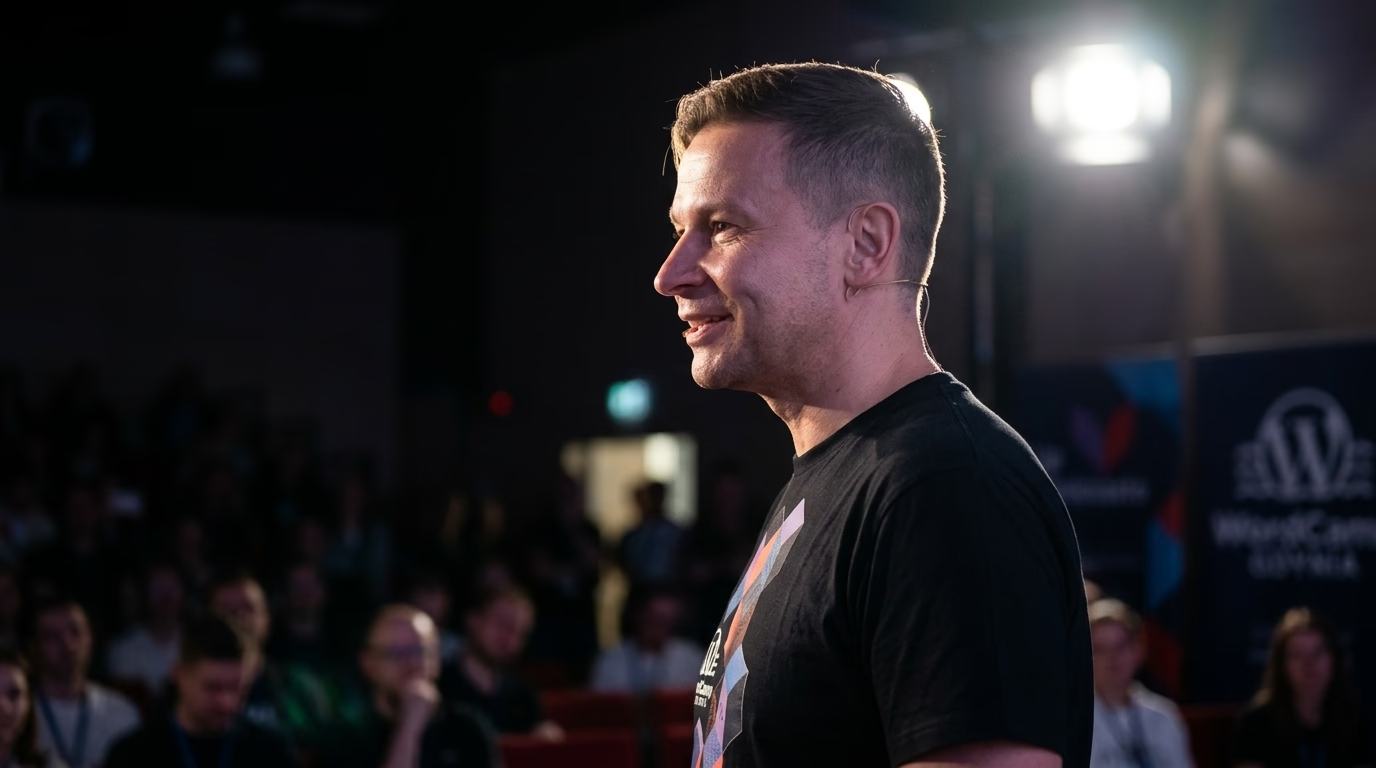
- I organise and speak at WordCamps.
- I have attended every WordCamp Europe from 2017 to 2026.
- Local WordPress meetup: WordPress Wrocław
Wrocław is the capital of the Lower Silesian Voivodeship (Dolny Śląsk) on the Oder, and one of Central Europe’s largest software engineering, R&D and advanced manufacturing hubs. Across the metropolitan area, websites serve distinct commercial roles: software houses, fintechs, game studios and global BPO/SSC/R&D centres around Plac Grunwaldzki, Stare Miasto, Fabryczna (Muchobór / Business Garden) and Krzyki / Powstańców Śląskich, biotechnology and hardware ventures at Wrocław Technology Park (Wrocławski Park Technologiczny, WPT), and automotive, electronics, battery and household-appliance manufacturers across the Wałbrzych Special Economic Zone (WSSE “Invest-Park”) and Legnica Special Economic Zone (LSSE) in Bielany Wrocławskie / Kobierzyce, Miękinia, Siechnice and Długołęka. If your company runs a site on WordPress, Joomla, Drupal or an ageing custom framework that has become slow, risky to patch or painful for editors, this page explains how I migrate it to Astro or Next.js from Gdynia without throwing away the search traffic it has earned. I work as a solo engineer, so the person who scopes the job also writes the redirect map and the TypeScript code.
How do I keep Polish, English, German and Ukrainian versions intact?
Many Wrocław sites publish in three or four languages. Because Lower Silesia borders Germany (Saxony) and the Czech Republic along the A4 and S8 corridors and employs a large international workforce, Wrocław’s own municipal portal (wroclaw.pl) is published in Polish, English, German and Ukrainian, and local B2B exporters, logistics operators and employers routinely maintain the same four-language split (pl, en, de, uk). Language versions are where CMS migrations break most often, because each locale has its own URLs, its own character set (Polish diacritics and Ukrainian Cyrillic) and its own indexing history in Google.
I treat every language as a dedicated inventory:
- Explicit locale mapping: Polish slugs with diacritics, English paths added later by WPML or Polylang, a German DACH section that covers core industrial products, and Ukrainian recruitment or service pages each get their own row and their own single-hop
301redirect in the migration matrix. - Deterministic
hreflanggeneration:hreflanglinks (pl-PL/pl,en,de-DE/de,uk-UA/uk, plusx-default) are generated directly from a sharedtranslationIdin the Astro Content Collection or headless CMS schema rather than typed by hand. Every page lists itself and all its translated siblings, so an untranslated blog post can never emit a broken or one-wayhreflangtag. - UTF-8 and slug encoding verification: Before cutover, an automated script checks every exported title, meta description, JSON-LD string and URL slug in both directions so that Polish characters (
ą, ć, ę, ł, ń, ó, ś, ź, ż), German umlauts (ä, ö, ü, ß) and Ukrainian Cyrillic script never turn into Mojibake or broken percent-encodings on the way out of MySQL.
Why Lower Silesian IT, R&D and industrial companies outgrow legacy CMS templates
Businesses in Wrocław and the surrounding Kobierzyce/Miękinia industrial belt usually hit three technical limits on monolithic WordPress, Drupal or Joomla installations:
- Developer documentation, case studies and high-velocity content. Wrocław software houses, AI startups and electronics R&D labs want their engineers and technical marketers to publish MDX case studies, architecture diagrams, API docs and benchmarks via Git pull requests rather than fighting a slow visual page builder. Astro’s Content Collections and island architecture turn Markdown/MDX into zero-JavaScript static HTML that passes Google’s official Core Web Vitals thresholds (Largest Contentful Paint up to 2.5 seconds, Interaction to Next Paint up to 200 milliseconds, Cumulative Layout Shift up to 0.1) out of the box.
- High-volume recruitment pipelines (JobPosting schema + ATS sync). Shared services centres, BPO hubs and tech companies around Plac Grunwaldzki and Fabryczna publish dozens of concurrent engineering and multilingual operational job offers connected to Greenhouse, Workday, SmartRecruiters, eRecruiter or Traffit. Legacy WordPress career plugins frequently break
JobPostingJSON-LD markup or slow down under campaign traffic. In Astro or Next.js, ATS webhooks trigger clean incremental builds with validated structured data. - Industrial B2B catalogues and compliance PDFs. Suppliers in the Wałbrzych and Legnica Special Economic Zones host thousands of technical datasheets, ISO/IATF 16949 certificates, RoHS/REACH declarations and CAD files. Decoupling the public frontend keeps every legacy PDF path working at the CDN edge while isolating ERP/PIM data syncs (SAP, Comarch ERP XL, IFS, Microsoft Dynamics) from visitor page requests.
Is Astro or Next.js the right target for my Wrocław site?
The choice follows what each route actually does:
- Astro fits sites that are mostly content and lead generation: corporate presentations, industrial product catalogues without per-user pricing, technical blogs, documentation (Starlight/MDX) and recruitment hubs. It renders static HTML at build time and ships JavaScript only to the specific UI islands that require client-side state.
- Next.js fits when part of the site behaves like a stateful web application: authenticated customer or supplier portals, SaaS dashboards, interactive product configurators or real-time pricing calculators fed by an API.
Your editorial content can stay in a private headless WordPress instance (if your marketers already know Gutenberg/ACF), move to a headless CMS like Directus, Sanity or Strapi, or live as typed Markdown files in Git. And sometimes the honest engineering answer is neither framework: if removing a few bloated plugins and configuring Redis + CDN cache fixes your WordPress speed problem, I will tell you so in the written scope before you spend budget on a rebuild. The full methodology is detailed on my Next.js and Astro migration page, and the Astro architecture on the Astro developer page.
What happens to my URLs and rankings during the move?
Google’s site-move documentation stresses mapping the old site’s URLs to the new ones with permanent server-side redirects, and that URL map is the spine of the project:
- Multi-source URL inventory. I pull every URL Google and your users know about from Google Search Console, XML sitemaps, analytics landing-page reports, backlink exports and a full site crawl, including old campaign landing pages and downloadable PDF files. Each URL is marked
keep,move (301),merge (301)orretire (410). - Typed content model. Pages, posts, custom fields, menus, categories, authors and media become typed TypeScript/Zod collections. Legacy shortcodes and page-builder blocks take the most care, because each one is parsed into a clean Astro/React component or semantic HTML.
- Single-hop 301 redirects. Every URL that changes gets a direct
301straight to its final destination. I flatten any redirect chains left over from earlier redesigns and never dump retired content onto the homepage. - Metadata and structured data parity. Titles, meta descriptions, canonicals, Open Graph tags and Schema.org JSON-LD are compared old-against-new with an automated script, page by page.
- Staged cutover. On larger Wrocław sites, edge routing rules let the new frontend take over section by section while legacy routes continue running on the old system. A single atomic switch is used on compact sites.
- Post-launch Search Console monitoring. Google notes that a small-to-medium site move takes a few weeks to settle in the index. I run scheduled Search Console checks across that window: page indexing coverage, redirect errors, crawl stats and query performance per language folder.
Pre-cutover verification gates for Wrocław migrations
Before switching live DNS or edge proxy rules, every staging build is verified against six objective gates:
| Verification gate | What I test on staging | Passing criterion before cutover |
|---|---|---|
| URL & PDF coverage | Crawl + GSC export + XML sitemaps + analytics + backlinks tested via HTTP script | 100% resolve with 200 OK at the same path or a single-hop 301 to the mapped target |
Quad-lingual hreflang (pl, en, de, uk) | Reciprocal <link rel="alternate" hreflang="..." /> tags in compiled HTML and sitemaps | Every locale links to itself, all siblings and x-default; zero broken return links or UTF-8 corruption |
| Structured data parity | Schema.org JSON-LD (Organization, Product, JobPosting, FAQPage) checked on build output | Zero validation errors; KRS/NIP/REGON corporate disclosures and job attributes preserved |
| Core Web Vitals readiness | Zero-JS static HTML baseline, responsive AVIF/WebP images and latin-ext / Cyrillic font subsets | Built to meet official web.dev thresholds (LCP <= 2.5 s, INP <= 200 ms, CLS <= 0.1) |
| PKE & UODO consent gate | Clean browser session inspection prior to interacting with the consent banner | Zero non-exempt marketing or analytics cookies/scripts fired before explicit opt-in |
| Forms, CRM & ATS endpoints | Live test submissions on contact, RFQ and recruitment application forms | Payloads delivered with HTTP 200/201, server-side validation and GDPR clauses |
Which Polish and EU rules matter for a website in Wrocław?
Rebuilding templates is the cleanest moment to bring technical compliance in line with Polish statutory law:
- Personal Data Protection Office (Prezes UODO) and GDPR (RODO). Contact forms, recruitment pipelines, analytics and embedded widgets process personal data under the GDPR and the Polish Act of 10 May 2018 on the Protection of Personal Data, supervised by the President of the Personal Data Protection Office (Prezes UODO). During the migration I audit every third-party script the legacy site loads, drop redundant trackers, and hand you a complete written list of hosting regions, CDN nodes and form processors so your Article 13 GDPR notices and RoPA records stay accurate.
- Polish Electronic Communications Law (Prawo komunikacji elektronicznej, PKE). Effective 10 November 2024, the PKE (Dz.U. 2024 poz. 1221) replaced the old Telecommunications Law and governs terminal equipment storage (cookies,
localStorage, tracking pixels) alongside commercial electronic communication consents (Article 398 PKE), supervised by Prezes UKE and Prezes UODO. On the new Astro or Next.js build, analytics and marketing tags remain strictly blocked until explicit user consent is granted, with an equal-prominence rejection option in the first banner layer. - Polish Accessibility Act (Polski Akt o Dostępności, PAD). Poland transposed the European Accessibility Act (Directive (EU) 2019/882) through the Act of 26 April 2024 (Dz.U. 2024 poz. 731), enforced from 28 June 2025 under the supervision of Prezes Zarządu PFRON and market surveillance bodies. The Act covers consumer e-commerce and digital contracting services while exempting service microenterprises (fewer than 10 employees and annual turnover or balance sheet total up to EUR 2 million). Because templates are rewritten from scratch during a migration, I bake semantic landmarks, keyboard focus order, explicit form labels and EN 301 549 / WCAG 2.1 Level AA contrast directly into the components.
- Commercial Companies Code (KSH Art. 206 & 374) and UOKiK. Under Articles 206 and 374 of the KSH, websites of Polish companies (sp. z o.o., P.S.A., S.A.) must display the full registered name, registered office and address, the registry court, for Wrocław companies, typically Sąd Rejonowy dla Wrocławia-Fabrycznej we Wrocławiu, VI Wydział Gospodarczy Krajowego Rejestru Sądowego, along with the KRS number, NIP, REGON and share capital (kapitał zakładowy). Consumer-facing stores must also comply with Prezes UOKiK Omnibus price history rules.
What does a Wrocław company own after the project (and how we work)?
You own everything: the Git repository, the CI/CD deployment pipeline, the environment variables, the versioned redirect map and the content model documentation. Nothing runs on an account in my name, and if your internal Wrocław developers take the codebase over on day one after launch, they find clean, standard Astro or Next.js TypeScript code with zero proprietary lock-in.
To keep engineering delivery focused, I follow two clear rules:
- Written, asynchronous communication only. I work remotely from Gdynia and do not hold video calls, phone consultations or live meetings. Every audit, scope document, redirect spreadsheet and staging review happens in writing by email or Git pull request, and I reply in writing on working days.
- Client-supplied visual design. If you want a visual redesign during the move, your in-house designer or creative studio provides the Figma files or brand guidelines, and I code them cleanly. When your Wrocław team wants to retain the existing visual interface, I rebuild that exact layout in Astro or Next.js without legacy plugin overhead.
How to get a written scope for your Wrocław migration
Send me a message via the contact page with three details: your current site URL, the CMS or framework it runs on, and where your traffic comes from (organic search, paid ads, newsletters, ATS job boards or direct B2B referrals). Mention the languages you publish in (pl, en, de, uk) and any ERP, CRM or ATS integrations. From that, I will write a clear scope listing the URLs in play, the content schema, the risks I see and the staged order of work, so you can decide on the written plan before any code is written.
Selected projects
Examples of my work.
Real Estate Platform: rezydencjapark.pl
Rezydencja Park Mielno is a complex of boutique apartments by the sea, created with the idea of harmony with the surrounding nature and providing a family at...
Real Estate Platform: sportostroda.pl
Sportostroda.pl is one of the interesting projects in my portfolio as a WordPress developer, realised as a local sports portal dedicated to the residents of ...
Real Estate Platform: surfuje.pl
surfuje.pl is a website for surfers and watersports enthusiasts, with clear content, simple publishing, and stable technical operation.
WordPress support & development in Wrocław
Need this service: Next.js / Astro migration in Wrocław?
Describe your project by e-mail. I reply within 48 hours.
Describe your projectExplore other WordPress services and knowledge base
Migration to Astro, Next.js, and headless WordPress.
WooCommerce sync with ERP and wholesale systems.
Business process automation around WordPress and company systems.
Library of concrete automation use cases.
Headless WordPress, Sanity, Strapi, and Contentful with Astro or Next.js.
Astro, MDX, edge delivery, and Core Web Vitals measured on real traffic.
Custom WordPress engineering and architecture.
Scalable headless, ERP, and AI architecture for enterprise.
Related categories
Supporting articles
Six to sixteen weeks for typical engagements, with a four-phase shape: discovery, scoping, build and cutover, tuning. The variables are catalogue size, integration count, URL preservation, and editorial team readiness, not framework choice.
A definitive 4-year Total Cost of Ownership (TCO) analysis, real-world Core Web Vitals benchmarks, Astro 7 GraphQL APQ architecture, and a 10-point executive decision matrix for choosing between decoupled and traditional WordPress.
The Shopify Plus vs WooCommerce headless decision in 2026 is no longer a binary "platform vs custom" trade-off. Both can run headless, both integrate AI, both ship at the edge. The real axes are control, total cost over five years, and exit strategy. This article walks the matrix with confirmed platform facts.