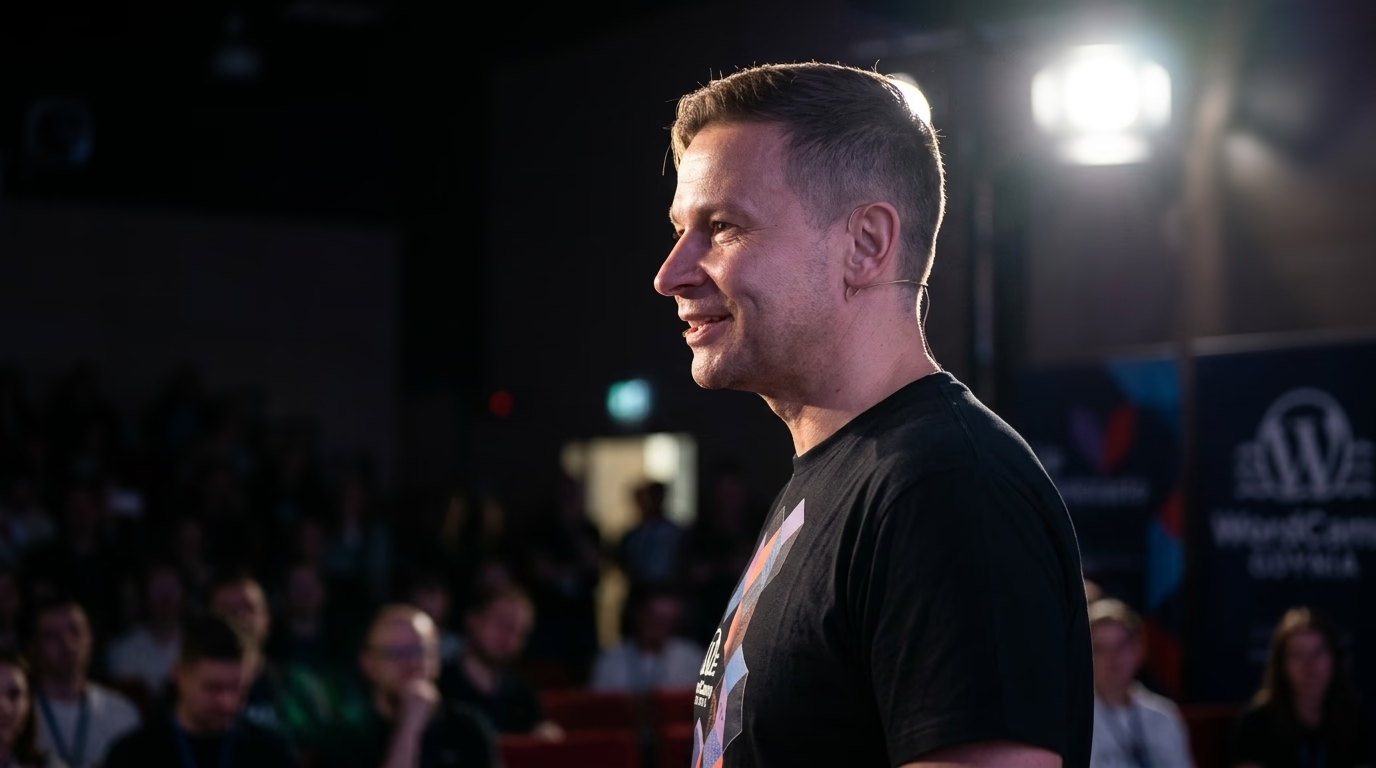
I support the WordPress community in Katowice
I am not just a remote agency. I am an active part of the ecosystem. I believe in Open Source and contributing back to the community that powers over 40% of the web (W3Techs).
Specific context: Local SEO visibility, fast mobile performance, and practical integrations with CRM, booking, and payment tools used by regional businesses.
Why hire a senior Next.js developer in Katowice?
Supporting the local business ecosystem in Katowice. I offer accessible, high-performance web development tailored for growing companies in the Katowice region.
Local SEO, fast pages on mobile, and integrations with the CRM, booking and payment tools that local businesses already use.
The React frontend landscape in Katowice is dominated by Next.js as the production-grade React framework. Next.js 15 with the App Router, React, Server Actions and Turbopack is my default stack for application-like frontends: dashboards, B2B portals, headless e-commerce, multi-tenant SaaS and any interface with rich interactivity on top of a backend API. Companies in Katowice that try to staff a senior Next.js role in-house typically wait three to six months and pay rates that rival full-stack Go or Rust hires; freelance senior contracting closes the timeline gap and lets the budget scale to the actual scope rather than to a permanent salary.
I deliver senior Next.js engineering for businesses in Katowice as a freelance contractor, EU jurisdiction, B2B contract on VAT invoice. The developer you speak to at the start is the one writing the code in week six. I work alone, so there is no offshore handoff and no project manager on your invoice. Pricing is individual after a one-hour audit, because a Next.js marketing site with 30 routes costs very differently from a multi-tenant SaaS with role-based access control, distributed caching and NIS2 compliance.
What sets Next.js apart from Astro and pure React
Next.js owns the application-shaped frontend space. The App Router with React Server Components fetches data on the server out of the box, Server Actions handle form submissions without a separate API layer, and the edge runtime can keep TTFB under 100 ms for request-response work. Astro owns the content-shaped frontend space; it ships zero JavaScript by default and wins on Lighthouse for marketing sites, blogs, documentation, and content-heavy landing pages. Pure React (Vite + react-router) wins for purely client-side single-page applications without SSR requirements.
For businesses in Katowice, the practical decision tree:
- Marketing site, blog, documentation, content catalogue: Astro
- B2B portal, SaaS dashboard, headless commerce, internal tooling: Next.js
- Embedded widget, mobile-first SPA without SEO needs: Vite + React
- Existing WordPress that needs a faster public frontend: headless WordPress with either Astro or Next.js depending on application surface
I deliver all four patterns. This page covers the Next.js side.
Greenfield Next.js applications
App Router architecture from the start: server components for data fetching, client components for interactivity, Server Actions for mutations and route handlers for REST/RPC endpoints. TypeScript in strict mode, Tailwind CSS or your chosen design system, shadcn/ui or a custom component library, server-side authentication with NextAuth, Auth.js or a third-party provider, Drizzle ORM or Prisma for database access, and Server Actions with revalidation paths for cache invalidation. I deliver Next.js applications in Katowice that scale predictably from MVP to production.
Headless commerce on Next.js
Shopify Hydrogen, BigCommerce, commercetools, Saleor, or custom GraphQL/REST API backends rendered through Next.js. Product pages as statically generated routes with on-demand revalidation, cart and checkout as interactive client components using Server Actions for changes, search on Algolia or Meilisearch, internationalisation with next-intl or the App Router’s built-in i18n, and edge caching for catalogue pages. The Next.js commerce architecture in Katowice delivers the editorial speed of static rendering with the dynamic behaviour of a SPA.
Headless WordPress on Next.js
WordPress as the editorial CMS, with a Next.js frontend fetching content through the REST API or GraphQL (WPGraphQL). Editors keep the WordPress workflow they already know, and the public frontend gets React Server Components, instant page transitions and Vercel-level deployment automation. Common pattern for businesses in Katowice with editorial content surfaces that need to ship fast on mobile.
Migration from Pages Router, CRA, Gatsby, or other frameworks
Next.js 12 Pages Router to Next.js 15 App Router, migrated route by route to avoid one high-risk switchover. Migrations from create-react-app to Next.js for projects that have outgrown client-only rendering. Migrations from Gatsby to Next.js or Astro, depending on whether the site is closer to an application or to a content site. Migrations from custom React + Webpack setups to Next.js when you would rather use the framework’s built-in tooling than maintain your own.
Performance optimisation
Without discipline, Next.js applications end up with heavy JavaScript bundles: client components everywhere, whole component libraries imported, image optimisation skipped, third-party scripts dropped into the global layout. I audit production Next.js applications in Katowice for bundle size (with @next/bundle-analyzer), code splitting opportunities, server-vs-client component boundaries, image and font optimisation, and Core Web Vitals. You get a prioritised list of fixes and a Lighthouse baseline taken before the optimisation work, so the improvement is measured under the same conditions.
React Server Components and Server Actions
The move to React Server Components and Server Actions in the App Router changes how data is fetched and how mutations work. I help your developers adopt the new patterns: which components must run on the client and which on the server, when to use Server Actions and when route handlers, how to handle authenticated mutations, how to invalidate caches across the server boundary, and how to test RSC trees that mix server and client code.
Internationalisation and multi-region routing
Next.js routing for multilingual sites: subpath routing (/en, /de, /pl), domain routing (.com, .de, .pl), or fully dynamic, with the locale resolved from cookies and headers. Translation pipelines with next-intl, react-i18next, or static JSON dictionaries. SEO with hreflang, canonical URLs, a sitemap per locale and localised structured data. I implement this for businesses in Katowice serving multiple EU markets or running global SaaS.
Custom backend-for-frontend patterns
Server Actions and route handlers as a thin BFF layer that combines calls to several backend services, normalises payloads, handles authentication, applies rate limiting and returns data in the shape the frontend needs. This pattern fits businesses in Katowice with microservices on the backend (often Laravel, Symfony, NestJS, or Go) and a Next.js frontend that needs a single endpoint per page.
What frontend work do growing and regional companies need in Katowice?
From a Next.js application architecture perspective: regional SMEs and growing scaleups hire senior developers under a constraint that larger companies rarely face, because every euro spent has to show a measurable business result within a quarter. What works is cutting the scope honestly at the start, getting to a working demo quickly, and shipping in small steps your operations team can follow on staging each week instead of seeing everything at the end of the quarter.
- Operational hygiene: monitoring, error tracking, and runbooks that the in-house ops person can act on without escalation
- Pragmatic technology choices: stack that the local talent market can hire for, not the latest framework on the conference circuit
- Honest scope cutting at discovery: features that should be deferred get deferred before they appear on the timeline
- Weekly progress visible on staging, not a milestone gate where six weeks of work is revealed at once
Framework versions
- Next.js 15 with App Router for new projects, Next.js 14 for projects already in production
- React 19 with the use() hook, useOptimistic, useFormStatus, and the new React compiler
- TypeScript 5.x in strict mode, with type-safe routes and typed Server Actions
- Turbopack for development, webpack or Turbopack for production depending on plugin compatibility
UI and styling
- Tailwind CSS 4 with design tokens and automatic purging, or a project-specific design system
- shadcn/ui for accessible component primitives layered with Radix UI and Tailwind
- Framer Motion for animation when the design genuinely benefits from motion
- CSS Modules or vanilla-extract when shadcn/ui is overkill for the project surface
Data, ORM, and authentication
- Prisma or Drizzle for type-safe database access, with PostgreSQL 16+ as the default
- NextAuth.js / Auth.js for authentication with email, OAuth, and credential providers
- Clerk or WorkOS for projects that need enterprise-grade auth out of the box
- Server Actions for form submissions and mutations, with Zod schema validation
- TanStack Query or SWR when client-side data fetching is genuinely required
Hosting and deployment
- Vercel as the default for Next.js, with preview deployments per pull request, edge runtime where it helps, and Vercel Analytics for Core Web Vitals
- Cloudflare Workers when the team prefers Cloudflare’s edge platform for cost or vendor-diversification reasons
- Self-hosted Node behind a reverse proxy when the project requires the EU-jurisdiction guarantee that excludes US-based hyperscalers from the request path
Testing and quality
- Playwright for end-to-end testing across browsers and viewports
- Vitest for unit and component tests, Testing Library for component interaction tests
- Storybook for component documentation and visual regression
- GitHub Actions for CI: lint, typecheck, tests, build, deploy to staging
- Lighthouse CI in the deployment pipeline so performance regressions block production
Observability and monitoring
- Sentry for error tracking and Session Replay
- Vercel Analytics or Cloudflare RUM for real-user Core Web Vitals
- Datadog or New Relic for application performance monitoring on self-hosted setups
- PostHog for product analytics with privacy-preserving session recording
Local context: Katowice’s startup and tech scene is one of the clearest technical reference points in Katowice, and WordPress Katowice Community is still a place where senior practitioners compare notes.
What does the market look like for businesses in Katowice?
The senior Next.js rate in Katowice reflects local market conditions and EU jurisdiction overhead. In my quotes, senior React developers with Next.js App Router experience charge 25 to 50 percent above the median full-stack rate, because the work needs both client-side React skills (state management, accessibility, mobile UX) and server-side architecture (RSC boundaries, caching strategies, BFF patterns), which junior and mid-level developers rarely have together. In my quotes, rates for clients in Germany, Norway, the UK and the US come out 30 to 80 percent above the Polish baseline, depending on the framework, the compliance requirements and the contract length.
The implication for businesses in Katowice: a senior Next.js developer hired locally is roughly the same hourly cost as one contracted through an EU-based freelance arrangement, but the freelance arrangement skips the recruitment lead time (which currently sits at 3 to 6 months for senior roles), provides B2B invoicing rather than full-time employment overhead, and lets the engagement scale up or down with the actual scope of work.
Compliance and jurisdiction
For Next.js applications serving clients in Poland, the usual compliance requirements are:
- GDPR
- NIS2
- OWASP Top 10
These requirements shape the cookie consent layer, the analytics setup and the process for data subject requests.
Engagement model and project timeline
Senior B2B in EU jurisdiction. A standard NDA and a framework agreement with a defined scope and milestones, billed as time and materials or at a fixed price depending on how complete the brief is. Discovery is a one-hour audit: I read your brief, send technical questions in writing, review the existing stack (if there is one), list the risks and unknowns, and then send an individual written quote for the scope. My proposals do not quote a starting hourly rate, because the audit usually moves the estimate by 20 to 40 percent either way.
A typical Next.js greenfield engagement in Katowice:
- Week 1, discovery, architecture decisions (RSC boundaries, auth, data layer), environment setup, runnable demo on staging by Friday
- Week 2-4, design system implementation, primary routes, authentication flow, database schema and Prisma/Drizzle setup, core mutations via Server Actions
- Week 5-8, feature completion, integrations with external services, admin surfaces, search, internationalisation if in scope
- Week 9-10, performance pass with bundle analysis and Lighthouse CI, accessibility audit (WCAG 2.2 AA), security review, observability setup
- Week 11-12, production cutover, monitoring, optional retainer hand-off
A typical migration to Next.js (Pages Router to App Router, or another framework to Next.js):
- Week 1-2, codebase audit, dependency analysis, route inventory, RSC boundary planning
- Week 3-6, route-by-route migration with the strangler pattern, regression tests on each migrated surface
- Week 7-10, full cutover to App Router, deletion of Pages Router code paths, performance pass
- Week 11-12, post-launch monitoring, retainer transition
App Router or Pages Router?
App Router for any greenfield project on Next.js 14 or 15. Pages Router only for existing applications where migrating is not yet worth the cost. Server Components and Server Actions in the App Router make development easier and raise the performance ceiling, and Vercel’s documentation now treats the App Router as the default.
Next.js or Remix or pure React?
Next.js for production applications that need SSR, ISR, the edge runtime and Vercel-level deployment automation as a baseline. Remix is a good alternative if you prefer its data-loading model, and it works well on Cloudflare Workers; it is now part of React Router 7. Plain React (Vite + react-router) for embedded widgets and SPAs that do not need SSR. The default for businesses in Katowice hiring senior frontend talent today is Next.js because the talent pool and the production track record are both larger.
Vercel or self-hosted?
Vercel for the least operational work, the fastest preview deploys and the most complete Next.js feature support. Self-hosted Node on AWS, GCP or Cloudflare when the project really needs data residency that keeps US hyperscalers out of the request path, when costs at scale make self-hosting cheaper than Vercel, or when your existing infrastructure decides it. I build both, and the choice depends on compliance requirements, scale and operational maturity.
Can I migrate from WordPress to Next.js?
Yes, in two flavours. Headless WordPress: WP keeps editorial, Next.js renders the public frontend by pulling via REST or GraphQL. Editors keep the same workflow, and the frontend gets application-level interactivity. Full migration: WP is replaced by a CMS more aligned with the React ecosystem (Sanity, Contentful, Strapi, Storyblok, Payload). Editors have to learn a new tool, but the architecture is consistent from end to end. The right choice depends on how much independence your editors need and how much of the current WordPress workflow is worth keeping.
How long does a Next.js B2B portal take?
A mid-sized B2B portal (authentication, role-based access, about 30 to 60 routes, 3 to 5 integrations, audit logging, basic admin) takes 10 to 16 weeks from start to finish. The range depends on how complex authentication is (single-tenant, multi-tenant or OIDC federation), how many integrations there are and what they look like, the compliance requirements (NIS2, DORA, accessibility), and how much the design system is customised. A SaaS with billing, multi-tenancy and complex permissions takes longer; a simple internal tool with single-tenant authentication takes less.
Do you do mobile applications too?
I deliver Next.js for web. For native mobile, I connect to React Native projects (sharing TypeScript types and API clients between the Next.js site and the React Native app), but I do not build native apps as the main scope. Most clients hire a separate React Native developer for the mobile app and connect it through a shared API or BFF layer.
Which other services are available in Katowice?
The Next.js service in Katowice fits with three adjacent services I deliver:
- PHP backend developer, for projects pairing a Next.js frontend with a Laravel or Symfony backend. Next.js as the BFF or the full client; PHP as the API that holds the system of record.
- Astro developer, for content-shaped surfaces (marketing sites, blogs, documentation) that benefit from Astro’s zero-JavaScript-by-default model rather than Next.js’s React-everywhere model.
- Headless WordPress, for editorial-led projects where keeping WordPress as the CMS while using Next.js for the public frontend is the right architecture.
How do you start a Next.js project in Katowice?
Senior Next.js developer, available for B2B projects. EU jurisdiction, individual quote after a one-hour audit. Send me the scope (greenfield, migration, performance optimisation, headless integration), the current stack if it is a migration, and your timeline. I reply on working days (CET).
Map of Katowice and surrounding area
We serve clients in Katowice and nearby areas.
Next.js projects in Katowice and Poland
Explore selected projects supporting our clients' success.
E-commerce Development: gdasj.pl
gdasj.pl is a local website from Gdansk, built for simple publishing, good performance, and clear access to content.
E-commerce Development: gidpl.ru
Since March 25, 2013, the GIDpl.ru portal has continuously informed users about the most important cultural and sports events as well as tourist and commerci...
E-commerce Development: haveabook.pl
The haveabook.pl website is a modern platform dedicated to publishing and printing, catering to demanding clients from Scandinavian countries. The project wa...
WordPress support & development in Katowice
Methodology guides (SEO, GEO, compliance)
How I approach AI citations, WooCommerce B2B modernization, and NIS2-aligned operational resilience on WordPress. These guides apply to every client location.
What makes Katowice unique
Local expertise: - Senior Next.js developer for businesses in Katowice, Poland - Next.js 15 with App Router, React 19, Server Components, Server Actions, TypeScript strict mode - Headless commerce on Shopify Hydrogen and headless WordPress with REST or GraphQL I work remotely and tailor solutions to the needs of businesses in Katowice. Key project decisions are based on real data from the Katowice market, not template assumptions.
Need this service: Next.js developer in Katowice?
Let's discuss how I can bring top-tier performance to your project.
Schedule free consultation in KatowiceFAQ - Next.js developer Katowice
When do you recommend headless WordPress with Next.js, and when not?
Headless makes sense when editors need WordPress but the frontend needs React-level interactivity, speed, or a shared design system with an app. It costs you the block editor preview and a second deployment to maintain, so I write that trade-off down before we commit. For a content site with no custom frontend needs, a well-tuned classic WordPress theme is usually the cheaper and more maintainable choice, and I will tell you that.
How do you decide between SSR, ISR, and static rendering?
I start from the data: fully static for content that changes rarely, ISR with on-demand revalidation for WordPress content that editors update, and SSR only for genuinely per-request or personalised pages. Each choice is a trade-off between freshness, cost, and cache behaviour on Vercel or Cloudflare, so I document why a route uses what rather than defaulting everything to SSR.
Explore other WordPress services and knowledge base
Strengthen your business with professional technical support in key areas of the WordPress ecosystem.
Migration to Astro, Next.js, and headless WordPress.
WooCommerce sync with ERP and wholesale systems.
Business process automation around WordPress and company systems.
Library of concrete automation use cases.
Headless WordPress, Sanity, Strapi, and Contentful with Astro or Next.js.
Astro, MDX, edge delivery, and Core Web Vitals measured on real traffic.
Custom WordPress engineering and architecture.
Scalable headless, ERP, and AI architecture for enterprise.
Related categories
Supporting articles
Six to sixteen weeks for typical engagements, with a four-phase shape: discovery, scoping, build and cutover, tuning. The variables are catalogue size, integration count, URL preservation, and editorial team readiness, not framework choice.

A definitive 4-year Total Cost of Ownership (TCO) analysis, real-world Core Web Vitals benchmarks, Astro 7 GraphQL APQ architecture, and a 10-point executive decision matrix for choosing between decoupled and traditional WordPress.

The Shopify Plus vs WooCommerce headless decision in 2026 is no longer a binary "platform vs custom" trade-off. Both can run headless, both integrate AI, both ship at the edge. The real axes are control, total cost over five years, and exit strategy. This article walks the matrix with confirmed platform facts.