My place in the WordPress community
- I have had a wordpress.org account since 2006.
- I contributed to WordPress core for versions 7.0 and 7.1.
- I maintain 30 plugins on wordpress.org.
- I organise and speak at WordCamps.
- I have attended every WordCamp Europe from 2017 to 2026.
- Local WordPress meetup: WordPress Leeds
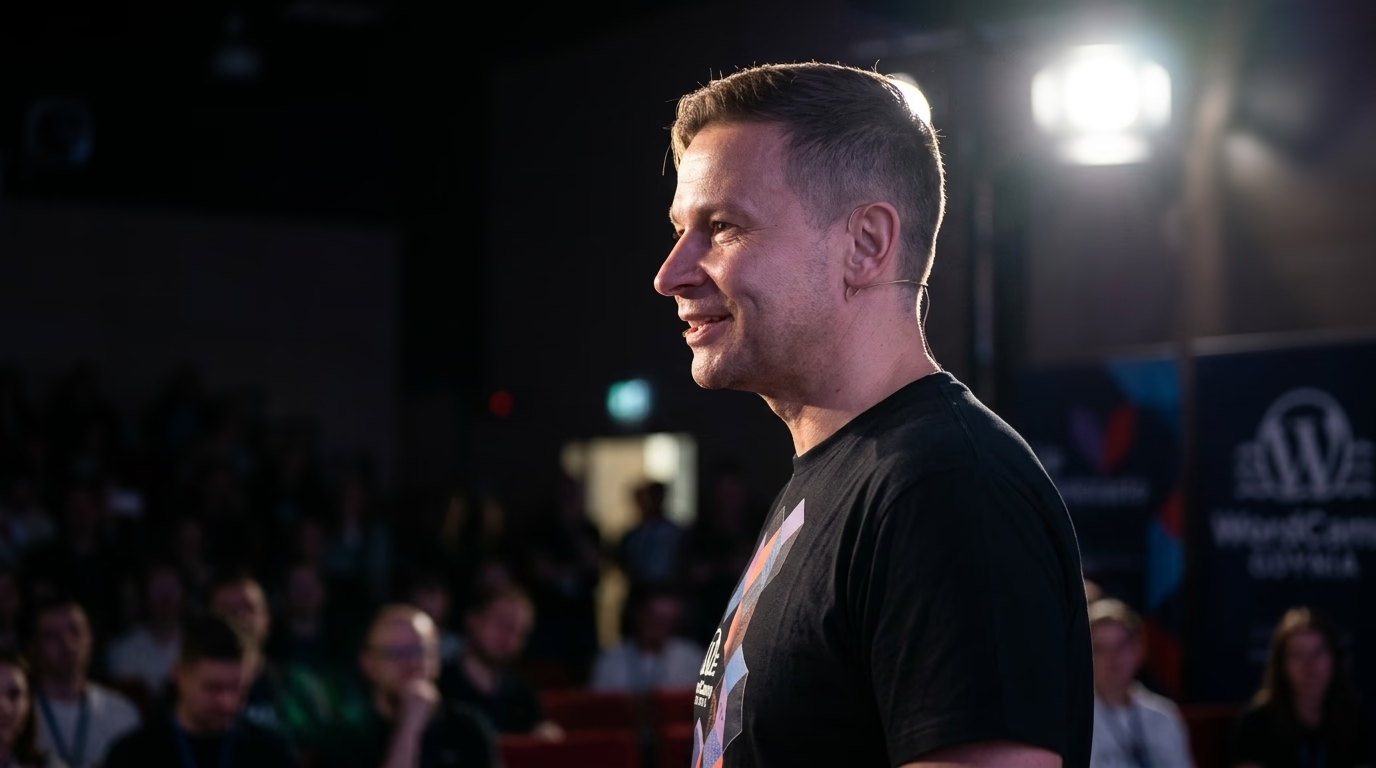
I am Mariusz Szatkowski, a freelance Next.js developer working from Gdynia, Poland. If you searched for a Next.js development agency in Leeds, I am not one: I am a sole proprietorship with no office in Leeds and no team behind me. The person who reads your brief is the person who writes the code, and a project that needs more hands than mine is called out in the written scope.
My clock runs one hour ahead of yours. Work goes through email and shared documents, and a reply reaches you within 48 hours. I have held a wordpress.org account since 2006, and I am a WordPress core contributor for 7.0 and 7.1. Thirty plugins of mine are on wordpress.org. I organise and speak at WordCamps and have been at every WordCamp Europe from 2017 to 2026.
What a Next.js brief from Leeds or Yorkshire usually contains
Most briefs fall into four groups: a customer or partner portal behind a login, a public site on a headless CMS that editors must keep updating, a storefront frontend on top of an existing commerce backend, and an older Pages Router application that has become slow to change.
Each starts with a read-only look at what runs today: routes, data sources, authentication, the build and the deployment. The scope arrives in writing, with assumptions and exclusions, and nothing starts until you confirm it. The general service is on the Next.js developer page. If your editors work in WordPress and should keep doing so, the headless WordPress page describes that setup.
Design: you bring it, I build it
Graphic design, UX, mockups and wireframes are outside what I offer. You or your designer supply the design as a Figma file or a wireframe, and I build it as a working, fast, accessible application. If you want a Next.js designer in Leeds, you need a designer first and a developer second, and I am happy to start once the screens exist.
A design that covers loading, empty and error states, validation messages and mobile layouts saves the most rework, because those are the states a Next.js app renders on the server and on the client in different ways.
Server Actions are public endpoints
The Next.js documentation states that Server Functions are reachable through direct POST requests, not only through the application’s UI, and tells you to verify authentication and authorization inside every one of them (Mutating data). Hiding a button for the wrong role does not protect anything.
In a portal build, that means every mutation checks the session and the ownership of the record on the server, before it touches the database. I write those checks into the action itself and test them with a request that skips the interface. Whether your data falls under UK GDPR and what your privacy notice must say is a question for you and your adviser; the software development for the UK and Ireland page covers how I handle data protection, VAT and contracts for UK clients.
Caching decides whether the site feels fast and stays correct
The documentation describes Incremental Static Regeneration as serving a cached page, regenerating it in the background once it is stale, and replacing it when the new version is ready. It recommends a long revalidation time, an hour rather than a second, and on-demand revalidation with revalidatePath or revalidateTag when an editor publishes (ISR guide).
For a CMS-driven site this is the pattern I use: pages are fast for visitors, and the publish action in the CMS triggers a targeted refresh instead of a full rebuild. For a portal, personal data stays on dynamically rendered routes, which the documentation says are sent with private, no-cache, no-store cache headers so user-specific pages are not cached (Self-hosting).
Hosting: one instance is easy, several need decisions
The same documentation says ISR is not supported in a static export, and that with several instances the default cache lives on each instance’s disk, so on-demand revalidation reaches only the instance that received the call. Several instances also need the same Server Functions encryption key, or you get “Failed to find Server Action” errors (Self-hosting).
If your hosting is a single Node.js server or a managed platform, little of this applies. If your IT team runs containers behind a load balancer, I put the shared cache handler and the encryption key in the scope as separate line items, so they are decided before launch and not discovered on it.
Next.js or Astro
A brochure site, a blog or a documentation site rarely needs a Next.js server. For content that changes slowly and has little interactivity, I recommend Astro and say so in the scope; see the Astro developer page. If you already run Next.js and are weighing a move, the Next.js and Astro migration page lays out how I judge route by route which framework fits.
Why a Leeds company hires beyond Leeds
Leeds had around 812,000 residents at the 2021 census, up 8.0% from 2011, against 3.7% for Yorkshire and The Humber and 6.6% for England (ONS, Leeds). Bradford had around 546,400, up 4.6% (ONS, Bradford), and York around 202,800, up 2.4% (ONS, York).
Those are the customers, staff and partners your application serves, spread across a county and not a postcode. I build for Leeds, Bradford, York and the rest of Yorkshire, and for companies elsewhere in the UK, with the same written process.
How a project runs
- You send the brief, the design file and, for an existing application, repository access or a code export.
- A written scope follows: assumptions, exclusions, milestones.
- I build in feature branches with preview deployments.
- You test on staging against the acceptance list we wrote together.
- I deploy with a rollback path and hand over documentation for your developers and your editors.
I do not propose calls or meetings. Decisions are made in writing, which leaves you a record of why each choice was made.
Questions people ask before writing
Are you a Next.js development agency in Leeds? No. I am a sole proprietorship in Gdynia, Poland, working remotely, with no account manager between you and the code.
Can you design the interface as well as build it? No. The design comes from you or your designer, and I turn it into the application.
Do you work with firms outside Leeds? Yes, across Yorkshire and the rest of the UK.
Can you take over an existing Next.js application? Yes. I start with a read-only review of routes, data fetching and authentication, then send a written scope.
How do I start? Email me the current stack, what hurts and what you want instead. Within 48 hours you get a recommended first step.
Selected projects
Examples of my work.
E-commerce Development: kochamruch.pl
kochamruch.pl is a website for a community focused on movement and physical activity, with content publishing and stable technical foundations.
E-commerce Development: kredytywarszawa.pl
kredytywarszawa.pl is a WordPress website for a business offering loans and financial services, focused on clear services, performance, and basic security.
E-commerce Development: led-lumina.pl
led-lumina.pl is a professional online store that presents a comprehensive range of innovative LED solutions for both individual and business customers. The ...
WordPress support & development in Leeds
See also in Great Britain
Need this service: Next.js developer in Leeds?
Describe your project by e-mail. I reply within 48 hours.
Describe your projectExplore other WordPress services and knowledge base
Migration to Astro, Next.js, and headless WordPress.
WooCommerce sync with ERP and wholesale systems.
Business process automation around WordPress and company systems.
Library of concrete automation use cases.
Headless WordPress, Sanity, Strapi, and Contentful with Astro or Next.js.
Astro, MDX, edge delivery, and Core Web Vitals measured on real traffic.
Custom WordPress engineering and architecture.
Scalable headless, ERP, and AI architecture for enterprise.
Related categories
Supporting articles
Six to sixteen weeks for typical engagements, with a four-phase shape: discovery, scoping, build and cutover, tuning. The variables are catalogue size, integration count, URL preservation, and editorial team readiness, not framework choice.
A definitive 4-year Total Cost of Ownership (TCO) analysis, real-world Core Web Vitals benchmarks, Astro 7 GraphQL APQ architecture, and a 10-point executive decision matrix for choosing between decoupled and traditional WordPress.
The Shopify Plus vs WooCommerce headless decision in 2026 is no longer a binary "platform vs custom" trade-off. Both can run headless, both integrate AI, both ship at the edge. The real axes are control, total cost over five years, and exit strategy. This article walks the matrix with confirmed platform facts.