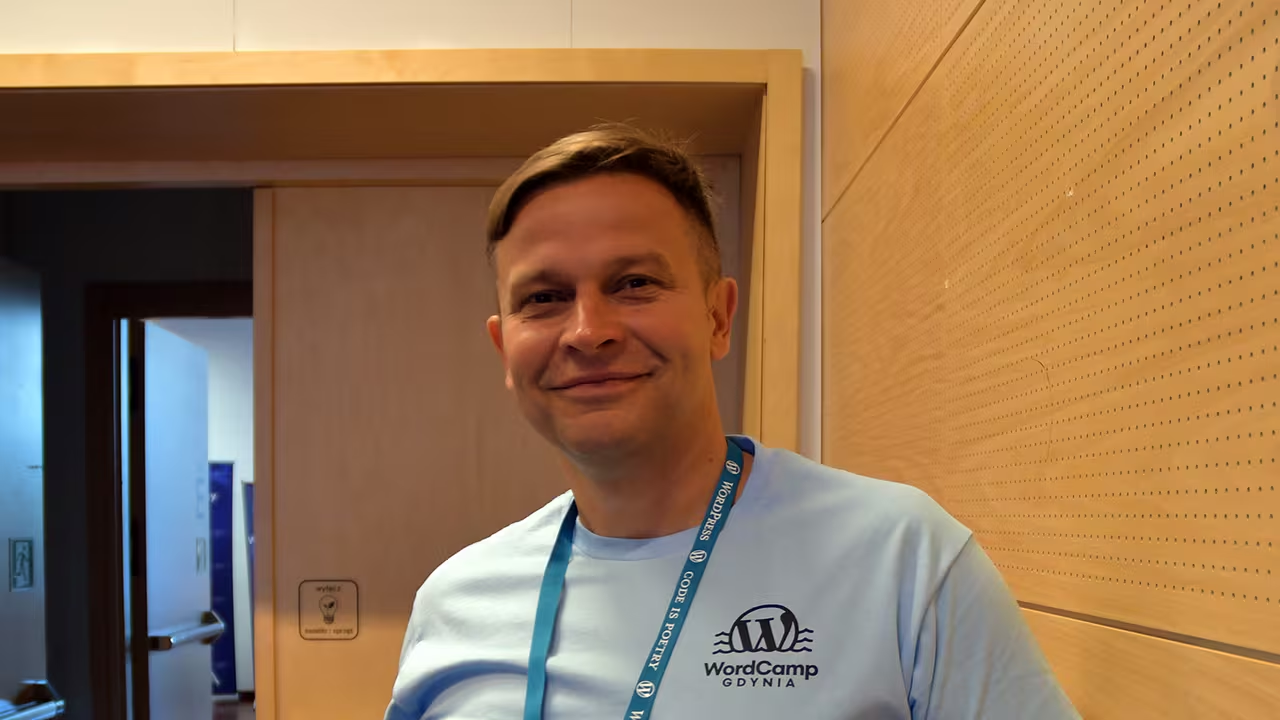
I joined the WordCamp Europe 2025 organising team (Budget Team). The event takes place in Basel, Switzerland, on 5-7 June 2025. 🇨🇭✨
For those who may not know the event, WordCamp Europe (WCEU) is the largest WordCamp event in Europe, bringing together developers, designers, marketers, business owners and WordPress enthusiasts from all over the world. It is a place where innovation meets community, and this year I have the honour of helping to organise it as part of the Budget Team.

Why WordCamp
WordPress runs 39.6% of all websites (W3Techs, October 2026), and an open-source community builds it. WordCamps are that community’s conferences: attendees learn from practitioners, meet people from the industry, contribute to WordPress and catch up on web development, design and business.
Who is on the WordCamp Europe 2025 budget team
On the Budget Team I work with:
- Emma Wager
- Kel Santiago-Pilarski
- Sebastian Miśniakiewicz
- Toze Vasconcelos
The team handles the event’s financial planning: sponsors, ticket sales and cost control.
What to expect from WordCamp Europe 2025
The programme has talks and workshops led by WordPress experts, time to meet people from the industry, sustainability and inclusivity in technology and community projects, and side events.
If you are passionate about WordPress, whether you are a developer, a designer, a content creator or simply curious about the open web, I warmly encourage you to join us at WCEU 2025 in Basel. You can follow updates and buy tickets here: https://europe.wordcamp.org/2025/
Contact
I am happy to talk. Are you going to WordCamp Europe 2025? Or have you attended earlier editions? Leave a comment below or send me a message. Let’s make this the best edition of the event together. 🚀
Who was on the WordCamp Europe 2025 organising team
The author’s membership of the Budget Team can be checked on the official WCEU 2025 organisers page. Mariusz Szatkowski is listed there in the Budget Team section alongside Emma Wager, Kel Santiago-Pilarski, Sebastian Miśniakiewicz and Toze Vasconcelos. The page describes this team as the people who bring the financial expertise needed before, during and after the event.
The same page lists 81 people in thirteen groups. All of them worked as volunteers, in their own free time.
| Group | People | Scope of work according to the organisers page |
|---|---|---|
| Lead Organisers | 3 | overall coordination: Laura Sacco, Steve Mosby, Uros Tasic |
| Attendee Services | 6 | attendee support and ticket logistics |
| Budget | 5 | finances before, during and after the event |
| Communications, Marketing & PR | 10 | blog, social media, attendee emails, media partners |
| Community | 7 | encouraging contribution to the WordPress project |
| Design | 9 | visual identity and materials for other teams |
| IT | 3 | technical support and access to tools |
| Local | 5 | logistics in Basel, local suppliers and venues |
| Photography | 7 | photos and video of the event |
| Speakers | 6 | the talk programme |
| Sponsors | 7 | working with sponsors |
| Volunteers | 8 | recruiting and coordinating volunteers |
| Website | 5 | design and operation of the event website |
The budget team description in the WCEU teams overview says its job is to make sure every euro is spent wisely. As a fit for the role it lists budget management experience, attention to detail and analytical skills.
Emma Wager from the same team described its work in an interview for the WCEU blog: “We don’t just manage spreadsheets but also use our collective ideas to brainstorm creative ideas to help other teams save money and secure the best deals” (Emma Wager, interview on europe.wordcamp.org).
How to become a WordCamp Europe organiser
People joined the WCEU 2025 team through an open call. The Call for Organisers closed on 31 August 2024. The call page lists several conditions that show the scale of the commitment:
- planning started in September 2024 and ran until the event in June 2025,
- many teams met weekly or every two weeks,
- the work happens in a distributed team, so time has to be set aside every week,
- organisers follow the code of conduct,
- a European time zone is recommended, because meetings are scheduled in it.
The final split into teams was decided only after applications were collected. The call page also advised people who want to propose their city as host of a future edition to first spend a year on the organising team.
A local WordCamp works on a different scale. The WordCamp Organizer Handbook recommends a team of 5 to 10 people from the local area, with each member taking one or two areas, for example venue, fundraising, budget, speakers or volunteers. WCEU splits the same areas between teams made up of people from across the continent.
The next call opened right after Basel: the WordPress.org recap reported that the call for organisers for 2026 was already open. On the WCEU 2026 organisers page Mariusz Szatkowski is again in the Budget Team, this time with Emma Wager, Carolina Osório, Katarzyna Kimel and Toze Vasconcelos.
How a WordCamp budget works
The financial rules are set out in the budget and finances chapter of the Community team handbook. The most important ones:
- One person on the team is responsible for the budget and the money, so someone always knows how much is available when the next decisions are made.
- Budget approval is the last required step before the event is announced and the calls for speakers, sponsors and volunteers open.
- Budgets are public. The handbook requires a WordCamp to be financially transparent, and WordCamp Central archives the final budget.
- Some items never go into the budget: design services, event agency services, gifts and perks for organisers, emcees, photography.
The money can be handled by WordPress Community Support PBC, a public benefit corporation set up as the financial and legal backbone of official WordPress events. According to the page on running the money through WPCS, this is the standard in the USA and Canada, and an option elsewhere. WPCS receives ticket and sponsor income, pays suppliers directly and keeps any surplus to support other community events.
Organisers do not earn money from a WordCamp. The handbook calls them community volunteers and points out that WordCamps are non-profit events and surpluses may not be taken for personal use. According to the ticket sales guidelines, tickets for local WordCamps should cost 25 USD per person per day or less.
One more rule matters for WCEU. The Global Community Sponsorship program, in which WordCamp Central collects money from global sponsors each quarter and distributes it among events, does not cover flagship conferences: WordCamp Europe, WordCamp Asia, WordCamp India and WordCamp US. The WCEU budget therefore relies on sponsors secured by the team itself and on ticket sales.
WordCamp Europe 2025 in numbers
The data comes from the official WordPress.org recap and the schedule announcement on the WCEU website.
| Metric | Value |
|---|---|
| Venue | Messe Basel and Congress Center Basel, Switzerland |
| Dates | 5 June Contributor Day, 6 and 7 June conference |
| Attendees on site | over 1,723 from 84 countries |
| Attendees online | 20,353 |
| Speakers | 52 from 23 countries and five continents |
| Programme | 45 sessions on three tracks and 4 workshops |
| Contributor Day | 640 people, 33 table leads, 21 teams |
Basel was the twelfth edition of WordCamp Europe. The first took place in 2013 in Leiden in the Netherlands, and the previous three were in Porto (2022), Athens (2023) and Turin (2024). WCEU 2025 also received the patronage of the European Parliament, for the second year in a row, approved by President Roberta Metsola.
What was on the WordCamp Europe 2025 programme
The schedule announcement promised shorter, 30-minute talks to leave more time for conversations and the sponsor area. The topics listed included the European Accessibility Act (EAA) and the Cyber Resilience Act, artificial intelligence, design, development, content and SEO.
The WordPress.org recap describes several specific sessions:
- Noel Tock’s keynote WordPress Without Borders: The Fight for Digital Freedom on open source as a tool of resilience, drawing among other things on his experience in Ukraine,
- Petya Raykovska’s talk on civil society organisations in Bulgaria that use WordPress,
- a session on connecting Figma design systems with block themes,
- the workshop Block Developer Cookbook: WCEU 2025 Edition with code recipes chosen by the community,
- a session on automating WordPress setup with WP-CLI, scripts and AI tools,
- WordPress Gems for Devs, a live introduction to the Interactivity API,
- a session on AI agents running in the browser.
The conference closed with a conversation between Matt Mullenweg and Mary Hubbard about EU regulation (Open Web Alliance), AI and the newly formed AI team in the WordPress project, followed by questions from the audience.
What Contributor Day is at WordCamp Europe
Contributor Day opened WCEU 2025 on Thursday 5 June. According to the Contributor Day page, it is a full day of working together on the WordPress project, open to people without experience. Registration was separate from buying a ticket, but required a ticket to the event.
The page lists what people can do that day: translate WordPress, fix bugs and test features, improve documentation, work on design, UX and marketing, help users on the forums, prepare photos and video. Beginners had onboarding tables and mentors. The organisers asked people to bring a laptop with a charger and their WordPress.org login details.
The WordPress.org recap reports that 640 people worked at 21 teams, looked after by 33 table leads. The teams included Core, Accessibility, Polyglots, Training, Community, Marketing, Meta, Hosting and Sustainability. From the budget side, Contributor Day is an ordinary cost item: the handbook reminds organisers to add all its expenses to the draft budget before submitting it.
How to volunteer at WordCamp Europe
A volunteer is a different role from an organiser: volunteers help on site, during the event itself. The WCEU 2025 call for volunteers ran until 31 March 2025 and set three requirements: conversational English, a WordPress.org account and the ability to travel to Basel.
The commitment was usually up to two half-days or one full day during the two conference days, and taking part in Contributor Day was optional. In return volunteers received a free ticket, one or two T-shirts, an invitation to a social event and entry to the after party. The after party took place on Saturday 7 June from 20:30 to 01:00 in the Track 1 room: no food, unlimited non-alcoholic drinks and two tokens for alcoholic drinks for each guest.
The list of volunteer roles grouped them by team. Attendee services had registration, swag distribution and an information point with lost and found. Communications had social media and PR support. The Community team had a Contributor Day assistant, a greeter at the community booth and a moderator for WordCamp Connect discussions. Speakers had a speaker assistant, an emcee, a track manager leading two assistants and an emcee through 3 to 4 talks per shift, and a workshop assistant. The emcee role among volunteers matches the handbook, according to which WordCamps do not pay emcees from the budget.
People who needed a visa for Switzerland first had to buy a ticket and request an invitation letter. Once accepted as volunteers, the ticket cost was refunded.
Coordination is handled by the Volunteers team. The WCEU teams overview speaks of recruiting, training and leading over 250 people through the three days of the event.
What rules apply to WordCamp Europe organisers
The WCEU 2025 lead organisers published an organisers’ pledge with four areas of commitment:
- transparency: reporting on progress and problems and taking responsibility for mistakes,
- sustainability: using resources sensibly,
- privacy: complying with the GDPR as fully as possible,
- diversity, equity, inclusion and belonging: removing barriers that make it harder to take part in the event.
All participants, including organisers, volunteers, speakers and sponsors, were bound by the WCEU 2025 code of conduct. It defines expected behaviour, a list of unacceptable behaviour, including harassment, and the consequences of breaking it.
How WordCamp Europe 2025 handled accessibility and inclusivity
The organisers’ pledge turned into concrete measures, described on the event pages.
- Venue. According to the venue information, Messe Basel and the Congress Center are fully accessible for people with reduced mobility: all areas are served by lifts or ramps, and assistance dogs are welcome.
- Food. Attendees gave their dietary requirements when buying a ticket. Vegetarian, vegan, gluten-free, lactose-free, kosher and halal options were available. Catering was provided by Wassermann & Company AG, which supports regional producers and does not use disposable tableware.
- Energy. The venue generates its own solar power and covers 100% of its electricity needs from renewable sources.
- Childcare. Childcare for children aged 3 to 10 ran from the start of Contributor Day through both conference days, except during the after party.
- Scholarships. The Diversity Scholarship 2025 went to Lua Salazar from Nicaragua, for whom it was the first flagship WordCamp. The WordPress Foundation announced on 4 November 2024 that the Kim Parsell Memorial Scholarship covers all flagship WordCamps, including WordCamp Europe. The scholarship supports people for whom the costs could make attending impossible.
Where WordCamp Europe 2026 took place
The next edition moved to Poland. WordCamp Europe 2026 took place in Kraków from 4 to 6 June 2026, with Contributor Day on 4 June, at the ICE Kraków Congress Centre. The lead organisers there were Angelos Synadakis, Francesco Di Candia and Ivelina Dimova. A year earlier all three worked in WCEU 2025 teams: Sponsors, Volunteers and Attendee Services respectively. The experience from one edition carried over to the next together with the people.
On the implementation side, we cover this topic under WordPress developer.