Business process automation: what to automate and with what
How to decide which WordPress and WooCommerce processes pay back, how n8n, Make, Zapier and custom code differ, and how to run a measured pilot.
We are not just a remote agency. We are an active part of the ecosystem. We believe in Open Source and contributing back to the community that powers over 40% of the web (W3Techs).
Specific Context: Local SEO visibility, fast mobile performance, and practical integrations with CRM, booking, and payment tools used by regional businesses.
Connecting with fellow developers in the Białystok region.
Join us at the next event →We support the local business ecosystem in Białystok. I provide accessible, high-performance WordPress development tailored to growing companies.
Local SEO visibility, fast mobile performance, and practical integrations with CRM, booking, and payment tools used by regional businesses.
Local context: Białystok Tech Hub is one of the clearest technical reference points in Białystok, and Białystok WordPress Meetup Group is still a place where senior practitioners compare notes.
The PHP backend landscape in Białystok is dominated by two production frameworks: Laravel for fast-moving business applications and Symfony for long-lived enterprise systems. Both run on PHP 8.3 and 8.4 with strict typing, PSR-12 compliance, Composer dependency management, and CI/CD pipelines as standard. Companies in Białystok that try to staff a senior PHP role in-house typically wait three to six months and pay rates that rival full-stack TypeScript hires; freelance senior contracting closes the timeline gap and lets the budget scale to the actual scope rather than to a permanent salary.
I deliver senior PHP engineering for businesses in Białystok as a freelance contractor, EU jurisdiction, B2B contract on VAT invoice. The model is simple: the engineer at discovery is the engineer at the keyboard at week six, no offshore handoff, no PM layer charged back to the client, no junior pipeline. Pricing is individual after a one-hour audit because a Laravel application with 50 routes is a different number from a Symfony system with 30 microservices and NIS2 compliance.
The difference, from the client’s perspective in Białystok, is not the speed of writing code. A senior writes at a similar pace to a mid, sometimes slower, because they review and document along the way. The difference is in architecture decisions (rejecting ideas that work in a demo but explode at 100k users or 1M orders), code review (rejecting a PR that ships a feature but leaves a trap for the junior to step on next month), refactoring (rewriting a module without changing its API so the rest of the system never knows), migrations (knowing when PHP 7.4 to 8.4 takes one sprint and when it takes three because the legacy code uses behaviours removed in 8.0 or 8.1), security (designing the threat model before the first line of authorisation code, not after the first audit), and communication (telling the business “this is possible, but it costs 3x more and yields 1.2x value” before work begins).
For businesses in Białystok, this translates into:
Laravel 11 and 12 backends for business applications, admin panels, REST APIs, and SaaS platforms. Eloquent ORM with eager loading discipline, Blade or Inertia.js for server-rendered UIs, Livewire for interactive components without a SPA, queues on Redis or Horizon for asynchronous work, scheduler for cron tasks. I build Laravel applications in Białystok that scale predictably from MVP to production: clean service-and-repository layers, domain events for cross-feature coordination, feature flags for safe rollout, and PHPUnit/Pest tests on the critical path.
Symfony 7.x for long-lived enterprise systems, B2B portals, and integrations with legacy ERP, CRM, or accounting systems. The Symfony advantage is its decoupled component architecture: Messenger for async, API Platform for REST/GraphQL with OpenAPI generation, Doctrine ORM with mapped DDD-style aggregates, Workflow component for state machines, and the Security component for sophisticated access control. Symfony fits projects in Białystok that will run for ten years rather than three.
API-first backends for mobile apps, single-page applications, headless commerce, and partner integrations. REST with OAuth2 / JWT authorisation, rate limiting, idempotency keys, structured error responses, OpenAPI documentation generated from code. GraphQL with federated schemas where multiple teams own different domains. gRPC for service-to-service traffic where REST overhead matters.
The honest take: most companies asking for microservices need a well-modularised monolith first. I build both. When microservices genuinely fit (independent scaling, team autonomy, language diversity), I deliver bounded contexts with clear API contracts, message bus for async communication, distributed tracing, and infrastructure-as-code. When a monolith fits (most cases), I deliver clean modules, internal API boundaries, and a strangler pattern path if the architecture ever needs to split.
Procedural PHP 5.6 with global state and no tests, Symfony 4 EOL, Laravel 6 with deprecated packages, custom CMS without a migration path. I refactor legacy PHP in Białystok using the strangler pattern: tests around the existing behaviour first, then gradual extraction of modules into clean architecture, with the old code paths removed only after the new ones are verified in production. Migrations from PHP 5.x to 8.4 typically span 4 to 12 weeks depending on dependencies, test coverage, and business criticality.
Slow PHP application after a year in production usually means N+1 queries, autoload bloat, missing database indexes, or PHP-FPM bootstrap dominating the request path. I profile with Xdebug for development, Blackfire or Tideways for production, and Datadog or New Relic for continuous monitoring. Then I work the failure list: query optimisation, OPcache and JIT tuning, Redis caching, CDN for static assets, and Laravel Octane (with Swoole or RoadRunner) when the workload genuinely benefits from long-lived processes.
Security work follows OWASP guidelines and the PHP security best practices: PDO prepared statements (never string concatenation in queries), CSRF tokens on every state-changing endpoint, input validation with proper types and constraints, output escaping in templates, security headers (CSP, HSTS, X-Frame-Options, X-Content-Type-Options), session hardening with secure and HttpOnly flags, audit logging for every authentication and authorisation event, and rate limiting on login and password-reset endpoints. I conduct security audits in Białystok on existing applications and remediate findings with documented before-and-after threat models.
PHP backends rarely live in isolation. Common integrations: SAP, Microsoft Dynamics, Salesforce, HubSpot for CRM; SAP Business One, Comarch ERP, fakturownia, wFirma, iFirma for accounting; Stripe, PayPal, Adyen, Worldpay, Przelewy24, Tpay, BLIK for payments; InPost, DPD, DHL, FedEx, Pocztex for shipping; Algolia, Meilisearch, Elasticsearch for search. Every integration ships with idempotent webhook handling, retry logic, dead-letter queues, and observability so failures are visible rather than silent.
From a backend engineering perspective: Regional small and medium businesses and growing scaleups buy senior engineering with one constraint that larger companies rarely face: every euro spent has to map to a measurable business outcome on a quarterly horizon. The model that works is honest scope cutting at discovery, fast iteration to a runnable demo, and a delivery cadence that lets the operations team see weekly progress rather than a quarterly reveal.
PHP 8.3 and 8.4 in new projects. PHP 8.1 LTS only when the application supports older infrastructure. PHP 7.4 and earlier appear only during the first phase of a migration. Strict typing (declare(strict_types=1)) in every file, parameter and return types throughout, readonly classes from PHP 8.3 where state should not change, property hooks from PHP 8.4 where setter logic belongs on the property rather than in a service.
PHPStan level 8 or Psalm for static analysis with zero ignored errors in new code. PHPUnit or Pest for unit and integration testing with coverage tied to business risk rather than to a metric for its own sake. Rector for automated refactors during PHP and framework upgrades. PHP-CS-Fixer or PHP_CodeSniffer for PSR-12 compliance enforced in CI. Code review on every pull request, including solo work where I bring in a senior B2B collaborator for review.
MySQL 8.x and MariaDB 11.x as defaults, with indexes designed for actual query patterns rather than generic. PostgreSQL 16+ for projects that need rich typing, JSONB, or serializable isolation. Redis for cache, queues, sessions, and distributed locks. Elasticsearch or Meilisearch for full-text search where the database default is not enough. Database migrations as code (Doctrine Migrations or Laravel Schema), idempotent, with rollback paths verified before production runs.
Git with conventional commits and signed commits, GitHub Actions for CI (lint, static analysis, tests, build artefact, deploy to staging), Docker locally and in CI with docker-compose for the multi-service stack (PHP-FPM, Nginx, MySQL, Redis, MailHog), planned deploys via blue-green or Deployer with atomic symlink swap, and monitoring stack with Sentry for errors plus New Relic or Datadog for application performance.
The senior PHP rate in Białystok reflects local market conditions and EU jurisdiction overhead. According to No Fluff Jobs Rynek pracy IT 2025/2026, 60 percent of IT openings in Poland in 2025 were senior, and 60.12 percent of work was fully remote per Just Join IT 2024/2025. Median senior B2B rate in Poland sat at individual quote net per month in 2024 (Just Join IT). Cross-border rates for clients in Germany, Norway, the UK, and the US run, in the quotes we write, 30 to 80 percent higher than the Polish baseline depending on the framework specialisation, the compliance posture required, and the contract length.
The implication for businesses in Białystok: a senior PHP engineer hired locally is roughly the same hourly cost as one contracted through an EU-based freelance arrangement, but the freelance arrangement skips the recruitment lead time (which currently sits at 3 to 6 months for senior roles), provides B2B invoicing rather than full-time employment overhead, and lets the engagement scale up or down with the actual scope of work.
Compliance posture for backends serving clients in Poland typically maps to:
These drivers shape the threat model and the audit trail before the first endpoint is shipped to staging.
Senior B2B in EU jurisdiction. NDA standard, framework agreement with scope and schedule, time-and-materials or fixed-scope depending on brief maturity. Discovery is a one-hour session where I listen to the brief, ask technical questions, check the state of the existing code (if any), identify risks and unknowns, and quote scope after the session, individually. No “from $X per hour” rates in the proposal because the audit phase typically shifts the estimate by 20 to 40 percent in either direction.
A typical Laravel greenfield engagement in Białystok:
A typical Symfony enterprise refactor:
The PHP developer service in Białystok fits with three adjacent services I deliver:
The WordPress and WooCommerce stack is handled separately at the dedicated pillars (WordPress developer, WooCommerce developer, headless WordPress) because that’s a different market segment and a different toolchain. This page covers PHP backend work outside the WordPress ecosystem.
Senior PHP developer, available for senior B2B engagements. EU jurisdiction, individual quote after a one-hour audit. Tell me the scope (greenfield, refactor, migration, integration, security audit), the framework or stack (Laravel, Symfony, Slim, custom), and the timeline. I reply within one working day.
We serve clients in Białystok and nearby areas.
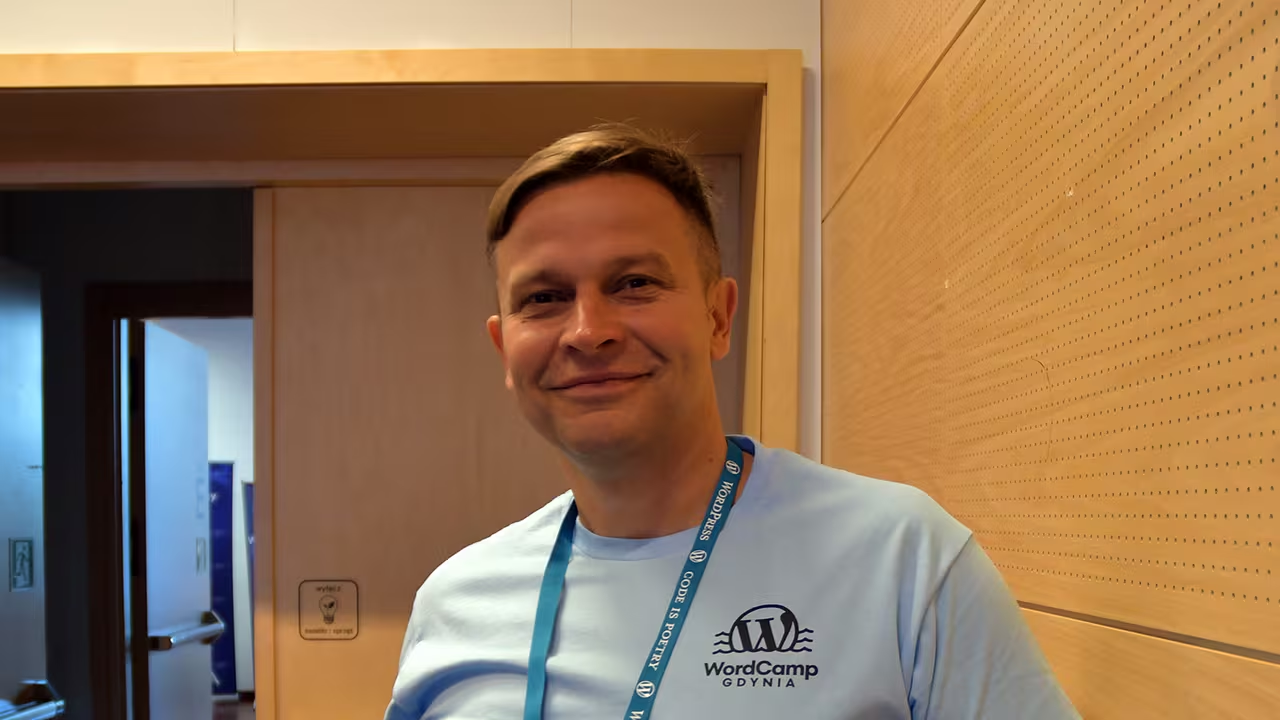
We have co-organised WordCamp Gdynia since 2015 and worked on the WordCamp Europe organising team since 2024. What we learn at those events goes back into the code we write for clients.
Explore selected projects supporting our clients' success.
zamki-szkocji.com is a comprehensive information portal dedicated to the castles of Scotland, combining rich historical content, interactive maps, photo gall...
scalac.io is an international platform founded in 2014 to meet the challenges associated with big data management and business operations scaling, specializing in Scala, distributed systems, and cryptography solutions.
Sprint.pl is a website created for Sprint S.A., an Olsztyn-based company operating since 1988 as a systems integrator and provider of advanced software. The ...
How we approach AI citations, WooCommerce B2B modernization, and NIS2-aligned operational resilience on WordPress. These guides apply to every client location.
Local expertise: - Senior PHP developer for businesses in Białystok, Poland - Laravel 11/12 and Symfony 7.x backends, REST APIs, microservices - PHP 8.3/8.4, Composer, PSR-12, PHPStan level 8, PHPUnit I work remotely and tailor solutions to the needs of businesses in Białystok. Key project decisions are based on real data from the Białystok market, not template assumptions.
Let's discuss how we can bring top-tier performance to your project.
Schedule free consultation in BiałystokStay updated with the PHP Developer community
How to decide which WordPress and WooCommerce processes pay back, how n8n, Make, Zapier and custom code differ, and how to run a measured pilot.
From 7 March to 10 October 2026 the Cloudflare Pages middleware on wppoland.com sent a 301 for every URL carrying utm_*, gclid, fbclid or msclkid. Analytics lost campaign data and Google Ads lost gclid; from 13 July the contact form lost lead sources too. Cause, fix and a curl test.
ICANN published 1,615 new gTLD applications on 7 October 2026. One is .wordpress, filed by the company behind .blog as a closed namespace with no rival applicant. What it means for site owners, the timeline to 2028, and what not to buy.
Bricksforge up to 3.1.8.9 lets anyone upload and run PHP through Pro Forms without logging in. Patchstack has seen attacks since 7 October 2026. How to check your version, what to update to and what to look for on the server.
wp_kses() is being rewritten on the HTML API in trunk. What changes for plugin and theme code, how to diff your real content on a trunk build, and what the legacy-parser filter is for.
More articles are available on /en/blog/
Białystok WordPress Meetup Group is the local meetup, at https://www.meetup.com/bialystok-wordpress-meetup-group/. Ask there before you sign with anyone, including me. A room of people who have already hired locally is a faster reference check than any portfolio page.
Both, and the choice is a trade-off I record rather than an instinct. Extending a codebase that already carries business logic is usually cheaper and lower-risk than a rewrite, so I default to that unless the existing architecture actively blocks the goal. When I do recommend a fresh build, I write down why, so the decision is auditable later.
I start by pinning the current PHP version and running the code through static analysis (PHPStan, Rector) to see what actually breaks before touching anything. Upgrades from 5.6 or 7.x to 8.x are done incrementally behind tests, not in one big-bang commit. Deprecations and behavioural changes get logged so nothing silently changes under the client.
Strengthen your business with professional technical support in key areas of the WordPress ecosystem.
Custom WordPress engineering and architecture.
Scalable headless, ERP, and AI architecture for enterprise.
Stores, checkout flow, and sales logic.
Business process automation around WordPress and company systems.
Library of concrete automation use cases.
Headless WordPress, Sanity, Strapi, and Contentful with Astro or Next.js.
Astro, MDX, edge delivery, and Core Web Vitals measured on real traffic.
Core Web Vitals, caching, and faster delivery.

How to start as a WordPress developer in 2026. Local environment, theme and plugin development, REST API and headless paths, security and Core Web Vitals. A practitioner playbook that does not waste your first month.
WordPress 7.0 with AI Client vs Astro 6 after Cloudflare acquisition. Speed, cost, SEO and security comparison. My take after 20 years as a WP developer - when to migrate and when to stay.
WordPress 7.0 with AI Client against Astro 7 with the Rust compiler and Vite 8. Speed, cost, SEO and security compared, plus the real bill for our own Astro 6 to 7 migration.