For most of the history of search engines, the result page was a list of ten blue links. In 2026 a growing share of queries ends in a written answer instead: Google shows AI Overviews and AI Mode, ChatGPT has a search feature, and Perplexity answers with numbered sources. Each of these answers links to the pages it used.
That changes what a WordPress site competes for. The goal is still to rank, but it is also to be one of the sources an answer engine cites. This guide covers what the vendors themselves document about how their systems find and show pages, which crawlers you have to let in, and how to write and mark up content so a model can lift a clear statement from it.
How AI answer engines change search in 2026
Google AI Overviews and AI Mode, Perplexity and ChatGPT search have changed how people find information. Many users no longer want a list of sites to open one by one; they want a summarised answer that saves them time, with links they can follow when they need detail or want to check a claim.
Why being the cited source matters
Every AI answer comes with citations. Being the source for a specific fact is now a goal in its own right. In classic SEO you competed for one of ten positions; in an AI answer you compete to be one of the few links shown next to the paragraph that answers the question.
Search engine versus answer engine
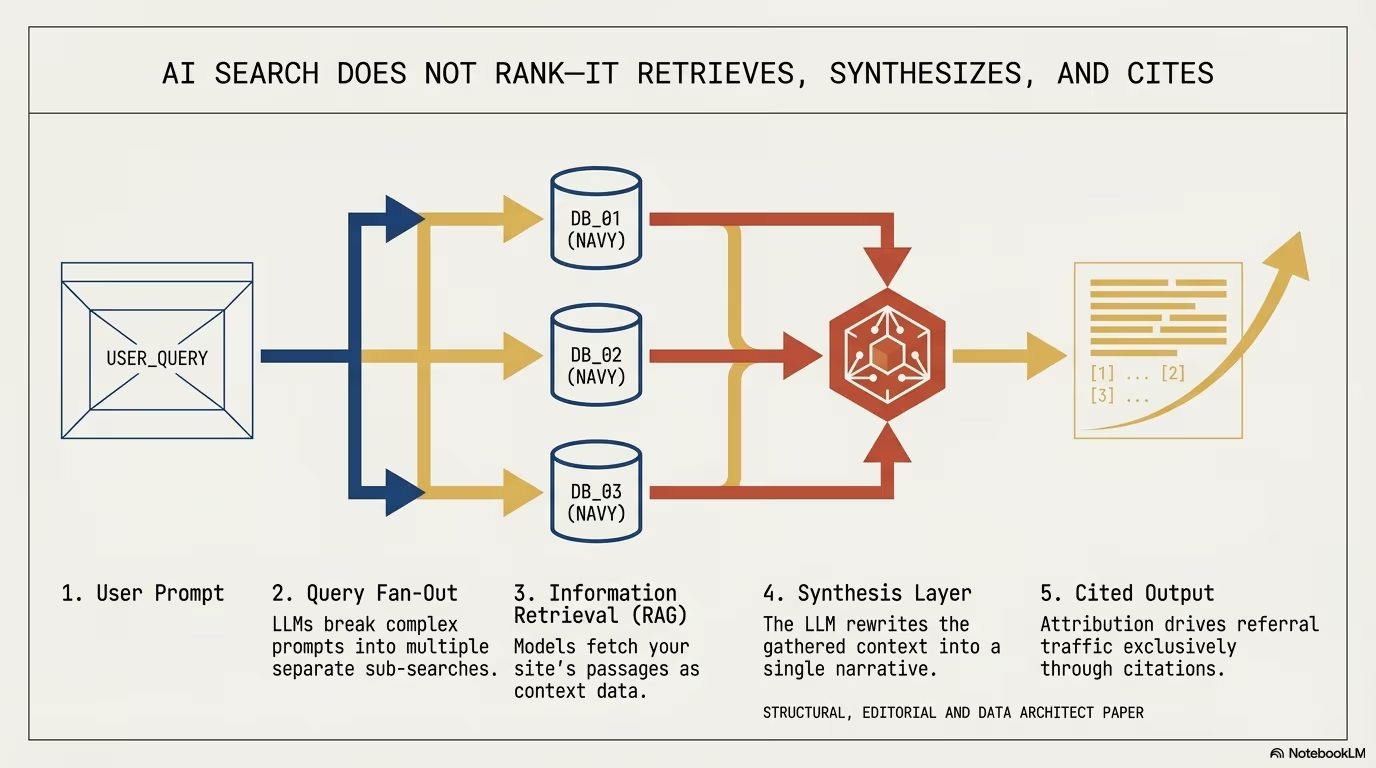
A classic search engine acts as an intermediary that sends visitors to websites. An answer engine reads several sources and writes a synthesis for the user. Your page still needs to be found and indexed, but it also needs to contain statements that can be quoted on their own, without the paragraph around them.
How Google AI Overviews and AI Mode choose pages
Google publishes one document for site owners on this topic, the AI features page in Google Search Central. It is short, and it contradicts a lot of what is sold as “AI SEO”.
According to Google, AI Overviews help people get the gist of a complicated topic or question faster, while AI Mode is meant for queries that need further exploration, reasoning or complex comparisons. Both may use a technique Google calls query fan-out: the system issues several related searches across subtopics and data sources, then assembles the answer from what those searches return. A page can therefore be cited for a subtopic it covers well, even when it would not rank for the original question.
The eligibility rule is the same as for normal search results. A page must be indexed and eligible to be shown in Google Search with a snippet. Google states that there are no additional technical requirements and no special optimisations needed. You do not need new machine readable files, AI text files or extra markup, and there is no special schema.org structured data to add for these features.
Google also writes that AI features can show a wider and more diverse set of links than a classic web search, and that AI Overviews appear only when its systems decide they add something to classic Search. For a WordPress site this means the groundwork is ordinary technical SEO: pages that are crawlable, indexable, not blocked from snippets, and worth quoting.
How to get cited in AI answers
AIO (AI optimisation) is often described as the next step after classic SEO. Google’s documentation above shows that the technical side has no special requirements, so the work moves to the content: how clear, verifiable and original it is.
Statement clarity: write sentences a model can quote
Avoid fluff. Use declarative sentences. Instead of “we think blocking AI bots might hurt your visibility”, write “Blocking Google-Extended does not affect inclusion or ranking in Google Search.” The second sentence names the subject, makes one checkable claim and can be copied into an answer without editing.
Clarity does not mean simplification. It means being precise and direct, and backing the claim with a source the reader can open. A sentence that depends on the previous paragraph (“this is why it matters”) cannot be lifted on its own, so each important claim should carry its own subject.
Information gain: give the model something it cannot find elsewhere
If you only repeat what Wikipedia says, there is little reason for an answer engine to pick your page over the dozens that say the same. Pages worth citing add something: original measurements, data from your own projects, a comparison you ran yourself, or a practitioner’s explanation of why a documented setting behaves the way it does in production.
Headings that work as stand-alone answers
Answer engines work with passages, not whole articles. Structure headings so they mirror the logic of the topic, and write each section so it still makes sense when read in isolation. A heading phrased the way people search (“how to block GPTBot in WordPress”) followed by a direct answer in the first sentence is easier to match to a query than a clever title.
How to add a key takeaways box in WordPress
On wppoland.com I put a structured summary of the key facts at the top of long posts. The reasoning is simple: a short block of self-contained statements is easy for a reader to scan and easy for any system to parse, quote and check against the rest of the page.
How to implement it with Gutenberg
Use a Gutenberg group or list block styled as a “Key takeaways” box. Behind the scenes, keep the page’s Article structured data consistent with what the box says. Google does not require special markup for AI features, so treat the box as content first: it has to be true, sourced and visible to the reader.
What the box should contain
A useful box names the main entity, lists three to five verifiable facts with concrete values, gives the date the facts were last checked and links the primary source for each one. Avoid marketing claims in it; a statement nobody can verify is a poor candidate for a citation.
How to write FAQs for AI search queries
AI search queries are often long and conversational: “How do I scale a WordPress Multisite for 100 enterprise subdomains using Docker?”
Phrase questions the way users ask them
Use your FAQ section deliberately. Phrase questions exactly as a user would say them to their phone or type them into a chat box. Skip internal jargon and academic phrasing.
Answer the how and the why
Answer the “how” and the “why”, not just the “what”. A one-line answer rarely helps anyone; an answer that includes the condition under which it is true, and an example, is more useful to the reader and gives an answer engine a complete passage to work with.
Keep expectations about markup realistic. Since August 2023 Google shows FAQ rich results only for well-known, authoritative government and health websites (Google Search Central blog). FAQ structured data still describes the page, but it will not produce an FAQ rich result for a typical WordPress business site.
Long-tail conversational queries
Instead of a page aimed at “WordPress SEO”, write content that answers questions such as “how do I improve SEO for a WooCommerce shop with products in several languages”. These specific queries are the kind people type into answer engines.
Which AI crawlers to allow in robots.txt
Each vendor separates crawlers that feed its search product from crawlers that collect training data and from fetchers that act on behalf of a single user. Blocking the wrong one removes you from answers; blocking the right one keeps your content out of training while you stay visible. The table below is built from each vendor’s own documentation.
| Vendor | Search crawler | Training crawler | User-triggered fetcher | Notes from the vendor |
|---|---|---|---|---|
| OpenAI | OAI-SearchBot | GPTBot | ChatGPT-User | Settings are independent; robots.txt changes take about 24 hours |
| Perplexity | PerplexityBot | none listed | Perplexity-User | PerplexityBot is not used for foundation model training |
| Anthropic | Claude-SearchBot | ClaudeBot | Claude-User | Supports Crawl-delay; IP blocking is not a reliable opt-out |
| Googlebot | Google-Extended (token only) | n/a | Google-Extended does not affect Google Search |
OpenAI: OAI-SearchBot, GPTBot and ChatGPT-User
According to OpenAI’s crawler documentation, OAI-SearchBot is used to surface websites in ChatGPT’s search features, and sites that opt out of it will not be shown in ChatGPT search answers. GPTBot crawls content that may be used to train OpenAI’s generative foundation models; disallowing it signals that your content should not be used for training. Each setting is independent, so you can allow OAI-SearchBot and disallow GPTBot. ChatGPT-User visits a page when a user asks ChatGPT or a custom GPT a question; because a person starts that action, robots.txt rules may not apply, and OpenAI says ChatGPT-User is not used to decide whether content can appear in search. OpenAI notes it can take about 24 hours for its systems to adjust after a robots.txt change, and it publishes IP lists for each bot (for example openai.com/searchbot.json).
Perplexity: PerplexityBot and Perplexity-User
Perplexity’s documentation describes PerplexityBot as the crawler that surfaces and links websites in Perplexity search results, and recommends allowing it in robots.txt if you want to appear there. Perplexity states that it is not used to crawl content for AI foundation models. Perplexity-User supports user actions: when someone asks a question, it may visit a page to help answer it. Because the user requested the fetch, it generally ignores robots.txt rules. Both have published IP ranges.
Anthropic: ClaudeBot, Claude-SearchBot and Claude-User
Anthropic’s help article on its crawlers lists three agents. ClaudeBot collects web content that may contribute to training; blocking it should exclude your future material from training datasets. Claude-SearchBot crawls to improve search result quality; blocking it means your content is not indexed for search, which may reduce its visibility in answers. Claude-User fetches pages when a Claude user asks a question that needs them; blocking it stops Claude from retrieving your page for those users. Anthropic’s bots honour robots.txt and support the non-standard Crawl-delay directive. Anthropic warns that blocking its IP addresses may not work as an opt-out, because the bots then cannot read your robots.txt.
Google-Extended and Google Search
Google’s list of common crawlers describes Google-Extended as the control for whether content Google crawls may be used to train future Gemini models and for grounding in some Gemini products. Google states that Google-Extended does not affect a site’s inclusion in Google Search and is not a ranking signal. It has no separate HTTP user agent; it is only a robots.txt token. AI Overviews and AI Mode are part of Search, so the control for them is Googlebot access plus the snippet controls described further down.
How to edit robots.txt in WordPress for AI crawlers
If no physical robots.txt file sits in the web root, WordPress serves a virtual one through do_robots(), a function present since WordPress 2.1. Its output passes through the robots_txt filter (available since WordPress 3.0), which receives the generated text and a flag saying whether the site is public. That filter is the clean place to add AI crawler rules from a theme or a small plugin:
add_filter( 'robots_txt', function ( $output, $public ) {
    if ( ! $public ) {
        return $output;
    }
    $output .= "\nUser-agent: GPTBot\nDisallow: /\n";
    $output .= "\nUser-agent: ClaudeBot\nDisallow: /\n";
    $output .= "\nUser-agent: Google-Extended\nDisallow: /\n";
    return $output;
}, 10, 2 );
This example keeps the site out of the three training crawlers while leaving OAI-SearchBot, PerplexityBot, Claude-SearchBot and Googlebot untouched, so the site stays eligible for their search answers. The check on the public flag leaves sites that discourage search engines alone. If your host or an SEO plugin writes a physical robots.txt file, the web server normally serves that file directly and the filter never runs, so edit the file instead. After the change, open /robots.txt in a browser and confirm the rules are there.
How to limit what AI features show from your pages
Google’s AI features page points site owners to the same controls that govern normal snippets. Googlebot access in robots.txt decides whether a page can be crawled at all. Beyond that:
noindexkeeps a page out of Search entirely, and therefore out of AI Overviews and AI Mode.nosnippetstops Google from showing a text snippet from the page, which also limits its use in AI features.data-nosnippeton an HTML element excludes just that part of the page from snippets.max-snippetsets a maximum snippet length in characters.
In WordPress, noindex and robots meta directives are usually set through the SEO plugin you already use, while data-nosnippet is an attribute you add in the block editor’s HTML view or in a template. Use these on content you do not want summarised, such as paid material, rather than blocking Googlebot, which would remove the page from classic results as well.
What schema to use for AI search
Google says plainly that AI Overviews and AI Mode need no special schema.org markup. Structured data still helps a page in classic Search and describes it unambiguously to any system that reads it, so it is worth keeping accurate.
Article schema beyond the basics
Beyond basic Article markup, properties such as about, mentions, citation and speakable describe what a page covers and which sources it relies on. Keep them consistent with the visible text; markup that claims more than the page shows helps nobody.
Person schema for authors
Give every author a Person entity with their role, affiliation and links to professional profiles that can be checked. This supports the trust signals discussed below and helps a reader, human or machine, see who stands behind a claim.
How to measure AI search traffic
Google counts traffic from AI features in the overall search traffic in Search Console. It appears in the Performance report under the “Web” search type and is not split out separately, so you will not find a dedicated AI Overviews filter there.
For other engines, start with your server logs. Filter requests by the user agents listed above (OAI-SearchBot, ChatGPT-User, PerplexityBot, Perplexity-User, Claude-SearchBot, Claude-User) to see which pages each vendor fetches, and compare the source addresses with the IP lists the vendors publish, because user agent strings are easy to fake. Then look at referral traffic in your analytics tool for visits from the answer engines’ domains, and check your main topics by hand in each engine to see whether your pages appear as sources. Repeat that check over a run of days and count how many of them your page appeared on: the next section shows why one check says almost nothing.
Why does my site drop out of AI answers from one day to the next?
Update, . On 29 October 2026 Ahrefs published a study of how stable AI citations are, written by Mateusz Makosiewicz. For 20 days Ahrefs re-ran the same questions every day in Google AI Mode, Google AI Overviews, ChatGPT, Gemini and Copilot and followed about 37,500 citations. The data comes from Ahrefs’ own Brand Radar product, so read it as vendor research. The findings that change what a business site should do:
- Half or more of the citations were gone the next day: about 60% in AI Mode and ChatGPT, 50% in AI Overviews and 80% in Gemini and Copilot. In ChatGPT, AI Mode and AI Overviews only 4.0 to 6.8% of citations lasted all 20 days.
- About 75% of lost citations came back during the study, half of them within three days. Between 20 and 27% of day-one citations dropped out for good.
- Pages that ranked in Google for the question held a citation for seven days or more in 29% of cases in AI Overviews and 28% in AI Mode. Pages that did not rank managed 4%.
- Organic traffic separated lasting citations from one-day ones (a median of 88 monthly visits against 8 in AI Overviews). Domain Rating sat at 64 to 78 in both groups.
- When a question named a brand, the brand’s own pages were cited for facts on 97 to 100% of days. For reviews, Google’s AI tools cited them on 0 to 5% of days.
- “Best X” questions churned the most, and 64% of Gemini answers and 53% of Copilot answers cited no source at all.
On the same day Search Engine Roundtable reported on an interview that David Iwanow recorded with Google’s John Mueller at Search Central Live Deep Dive Europe 2026 (video). According to that report, Mueller said listicles are not spam in themselves, while a strategy built on thousands of them is risky. Tricks that spread fast tend to be recognised and discounted by the systems, as keyword stuffing and white text on a white background were, and site owners should question consultants who promise extraordinary results. I could not get a transcript of the video, so this is the report’s account of what he said.
What should a business site do about AI citations now?
- Measure on how many of the last seven days your page was cited. Wait two to three weeks before rewriting a page that dropped out.
- Work on Google rankings for the questions you want to be cited for, and give those pages titles that match the questions.
- Keep your offer, scope and contact pages accurate and easy to find. For questions that name your company, those are the pages an answer quotes.
- Count brand mentions separately from links, because cited pages often go unnamed in the answer text.
- In Gemini and Copilot, check whether the answer cited anyone at all before counting a missing citation as a loss.
Which AI search tactics should a business site stop using?
- Bulk “best accountant in Dublin” lists that put your own company first. Mueller called that kind of strategy risky, and “best X” answers are also the least stable citations in the Ahrefs data.
- Link buying to lift Domain Rating for AI visibility. In this study traffic and rankings separated the lasting citations, and links count only as far as they help a page rank.
- Contracts that guarantee AI citations. With 50 to 80% of citations changing overnight, nobody can deliver that guarantee.
This is how I run SEO and GEO optimisation for WordPress: rankings and accurate pages first, citations tracked over weeks.
How to make your content trustworthy for AI
Answer engines can repeat mistakes they find, so a page that makes its claims easy to verify is a safer source to quote. To make yours easier to trust:
- Link to the primary source for each important claim, such as official documentation, a standard or a release note.
- Keep your Author schema (
Person) complete, showing that the writer works in the field. - Date your facts and update them when the source changes; a stale number is worse than none.
Learn more about SEO and GEO optimisation services at WPPoland.
Conclusion
Optimising for AI search is mostly the work good SEO already asked for: pages that can be crawled and indexed, clear statements with sources, and something original to say. The new part is choosing which crawlers to allow. By focusing on statement clarity and information gain in your WordPress content, and by letting the search crawlers in while you decide about training crawlers, you give answer engines a reason to cite you.
LLM citation work holds up when WordPress AI integration exposes the entities and facts those engines actually quote.