A software developer who is actually based in Gdynia
WPPoland is one person: Mariusz Szatkowski, a web and e-commerce software developer working from Gdynia. The work is the server side and the glue of web systems, in PHP and WordPress, WooCommerce, TypeScript on Node.js, Astro and Next.js front ends and Cloudflare Workers at the edge. The place is not a marketing line. Gdynia is where the work has been done since the WPPoland brand started in 2007, it is the place of work recorded on his Wikidata entry, and from 2007 to 2015 it was also where he worked as a web developer and internet marketing specialist at Vector Group.
Most clients are elsewhere, in Germany, Austria, the Nordics and the rest of Poland, and the work is remote by default. What being local changes for a company in Gdynia, Sopot or Gdansk is simple: when an hour at a whiteboard saves a week of email, the meeting can happen in the same city, in Polish.
The general picture of the offer, the stack table and the track record are on the main software developer page. This page is about what is specific to the Tricity.

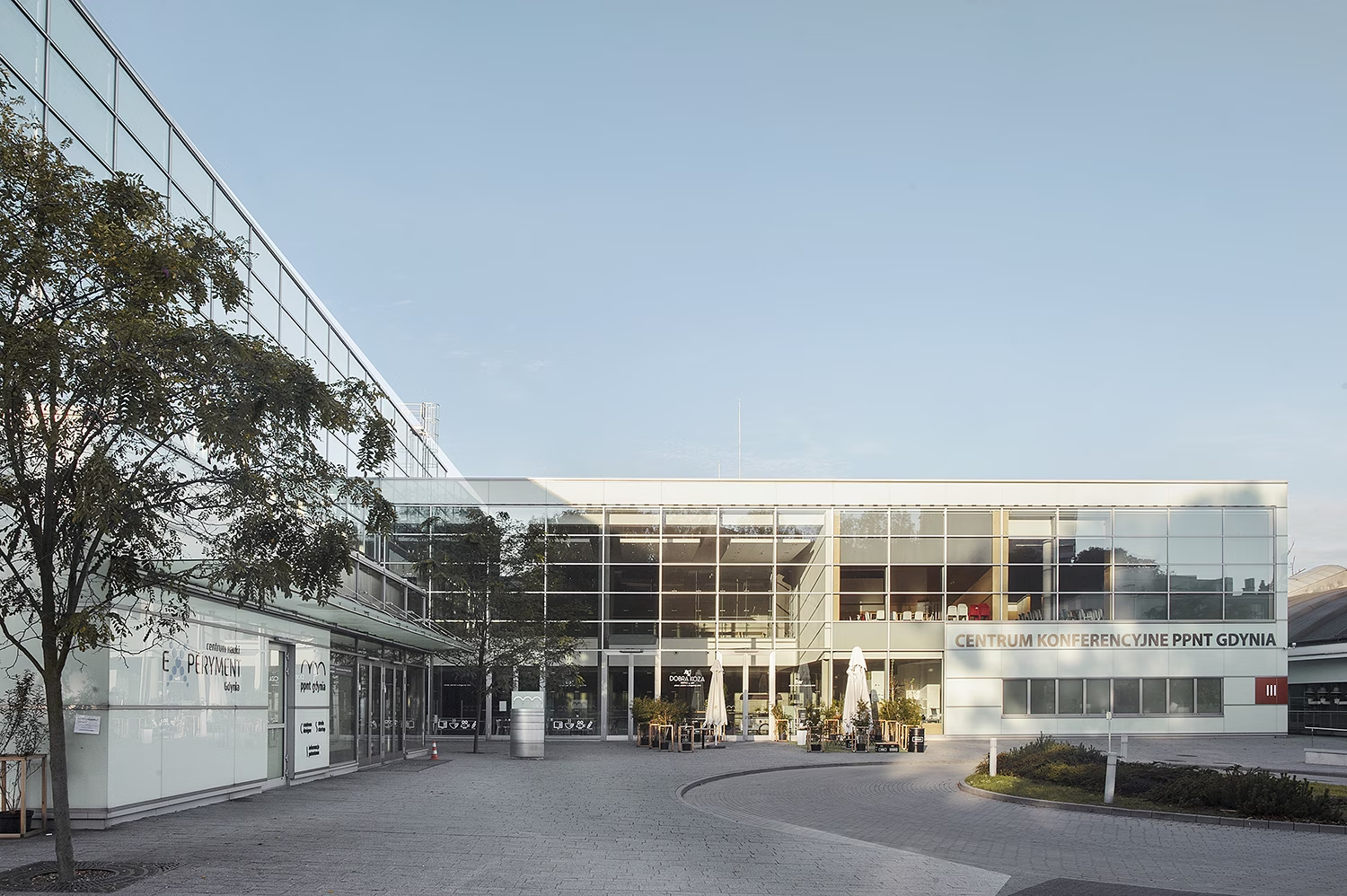
WordCamp Gdynia 2025, held from 26 to 28 September 2025 at the Pomeranian Science and Technology Park, Aleja Zwycięstwa 96/98.
Who hires a web developer in the Tricity
The Tricity economy is broad enough that “a developer” means different things to different buyers. Three kinds of request come up most often, and they need different answers.
- Online shops and B2B sellers. A WooCommerce store that has grown past its first plugins: an ERP or wholesaler feed, invoicing, BLIK and card payments, several warehouses. The problem is usually the joins between systems, not the shop front.
- Companies with a WordPress site that has become software. A booking system, a member area or a document portal that started as a plugin and now holds business logic nobody has documented.
- Technology teams with a gap. A product company or a service centre that needs one senior person on a web or integration problem for a few months, without adding a permanent hire.
The third case is common here because of how many engineering employers the area holds. That competition for developers is also the reason a contractor who can start next month is sometimes easier to find than a permanent hire.
Polish e-commerce requirements that end up in the code
A developer from outside Poland can build a good WooCommerce store. What a local developer brings is familiarity with the requirements that only apply here and that land directly in checkout, invoice and data code.
KSeF e-invoicing
The National e-Invoice System (KSeF) became mandatory for issuing invoices on 1 February 2026 for taxpayers whose sales, including tax, exceeded 200 million zlotys in 2024, and on 1 April 2026 for all other taxpayers, with a deferral for those whose monthly invoiced sales do not exceed 10,000 zlotys gross. Receiving invoices through KSeF has been mandatory since 1 February 2026 (source: the Ministry of Finance KSeF portal).
For a store that means one of two things: the invoicing software that already talks to KSeF has to receive complete and correct order data from WooCommerce, or the connection has to be built. The typical failures are mundane and expensive: a company tax number (NIP) collected in a free-text field, a B2B customer checking out without an invoice flag, corrections that never leave the shop. The code work is making the order data trustworthy. The tax interpretation stays with your accountant.
BLIK and the payment mix
BLIK processed 2.9 billion transactions worth 441.5 billion zlotys in 2025, with online payments growing by 20% to 1.4 billion operations and 20.7 million active accounts (ITwiz, based on Polski Standard Płatności figures). A Polish checkout without BLIK leaves money on the table, and a checkout where BLIK is present but the order status is not updated reliably creates a support queue. The work is in the payment operator’s webhooks, the order state machine and the refunds, not in the button.
Accessibility act
The Polish act implementing the European Accessibility Act has applied since 28 June 2025 and covers e-commerce services; microenterprises do not have to adapt (source: biznes.gov.pl). For a shop above that threshold, accessibility is now a legal requirement rather than a nice-to-have. The practical work is an audit against WCAG, then fixes where stores usually fail: form labels and error messages in checkout, keyboard access to filters and the cart, contrast in the theme, and product images without text alternatives.
Withdrawal button and consumer law
Directive (EU) 2023/2673 requires an online withdrawal function for distance contracts. As of June 2026 Poland had not transposed it, and the professional press described the country as already late (Prawo.pl, 9 June 2026). The date the Polish rules will apply is therefore still open. The sensible preparation is technical: an order history that can identify a contract, a withdrawal form that is easy to reach, and an e-mail acknowledgement with a timestamp.
Personal data
Personal data processing is supervised by the Personal Data Protection Office (UODO). For development work this means a data processing agreement before production data is copied, anonymised staging copies, and deleting the copies at the end of the engagement.
The local technology ecosystem, briefly
Two places explain why the Tricity is a technology market and not only a port region.
The Pomeranian Science and Technology Park (PPNT) in Gdynia was set up in 2001 on the initiative of the Pomeranian Technology Centre association and the City of Gdynia. It describes itself as the largest hub in Poland of organisations working where business, science and technology meet, with more than 250 companies, 76,000 square metres of usable space and 1,343 people working directly in the park (PPNT). It is also where the WordPress community in Gdynia meets for its larger events.
Olivia Centre in Gdansk has about 175,000 square metres, most of it offices, and its Olivia Star tower, at 180 metres, is the tallest building in northern Poland (Wikipedia). Its tenants include Allianz, Amazon, Bayer, Energa, Epam Systems, PwC, Ricoh and Sii (Gedanopedia).
For a company buying development, this ecosystem has two effects. There is a deep pool of engineers, and there is strong competition for them. A permanent hire takes months; a senior contractor for a defined problem can start much sooner. Neither is always right, and the decision table on the main page covers when a freelancer, an agency or a software house fits.
Local proof you can check
These can be verified without taking anyone’s word for it.
- CMSConf 2026. A conference for creators and developers of content management systems, held from 12 to 14 November 2026 at PPNT in Gdynia. Mariusz is listed as Conference Coordinator on the CMSConf website.
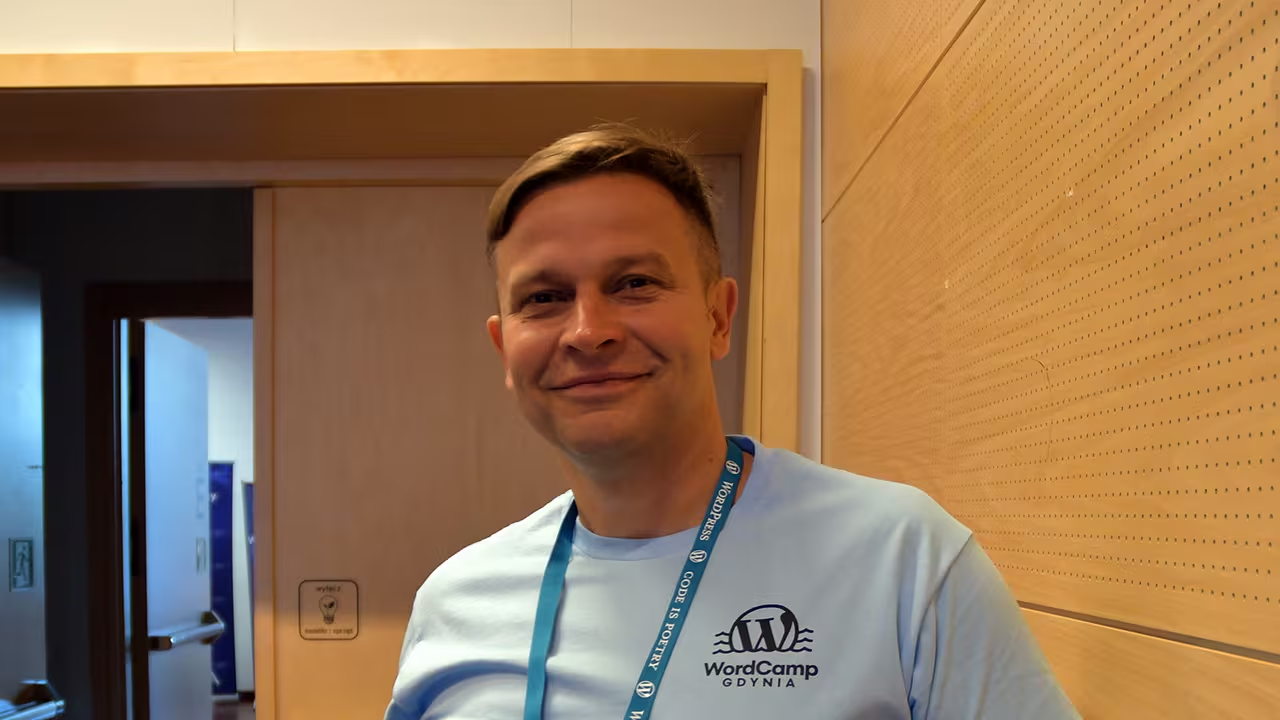
- WordCamp Gdynia. The 2024 edition was held from 4 to 6 October 2024 at the Maritime Fisheries Institute, and the 2025 edition from 26 to 28 September 2025 at PPNT (2024, 2025). The photos on this page are from those editions.
- WordUp Gdynia. The local WordPress meetup has 473 members as of September 2026 and meets at the Gdynia City Museum, Zawiszy Czarnego 1 (meetup page).
- WordCamp Europe. Part of the organising team since 2024 on the budget track, for the 2025 edition in Basel and the 2026 edition in Krakow.
- Public code. The read-only WooCommerce MCP server (TypeScript, MIT licence) and the plugins on wordpress.org.
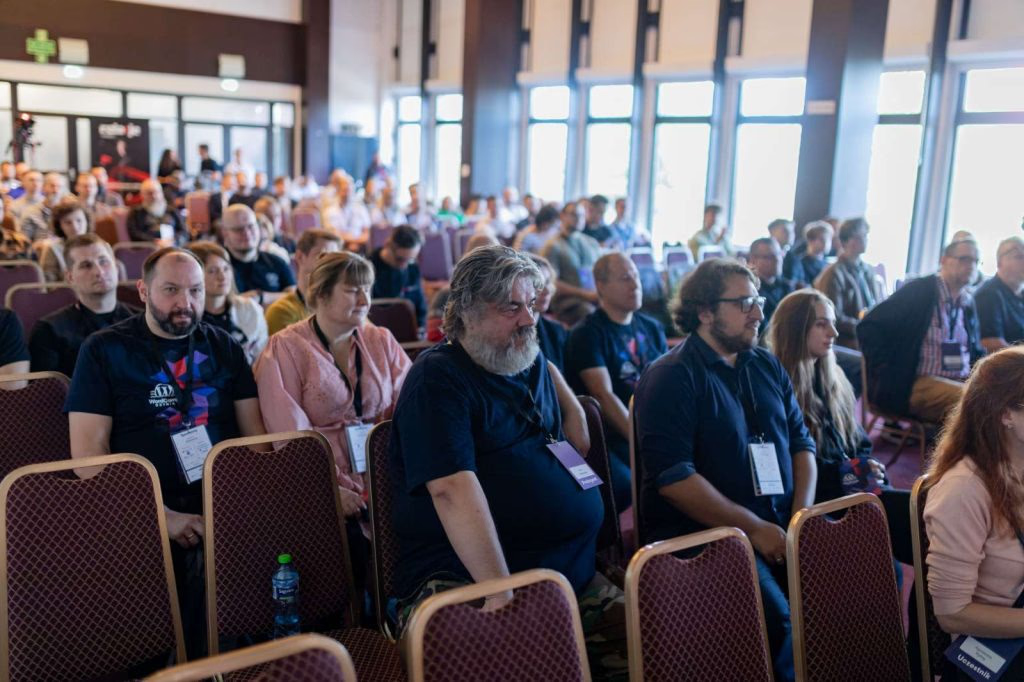
WordCamp Gdynia 2024, 4 to 6 October 2024.
Engagements that fit a Tricity company
The client work is under NDA, so the case studies are anonymised and say so. The ones closest to what Tricity companies ask for:
- A slow B2B WooCommerce store, recovered by profiling checkout and database queries rather than adding a cache plugin: WooCommerce performance recovery. This is the typical state of a store that grew from a few hundred products to wholesale volume.
- A headless WooCommerce build on Cloudflare, for a catalogue where speed and security mattered more than a visual page builder: headless WooCommerce on Cloudflare.
- A written migration plan for moving a WordPress site to a headless front end, including the parts that should stay as they are: headless migration plan. A plan like this is often the right first purchase, before any code is written.
- An AI integration with human review in every step: AI content operations integration. Relevant for service centres and publishers that want to try AI on their content without handing it the publish button.
None of these depended on the client being local. What local presence added, where it applied, was the first workshop.
When a local developer matters, and when it does not
Being in the same city is useful in a few specific situations and irrelevant in most others.
| Situation | Does being in the Tricity help? |
|---|---|
| A workshop to map an ERP, warehouse or invoicing process with the people who run it | Yes, a half day in the room replaces weeks of calls |
| Polish-language requirements, documents or contracts that must be read closely | Yes, and so does knowing the local vendors (payment operators, invoicing software) |
| An integration with your accountant’s KSeF setup | Somewhat: the accountant and the developer need to talk once, in Polish |
| Ongoing development, bug fixes and releases | No, this is remote work with written decisions and weekly demos |
| Emergency response outside working hours | No, there is no 24/7 on-call service here, local or not |
The rule of thumb: choose on skill and working method first, then treat proximity as a bonus. A local developer who cannot show public code or a written process is not a better choice than a remote one who can.
Starting a project from the Tricity
- Write the brief. The system, the problem and the deadline, plus the repositories, hosting, payment operator and invoicing software in use. Polish or English, whichever your team works in.
- Meet if it helps. For process-heavy work, a meeting in Gdynia, Sopot or Gdansk. For a clearly scoped fix, no meeting is needed.
- Agree the scope in writing. Inclusions, exclusions and assumptions; design and wireframes come from the client.
- Baseline, then change. A staging copy and measurements first, especially of the order, payment and invoice flows that must not break.
- Iterate weekly and release safely. Commits in your repository, demos on staging, a rehearsed rollback.
What is not on offer
The same limits apply in Gdynia as anywhere else.
- No graphic design, wireframes or UX design. The layout comes from the client; turning it into a working, responsive interface is the job.
- No mobile apps and no 24/7 on-call.
- No team pretending to be bigger. One person, one calendar. If the work needs several developers in parallel from day one, a Tricity software house is the better fit.
- No tax or legal advice. KSeF, accessibility and consumer law are implemented in code according to what your accountant or lawyer decides.
Related pages
For WordPress work specifically, including maintenance and site builds for Tricity companies, see the WordPress developer in Gdansk, Gdynia and Sopot page. The full offer, stack and track record are on the software developer page, and background on the person is on the about page.
If you have a web or e-commerce system in the Tricity that has to work reliably, describe it in writing. A reply with questions or a first scope usually follows within one working day.