Who writes the code for Vienna clients
WPPoland is one senior web and e-commerce software developer, Mariusz Szatkowski. The work covers the server side of websites and shops (PHP, WordPress, WooCommerce), TypeScript and Node.js services, headless front ends in Astro and Next.js, and the integrations that make a shop agree with the rest of a company.
The Vienna connection has two parts, and both can be checked. Since October 2025 the work includes a contract as full-stack engineer for a Vienna software engineering agency, on a subscription media and commerce platform. That platform is a Composer monorepo describing the whole WordPress application, with CI in which code review and acceptance on staging are independent release gates, Stripe subscription flows, and a Kotlin and Spring Boot service that consolidates ERP, CleverReach and address data into Mautic. My own work there is importing subscription invoice lines (about 100,000 at the last count) and pushing them into Mautic in bulk chunks, a supervised backfill, failure handling with retries on transient Mautic errors, and runbooks. The role is listed on the LinkedIn profile; the client behind the platform stays anonymous.
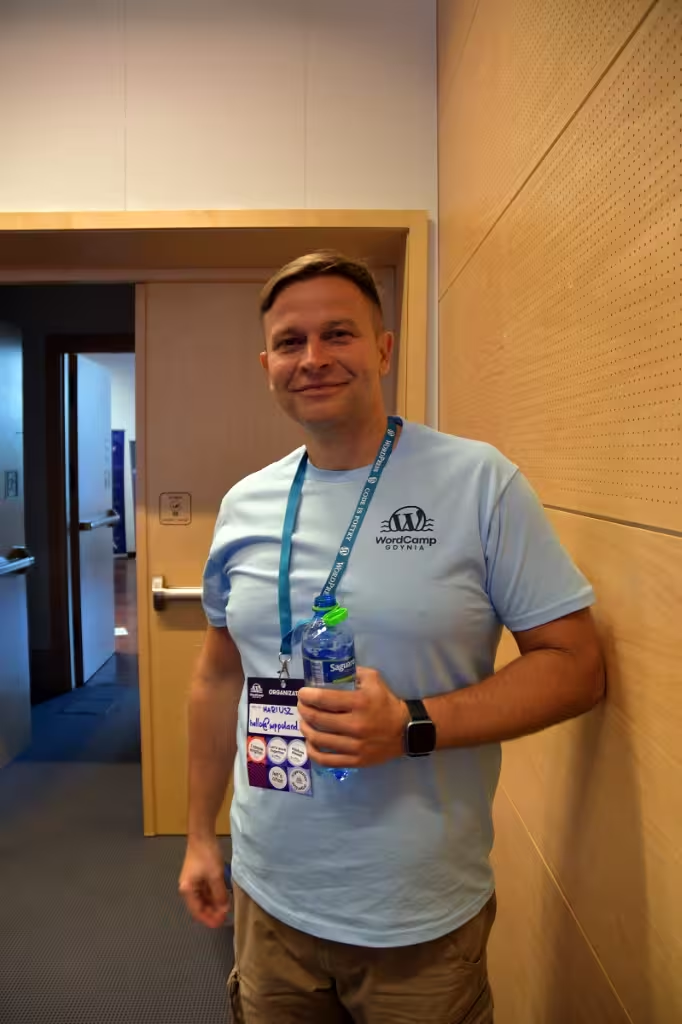
The second part is simpler: being in Vienna in person. The two photos on this page were taken in September 2026, one looking across Donaustadt towards the Wienerwald, one at a tram junction below a high-rise.

Own photo, Vienna, September 2026.
The base stays Gdynia, Poland. There is no Vienna office and no team, and this page does not pretend otherwise. What a Vienna company gets is the person who writes the code, in the same time zone, working in German or English.
Why software developers are hard to hire in Vienna
Vienna is where most of Austria’s software work happens. According to the Wiener ArbeitnehmerInnen Förderungsfonds (waff), about 8,800 ICT companies were based in Vienna in 2022, with more than 67,000 people employed: 37 per cent of Austria’s ICT firms and half of the country’s ICT workforce (waff). That density has a side effect for buyers. Good in-house developers are hard to hire and harder to keep, and agencies run full order books, so a company with a WordPress or WooCommerce system that has outgrown its original build often waits months for a slot.
The requests that come out of that situation are rarely “build us a website”. They look more like this:
- a WooCommerce shop that has to hand orders and invoices to the tax adviser in a format BMD or RZL can import, without someone retyping them every month;
- a subscription or membership site where payments, access rights and newsletter lists drift apart, and nobody is sure which system is right;
- a company site built years ago by an agency that no longer exists, with a custom theme nobody dares to update;
- a shop that has to meet the Barrierefreiheitsgesetz and the new withdrawal rules, and needs someone to change the checkout rather than install a banner.
Each of those is software work in an existing system, which is the kind of work described on the software developer page.
Which Austrian laws affect web and e-commerce code
Most compliance pages list laws. What matters to a developer is which of them change what the code has to do. For a web or e-commerce system serving Austrian customers, these are the ones that do.
Austrian Datenschutzgesetz (DSG) and the GDPR
The GDPR applies in Austria as everywhere in the EU, but the Datenschutzgesetz (DSG) adds to it. Its first section grants a right to confidentiality of personal data that applies to “Jedermann”, everyone, as a constitutional provision (DSG, RIS). The supervisory authority is the Datenschutzbehörde, set up under Article 51 GDPR by section 18 of the same act. For the code, that means the usual discipline done properly: no tracking before consent, no personal data in logs that nobody needs, a deletion path that actually deletes, and processor agreements for every external service a shop sends data to. That includes me: before I get access to a system holding personal data, I sign a data processing agreement under Art. 28 GDPR. I use no sub-processors.
Barrierefreiheitsgesetz for online shops
The Barrierefreiheitsgesetz (BaFG) implements the European Accessibility Act. The Ministry of Social Affairs states that it applies from 28 June 2025, and that micro-enterprises providing services are fully exempt (Sozialministerium). Online shops are in scope. Market surveillance sits with the Sozialministeriumservice. Public bodies have a separate law, the Web-Zugänglichkeits-Gesetz, in force since 23 July 2019 (Bundeskanzleramt).
An overlay script fixes none of this. Accessibility in code means labelled form fields in the checkout, error messages a screen reader announces, focus that does not disappear inside a modal, and a cart that works with a keyboard. Those fixes sit in the theme and in plugin templates, which is why they need a developer.
FAGG withdrawal button in online shops
The Fern- und Auswärtsgeschäfte-Gesetz (FAGG) gives consumers 14 days to withdraw from a distance contract “without giving reasons” (FAGG, RIS). Directive 2023/2673 adds a withdrawal function for contracts concluded through an online interface. Austria transposed it through the Verbraucherrechts-Änderungsgesetz, BGBl. I Nr. 59/2026, published on 28 July 2026; the Unternehmensserviceportal lists it as entering into force in parts on 27 September and 1 October 2026 (USP). In a WooCommerce shop, changing a line of text does not cover it. The shop needs a visible function in the account or order confirmation, a confirmation to the customer, and an order status the back office can act on. The details of which contracts are covered belong with a lawyer; building the flow is developer work. Both dates have passed, so a shop without the function needs it now.
Impressum and Offenlegung in Austria
Two separate duties apply to most Austrian company sites. The E-Commerce-Gesetz, section 5, requires provider information to be “easily and directly accessible at all times”: name, address, email, company register number, supervisory authority, chamber and VAT number where they apply (ECG §5, RIS). The Mediengesetz, section 25, adds the Offenlegung, with a reduced version for small sites that needs only the name or company, the business purpose where relevant, and the place of residence or seat (MedienG §25, RIS). Developers from outside Austria often merge the two into one German-style Impressum page. On a multilingual site the practical rule is that both must be reachable from every language version, not only from the German one.
Who must send e-invoices (e-Rechnung) in Austria
Electronic invoices to federal bodies have been mandatory since 1 January 2014, submitted through the Unternehmensserviceportal or PEPPOL (USP). There is no general domestic B2B mandate yet. Under the EU’s VAT in the Digital Age package, the Wirtschaftskammer notes that paper and PDF invoices will no longer be allowed for cross-border B2B transactions within the EU from 1 July 2030 (WKO). A shop that sells to federal institutions needs structured invoices now; every other B2B shop has time, but the invoice data model is cheaper to fix during a planned rebuild than under a deadline.
Which payment methods Austrian online shoppers use
The payment mix in Austria differs from Germany and from Poland. The US Trade Administration’s country guide puts cards at 34 per cent of e-commerce transactions in 2024, bank transfer through eps at 30 per cent, e-wallets led by PayPal at 28 per cent, and buy-now-pay-later services such as Klarna and Ratepay at nearly 7 per cent (trade.gov).
eps deserves a note because foreign developers tend to skip it. It is a bank transfer that the customer completes inside their own online banking, was built by Austria’s largest banks, and is the official payment method of Austrian e-government (Ombudsstelle). A shop checkout that offers cards and PayPal but not eps leaves out a method that about three in ten transactions use. The newer European wallet, Wero, is coming: Erste Bank Oesterreich, RBI and three Raiffeisen Landesbanken are joining the European Payments Initiative, which calls Austria a strategic market, without a launch date for Austria yet (RBI). For a shop being rebuilt now, that argues for a payment layer where a method can be added without touching the checkout logic.
WooCommerce exports for BMD and RZL
Austrian accounting runs largely through tax advisers, and tax advisers largely run BMD or RZL. BMD describes itself as the Austrian market leader with over 30,000 customers (BMD); RZL says it has served the Austrian tax-adviser market for over 42 years (RZL). Those are the vendors’ own claims, but anyone who has sat with an Austrian adviser knows the names.
Whether WooCommerce can talk to BMD is rarely the real question. What matters is what the adviser needs to receive, in which format, how often, and who corrects an entry when a refund arrives after the month is closed. The way to answer it is a sample export, agreed with the adviser before any code is written, and a written map of which system owns which number. That is the same source-of-truth question that sits behind every ERP integration.
Software development services for Vienna companies
The offer is the same as on the main software developer page, narrowed to what Austrian systems tend to need:
- WooCommerce with Austrian specifics: eps and card payments, the withdrawal function, an accessible checkout, VAT handling for AT and cross-border EU sales, invoice exports for the tax adviser.
- Integrations: shop to ERP, shop to BMD or RZL exports, newsletter and marketing automation (CleverReach and Mautic are both in daily use on that platform), subscription billing with Stripe.
- Rescue and continuation: taking over a WordPress system built by someone else, putting it under version control, adding a staging environment and tests, then fixing what matters.
- Headless and edge builds: Astro or Next.js on top of WordPress, deployed to Cloudflare, when the content model is stable and speed matters more than a visual builder.
- AI with a paper trail: read-only MCP access to shop data, and a self-hosted model instead of a hosted API where data should not leave the company’s servers.
For plain WordPress work in Vienna, including agency support, the WordPress developer in Vienna page is the more specific one.
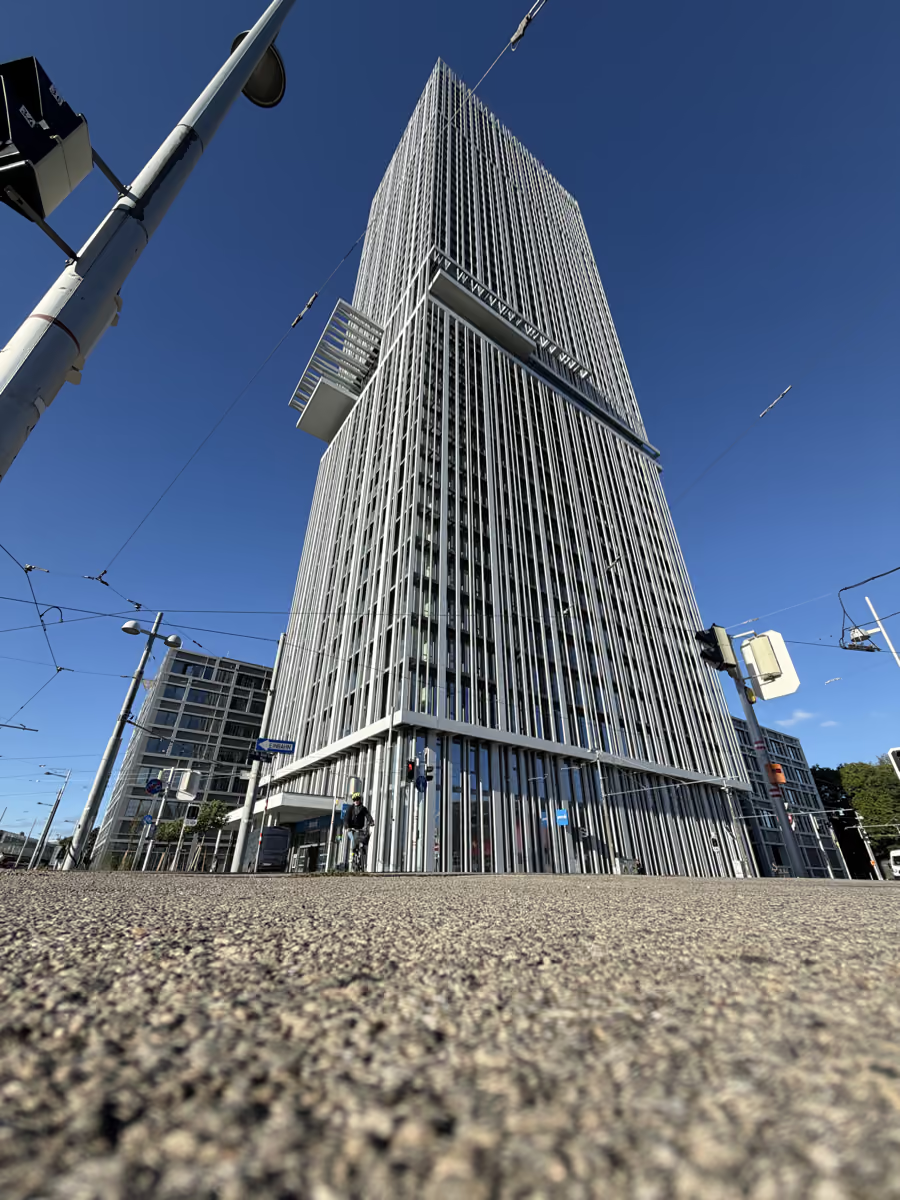
Own photo, Vienna, September 2026.
Should you hire a Vienna agency or a remote developer?
A Vienna company has three honest options, and the right one depends on the work.
| Situation | Better choice | Why |
|---|---|---|
| New brand site with design, copy and photography | A Vienna agency | Design and content production are not on offer here |
| Long project needing five people from day one | An agency or software house | One person cannot staff a parallel team |
| Existing WordPress or WooCommerce system that needs changes, integrations or a rescue | One senior developer | Continuity, one person who knows the code, no hand-offs |
| Agency with a full order book and a technical backlog | A contract developer working in the agency’s process | The model already used on my Vienna contract |
The fourth row is worth reading twice if you run an agency. Working inside an agency’s own repository, review rules and release gates, under the agency’s name towards the client, is how the Vienna contract runs.
What to ask a software developer before hiring
Whoever you hire, these questions separate a developer from a reseller of plugins:
- Where will the code live on day one, and under whose account? The right answer is your repository.
- How do changes reach production? Look for staging, review and a rollback path, not FTP.
- Which personal data does the new feature store, where, for how long, and which processors receive it? The DSG does not accept “the plugin handles it”.
- How is accessibility tested? A named method (keyboard pass, screen reader check, automated audit with manual follow-up), not an overlay.
- What happens when you leave? Documentation in the repository and a handover, not a phone number.
WordPress community in Vienna
Vienna has an active WordPress community. The WordPress Meetup Vienna counted 1,755 members in September 2026 and usually meets on the second Wednesday of the month at the SAE Institute on Hohenstaufengasse (Meetup). Beyond Vienna, the community work that can be checked is on the European level: a member of the WordCamp Europe organising team since 2024, in the budget track, for the 2025 edition in Basel and the 2026 edition in Krakow. More on that is on the about page.
What is not included
No graphic design, wireframes or UX design; the layout comes from you or your agency. No native mobile apps. No 24/7 on-call duty and no guaranteed response times. No legal advice: this page names the Austrian laws that change code, and your lawyer decides how they apply to your company. And no Vienna office, since there is one person, based in Gdynia, who is sometimes in Vienna.
How to send a project request
Describe the system and the problem in writing, in German or English. Name the connected systems (BMD, RZL, ERP, payment provider) and any deadline, such as the October 2026 withdrawal rules. You get a written reply with questions or a first scope.