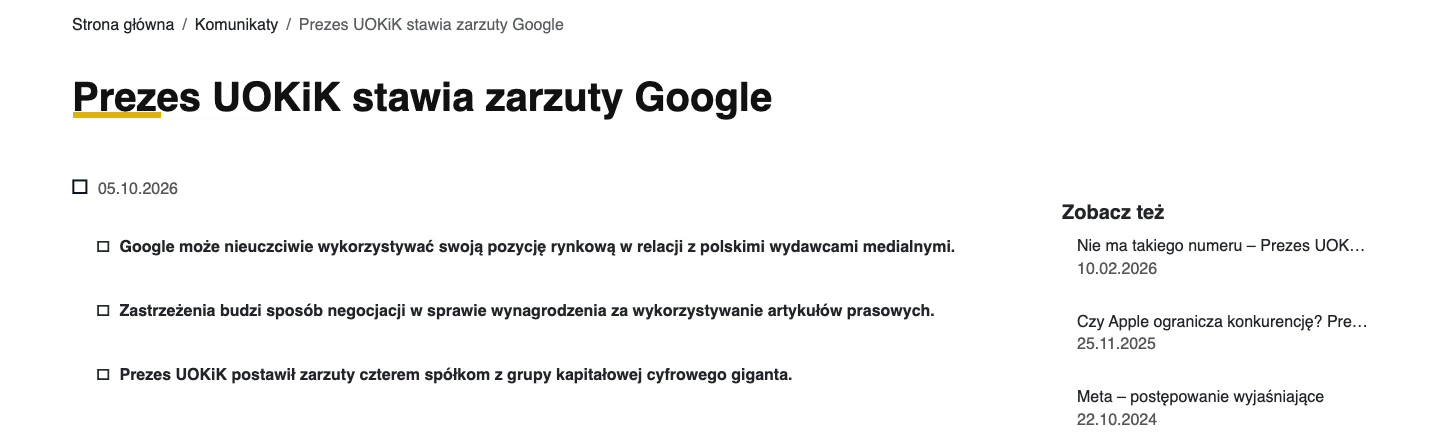
On 5 October 2026, the President of UOKiK filed charges against four Google subsidiaries over how the company negotiated payment terms with press publishers. The proceeding covers Google Search, Google News and Google Discover. The case concerns the Polish market and Polish press publishers, but the controls described below work the same for any site. For a publisher running WordPress, nothing changes today in traffic or indexing. What changes is the context of payment negotiations, and several settings you control deserve review right now, before anyone changes them based on headlines.
Why UOKiK filed charges against Google
The charges centre on missing data. The agency describes it this way:
“According to information held by the Office, when proposing payment to publishers Google failed to provide them with data required by law to assess the offered rates.”
UOKiK, Prezes UOKiK stawia zarzuty Google, 5 October 2026, own translation
The Office specifies what was missing: information on how Google uses press publications and what revenue it derives from them, explanation of the parameters used in the calculation, and documentation to verify the assumptions. The effect UOKiK calls information asymmetry: a publisher cannot judge whether the offer is profitable or present a counteroffer based on data.
The legal charge is suspected abuse of dominance. Holding a dominant position is not prohibited. What is prohibited is using it to impose terms on counterparties who depend on the platform. The statement emphasises that publishers depend on Google as a channel to reach readers and lack full knowledge of the value of the content being used.
Charges apply to four subsidiaries:
| Subsidiary | Role according to UOKiK statement |
|---|---|
| Alphabet Inc | parent company of Google group |
| Google LLC | advertising services; previously operated Google Search in the EEA |
| Google Ireland Limited | currently operates and manages Google Search in the EEA |
| Google Poland | sales of online advertising space |
UOKiK President Tomasz Chróstny, in a statement attached to the release, assesses the effect of missing data this way:
“The absence of this data led to a situation where negotiations became a sham and tended towards the dominant market player imposing its terms.”
Tomasz Chróstny, President of UOKiK, UOKiK press release, 5 October 2026, own translation
On what grounds can publishers demand payment from Google
The basis is the 2024 amendment to copyright law, which implemented Directive (EU) 2019/790, called the DSM Directive. Press publishers’ rights stem from Article 15. According to the UOKiK statement, the rules allow online services to use press publications in exchange for payment, and the platform must provide publishers with the information necessary to determine payment amount. This information obligation is precisely what the Office says was not met.
Article 15 of the Directive has several limits a WordPress publisher should know, because they affect whether you are a party to the negotiation:
- the right does not cover hyperlinks or the use of single words or very short excerpts,
- it does not cover private or non-commercial use by individuals,
- it expires two years after publication, counted from 1 January of the year following publication,
- the authors of the texts must receive a fair share of the revenue the publisher obtains from this right.
A separate question is the definition. Article 2(4) of the Directive recognises as a press publication a collection consisting mainly of literary works of journalistic character, published as an element of a periodical or regularly updated publication under a single title, intended to inform the public, at the initiative and under editorial responsibility of the service provider. Scientific journals are explicitly excluded. In practice, a regularly maintained local news site fits this definition more easily than a company sales blog. A lawyer judges the boundaries of a specific case, not the person who configures WordPress.
If talks with the platform do not result in agreement, the rules provide an arbiter. The statement notes that UOKiK itself is not one:
“Significantly, the President of UOKiK is not a party to negotiations or to any dispute between Google and press publishers.”
UOKiK, UOKiK press release, 5 October 2026, own translation
According to the same statement, the Office does not judge whether the proposed rate is appropriate. If parties cannot agree, the President of the Office of Electronic Communications (UKE) may set the payment amount. The UOKiK proceeding addresses the method of conducting negotiations, not the amount.
Do the UOKiK charges cover AI Overviews
No, and the statement itself makes this clear. The introduction describes the phenomenon more broadly: readers stop at excerpts in search results or at a synthesis of articles prepared by artificial intelligence and do not click the link. But the Office defines the scope of its proceeding narrowly. The European Commission separately investigates Google services based on artificial intelligence, which launched formal proceedings in December 2025 on whether Google uses publisher content in such services without proper compensation and without giving publishers the ability to object. The statement says:
“The subject matter of the Commission’s proceeding is different from the antimonopoly proceeding initiated by the President of UOKiK.”
UOKiK, UOKiK press release, 5 October 2026, own translation
The Polish Office’s proceeding covers the use of publisher content in Google Search results and in Google News and Discover. Both proceedings are independent, which according to the statement was agreed with the Commission before the formal proceeding began.
What the charges change for a WordPress publisher today
At the technical level, nothing. Charges are a stage of the antimonopoly proceeding, not a final decision. A penalty up to 10% of turnover is the upper limit set by law, and the statement notes that liability of individual subsidiaries will be analysed only during the proceeding. Ranking, indexing, Discover and traffic from search work tomorrow the same as yesterday.
What changes is the context of payment talks. The statement says Google has not signed contracts with most Polish press publishers and that concerns exist about how it conducted negotiations with publisher organisations. A publisher who belongs to such an organisation now has the public position of the Office: that demanding data about how publications are used and what revenue they generate is a demand rooted in law. A publisher who belongs to no organisation should at least know who negotiates on their behalf or whether anyone does.
The second change is the risk of hasty decisions. After a high-profile case involving Google, it is easy to think of “cutting off Google” in robots.txt or adding noindex wholesale. A publisher then loses traffic and gains no argument in negotiations. Payment under Article 15 applies to the use of publications in search, News and Discover. A page removed from search ceases to be the subject of that conversation.
What a publisher controls: Content-Signal, Google-Extended and Search Console
Today a publisher has three separate mechanisms to affect what Google does with their content, and a fourth that switches off everything at once.
| Mechanism | Where to set it | What it affects | What it does not affect |
|---|---|---|---|
| Search generative AI control | Search Console, Settings | AI Overviews, AI Mode, generative features in Discover | ranking, AI training |
| Google-Extended | robots.txt | training and grounding of Gemini models outside Search | presence in Google Search, ranking |
| Content-Signal | robots.txt | declaration of consent for search, ai-input, ai-train | nothing blocked technically |
| noindex | meta robots or HTTP header | removes the URL from Google Search entirely | nothing stays in search |
Search generative AI control in Search Console
This is the newest of these settings. Google describes it in Search Console help and gives the release date:
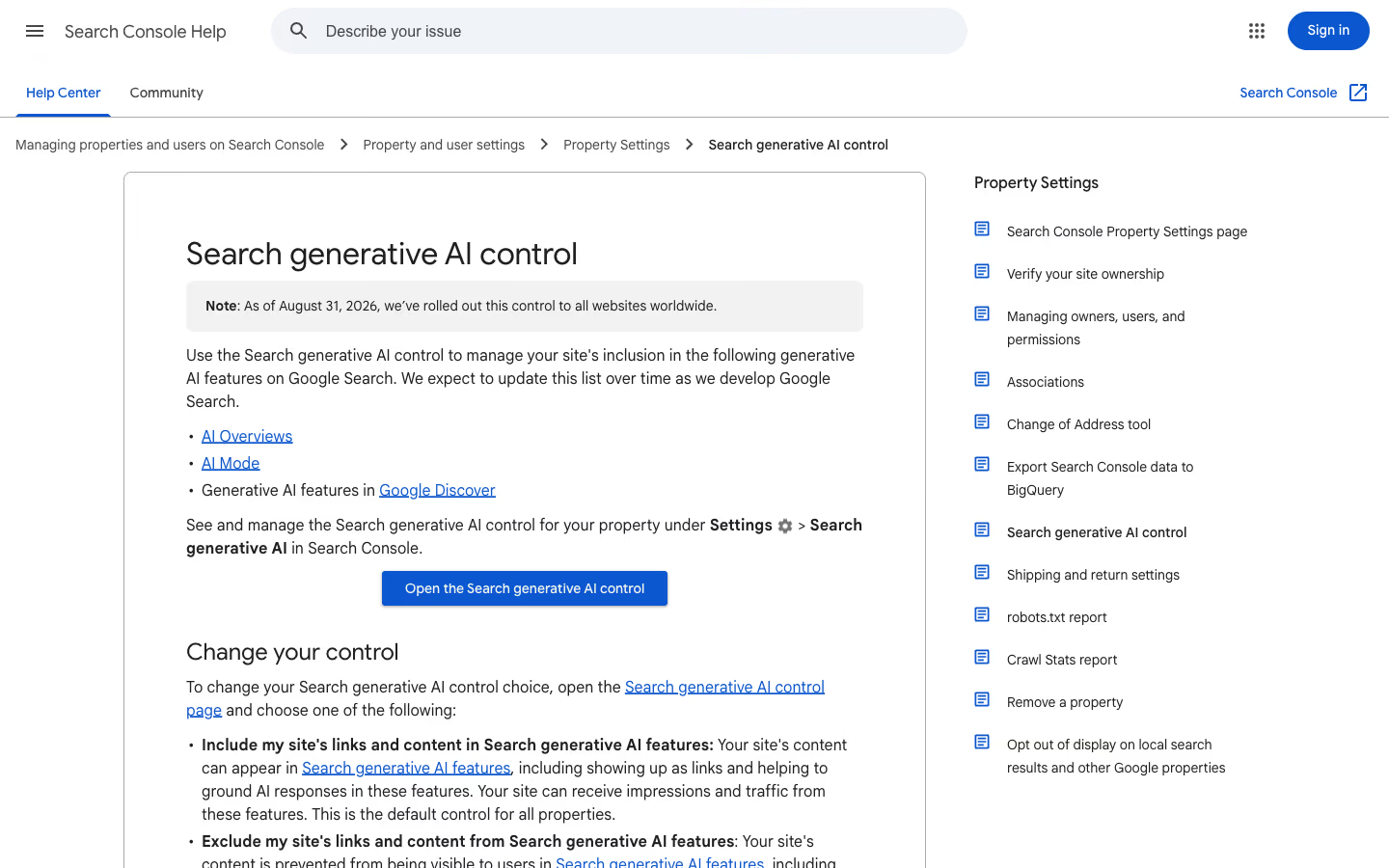
“As of August 31, 2026, we’ve rolled out this control to all websites worldwide.”
Google, Search generative AI control, Search Console Help
It covers AI Overviews, AI Mode and generative features in Google Discover. By default, a site is included. After disabling, content does not appear in these features, neither as a link nor as a source for grounding answers, and Google notes that the change usually takes effect after a few days, in some cases longer due to caching. The setting is inherited: a URL-prefix property, such as a separate site section, inherits it from its parent property unless you set it separately for that property.
The most important limit stands in the same documentation:
“This control doesn’t affect AI training; to limit training of the models used to generate responses in Search generative AI features, use Google-Extended.”
Google, Search generative AI control, Search Console Help
Before changing the setting, check the performance report for generative AI features in Search Console. Without numbers from before the change, you cannot assess how much traffic the decision costs.
Google-Extended in robots.txt
Google-Extended is a token in robots.txt, not a separate robot. According to Google crawler documentation, it has no User-Agent string in HTTP requests, so you will not see it in server logs. Crawling is done by Google’s regular crawlers, and the token acts as a setting. It covers training of future Gemini models and grounding of answers in Gemini Apps and Vertex AI. Google states that it does not affect the presence of a site in Google Search and is not a ranking signal.
On WordPress, robots.txt may be a physical file in the root directory or a file generated by WordPress via the do_robots() function. The physical file takes precedence, so before you add anything in an SEO plugin panel, check which one your server actually returns. For a generated file, a filter suffices:
add_filter( 'robots_txt', function ( $output, $public ) {
    if ( $public ) {
        $output .= "\nUser-agent: Google-Extended\nDisallow: /\n";
    }
    return $output;
}, 10, 2 );Content-Signal and Article 4 of the Directive
Our own robots.txt uses the line Content-Signal: search=yes, ai-input=yes, ai-train=no, and a comment above it notes that the limits expressed by these signals are an explicit reservation of rights in the sense of Article 4 of Directive 2019/790. Article 4 is the text and data mining exception, which a rights holder can opt out of in a machine-readable way. It is a different provision than Article 15, on which the publisher dispute with Google rests. The first addresses whether copying content for analysis and training is allowed. The second addresses whether and how much a platform pays for the use of publications in its services. A line in robots.txt is neither a contract nor a claim for payment.
Content-Signal also has a technical limit we described in our own case: a line placed only in the wildcard group does not reach crawlers that have their own sections in the file. In our file, the signal now stands separately in the groups of individual crawlers, including the Google-Extended group. We have not measured which operators respect it, and we do not claim this.
noindex as the only complete exit from search
Google documentation is clear: to completely block content from appearing in Google Search, you must use noindex. On WordPress since version 5.7, the robots meta tag is set via the wp_robots filter, and most SEO plugins do this per post or per content type. noindex removes the page from results, from News and from Discover, that is, from the services for which a publisher can demand payment, so it gives a publisher nothing in negotiations. It makes sense for tag archives, search pages and technical content, not editorial articles.
How to review site settings after the UOKiK charges
Review a WordPress news site in five steps:
- Download robots.txt from production with
curland check whether the server returns a physical file or a generated one. Cache plugins and CDNs can serve an old version. - List the User-agent groups and verify that the declarations you care about appear in every group they should affect.
- Record the state of the generative AI feature performance report in Search Console. Without a baseline, you cannot judge the impact of a change.
- Decide on Search generative AI control separately for the domain property and for sections set up as separate properties.
- Review where noindex stands. A template that accidentally adds noindex to news categories costs more than any decision about AI.
If you also publish with an eye to generative responses, we described the context of these decisions in the GEO guide. Disabling a site from generative features while simultaneously optimizing for citations in those same features is a contradiction, so choose one consciously.
What comes next in the UOKiK proceeding against Google
The proceeding continues and the statement does not give a decision deadline. Three threads deserve watching. First is the proceeding itself and any decision with a penalty. Second are talks between publishers and Google, and the possible role of the President of UKE if no agreement is reached. Third is the European Commission proceeding on AI services, which could affect AI Overviews directly, which the Polish case does not.
The statement places the case in a broader sequence: UOKiK is closing an antimonopoly case against Apple, and against Meta it is conducting an explanatory proceeding on changes to how it presents links to press publications. A publisher changes site settings on their own, in an hour, and can measure the effect in Search Console. The right to payment stems from law and is decided in talks, before the President of UKE or indirectly in the UOKiK proceeding.