WordPress websites for hospitals and clinics
People open a hospital website with a short list of questions: where is A&E, what are the visiting hours on the ward, what do I bring for my admission. If the answer is three clicks deep, they ring switchboard instead. I build WordPress sites that put those answers first and that your communications team can keep current without a developer.
What patients look for first
I order the navigation around the questions that otherwise end up on the phone:
- A&E and urgent care: entrance, directions, parking and phone number, visible on a phone without scrolling.
- Departments and outpatient clinics: one page per unit, with opening hours, where it is in the building and a link to booking.
- Admission and discharge: what to bring and which forms exist, as printable PDFs.
- Visiting and service notices: your editors publish changes themselves from the dashboard.
The consultant directory runs on custom post types and fields (specialty, department, clinic times), so each fact is entered once and shown wherever it is needed.
Who I am
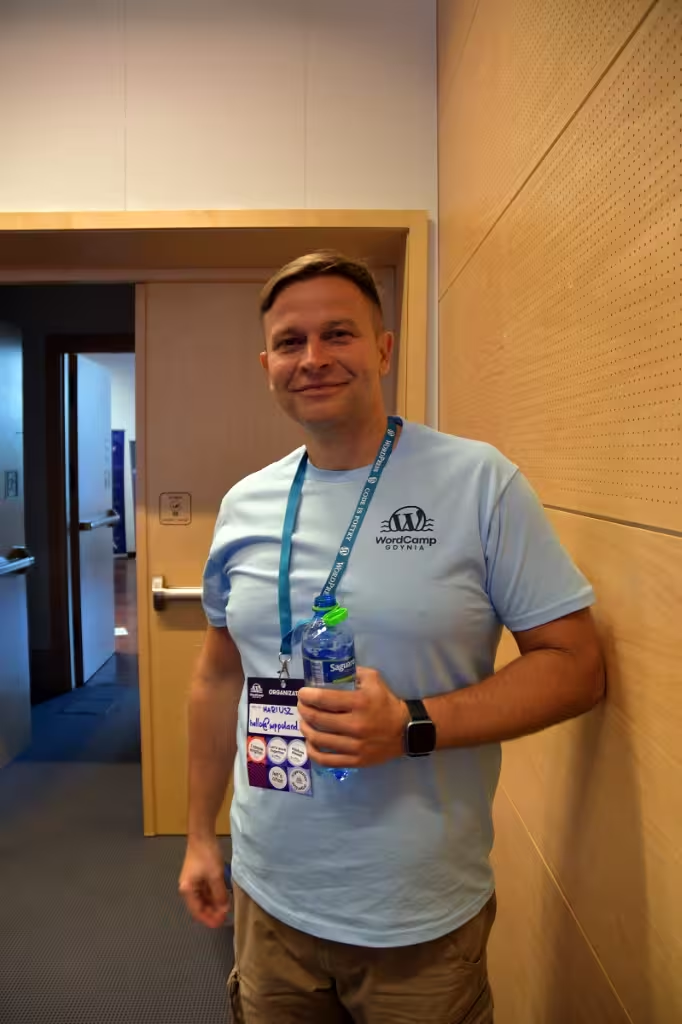
I am Mariusz Szatkowski, a senior WordPress developer since 2006, based in Gdynia, Poland. WPPoland is the name I work under. I work alone: I write the code you receive and I pass your credentials to nobody.
What I build
WordPress themes from the design your hospital or its agency supplies, directories of departments, clinics and consultants, embedding of your existing booking system, accessibility testing, migrations from older CMSs and ongoing maintenance. I do not produce graphic design or wireframes.
Accessibility law in the UK and Ireland
United Kingdom. The Public Sector Bodies (Websites and Mobile Applications) (No. 2) Accessibility Regulations 2018 (SI 2018/952) apply to public sector bodies. Regulation 3 defines them as the State, regional or local authorities and bodies governed by public law. Regulation 6 requires their websites to be accessible and regulation 8 requires an accessibility statement. Regulation 4 excludes some content, for example office files published before 23 September 2018 and third-party content the body neither funds nor controls.
Ireland. The European Union (Accessibility of Websites and Mobile Applications of Public Sector Bodies) Regulations 2020 (S.I. No. 358/2020) use the same definition. Regulation 4 requires websites to be perceivable, operable, understandable and robust, regulation 5 presumes conformity where harmonised standards are met, and regulation 7 requires a detailed accessibility statement using the model in Commission Implementing Decision (EU) 2018/1523.
Whether a given trust, health board or hospital group falls within the definition is for its own legal team to confirm. A privately owned hospital usually does not, though its patients need an accessible site just the same.
I test against WCAG 2.1 AA: full keyboard operation, NVDA and VoiceOver, zoom to 200 and 400 percent, contrast, clear form errors and accessible PDFs. axe-core catches part of the issues automatically; I check the rest by hand. You receive a list of failures with their cause and fix status, which is what an accessibility statement has to describe.
Health data stays out of WordPress
Health data is special category data under Article 9 of the GDPR, and of the UK GDPR in the United Kingdom. The public website therefore holds information only: department pages, patient leaflets, news. Records, results and prescriptions stay in your clinical systems and the vendor’s patient portal.
That leads to concrete decisions:
- the contact form has no field for symptoms or patient numbers and says plainly that it is not for emergencies,
- form plugins do not store submissions in the site database unless you need them to,
- analytics and third-party chat widgets load only after consent and never on booking pages,
- editors get only the permissions they use, and administrators sign in with a second factor.
Booking through your existing system
Clinic schedules live in your patient administration system, so the website does not copy them. I connect the booking tool you already use: a link or an embed following the vendor’s documentation, or the vendor’s API if one exists and your contract covers it. Which fields pass through the interface is agreed in writing with your IT team before I build it.
If the vendor’s system does not respond, the page shows the booking phone number and a short notice instead of an empty frame.
Testing and handover
I test with real patient tasks: find A&E, open the bowel preparation leaflet, book an outpatient appointment. Each task is run on a phone, with a keyboard only and with a screen reader. Before launch I restore a backup to an empty server to prove the restore works.
Handover includes the code in the repository, a description of the integrations, a list of third-party services, an editor guide and the accessibility test results. Content is exportable, so you can change supplier later.
Contract and maintenance
- Contract and invoice: a B2B contract under Polish law, invoiced with my EU VAT ID PL7393037445. Before I get access I sign a processor agreement under Article 28 GDPR. I use no sub-processors.
- Tenders: I can write technical and accessibility requirements so they can be checked at acceptance. The procurement process itself is run by your organisation.
- Maintenance: uptime monitoring every 1 to 5 minutes, backups kept at least 30 days in EU countries and updates tested on staging first. I do not offer 24/7 on-call cover or guaranteed response times.
Send me through the contact form what should be built, which systems it connects to and who will edit it. You will get written questions or a quote.
Similar accessibility and data protection requirements apply to other institutions too: websites for government offices, websites for cultural institutions and websites for foundations.