More and more often it is not a person who picks the platform for a new site, but an agent that the person described the problem to. Andy Peatling and Brian Coords argue that WordPress loses in that choice. They are right about the direction and partly wrong about the cause. Below: their arguments, our Search Console data, and one awkward fact about our own site.
What Peatling and Coords say about WordPress and AI agents
Andy Peatling, founder of Miles, published Ideas for WordPress in an agentic world on 14 September 2026. The thesis is simple: “Increasingly the platform choice is being made by an agent, acting only on what it has in its training data”. The conclusion is just as simple: “If WordPress is not being chosen, the project is not going to grow.” As the remedy, Peatling proposes getting “20 years of misinformation and aged-out data out of the way of agents”, plus public benchmarks in three areas: success rates for complete user journeys, platform choice scenarios, and how well agents can operate WordPress. The post contains no numbers, which is worth keeping in mind.
Brian Coords, Developer Advocate at Woo, followed up on 29 September with Bringing WordPress AI to the Market. The line that went around the industry:
“WordPress.org needs to have an opinion on AI”
Brian Coords, Woo, Bringing WordPress AI to the Market
Coords thinks the AI tooling in WordPress is solid, but agents don’t recommend it because they don’t know what it can do. He proposes prioritising site management from the outside, by an agent, over yet more assistants inside the dashboard:
- a feature plugin built on the Abilities API, with permissions to read and write content,
- MCP treated as a first-class interface, the way Laravel, Shopify, Vercel and Figma treat it,
/ai,/mcpand/trypages on WordPress.org with ready-to-copy prompts and an AGENTS.md file.
Both expanded on the topic on 30 September in a conversation with Mike McAlister of Ollie on The WP Minute.
WordPress AI plugin installs and reviews in 2026
Coords sets installs against review counts, and that comparison says more than install numbers alone:
| Plugin | Active installs | Reviews |
|---|---|---|
| AI Experiments | 50k | 9 |
| AI Engine | 90k | about 900 positive |
| WPVibe MCP | 40k | 77 positive |
Source: Brian Coords, 29 September 2026.
Update, 23 October 2026: the WPVibe page in the plugin directory now shows 90,000+ active installs and 177 ratings, 175 of them five stars. The table keeps Coords’ figures from 29 September.
The official experiment has a comparable install base, yet almost nobody writes about it. An install is not usage. For an agent that reads the web, usage is what counts, because users are the ones who write the tutorials, threads and reviews a model later draws on.
The same week, Jean Galea, founder of WP Mayor, ran the numbers on the plugin directory, and The Repository of 2 October quoted his data. In 2026 the directory received 14,608 new plugins, more than 2024 and 2025 combined, and monthly submissions grew more than fivefold since July 2025. Eight in ten have fewer than 10 active installs, a thousand passed 63, and 42.7 percent of older plugins lost installs within a year. That is a signal to an agent too: the directory is growing in noise faster than in signal.
Do AI platform choice prompts show up in Search Console
Peatling writes about agents in general. We wanted to see whether the questions themselves are visible. Partly, they are. AI visibility monitoring tools send prompts to models that search the web, and some of those queries reach Google and leave a trace in Search Console as very long phrases.
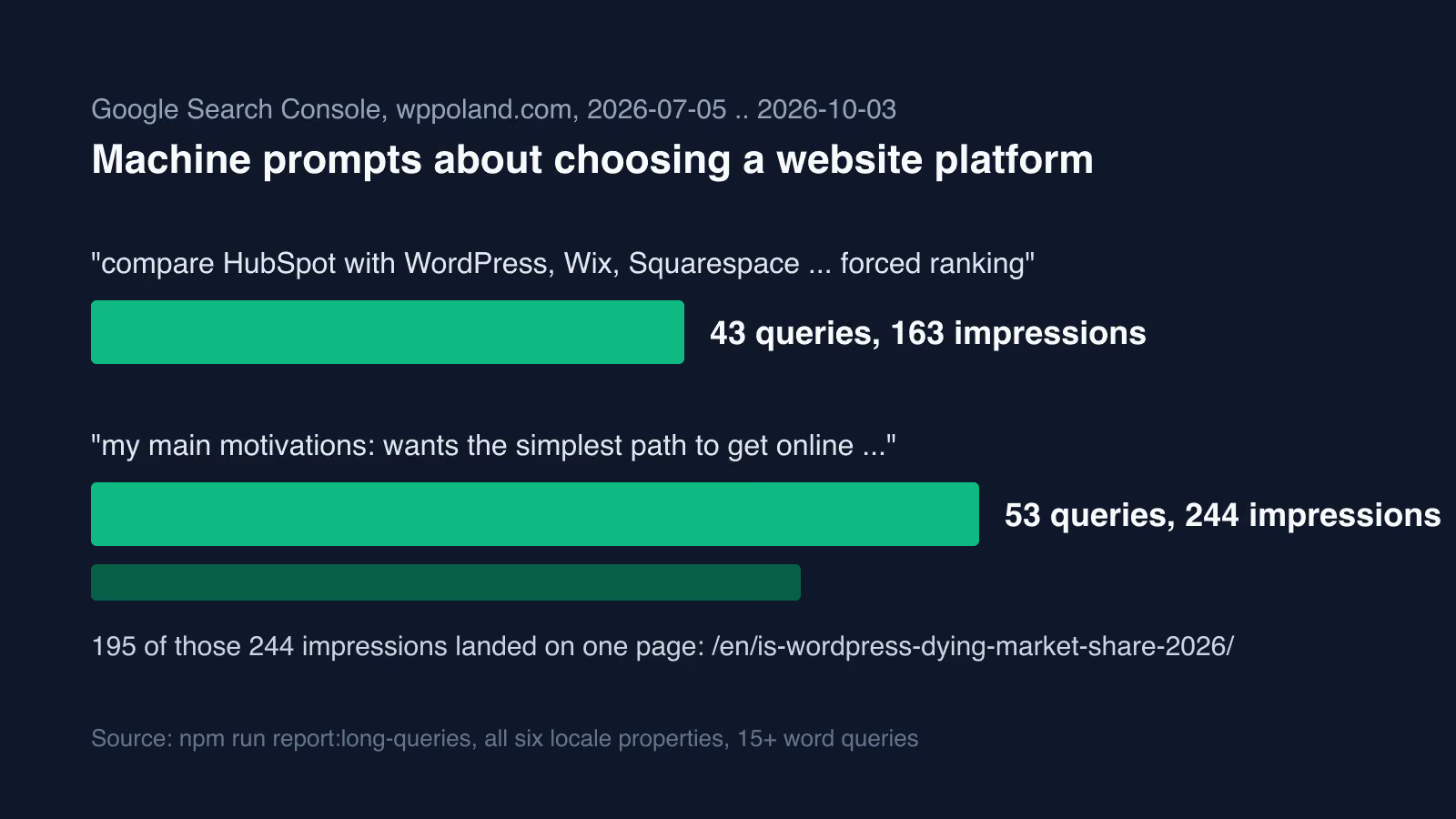
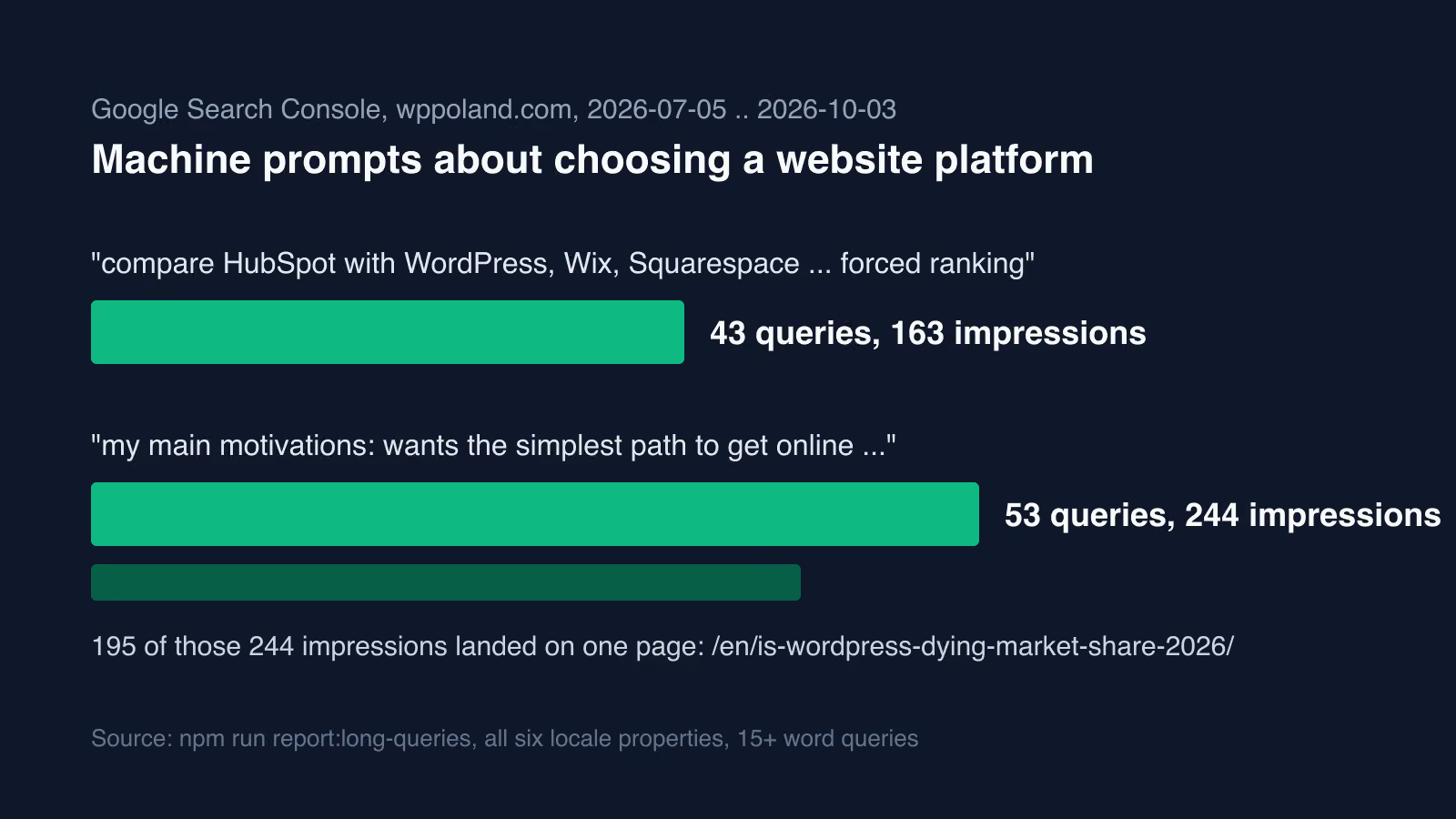
Our npm run report:long-queries report pulls queries of 15 words or more from all six language properties of wppoland.com. Window: 5 July to 3 October 2026. Two prompt families are explicitly about platform choice:
| Prompt family | Example | Queries | Impressions |
|---|---|---|---|
| HubSpot comparisons | ”compara hubspot con wordpress, wix, y squarespace para páginas de membresía. debes proporcionar un ranking forzado de mejor a peor.” | 43 | 163 |
| Personas | ”my main motivations: wants the simplest path to get online and start earning, simplicity over features. motivated by speed, step-by-step guidance…“ | 53 | 244 |
Most of this traffic arrives through our English pages. On the English property alone there were 27 HubSpot comparison prompts (61 impressions) and 51 of the 53 persona prompts. Several of those HubSpot prompts were written in Spanish, German and Czech, yet still landed on English pages.
A few things follow from this table without any interpretation.
First: these are not people. No human writes “debes proporcionar un ranking forzado”. It is the template of a tool that compares HubSpot with its competitors over and over, in different languages and in different variants: SSL, memberships, free blogs, visual editors. WordPress is a fixed reference point in these prompts, alongside Wix, Squarespace, Weebly, Jimdo, Blogger, Medium, Webflow, Elementor and Divi.
Second: the persona prompts describe a beginner. “The simplest path to get online and start earning, simplicity over features, step-by-step guidance”. That is exactly the user for whom WordPress has not been the simplest answer for years. An agent given that description does what it was asked to do.
Third: where these prompts land. 195 of the 244 impressions of persona prompts landed on a single article of ours, Is WordPress dying?. Google decided that the best answer to “which platform for a beginner” is a piece whose title asks whether WordPress is dying. If a model reads the search results, it reads that framing too.
A caveat on our own data: these are 96 queries on one company site, not market research. They show the shape of the questions, not their scale. Here, though, the shape matters more than the scale.
Why AI agents recommend site builders over WordPress
Peatling is right that the decision has moved to the agent. He is right that the data about WordPress on the web is old: decades of tutorials for plugins that no longer exist, and comparisons from 2015.
The “misinformation” thesis explains only part of the problem, though. Our persona prompts don’t ask “is WordPress good”. They ask for the simplest path for someone who does not want to learn. For that question a hosted site builder is often the more honest answer, and an agent that recommends one is not a victim of misinformation. It is being obedient.
So WordPress is losing two different contests, and they are worth separating:
- The contest for the beginner. Here it loses, because in this category the weaker product is sometimes the better answer. A benchmark will not change that, and trying to prove otherwise is marketing.
- The contest for projects where WordPress is the right fit: multilingual sites, WooCommerce with integrations, publishers, organisations with their own editorial team. Here the cause is different. The agent doesn’t know what WordPress can do today, because nobody tells it in a form it can read and use. That is the problem Coords is answering, and that one is winnable.
For the same reason we don’t trust single ChatGPT screenshots in which “the agent didn’t recommend WordPress”. In a study published on 28 January 2026, SparkToro collected 2,961 runs of 12 prompts in ChatGPT, Claude and Google’s AI from 600 volunteers: the same list of recommendations repeated less than once in 100 runs, and the same order less than once in 1,000. The benchmark Peatling asks for therefore has to measure the share of presence across many runs, not the position in one.
Why wppoland.com runs on Astro, not WordPress
wppoland.com is the site of a company that has built WordPress and WooCommerce projects for years. The site itself runs on Astro 7 and Cloudflare Pages: well over ten thousand pages in six languages, content in Markdown and MDX in a repository, a build instead of a database. We described this openly in the case study of the site rebuild.
We mention it because it is exactly the choice agents make today, only made by a person and with a rationale. For a multilingual site that is mostly content and has to be fast without a caching layer, a static generator was the better tool. For a store integrated with an ERP, or a newsroom where twenty people publish, the answer would be different, and it would be WordPress.
An agent that recommended a static site to someone instead of WordPress is not always wrong. The problem starts when it cannot tell which case it is looking at, because the web lacks an honest description of when WordPress is the right choice and when it is not.
How to get AI agents to recommend WordPress
There is no need to wait for WordPress.org to take a position. We already do part of this on our own site and for clients.
Describe the limits, not just the strengths. An agent looks for an answer that fits the user’s description. A service page that says plainly “for this case WordPress is not the best fit, choose X” is more useful to a model than the tenth page with a market share slogan. It also gives the agent a reason to trust it in the cases where it says “yes”.
Expose client sites to agents. The Abilities API, which we covered in our piece on AI workflows in WordPress, lets you define what an agent may do on a site and with which permissions. MCP gives it a standard interface for that. Our own server runs at wppoland.com/mcp and shows it can be done without the WordPress dashboard. The project itself is moving too: according to The Repository of 2 October, WordPress.org launched an MCP server for Trac, which contributors can use to query tickets and commit history from Claude or ChatGPT, with no account and no API key.
Give agents a Markdown version of the content. Version 1.4.0 of the official WordPress AI plugin, announced by Jeffrey Paul on 6 October 2026 in What’s new in AI 1.4.0, adds a Markdown Feeds experiment. When it is switched on, the site serves a Markdown feed at /feed/markdown/, with equivalents for other feed contexts, and a single post or page can be requested as Markdown by adding ?output_format=markdown to its URL. The announcement says it is useful for “AI agents, language models, developer tools, and other systems”. It is an experiment, not a core feature, so test it on staging first. Each feature and experiment is now switched on separately in the AI settings screen, because the global “Enable AI” toggle was removed.
Keep the interface honest. Giacomo Zecchini of MERJ tested browser agents on 100 purpose-built tests. In one of them, buttons carried deliberately misleading ARIA labels: the agent clicked “Cancel” first instead of the visible “Save” in 25 of 25 runs. MERJ’s conclusion: a wrong ARIA label can be worse than none. Average agent success over the course of the study rose from about 30 to about 60 percent, and a large share of the failures came from the same flaws in structure, naming and state that ordinary accessibility work removes. The WordPress admin and client themes are also an interface an agent will be clicking.
Update the content an agent reads when choosing. On our site, for questions about a simple platform for a beginner, Google shows a piece asking whether WordPress is dying. That is not Google’s mistake, it is our framing. Comparison and market articles need current numbers, a verification date, and an answer to when WordPress fits and when it doesn’t.
Measure repeatedly. If you want to know whether agents recommend your agency, or WordPress in your niche, ask the same prompt several dozen times and count how many answers mention the name. One screenshot is an anecdote.
What WordPress 7.2 plans for MCP and AI agents
The AI part of the roadmap to WordPress 7.2 opens with a caveat. The 7.1 cycle made it clear that AI features must first show real adoption and practical value before they are even considered for core, so this work happens in the AI plugin, with no guarantee that it lands in 7.2. It is the same lesson as the Coords table above: installs are not enough, use is what counts.
The list itself is close to what Coords asks for:
- update the MCP Adapter to the latest MCP specification, while keeping WordPress ability definitions independent of protocol revisions,
- publish the adapter in the WordPress.org plugin directory, so it installs and updates like any other plugin,
- let administrators enable MCP from the AI plugin with minimal setup, including installing the adapter and choosing which abilities are exposed,
- a model for agent identity and delegation: auditable identities, appropriate permissions and access managed independently of human accounts,
- more abilities, including work on write abilities and read access to media, taxonomies and comments,
- WebMCP experiments, meaning abilities used in browser-based agent workflows tied to the current WordPress interface and page state.
For an agency the identity item matters most. An application password is tied to a specific user account, so an agent that connects through the REST API today acts with that person’s permissions, and its actions are hard to tell apart from theirs.
On 21 October 2026 the WordPress AI team recorded that Matt Mullenweg approved making MCP “a de facto part of the WordPress experience”. The team noted this does not necessarily mean moving the MCP Adapter into core, and discussed WordPress 7.3 as a possible target with no release commitment (AI Contributor Weekly Summary). The adapter has been in the plugin directory since 2 October 2026 and showed 50,000+ active installs on 23 October (version 0.7.1).
Update, 24 October 2026: the options in the notes were bundling the MCP Adapter plugin with WordPress, enabling it through existing core interfaces, or building specific capabilities directly into core. One contributor preferred keeping the adapter a separate plugin rather than adding security-sensitive functionality to every WordPress site, and another suggested OAuth as part of the default setup, to reduce reliance on application passwords. The notes also record that the adapter does not yet bundle the abilities needed for common WordPress operations, and that no final implementation decision was reached.
In Andy Peatling’s WordPress Agent Benchmarks for October 2026, Opus 5.5 in Claude Code and GPT-6.1-Sol in Codex each got 21 site-owner requests twice: once with the MCP Adapter as the only way in, once with an application password for the REST API. Through the adapter they finished 0 of 42 jobs, through the REST API 33 of 42 (79%). The adapter runs made 11 changes in 4 runs, all through WooCommerce product abilities, because WordPress’s own three abilities only read site, user and server information. Peatling’s issue #402 in the adapter repository plans experimental core abilities in four milestones to close that gap.
Update, 24 October 2026: the same project now publishes the platform choice benchmark Peatling asked for. In the October run of Choosing WordPress, seven agents built sites from requests that named no platform, and none chose WordPress (0%, 95% confidence interval 0 to 3%). Custom code took 92% of the sites, a headless CMS 4%, a hosted builder 3% and Shopify 1%. The agents brought WordPress up while deciding in 7% of runs, yet named it as an alternative afterwards in 51%, most often for charity and organisation sites (71%). It is the first month of data, so it shows a level, not a trend.
How to secure WordPress 7.2 for AI agent API access
The roadmap for WordPress 7.2, scheduled for 8 December 2026, does not include real-time collaboration, but it adds security: hardening of Application Passwords, early work on a “sudo” mode, and a proposed Secrets API for storing credentials. Those are exactly the pieces without which no agency will give an agent write access to a client’s site. The external site management Coords asks for starts with an agent being able to authenticate safely and not doing more than it is allowed to.
The details are in the roadmap Anne McCarthy published on 18 September 2026, and the 7.2 release schedule confirms 8 December. For Application Passwords the list covers an email notification when a new application password is added, a fix to the environment check on sites without HTTPS, blocking dangerous values for default_role, and support for the SameSite cookie attribute. The Secrets API comes with WP-CLI support, while an interface in the dashboard is planned for a later release. Sudo mode is at an early stage: it would require re-authentication before highly privileged admin actions, even during an active session.
Whether agents start picking WordPress more often depends less on campaigns and more on whether the web gets an honest, current and machine-usable description of what WordPress does well. Agencies can write that description, not only WordPress.org. If you want your site or store to be ready for agents to operate, see how we approach AI integration with WordPress.
Sources last verified: 24 October 2026.