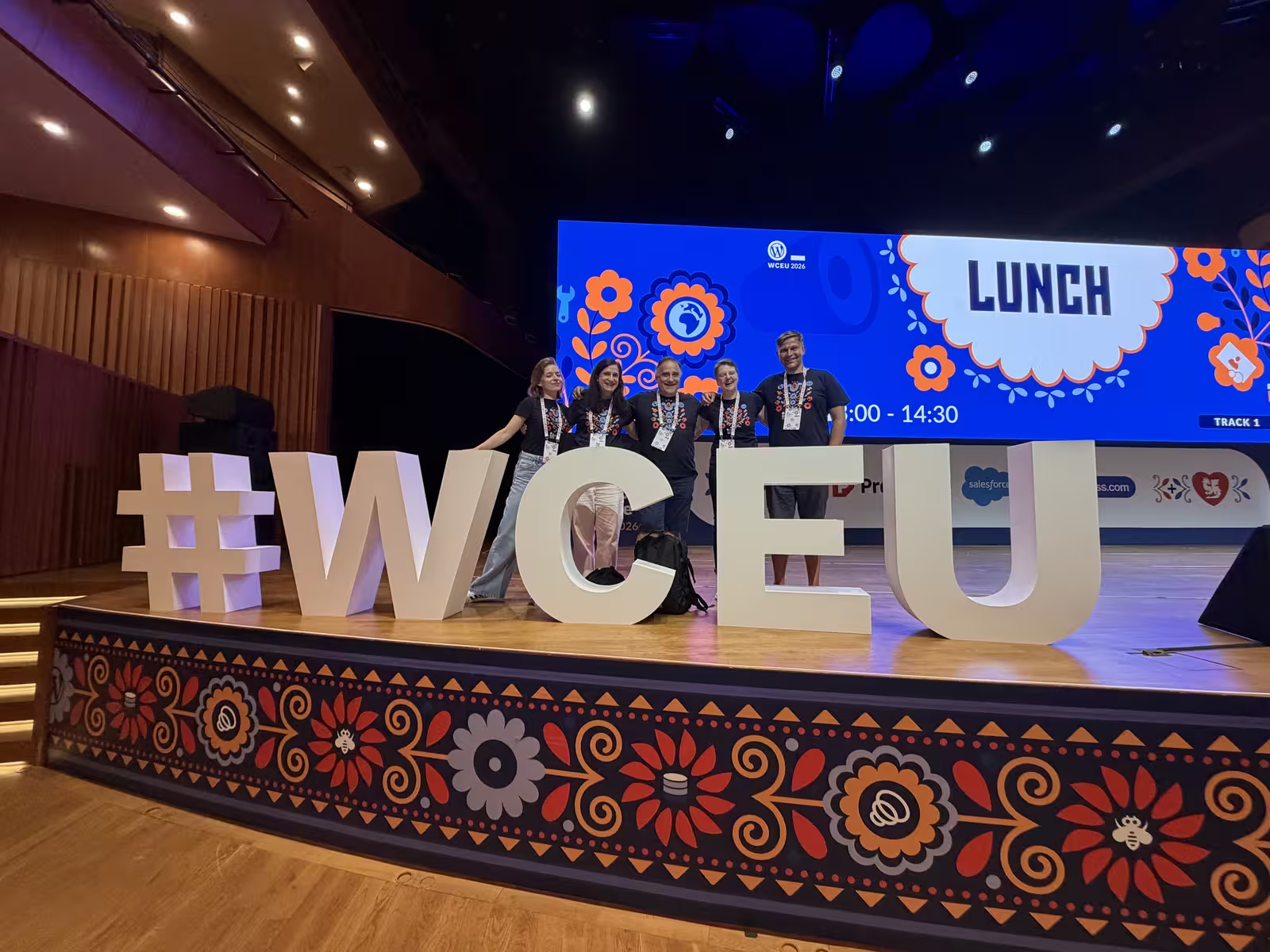
In an era where remote engineering workflows dominate and artificial intelligence models generate boilerplate syntax in seconds, many software engineers fall into the trap of professional isolation. Sitting in a home office communicating solely through Slack channels, GitHub pull requests, and automated ticket trackers creates an illusion of complete self-sufficiency. However, technical proficiency alone only solves immediate implementation tasks; it is your professional network that safeguards your career, shields you from catastrophic client downtime, and surfaces high-value enterprise contracts.
This guide looks at why active participation in local WordPress meetups (official WordPress Chapter meetups; in Poland many of these groups run under the WordUp name) remains one of the highest-yield career investments for independent developers, technical architects, and agency founders.
What is the bus factor for a freelance developer
In software engineering, the bus factor measures the risk associated with project knowledge being concentrated in too few individuals. For freelance developers, solo consultants, and boutique agency owners, the personal bus factor is precisely one. You act simultaneously as the lead solutions architect, full-stack programmer, database administrator, customer support specialist, and billing clerk.
When personal emergencies, medical downtime, or severe burnout strike, an isolated solo operation faces immediate operational crisis. Local developer meetups provide the ultimate structural insurance policy:
How freelancers cover for each other in emergencies
- Handling acute capacity overflows: When your sales pipeline delivers three enterprise migrations simultaneously, turning away clients damages long-term revenue. A trusted network of vetted peers from local meetups allows you to subcontract specialized components or hand off secondary projects with complete confidence.
- Emergency production troubleshooting: When a critical WooCommerce database locks up at 2:00 AM following an obscure plugin collision, having direct phone access to an experienced systems administrator you know personally from local meetups can resolve downtime in minutes rather than hours.
- Vacation and sickness coverage: Stepping away from client maintenance contracts for two weeks of uninterrupted rest requires dependable cover. Establishing reciprocal maintenance pacts with fellow local engineers ensures service level agreements (SLAs) are honoured without sacrificing work-life balance.
How to grow beyond the senior developer plateau
After five to eight years of writing production code, reading additional technical documentation yields diminishing returns. Technical stagnation occurs when an engineer repeatedly applies familiar design patterns to identical problems. True cognitive expansion happens when you are forced to synthesize, explain, and defend architectural decisions in front of experienced peers.
Why give a lightning talk at a meetup
Delivering a concise ten-minute lightning talk is one of the most effective methods for solidifying technical mastery:
- Eliminating intellectual fuzziness: Preparing a concise presentation on block bindings, custom REST API endpoints, or database query profiling forces you to deconstruct concepts to their fundamental mechanics.
- Constructive peer review: During the post-talk Q&A session, questions from senior infrastructure engineers and frontend specialists often illuminate edge cases and performance trade-offs you had never considered.
- Building industry authority: Demonstrating hands-on competence in public establishes you as the regional subject-matter expert on specific topics, such as Core Web Vitals optimization or headless WordPress architecture.
How mentoring juniors sharpens your own skills
Explaining development toolchains, Git branching workflows, or child theme architecture to junior developers is not merely an act of goodwill. Deconstructing complex concepts for beginners forces senior engineers to reassess basic assumptions, root out obsolete habits, and refine their technical communication skills.
How to find WordPress clients without Upwork
High-budget commercial clients with serious technical challenges rarely hire engineering talent through anonymous gig platforms like Upwork or Fiverr. They recognize that low-bid freelance marketplaces introduce unacceptable risks regarding code quality, data security, and long-term maintainability.
Instead, enterprise decision-makers (CTOs, marketing directors, and business owners) rely on trusted referrals. When planning a platform migration, their first action is to ask their professional circle: “Who is the absolute best WordPress engineer in our region?”
CLIENT ACQUISITION CHANNEL VALUE COMPARISON:
+--------------------------------------------------------------+
| Anonymous Freelance Portals (Upwork, Fiverr)                 |
|   - Extreme price competition and margin compression         |
|   - Opaque ratings and a platform service fee per contract   |
|   - Transactional, disposable vendor relationships          |
+--------------------------------------------------------------+
                             vs
+--------------------------------------------------------------+
| Local Engineering Community Referrals (WordUp Meetups)       |
|   - High-trust, pre-qualified inbound client leads           |
|   - Zero commission leak to third-party platforms            |
|   - Value-based pricing and multi-year retainer contracts     |
+--------------------------------------------------------------+
When you are a consistent presence at local developer meetups, contributing constructive answers to architectural challenges and showcasing deep domain expertise, you become the primary recommendation when substantial projects surface. Direct human trust forged over coffee consistently outperforms a polished digital portfolio.
What soft skills do developers need in the AI era
Generative AI models and automated coding assistants excel at outputting boilerplate code, generating regex patterns, and converting design mockups into raw CSS. However, these tools are fundamentally incapable of executing the nuanced human interactions that define successful engineering delivery:
Active listening in client discovery
Interacting with a diverse spectrum of attendees at community meetups (including non-technical business founders, content editors, and visual designers) provides invaluable practice in translating abstract technical constraints into clear commercial trade-offs. You learn to listen for underlying business objectives rather than reacting defensively to superficial feature requests.
How to present technical decisions to stakeholders
Standing before a room of thirty peers to advocate for modern coding standards or headless architectures prepares you directly for boardroom presentations. Engineers who can persuasively articulate why investing in technical debt reduction drives bottom-line profitability earn greater influence and commanding compensation rates.
How to partner with competing WordPress freelancers
In regional technology markets, inexperienced developers view other local agencies and freelancers as rivals competing for a finite pool of work. Mature engineering leaders recognize the reality of coopetition (cooperative competition).
COOPETITION ECOSYSTEM MATRIX:
+-------------------------------------------------------------+
| You: Senior Backend & Performance Engineer                  |
| Peer A: Dedicated Headless React / Vue Specialist           |
| Peer B: UX/UI Designer and Enterprise Brand Strategist      |
| Peer C: High-Availability Cloud DevOps Administrator        |
+-------------------------------------------------------------+
                             |
         [Combined consortium for multi-tier RFP tenders]
                             v
+-------------------------------------------------------------+
| Enterprise contract won over large monolithic               |
| Agencies Due to Specialized Regional Excellence             |
+-------------------------------------------------------------+
By assembling flexible project consortiums with peers met at local gatherings, small teams can routinely compete against and win multi-thousand-dollar contracts against large monolithic digital agencies, delivering superior engineering velocity with significantly lower overheads.
How to start a local WordPress meetup
If your city currently lacks an active WordPress meetup group, stepping forward as a community organizer is the fastest accelerator for regional visibility and industry leadership.
Venue, format and content for a WordPress meetup
- Join the official WordPress Chapter Program: Apply through the meetup interest form in the Community Team handbook on make.wordpress.org/community. For chapter groups, WordPress Community Support, PBC pays the meetup.com dues (the rules are in the next section).
- Secure a neutral, community-friendly venue: Avoid hosting meetups in a commercial agency’s private sales room, which can alienate other local developers. Partner with local universities, public libraries, tech incubators, or coworking spaces willing to offer seminar rooms for free in exchange for community visibility.
- Establish a predictable, low-friction format:
- 18:00 - 18:30: Welcome, informal networking, and refreshments.
- 18:30 - 19:15: Technical presentation (30 minutes of deep-dive content followed by 15 minutes of structured Q&A).
- 19:15 - 19:30: Community announcements (open jobs, project help needed, upcoming WordCamps).
- 19:30 onwards: Informal post-meetup social gathering at a nearby venue.
- Curate inclusive, non-commercial content: Follow the Five Good Faith Rules and the code of conduct that every chapter group signs up to. Presentations must focus strictly on knowledge sharing, technical best practices, and open-source tooling, forbidding commercial sales pitches.
What the WordPress chapter meetup program requires
WordPress runs a single Meetup.com account for the WordPress Chapter Meetup Program. Groups on that account have their meetup.com dues paid by WordPress Community Support, PBC, the public benefit corporation that the Community Team handbook names as the financial and legal support for WordCamps and meetup groups. In exchange, every chapter group commits to a code of conduct and to five rules written by volunteer meetup organizers:
- WordPress Meetups are for the benefit of the WordPress community as a whole, not specific businesses or individuals. All actions taken as an event organizer are with the best interest of the community in mind.
- Membership in the local meetup group is open to all who wish to join, regardless of ability, skill, financial status or any other criteria.
- Meetups are volunteer-run with volunteer speakers.
- Meetup groups allow events to be organized by any reliable/trusted member of the community.
- Meetups are welcoming places where everyone works to foster an accepting environment which is free of discrimination, incitement to violence, promotion of hate, and general jerk-like behavior.
WordPress Community Team, Meetup Program Basics
Organizers are also asked to uphold the GPL. The handbook gives the reason: an attendee who installs a non-GPL plugin or theme may not realize they are giving away the rights WordPress grants them.
The application path has four branches. Check the Meetup Pro WordPress page for an existing group first. If there is none, fill in the meetup interest form; approved applicants get a new group set up for their city and become its first organizer. If a group exists but has held no event for at least three months, use the same form, give the group URL and ask to become a co-organizer. If the group is active, contact its organizers and offer help. The handbook also points new organizers to the online Meetup Organizer Training.
Groups commonly meet once a month, and there is no minimum attendance: the handbook counts anything that brings together two or more people to share their WordPress experience. For the career argument in this article, rule 1 carries the most weight. A chapter meetup cannot be run as the sales funnel of the organizer’s agency, so the referrals described above come from help people watched you give in the room.
Which meetup formats work besides a talk
The Meetup Organizer Handbook lists nine event formats: networking or social events, show and tell, diverse speaker workshops, charity hackathons, coworking or workalong sessions, coffee and code, brown bag sessions, workshops, and grouped lightning talks. The program basics page adds help desks and contributor sprints to the list of accepted formats.
Three of them map directly onto the career problems described earlier:
- Grouped lightning talks: one theme split into several short talks. The handbook recommends the format because it gives more members a chance to speak, especially those who would not volunteer for a long talk. For a senior developer stuck on the plateau, this is the cheapest first stage.
- Show and tell: a member walks through a current website or project and the room responds. It is peer review without slides: a WooCommerce performance problem or an unusual hosting setup gets looked at by people who have hit similar ones.
- Coworking or workalong: people work on their own projects in one room, with someone to ask when they get stuck. For a freelancer whose bus factor is one, a monthly workalong is how you meet the person who later covers your holiday.
The diverse speaker workshop has a different job: the handbook describes it as training people from under-represented groups to speak at meetups. Groups that run it end up with a wider speaker pool, which keeps the monthly calendar from depending on the same three volunteers.
How a meetup leads to organizing a WordCamp
The Community Team handbook describes WordCamps as “casual, locally-organized conferences covering everything related to WordPress”. The step from meetup to WordCamp is spelled out in Should You Be an Organizer?: anyone who has never organized a large event should run a WordPress meetup “for a few months” first, and successful applicants are already active in their local WordPress community.
Further requirements from the same page:
- Organizing teams should have 5 to 10 members, preferably drawn from different people in the meetup group, not from one company, school or circle of friends.
- Organizers and events are approved by the WordPress Community Team.
- WordCamps are not-for-profit. Leftover funds are not pocketed by organizers, and a for-profit WordPress conference has to run under another brand.
The ticket guidance sets the price at 25 USD per person per day or less, including lunch and a piece of swag, with typical prices of 20 to 25 USD per day. Speakers donate their time and receive complimentary tickets. That price level is why a WordCamp is a realistic next step for someone who has given a few meetup lightning talks: the audience is larger, but the barrier to attending and speaking stays low.
The scale comes from WordCamp Central: the first WordCamp was organized in San Francisco by Matt Mullenweg in 2006, and on 13 October 2026 the page counted 1,517 WordPress events in 422 cities across 72 countries.
Which WordCamps take place in Europe in 2026 and 2027
The list below comes from the public WordCamp Central REST API (https://central.wordcamp.org/wp-json/wp/v2/wordcamps?status=wcpt-scheduled), read on 13 October 2026. Dates in the API are Unix timestamps in the field named Start Date (YYYY-mm-dd), so a script has to convert them before display.
| Event | City | Dates |
|---|---|---|
| WordCamp Galicia 2026 | A Coruña, Spain | 16 to 18 October 2026 |
| WordPress Day for AI Faro 2026 | Faro, Portugal | 24 October 2026 |
| WordCamp Sofia 2026 | Sofia, Bulgaria | 24 to 25 October 2026 |
| WordCamp Valencia 2026 | Valencia, Spain | 31 October to 1 November 2026 |
| WordCamp Manchester 2026 | Manchester, UK | 6 November 2026 |
| WordCamp Netherlands 2026 | Netherlands | 12 to 13 November 2026 |
| WordCamp Pisa 2026 | Pisa, Italy | 13 to 14 November 2026 |
| WordCamp Athens 2026 | Athens, Greece | 11 to 12 December 2026 |
| WordCamp Switzerland 2027 | Murten, Switzerland | 5 to 6 March 2027 |
| WordCamp Europe 2027 | Málaga, Spain | 27 to 29 May 2027 |
For readers in the UK, WordCamp Manchester on 6 November 2026 is the nearest event in the list. Earlier in 2026, WordCamp Europe 2026 ran in Kraków from 4 to 6 June. Dates can change after publication, so confirm them on each event site before booking travel.
What the WordPress community code of conduct covers
Chapter meetups commit to a code of conduct, and the Community Team publishes a WordCamp code of conduct template that local teams customize. Its purpose clause promises a welcoming environment regardless of gender, sexual orientation, disability, ethnicity, religion, age, caste, social class, “preferred operating system, programming language, or text editor”.
The template defines harassment concretely: offensive verbal comments related to gender, sexual orientation, race, religion or disability; sexual images in public spaces, including presentation slides; deliberate intimidation, stalking or following; harassing photography or recording; sustained disruption of talks; inappropriate physical contact and unwelcome sexual attention. Anyone asked to stop is expected to comply immediately, and organizers may expel a participant without warning or refund. If an incident leads to removal from a WordCamp, organizers file a report to [email protected].
For a first-time speaker this is practical information. The Q&A after a lightning talk can be sharp on technical points, but sustained disruption of a talk is listed as unacceptable, and there is a named person to go to. For an organizer, the same text is the rulebook you enforce.
How to join WordPress online workshops without a local meetup
Not every town has an active group. Learn WordPress runs online workshops, which it describes as “live sessions where you can learn alongside other WordPress enthusiasts”. RSVPs go through a Meetup.com group, each event links to its RSVP page, and participants must agree to the code of conduct. Past sessions are available as recordings, and there is an application form for people who want to facilitate.
For someone without a local meetup this covers two of the needs discussed above. Attending regularly keeps contact with peers who work on the same problems, and facilitating a workshop is speaking practice in front of a live audience before a local group exists.
What is Five for the Future in WordPress
Participating in local meetups integrates you directly into the global open-source community behind WordPress, which WordCamp Central describes as powering over 43% of the web. The Five for the Future initiative encourages organisations and independent developers to dedicate 5% of their working capacity to the WordPress project.
Local meetups frequently host dedicated Contributor Days where attendees collaborate on:
- Core development: Patching bugs, reviewing tickets on Trac, and writing automated unit tests.
- Documentation and internationalisation: Translating core packages, themes, and plugins into regional languages.
- Accessibility audits: Testing default themes and block components against WCAG 2.2 Level AA accessibility standards.
Contributing to the open-source commons is not merely altruistic. It grants engineers deep architectural familiarity with upcoming core changes (such as Full Site Editing advancements, block bindings, and data views), keeping you months ahead of competitors who only react to official release notes.
Conclusion
Writing code in isolation might sustain a career during periods of high market demand, but building an enduring, resilient engineering practice requires deep regional connections. Local meetups provide peer support during critical production crises, create direct conduits to high-value enterprise clients, and foster the communication skills essential for navigating the AI era.
Whether you are looking to overcome technical stagnation, build a strategic referral network, or explore complex development architectures, step away from your workstation and engage with your local engineering community.
To see how community work connects with enterprise-grade delivery at WPPoland, read about our WordPress developer services.