On 3 November 2026 Barn2 published a country-by-country comparison of WooCommerce and Shopify built on HTTP Archive crawl data. In the UK, Shopify comes out ahead: 9.2% of crawled sites against 5.8% for WooCommerce. Ireland is not in the dataset at all. This guide explains what those numbers measure and what they leave out, then goes through the things that decide the platform for a shop selling from the UK or Ireland: payments, the e-invoicing dates both governments have now set, who owns what, and when I recommend each option.
What does the Barn2 WooCommerce vs Shopify data actually measure?
The source is a post by Barn2 founder Katie Keith, titled “WooCommerce is growing. Just not in English.”. It was published on 3 November 2026. The method, as the post describes it:
- Data source: the HTTP Archive “geo dimension” for the crawls of August 2023, August 2025 and August 2026. HTTP Archive crawls the origins listed in the Chrome UX Report (CrUX).
- Countries: the 25 countries with the largest HTTP Archive crawl base in August 2026. China is excluded because the crawl barely reaches it.
- Metric: the platform’s share of the sites crawled in that country, not a raw count of shops. The crawl base shrank by about 10% over the period, so counts would mislead.
- Same month each year: August against August, because the December crawl is smaller and inflates shares.
- Detection: the crawler looks at the homepage and one interior page. A shop behind a login or a password page can be missed.
“Country” here does not mean where the shop is based. The post says each site is tagged with “the country it’s served from”, but Google’s CrUX documentation says the country values are “inferred from users’ IP addresses”. So a “UK site” in this data is a site that enough Chrome users in the UK visited. It is not a .co.uk domain and not a site hosted in London. A large US store with British visitors can sit in the UK figure. The CrUX docs do not spell out whether one site can count in several countries, but the method makes that plausible.
The post also publishes no query, spreadsheet or dataset, only a link to httparchive.org. I could not reproduce the numbers from the post alone, and I have not queried HTTP Archive myself. Treat the figures as one careful reading of a public crawl, not as a census of online shops.
How do WooCommerce and Shopify compare in the UK?
Here are the UK figures next to the other English-speaking markets and a few European ones, copied from Barn2’s August 2026 table:
| Country | WooCommerce | Shopify | Leader |
|---|---|---|---|
| United Kingdom | 5.8% | 9.2% | Shopify |
| United States | 4.2% | 8.9% | Shopify |
| Canada | 4.2% | 9.8% | Shopify |
| Australia | 5.9% | 13.5% | Shopify |
| Netherlands | 6.2% | 5.2% | WooCommerce |
| France | 5.6% | 5.5% | WooCommerce |
| Germany | 3.8% | 5.1% | Shopify |
| Spain | 9.1% | 5.0% | WooCommerce |
| Poland | 7.0% | 2.4% | WooCommerce |
Across all 25 countries, WooCommerce leads in 14 and Shopify in 11. The headline of the post comes from the language split: English is not an official language in any of the 14 WooCommerce countries, and Shopify leads in all seven countries in the set where English is an official language. The UK fits that pattern. WooCommerce still runs on a lot of British sites in absolute terms, but Shopify shows up on more of them.
The trend runs one way too. Barn2 reports that Shopify grew its share in 24 of the 25 countries between August 2023 and August 2026, and that WooCommerce’s lead narrowed in 12 of the 14 countries where it leads. The post does not name the exceptions. It also does not print the UK’s 2023 and 2025 figures in the text; they are only in a chart image I could not load, so I am not quoting a UK trend line.
Barn2 tests two explanations and rejects both as the main cause. Shopify Payments availability does not explain it, because Shopify Payments works in Poland, Spain, Italy, France and the Netherlands and WooCommerce still leads there. Wealth explains little: the post reports a weak rank correlation of +0.35 with GDP per head.
Among sites British Chrome users visit, Shopify is detected more often. For a shop owner that means the UK has a deep pool of Shopify themes, apps, agencies and staff who already know the admin. It says nothing about which platform fits your catalogue and integrations.
Why is there no WooCommerce or Shopify figure for Ireland?
Ireland is not among the 25 countries in the Barn2 analysis, so the post gives no Irish split. I have not found another source in my research that measures the two platforms for Ireland with a comparable method, and I am not going to estimate one.
It is tempting to borrow the UK figure, since many Irish shoppers use British retailers and many Irish shops sell into the UK. The CrUX method makes that borrowing riskier than it looks. Because country is assigned by where visitors are, the UK figure already contains whatever Irish and international sites British users visit, and an Irish figure would be built from Irish visitors. The two would overlap, and nobody can tell you by how much from this post.
If you need a number for Ireland, the honest route is to query HTTP Archive and CrUX directly for the IE country code with your own detection rules, and publish the query with the result. For a platform decision for one shop, you do not need it. The factors below matter more.
Which payment options work with Shopify and WooCommerce in the UK and Ireland?
Shopify lists both the United Kingdom and Ireland as supported countries for Shopify Payments, its built-in processor. The country pages say it accepts credit and debit cards, accelerated checkouts and local payment methods, and that card processing rates depend on your Shopify plan. Activation involves verifying personal and business details.
The structural point is in Shopify’s page on third-party payment providers: “Third-party transaction fees apply to all transactions processed through third-party and alternate payment gateways, even when Shopify Payments is activated.” PayPal is exempt from that fee if Shopify Payments is your primary provider. Shopify points to its own pricing page for the rates in your location. In practice this means Shopify is cheapest to run on Shopify Payments, and adding a processor you already have a contract with costs an extra fee per transaction on top of that processor’s own charges.
WooCommerce has no built-in processor. You install a gateway plugin from the provider you choose and sign a contract with that provider directly. WooCommerce takes no cut of the transaction. You pay the processor’s fees and nothing on top, but you also own the integration: updates to the gateway plugin, webhook settings and checkout testing land on you or on your developer.
For a UK or Irish shop selling to UK and Irish customers with card payments, both routes work. The question is whether your business already has a payment contract you want to keep. If it does, WooCommerce keeps it without a platform surcharge. If it does not, Shopify Payments is the shortest path to a working checkout.
Does UK e-invoicing from 2029 affect the choice of shop platform?
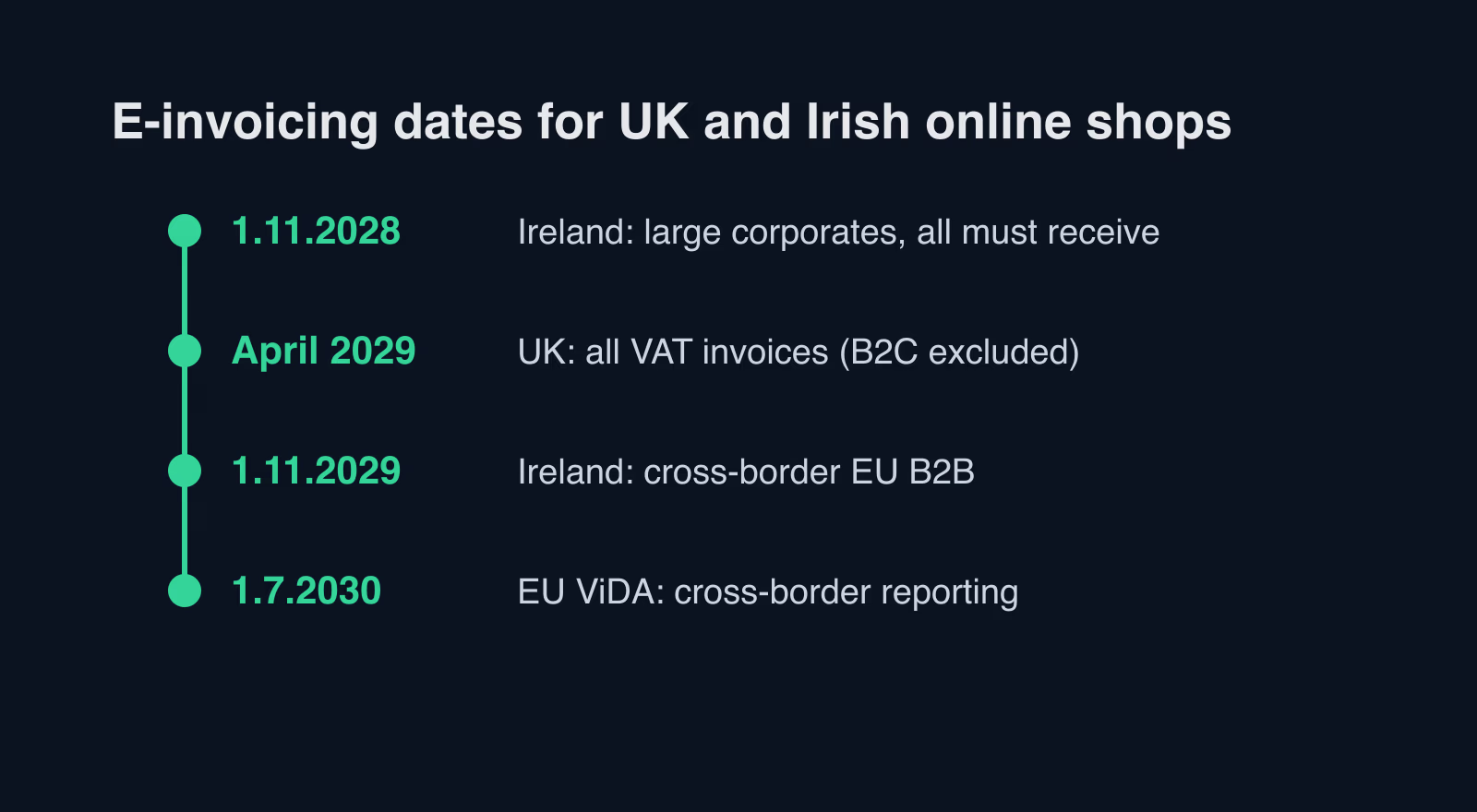
The UK government published a policy paper on VAT e-invoicing on 28 October 2026. VAT invoices must be e-invoices from 1 April 2029. Scope and exemptions are left to secondary legislation that has not been made yet.
The paper does not address B2C sales specifically, and I am not going to guess how retail receipts will be treated before the regulations exist. What I can say:
- Neither WooCommerce nor Shopify is a VAT invoicing system by design. Both create order records and send order emails. If you issue VAT invoices to business customers, you almost certainly already use an accounting or invoicing tool connected to the shop.
- The 2029 duty will land on that invoicing tool. What you need to check is whether your shop platform can pass complete order data (customer VAT numbers, line-level VAT, credit notes for refunds) to a tool that can issue the required format.
- On WooCommerce, that connection is a plugin or a custom integration through the REST API, which you control. On Shopify, it is an app from the Shopify App Store, which works within the data Shopify exposes to apps.
Two and a half years is enough time to sort this out on either platform. It is a reason to ask your accountant which invoicing tool they expect to support the new format, and to choose the shop integration around that answer.
What do the Irish e-invoicing dates mean for an online shop?
Revenue’s VAT modernisation timeline sets out three stages:
| Date | What Revenue plans |
|---|---|
| November 2028 | E-invoicing for domestic B2B transactions of large corporates |
| November 2029 | Extended to businesses in cross-border EU B2B trade |
| July 2030 | Full implementation of the EU’s VAT in the Digital Age (ViDA) package |
B2C sales are not mentioned on that page. An Irish shop that sells only to consumers is not named in any of the three stages. An Irish shop that sells to businesses in other EU countries is in scope from November 2029, which catches a lot of small Irish B2B sellers who would not count themselves as large.
The platform consequence is the same as in the UK. The e-invoice comes from the invoicing or accounting system, and the shop has to feed it clean data. If you sell B2B across borders and plan to stay on your platform past 2029, make sure the order export includes the buyer’s VAT number and country on every order, because that is the data you will need.
A shop that sells from Ireland into Great Britain, or from the UK into Ireland, may face both regimes on different dates. I would plan for the earlier of the two that applies to you, which for an Irish B2B seller into the EU is November 2029.
Who owns the shop, and what do you pay for?
WooCommerce is a free, open-source plugin for WordPress. You run it on hosting you choose. The code, the database and the customer data sit on a server you control, and you can move all of it to another host. The costs are hosting, premium plugins or extensions where you need them, your payment processor’s fees, and the time of whoever keeps WordPress, WooCommerce and the plugins updated. That last item is the one people underestimate.
Shopify is a hosted service. You pay a monthly subscription, and Shopify runs the servers, the checkout and the security patching. Paid apps from the App Store add their own subscriptions. Transaction fees depend on whether you use Shopify Payments, as covered above. You can export products, customers and orders, but the theme and app logic stay on Shopify’s platform.
Prices for both change often and differ by plan and region, so I am not listing them here. Check Shopify’s current pricing page and your hosting provider’s for the figures that apply on the day you decide.
The data protection side follows the same split. Under GDPR in Ireland and UK GDPR in Britain, you are the controller of your customers’ data on either platform. With WooCommerce, your host is a processor and you choose where the server sits. With Shopify, Shopify is the processor on the terms it sets. With WooCommerce you configure those controls yourself; with Shopify you accept Shopify’s.
How do WooCommerce and Shopify compare for a UK or Irish shop?
| Criterion | WooCommerce | Shopify |
|---|---|---|
| Share of crawled UK sites, Aug 2026 (Barn2) | 5.8% | 9.2% |
| Share for Ireland | Not in the Barn2 data | Not in the Barn2 data |
| Built-in payment processor in UK and IE | None; you pick a gateway plugin | Shopify Payments, supported in both |
| Fee for using another processor | None from WooCommerce | Third-party transaction fee, PayPal exempt with Shopify Payments as primary |
| Hosting and security patching | Your host and your developer | Shopify |
| Data location and portability | Your server, full database export | Shopify’s infrastructure, export of products, customers and orders |
| UK VAT e-invoicing from 1 April 2029 | Through an invoicing plugin or custom integration | Through an App Store app |
| Irish B2B e-invoicing from Nov 2028 / Nov 2029 | Same: depends on the invoicing integration | Same: depends on the invoicing app |
| Custom checkout and pricing logic | Full access to code | Within Shopify’s checkout extensibility and app limits |
| Local talent pool | Large WordPress community | Shopify detected on more UK sites, so a deep UK agency and app market |
| Who does updates | You or your developer | Shopify for the platform, app vendors for apps |
When do I recommend WooCommerce for a UK or Irish shop?
I recommend WooCommerce when one or more of these apply:
- The shop is part of a content-heavy site. Guides, a blog, a knowledge base or landing pages for SEO already run on WordPress, and the shop sits inside them.
- Pricing is not standard. Trade accounts with per-customer prices, quantity breaks, B2B ordering for Irish and EU customers with VAT number validation, or product configurators that change price with every option.
- You already have a payment contract you want to keep, and paying a platform fee on top of it does not make sense.
- You want the database on a server you choose, for example because your customer data processing needs to stay with a specific host.
- There is an ongoing budget for maintenance. WooCommerce without someone keeping it updated is how shops get hacked.
When do I recommend Shopify for a UK or Irish shop?
I recommend Shopify when:
- The catalogue is standard: products with variants, standard shipping rules, standard discounts.
- The team is small and nobody wants to be responsible for servers and plugin updates.
- Speed of launch matters more than control, and the apps you need already exist.
- You sell mainly to UK and Irish consumers by card, and Shopify Payments covers what you need without a separate processor.
The UK market share figure is a small point in Shopify’s favour here. A larger installed base usually means more British agencies, freelancers and apps that know the platform, and more staff who have used the admin before, though I would not choose a platform on that alone.
What should you check before you decide?
- Write down your payment contracts. If you have one, price it on both platforms, including Shopify’s third-party transaction fee.
- Ask your accountant about 2029. Which invoicing tool will they use for UK VAT e-invoicing or Irish B2B e-invoicing, and does it integrate with WooCommerce, Shopify or both?
- List every custom rule. Trade prices, bundles, subscription logic, delivery date rules. Check whether a Shopify app does each one, or whether it needs custom code.
- Decide who maintains it. Name the person or company responsible for updates. If there is nobody, Shopify removes most of that job.
- Check data export. If you might move platforms in five years, test what each one lets you take with you.
- Ignore the market share headline. Use it for the size of the talent pool, not for the decision.
Next step
If your shop leans towards custom pricing, B2B ordering or content-led SEO, read how I build and maintain shops as a WooCommerce developer. If it is a standard catalogue and you want the platform to carry hosting and security, see how I work as a Shopify developer. Either way, bring the list from the section above, and we can start from your payment contracts and your invoicing tool rather than from the platform name.