WordCamp Gdynia 2025 is behind us! Three intense days at PPNT Gdynia demonstrated the strength of our community: from the free WordPress Academy for beginners on Friday to a Saturday filled with expert sessions and workshops, concluding with Contributor Day on Sunday.
This edition was unique as it was bilingual, heavily focused on practical applications, networking, and real-world case studies.
Attendance Statistics: We welcomed a total of 293 conference attendees and 61 participants in the Academy. Despite navigating challenges, we maintained a positive, open atmosphere with broad representation from the WordPress ecosystem.
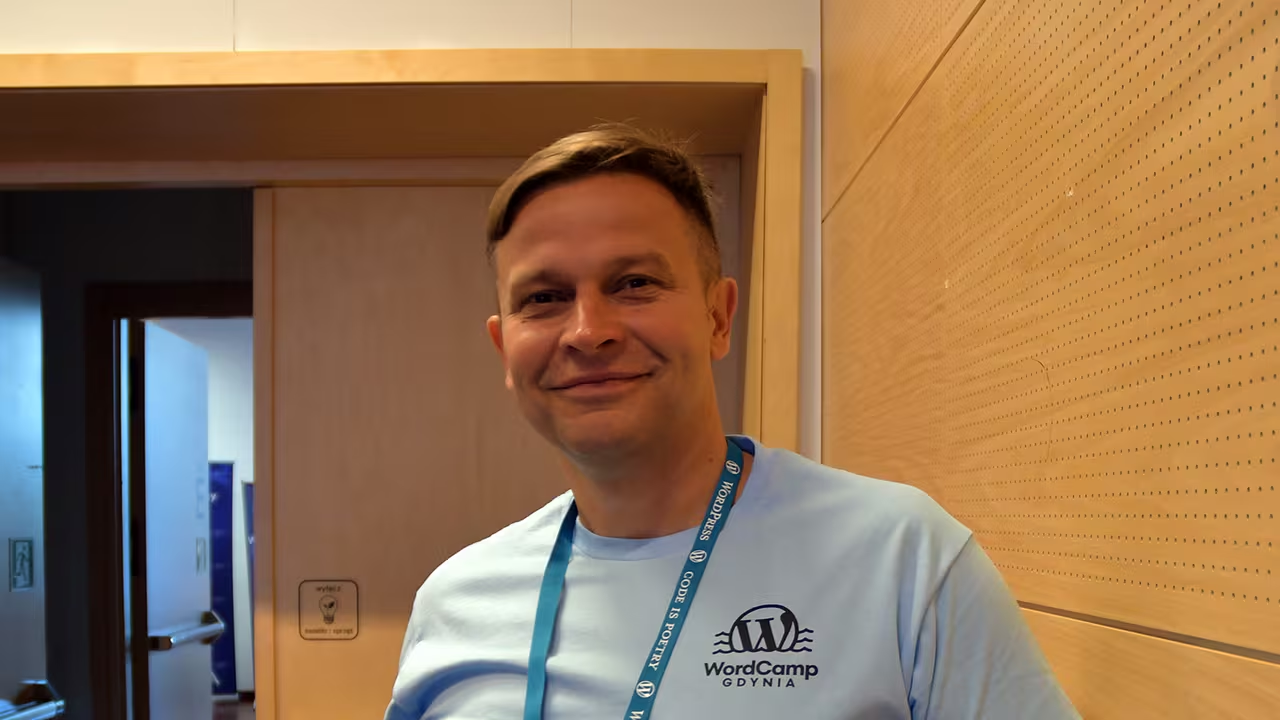
 Mariusz Szatkowski during WordCamp Gdynia 2025. Photo: Gerard Urbański
WordPress and AI talks at WordCamp Gdynia 2025
The conference stood out for its focus on the intersection of WordPress and Artificial Intelligence. Several sessions explored how AI is reshaping security, content editing, and automation.
🔐 security at machine speed
Rashmi Nagpal & Maciek Palmowski (Patchstack) shared how AI agents are revolutionizing vulnerability management. They introduced “Code Guardian”, a multi-agent AI system that autonomously detects, patches, and verifies code vulnerabilities, drastically reducing the “exposure window” for businesses.
🤖 AI content editing
Karol Król demonstrated how Large Language Models (LLMs) can be integrated directly into WordPress to handle content editing tasks. He shared practical insights on cost, quality balance, and the best prompting strategies for autonomous blog editing.
⚡ performance & scaling
Jakub Jóźwiak shared expert lessons on managing massive WordPress databases (up to 16 GB), while Mateusz Zadorozny provided a case study on troubleshooting WooCommerce performance bottlenecks caused by conflicting plugins.
Workshops at WordCamp Gdynia 2025
The workshop day was hands-on, with three sessions running in parallel:
- Birgit Pauli-Haack taught how to master WordPress Playground Blueprints for zero-friction product demos.
- Jessica Lyschik shared the mindset of a “Speed Build Legend” for rapid prototyping in the Site Editor.
- Karolína Vyskočilová showed how to automate workflows using Make (formerly Integromat), replacing bloated plugins with simplified visual automations.
Corporate social responsibility (CSR) at WordCamp Gdynia
The “Sprawni Inaczej” Foundation from Gdańsk joined the event to discuss accessibility and social inclusion, and our community raised over 500 PLN to support their mission.
WordCamp Gdynia 2025 sponsors
Special thanks to our Global sponsors: Bluehost, WordPress.com, Woo, hosting.com, Kinsta, and many local partners including dhosting, wpbakery.com, PayU, and Patchstack.
All recordings will be progressively published on WordPress.tv and the WordCamp Gdynia YouTube channel.
Photos by Julia Marszewska. Recap by Mariusz Szatkowski.
How WordCamp Gdynia 2025 was funded and where the budget went
The organisers published the shares of income and spending for this edition.
Funding sources:
- local sponsors: ~44%
- Community Sponsorship grant: ~35%
- ticket sales: ~17%
- micro-sponsorship: ~3%
Largest spending categories:
- Food & Beverage (lunch, coffee, drinks, snacks): ~34%
- After Party: ~17%
- Venue (rental, security, cleaning): ~15%
- Speaker Event (dinner, gifts, catering): ~10%
- Swag (t-shirts): ~10%
- Audio/Visual (recordings, sound, equipment): ~9%
- Signage & Badges: ~3%
- Other (printing, small purchases, rentals): ~3%
WordCamp Gdynia 2025 speakers and what each talk covered
The sections below describe every session in the programme, in the order the organisers presented them.
Rashmi Nagpal and Maciek Palmowski: AI agents for code security
Two speakers from Patchstack joined forces to take on one of the most pressing problems in technology today: securing code at machine speed. Their talk was titled Automating the Patch: AI Agents for Code Security and Beyond.
Attackers can exploit vulnerabilities within days, sometimes hours, while organisations need weeks or even months to ship a fix. According to the talk, the result is an average “exposure window” of 97 days, which leaves companies in a dangerous zone. With more than 29,000 CVEs reported in 2023, the scale of the problem clearly exceeds a defence based only on human work.
Rashmi Nagpal presented a practical answer to this asymmetry: a multi-agent AI system that autonomously detects vulnerabilities, generates patches and verifies the fixes, using fine-tuned large language models. The system, called “Code Guardian”, shows how autonomous AI agents can take over the heaviest tasks of modern security operations, faster, more safely and more reliably than before.
Maciek Palmowski then presented Patchstack’s mVDP programme, designed to simplify vulnerability disclosure for WordPress plugin and theme authors. He showed how agentic AI building blocks can be plugged into real ecosystems such as WordPress and speed up the whole security cycle, from detection through the patch to protection.
The session covered:
- how AI agents can change vulnerability management,
- the architecture of the “Code Guardian” system,
- practical ways for WordPress developers and agencies to adopt automated security processes,
- the changing role of vulnerability disclosure programmes and open source in security.
Rashmi is a Machine Learning Engineer and Research Affiliate at MIT, with almost five years of experience at pre-seed startups and large companies. She specialises in building new AI/ML products. Outside code she watches the sky through a telescope and plays strategy board games.
Maciek is a web developer and Security Community Manager at Patchstack. He has worked with open source, CMS platforms and automation for years and writes popular newsletters that keep the community up to date with WordPress and web security news. When he is not writing or coding, he is most likely holding a mug of strong coffee.
Katarzyna Janoska: moving from Elementor to the block editor
1001 wrong assumptions: stories of a bumpy move from Elementor to Blocks. “Move from Elementor to the Block Editor,” they said. “How hard can it be?” Very hard, as it turns out. Katarzyna shared an unvarnished account of switching from Elementor to the Block Editor: a journey full of 1001 wrong assumptions, unexpected traps and lessons learned the painful way. From client requirements of the “it must look exactly like this” kind to tight deadlines, she showed that even experienced developers can stumble, and how to come out of it with dignity. For anyone who works with clients, runs projects heavy on the visual layer, or wants such a migration to go more smoothly, the talk was full of practical observations from real projects.
Karol Król: a WordPress site that edits its own blog posts with AI
What if your WordPress site could edit its own blog posts? Karol Król took the audience into AI-assisted content editing with his talk I taught my WordPress site to edit its own blog posts (Yes, using AI).
Karol showed how large language models (LLMs) can integrate directly with WordPress to take over tasks previously reserved for people. In this hands-on session he demonstrated:
- how an AI model edited posts live inside WordPress,
- which models work best for different types of editing tasks,
- the costs and trade-offs of using AI editors at scale,
- real problems and how to overcome them,
- prompting strategies that actually work.
For anyone wondering how AI can save time without losing quality, the talk hit the mark. It suited bloggers, content creators and agencies that do not always have the budget for a full-time editor and still want polished, professional content.
Karol Król has worked with WordPress for years as a content creator and educator, best known for the WP Workshop channel on YouTube, where he explains WordPress through tutorials, experiments and practical tips. He turns technical complexity into simple lessons.
The session was candid: Karol showed the impressive results, and also the places where AI still fails, the situations where a human editor cannot be replaced, and how to balance automation with authenticity.
Mateusz Zadorozny: one plugin that broke WooCommerce performance tests
Testing with adventures: how one plugin prank wrecked our performance tests, a WooCommerce case study. The performance tests were supposed to be a formality: a few endpoints, a pricing microservice on AWS Lambda and some test data. At 17 seconds of response time the fun stopped. Mateusz told a real e-commerce story in which a forgotten plugin derailed the performance tests completely. He showed how his team tracked down the culprit, which tools they used (including k6, Query Monitor and profiling logs), and what they concluded about “innocent” plugins, staging hygiene and keeping dev, test and prod in order. The talk was technical and funny at once, because sometimes the smallest detail causes the biggest headache.
Lena Sędkiewicz: digital wellbeing for people who work online
We live in a digital world that offers great opportunities and also challenges our health and wellbeing. Technology makes life faster, simpler and more connected, and it can also overstimulate, overwhelm and exhaust us more than we realise.
Lena Sędkiewicz spoke about caring for mind and body in an era of constant notifications and screens that never switch off, in her talk (Cyber)Brain. How to look after wellbeing in the digital era.
She covered:
- the hidden risks of excessive technology use and digital overstimulation,
- the effect of constant connectivity on the brain and mental health,
- practical digital hygiene: simple habits that help keep focus, balance and calm,
- techniques that protect mental and physical health while working and living online.
The goal was to use technology consciously, so that it serves us, without rejecting it.
Lena is a psychologist and fencing coach by training, a journalist by passion and a SFBT therapist. She has written two books, travelled widely and eventually found her professional place in web development: since 2021 she has worked full time as a web developer. Outside code and therapy she is a big fan of Max Verstappen, crochets, plays board games and watches football. Her view is that digital health matters as much as physical health, and both are needed to function well in the long run.
Jakub Jóźwiak: working with a 16 GB WordPress database
What happens when a WordPress database does not just grow, but reaches 16 GB and more? Jakub Jóźwiak dug into oversized WordPress databases in his talk Working with a large WordPress database: problems and solutions.
Based on a real case study he discussed:
- the most common problems caused by large databases, from slow queries to site instability,
- how to diagnose bottlenecks and pinpoint the source of slowdowns,
- optimisation techniques that restore speed and reliability,
- practical lessons from running a 16 GB WordPress installation.
Jakub shared details that can save a project when things get out of control.
He has worked in IT for more than 16 years, a large part of it studying how WordPress works from the inside. He is at home in large, complex installations, multisite environments and optimisation problems that others avoid, and he looks for unconventional solutions with a measurable effect. He currently leads a team of 40 developers at WLC, where he helps clients push the performance and scalability limits of WordPress, combining technical depth with an understanding of business needs.
Simon Kraft: podcasting with WordPress, recorded live
Podcasting is often called blogging for the ears, and just as with blogs, WordPress handles it well. Simon Kraft took the audience through the practical side of podcasting and, together with the audience, created and published a podcast episode during the event. Step by step he went through the whole process: preparing the concept and equipment, setting up the recording station, post-production tips, and publishing the first episode with WordPress and podcast plugins. Simon is known in the WordPress community for his work at the intersection of open source and cybersecurity at Patchstack. He is also the voice of the KrautPress podcast and a co-author of WordPress 6 Comprehensive Guide. His workshops are practical, accessible and full of tips that can be applied straight away. Whether someone was thinking about starting a podcast or wanted to understand how WordPress supports audio publishing, the session showed how it is done in practice.
WordPress for beginners track at WordCamp Gdynia 2025
Everyone starts with WordPress at some point, and the start is rarely easy: installation, hosting, first errors, SEO and a million questions without simple answers. This year participants got a dedicated WordPress for Beginners track: practical workshops and talks run by experts who remember their own first steps. Four perspectives shared one goal, helping people build their first WordPress site deliberately and well.
- Izabela Karkocha has built websites for more than 13 years and teaches how to do it wisely. She presented SEO from the basics: simple rules that make a first site friendly to Google from day one and avoid the most common beginner mistakes.
- Karolina Tanona, COO at Netivo, works between business and technology. She spoke about soft skills in the age of AI and the role of the WordPress developer of the future: why soft skills now matter as much as technical ones, and how to prepare for work in a world where AI is part of every day.
- Piotr Pantkowski, from the hosting industry for years and now at dhosting.pl, gave the talk How to start your own website? and explained domains, hosting and SSL in plain terms, without jargon, so participants could take the first steps on their own.
- Kasia Aleszczyk, author of the book WordPress w 10 krokach (WordPress in 10 steps), a blog and a podcast, and a WordCamp co-organiser, showed in her session From installation to..? how to build a site from scratch, how to organise content and which good practices make the result look professional, even without knowing code.
The track was designed to take participants step by step through building a site: from installation and first settings, through design and content, to SEO and further skills.
Aleksandra Lemańska and Gerard Urbański: burnout in IT
Their talk: Burnt out as an IT person? Time for a change! Gerard’s story and the IT Burnout Framework.
Burnout is one of the largest and quietest crises in IT. Long hours, endless deadlines, constant context switching and the pressure to always stay current can exhaust even the most committed developers and freelancers. What happens when motivation fades, and how do you get it back?
- Aleksandra Lemańska is a CQ leadership mentor, change manager, HR consultant and founder of LemanSkills. She helps leaders and teams out of professional stagnation with her CQ Leadership Method, based on the Process Communication Model and transactional analysis, and she shows how burnout can become a starting point for deep change.
- Gerard Urbański has worked in IT for more than 20 years as a freelancer, project and IT manager, web developer, SEO consultant, graphic designer and event photographer. That versatility came at a high price: burnout. His story was honest and moving, about how the passion that drives us can also consume us, and about resilience, finding new paths and turning personal difficulty into lessons for others.
Together they spoke about:
- a real burnout story from IT, without embellishment,
- practical ways to spot the first signs of disengagement,
- tools and methods that help regain control, energy and balance,
- communication, leadership and self-awareness as protection against burnout,
- how organisations and individuals can build healthier, more sustainable careers in tech.
The talk was aimed also at people who are not burnt out yet: an invitation to reflect early, and to give yourself, your team or your company tools that protect both mental health and business results.
Krzysztof Dyszczyk: n8n and LLM automations for small businesses
Running a small business often means wearing too many hats: sending newsletters, updating product descriptions, handling WooCommerce orders. Krzysiek Dyszczyk showed how to hand some of these repetitive tasks to automation tools and AI in his session n8n + LLM: simple automations for small businesses.
The talk was aimed at beginners, freelancers and small business owners looking for practical ways to save time without going deep into complex technology. Krzysiek showed how to:
- use n8n to build simple workflows in minutes,
- trigger automations with WooCommerce webhooks after an order is placed,
- generate content such as product descriptions, meta tags and alt text with language models (LLMs),
- build lean mailing workflows without expensive marketing platforms.
The examples were simple and practical enough to deploy on a site the same day.
Krzysztof Dyszczyk is the CEO of WP Desk, a company building solutions for WordPress and WooCommerce. He has led its technical development from the start, combining a background in mathematics and computer science (UMCS Lublin) with years of practice. He works on innovation, automation and cybersecurity and has spoken at many technology conferences on JavaScript, PHP, Python, Big Data and AI. His approach: every challenge is a chance to build a smarter, more efficient solution.
Piotr Pantkowski: domains, hosting and SSL for a first website
Starting a first website can be overwhelming. Domains, hosting, SSL certificates: what do you really need to know to do it right? In his session How to start your own website? Piotr Pantkowski broke the process down into its parts.
The talk was for complete beginners who wanted to understand how websites work without getting lost in jargon. Whether they planned to build a site themselves or just wanted to know what happens under the hood when someone else does it, Piotr explained the process step by step.
Participants learned:
- what a domain really is and how to choose the right extension,
- what hosting is and what to look for when choosing a provider,
- how an SSL certificate works and why it matters for trust and security,
- which elements every website is made of.
Piotr is a hosting expert with years of experience at some of the largest companies in Poland and abroad. He started in customer support at AZ.pl, became Hosting Product Manager at home.pl and later joined cyber_Folks (formerly linuxpl, hekko.pl, kei.pl, zenbox.pl, domeny.pl) as Head of Hosting, developing the business in Romania and Croatia. He now holds a leading role at dhosting.pl, a company with more than 18 years on the Polish market. He also builds WordPress sites with no-code tools and builders such as Divi.
Andrzej Piotrowski: GlotPress for commercial translation projects
Anyone who has worked on a multilingual project knows how hard it can be. WordPress has a rich translation ecosystem with tools for defining strings and generating language files, but what if the project is not published in the official repository? What if it is a commercial application or a custom solution that needs translation files and also a consistent system for managing and updating them?
Andrzej Piotrowski showed how to solve this in his talk GlotPress: your own translation system for commercial projects. He explained how to:
- set up GlotPress as your own translation management platform,
- automate translation updates for consistency and efficiency,
- use AI support to speed up and improve the translation process,
- apply GlotPress beyond WordPress projects, in standalone applications and internal company tools.
After the talk, participants knew how to turn GlotPress into a working tool that keeps translations organised, current and easy to manage, even outside the official WordPress ecosystem.
Andrzej is a WordPress backend developer with more than ten years of experience. He has worked on complex projects that needed advanced multilingual support and knows translation management problems first hand. Outside programming he is a semi-professional ultramarathon runner representing Poland and an active translation editor in the WordPress ecosystem.
Piotr Niewiadomski: writing plugins and themes in modern PHP
When building WordPress plugins and themes, it is easy to fall into “we do it the way we always have”. When modern PHP practices, continuous integration and automated tests come into play, code scales, teamwork becomes more reliable and annoying regressions become rare.
Piotrek Niewiadomski gave the talk Writing plugins and themes in modern PHP, showing how to:
- build a modern, scalable development process for WordPress projects,
- use static analysis, consistent coding conventions and automated tests to catch errors before they reach production,
- create an organised, integrated development environment that reduces the risk of regressions in team work,
- understand why professional workflows matter for freelancers and small teams as well as large companies.
Piotr is a Tech Lead at Piwik PRO and Cookie Information. He has built solid solutions for modern web development for years, and outside code he travels, dances and takes photographs. Agencies, freelancers and larger development teams all got practical guidance on raising the quality of WordPress projects with modern PHP.
Krzysztof Miotk: customer segmentation and hidden needs
Every brand wants loyal customers who line up to buy after a single message. The secret often lies in discovering their “guilty pleasures” and segmenting well. Krzysztof Miotk gave the talk Your customers’ guilty pleasure, or how to segment customers to discover their hidden needs.
He discussed:
- the most common mistakes brands make in customer segmentation, in large corporations and startups alike,
- why companies such as mBank and Morele stumbled here, and what can be learned from it,
- how x-kom shows better practice,
- real examples, including a visualisation of customer segmentation at OLX.
Krzysztof showed what to fix, why current segmentation may not work, and how to make it support a real relationship between brand and customer.
Known as the “UX Witcher”, Krzysztof Miotk founded the UX agency Quale and hosts the podcast UX po Godzinach. He leads the first postgraduate UX Research programme in Poland. As a UX researcher he has run projects for well-known brands in Poland and abroad, including BLIK, G2A, mBank, OLX, Booste, Gemini, Santander BP, Alior Bank, Tubądzin and T-Mobile.
Panel: leads in the age of AI, WordPress between automation and relationships
On Saturday 27 September 2025 Mariusz Szatkowski moderated the panel Leads in the age of AI: WordPress between automation and relationships. The discussion was about how to win clients now, when AI and automation play a growing role. The questions included:
- do classic methods (content, SEO, a WordPress blog, contact forms) still have the edge,
- how automations and integrations (chatbots, marketing automation, AI copywriting) change lead generation,
- whether the number of leads still goes together with quality and client relationships,
- which WordPress tools actually worked in 2025,
- whether AI is a competitive advantage or a threat to authentic contact with clients.
On stage: Paweł Gontarek, CEO of Semgence & Zgred; Daniel Kędzierski, CEO of FastTony, chair of TO GROWTH and Philip Kotler Awards laureate; Krzysztof Radzikowski, analyst, programmer, SEO specialist and WordPress contributor from SeoFly. Mariusz Szatkowski, WordPress developer, consultant and co-organiser of WordCamp Gdynia 2025, moderated. The perspectives clashed hard, AI against the classics and automation against relationships, at moments in the style of a Jerry Springer show, and the discussion produced real sparks.
Birgit Pauli-Haack: WordPress Playground blueprints for product demos
How do you let potential customers try your WordPress product instead of just reading about it? Birgit Pauli-Haack showed exactly that in her session From Zero to Demo: Mastering WordPress Playground Blueprints.
WordPress Playground can be turned into a demo environment for plugins and themes. Birgit showed step by step how to build preconfigured blueprints that start instantly in the browser, so users can test a product in practice without server load, security risk or complicated setup.
Participants learned how to:
- configure the key WordPress settings for a demo environment,
- fill the site with sample content and data,
- add extra plugins to show a complete workflow,
- package everything into a safe blueprint that runs with one click.
As curator of Gutenberg Times and a long-time WordPress advocate, Birgit has helped developers and product teams adopt new tools and workflow improvements for years. Her record includes many contributions to the Gutenberg project, education work and WordCamp talks around the world. The session suited product makers, plugin and theme authors and agencies that want to lower barriers and build trust.
Jessica Lyschik: the speed build mindset for client work
How much can you really achieve in 30 minutes with the WordPress Site Editor, and what should you deliberately not do in that time? Jessica Lyschik gave the talk The Mindset of a Speed Build Legend: What You Can Totally Borrow for Client Work.
Drawing on intense Speed Build Challenges with some of the best-known community contributors, Jessica described the mindset and techniques that support fast, accurate decisions when time is short and expectations are high. Participants got methods they could use in their projects right away:
- fast prototyping under tight deadlines,
- choosing the right blocks to balance speed and quality,
- clear decision frameworks under time pressure.
Jessica is a frontend and WordPress developer at Greyd. After almost a decade of Python, she focused on WordPress in 2015 and now specialises in CSS, the Block Editor, the Site Editor and performance optimisation. She is an active WordPress contributor and was Default Theme Co-Lead for Twenty Twenty-Four, released with WordPress 6.4. She also speaks at conferences, volunteers, organises meetups and WordCamps and takes part in public Speed Build Challenges. Away from tech she builds Lego sets, plays the piano and walks in nature.
Christian Taylor: social video and the loyalty loop for WordPress brands
When does the customer journey really start? For Christian Taylor the answer is clear: the sale is the beginning of your loyalty loop. In his talk The Loyalty Loop: Social Video for WordPress Brands he went into creating social video content that builds customer loyalty, stronger relationships and a community around a WordPress brand.
Christian, also known as craylor, is a YouTuber and entrepreneur from Nashville, Tennessee. On his channel he helps entrepreneurs and small business owners find the right tools to grow online, and he specialises in making WordPress, hosting and website building simple.
Participants learned:
- which types of video turn one-time customers into loyal advocates,
- how to design content that brings people back and deepens engagement,
- how to build your own loyalty loop step by step with video at the centre.
The talk went beyond marketing tactics: it was about long-term trust and community around WordPress products and services.
Karolína Vyskočilová: automating WordPress with Make instead of plugins
Karolína is a WordPress developer, consultant and automation enthusiast working where open source, business processes and AI tools meet. Years of improving company workflows made her keen to show how even small teams can work smarter with the right automations.
Her session: Beyond Plugins: Automate with Make in Minutes, Not Months. In this demo-heavy talk participants saw how to:
- connect WordPress with tools such as Google Sheets, Slack, CRMs or AI services, even where no ready plugin exists,
- replace repetitive manual tasks with visual workflows in Make (formerly Integromat), Zapier or IFTTT,
- make one form submission start a whole process: a support ticket, an AI priority score, a Slack notification to the right person and a CRM update within seconds,
- prototype and test new ideas faster by building minimal automations in hours instead of weeks.
Plugins are not always the best answer: too many of them can slow a site, raise maintenance costs or add vulnerabilities. Visual automation platforms offer flexible, secure and economical alternatives without writing code. Freelancers with many clients, agencies building complex solutions and business owners trying to scale all got ways to save time, reduce errors and focus on the work that matters.
Edgars Veidenbaums: custom WordPress elements in WPBakery
Edgars Veidenbaums has more than 15 years of experience with WordPress and moved from building themes to advanced plugin design. As Development Manager at WPBakery he showed how to build custom WordPress elements with the shortcode architecture and the vc_map() function.
The session was useful for people who want to deliver projects faster, simplify admin-side work and keep control over the interface without adopting a large React stack.
Robert Windisch: WordPress Multisite for everyone
Not Just for Enterprises: A Deep Dive into WordPress Multisite for Everyone. When you hear “WordPress Multisite”, you may think it only suits huge organisations. Robert Windisch, CIO at Syde and a well-known figure in the WordPress community since 2005, showed that this assumption is wrong.
In this practical session Robert walked participants through:
- setting up a standard multisite network,
- advanced modifications with multiple paths in subdirectories,
- managing a network of hundreds or even thousands of sites,
- the cases where a multi-network setup is worth considering.
Whether someone ran three sites or three thousand, they left with the confidence and technical knowledge to make Multisite a reliable part of their projects. Robert is known for his conference hat, his enthusiasm for the WordPress community and deep knowledge of multilingual setups and enterprise-scale projects. Let him talk long enough and multisite will come up.
Wojciech Babicz: are WordPress autoinstallers safe
Autoinstallers for WordPress: a handy tool or pure evil? Wojciech Babicz, CEO of Smarthost.pl, answered that question. For years autoinstallers had a bad reputation in the WordPress community: they were seen as dangerous, unnecessary or badly designed, since installing WordPress by hand was supposed to be quick and simple. Wojciech showed step by step how a modern autoinstaller works (for example Softaculous in cPanel), which safeguards it adds and where it offers features a manual install does not, such as staging environments. He also went through the old objections and checked whether they still hold in 2025. With years of running a hosting company, a background in IT and cybersecurity (including NIS2, ISO certification and GDPR) and academic teaching, Wojciech combined technical knowledge with a business view. Outside tech he travels and takes photographs. The talk let participants look at autoinstallers again and consider that they may not be the villains they were taken for.
Krzysiek Dróżdż: risky client requests that look harmless
Would you give someone power of attorney over your bank account? Probably not. Yet in the website world many of us agree to equally risky requests, often without thinking. Krzysiek Dróżdż analysed everyday, seemingly innocent requests that come up in work with clients and teams and can lead to data loss, access problems or even legal trouble. With the audience he looked at what these situations really mean, why they are so common and how to protect yourself and your clients. Krzysiek is a WordPress and PHP developer with almost twenty years of experience, co-founder of 360DigitalCare and CEO of WPmagus. Since 2005 he has built custom themes, plugins and advanced solutions for clients ranging from Polish brands such as Próchnik and Browar Czarnków, through law firms and medical groups, to the Ministry of Education. He is a known contributor on WordPress Stack Exchange, a speaker, an organiser and a long-time active member of the WordPress community. The talk made many people look again at habits everyone treats as normal, and at the real risks behind them.
Tomasz Palak: what the Cyber Resilience Act means for WordPress
When law meets technology, things get interesting. Tomasz Palak is a lawyer, speaker, blogger and educator who translates complex regulations into practical guidance that can be applied straight away. With more than ten years of experience he has spoken at TEDx, Marketing & Technology, Infoshare and many universities, always mixing expertise with humour and real examples. In his session How the Cyber Resilience Act will shake things up Tomasz covered a topic most people would rather avoid: new obligations and legal liability for website builders. He explained what the Cyber Resilience Act means in practice, why it matters for people working with WordPress, and how to prepare before the rules become a serious problem. The talk was full of simple examples, specifics and light humour, which made a complicated technology law easy to follow.
Anna Kowalczyk: from freelancer to collective
Anna Kowalczyk, content manager, copywriter and founder of the marketing collective Cosome, spoke about a way of working that combines a freelancer’s independence with the strength of a team. In practice that means building a trusted network of specialists, clear rules of cooperation, sharing responsibility and a deliberate approach to the leader’s role.
The session was for people who want to take on larger projects without adopting the classic agency model.
Magdalena Ślęzak: brand colours that fail the contrast test
How do you keep a strong brand identity without giving up accessibility? Magdalena Ślęzak took on one of the hardest problems designers and developers face: what happens when brand colours fail contrast tests, and what to do when a client insists on a low-contrast design that excludes part of the audience.
In her talk When Brand Colours Fail the Contrast Test. How to Reconcile Branding with Accessibility in WordPress Magdalena shared:
- practical guidance on adapting brand elements (colours, logo, typography) to digital accessibility standards,
- ways to educate clients and use design techniques to build sites that stay true to the brand and are accessible to everyone,
- a strategy for building “complementary palettes” that keep the brand recognisable while ensuring accessibility,
- simple tools to check and improve designs for accessibility.
Magdalena has many years of experience in digital accessibility, project management and business empathy, and her session was essential for anyone who cares about inclusive design.
Tim Nash: the dark side of automatic updates in CI/CD
Automatic updates: friend or foe? For years the advice was simple: “Just turn on automatic updates, nothing will happen.” For many WordPress sites that is true: updates are a key safety net against vulnerabilities that are now exploited within hours, not weeks. But when you run continuous integration and deployment (CI/CD), manage many dependencies and deploy changes at scale, “turn it on” is no longer enough. Tim Nash, security consultant, educator and long-time WordPress security expert, gave the session The Dark Side of Automatic Updates: Securing WordPress Supply Chains in CI/CD. He shared practical strategies for making automatic updates safer without slowing work down: staging environments and integrity checks, automated safeguards in CI/CD pipelines, and techniques that keep sites secure, fast and reliable. Whether participants managed one WordPress site or hundreds, they left with concrete steps to secure the update process.
Paweł Gontarek: does AI-generated content rank in Google and AI chatbots
AI-generated content is everywhere now. The real question is whether it helps you get found in Google and in AI chatbots. Paweł Gontarek, known as “Zgred”, is an SEO strategist, trainer and founder of Semgence who has helped many companies cut through the noise and build lasting visibility online. In his talk Paweł shared practical examples of how AI can support, but not replace, solid SEO practice; the typical mistakes marketers make when writing for search engines and AI systems; and the strategies that still work in 2025, along with the ones that only waste time. The focus was on concrete, measurable ways to make content work for you in search engines, AI assistants and readers’ eyes.
Georg Richard Aare: staying visible in AI-assisted search
Search has changed. Georg Richard Aare, co-founder of RankUp, joined the bilingual stage with a background in SEO and marketing automation, helping companies stay visible in a fast-changing digital world. His work focuses on AI-supported SEO processes that save time while keeping a strong online presence, in classic search and in content discovery through language models (LLMs). In his English-language session Georg answered questions every company and WordPress professional now asks: how to stay visible in the era of AI-assisted search, which strategies still count as Google and AI assistants change how users find content, and how to use automation without losing authenticity. The talk was aimed at anyone who wants to prepare their WordPress projects for what comes next.
Daniel Dudzic: WooCommerce, scale and user experience
Daniel Dudzic knows the WordPress ecosystem from the product, support and contribution sides. He worked at WooThemes and Automattic, supported a global customer community, contributed to WooCommerce Blocks, and now, as Senior Full Stack Engineer at Syde GmbH, focuses on payment integrations and scaling complex solutions.
His perspective was especially valuable for people building WordPress products at scale who must combine engineering, user experience and the reality of post-launch support.
Tomasz Dziuda: practical problem solving in web projects
Tomasz has built websites and web applications for more than a decade, for small local businesses and large international projects. Over the years he has gained broad experience as a developer and as a problem solver able to handle complex IT challenges, with a view of technology that goes beyond writing code. Outside client work he is active in the WordPress community as a speaker, member and former co-organiser of meetups and conferences. He co-created Bookero, a booking system that helps businesses manage reservations, and founded Publii, a lightweight CMS alternative to WordPress for users who need something simpler and faster. At WordCamp Gdynia Tomasz shared what years of work taught him: how practical problem-solving skills turn into effective technology solutions.
Robert Abela: WordPress user account security
Robert Abela, CEO and founder of Melapress, spoke about practical security of WordPress user accounts. The topic is less flashy than new features, and it is essential for shops, agencies and site owners who must keep sites scalable and resilient.
The session made the point that security should be a permanent part of a WordPress strategy, not an add-on: from password and permission policies to auditing user activity.
Szymon Jankowski: AI as a practical tool
Szymon Jankowski, AI trainer and founder of a training company running workshops for businesses across Poland, showed AI from the practical side. His case was one in which AI helped an event organiser quickly build a working online graphics generator.
The main takeaway was simple: AI does not replace thinking, but used well it shortens the path from a problem to a working tool.
Harry Kimpel: WordPress observability with New Relic and OpenTelemetry
Harry Kimpel, Principal Developer Relations Engineer at New Relic, ran a practical session on monitoring WordPress with New Relic and OpenTelemetry. The focus was observability: treating performance, errors and infrastructure signals as a normal part of project work, rather than something switched on only after an outage.
Anna Widera: WooCommerce cart UX mistakes
Anna Widera, frontend developer, project manager and WordPress enthusiast since 2012, spoke about five UX mistakes that make customers abandon WooCommerce carts. The strongest part was practical: specific friction points in the purchase path, their effect on conversion and ways to fix them without rebuilding the whole shop.
Remkus de Vries: why caching does not solve performance problems
Remkus de Vries is a performance specialist in the WordPress ecosystem, focused on speed, security and scalability. He co-founded Scanfully, which helps site owners get ahead of performance problems, and is the voice behind Within WordPress, a newsletter, podcast and YouTube channel for people who take building better, faster websites seriously. His talk Caching Doesn’t Solve Performance Problems took apart common myths and shared practical observations that apply to any WordPress project.
All recordings are available on WordPress.tv.