WordPress history, from 4.9 to the Gutenberg era
WordPress 4.9 was "the calm before the storm." We analyze this pivotal moment in WP history that prepared the ground for the block editor. What changed since? How did the ecosystem evolve?
I am Mariusz Szatkowski, a WordPress developer in Gdynia, Poland, and I have worked with WordPress since 2006. If you searched for “sviluppo WordPress Milano” or for an Italian WordPress developer, one thing first: I am not Italian and I do not write Italian. I work for Milan companies remotely, in English, and the Italian texts on the site come from you. What I bring is the code, the structure and a build process that keeps Italian legal requirements in the acceptance list instead of leaving them for after launch.
This page fits a Milan company that already writes its own content, or has someone who does, and needs a developer to turn a layout and a set of requirements into a working WordPress site. Typical starting points:
Graphic design, mockups and wireframes are not something I produce. You bring the layout, either from your designer or by filling in a spreadsheet where you mark which elements go where on each view. I implement that as a responsive WordPress theme.
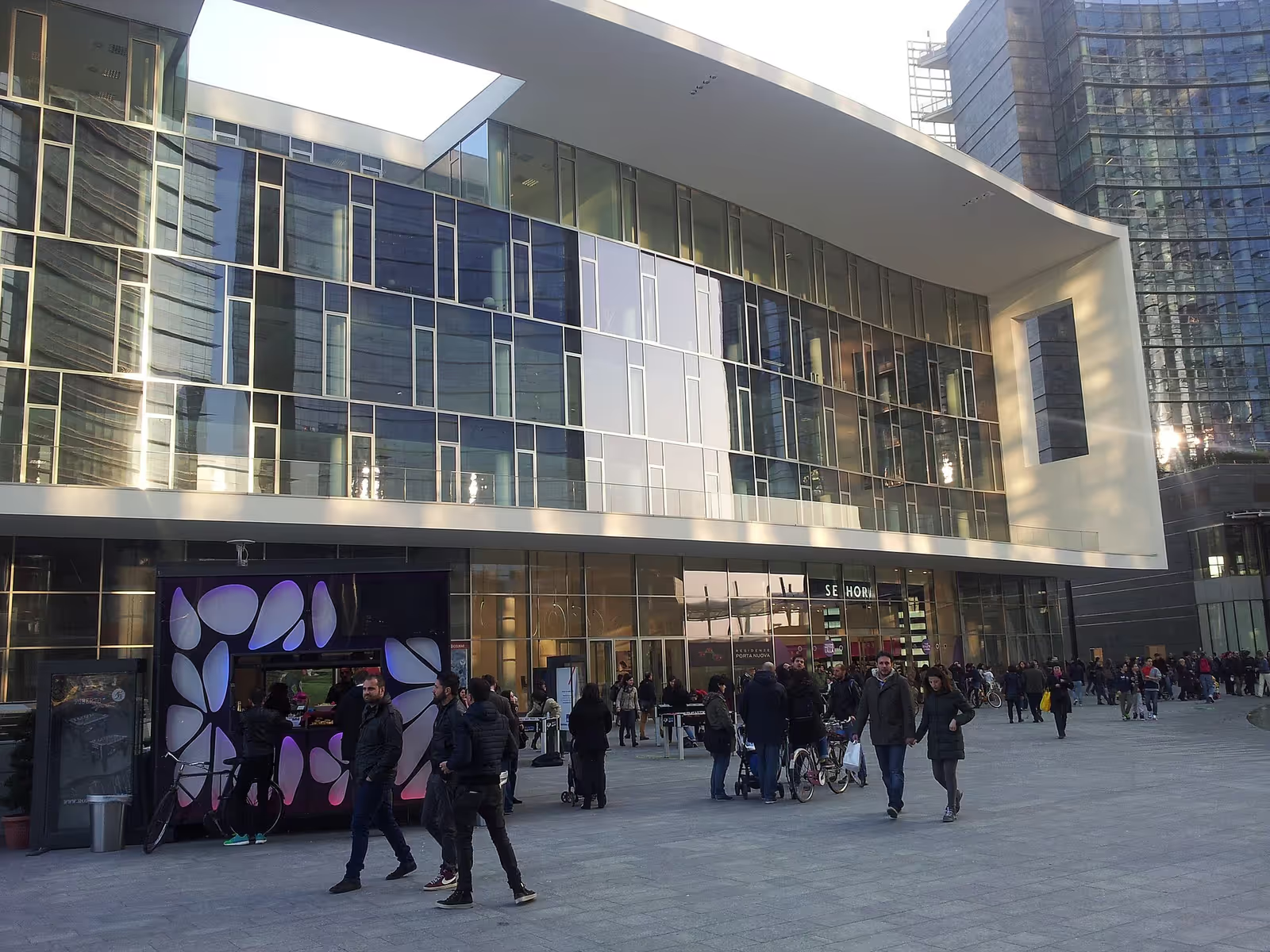
Photo: DaveM93, CC BY-SA 3.0, Wikimedia Commons.
On 11 June 2026, for the DigIT Export Day, Assolombarda published results of a Promos Italia survey on how companies in the provinces of Milan, Monza Brianza and Lodi use digital tools for export. The event had the support of the Camera di commercio Milano Monza Brianza Lodi and its Punto Impresa Digitale. The sample was small, 47 companies that export or plan to, surveyed in May 2026, so I read the figures as a signal rather than a census:
The last figure is the one that matters for a developer. A site that exists in three languages but loads slowly, has broken hreflang or ships the English menu on the German pages loses the visitors that the translation was meant to win. The fix is rarely a new design. It is usually structure: one content model, clear language URLs, translated slugs, menus and forms per language, and an editor workflow that shows which pages are missing a translation.
This is also where working in English with a Polish developer is less strange than it sounds. When a Milan company writes to buyers in Germany, Spain or the UK, the English version is often the reference text that the other languages are checked against. I work from that version, and you or your translators supply each other language.
Performance targets are the official Core Web Vitals thresholds, LCP up to 2.5 s, INP up to 200 ms and CLS up to 0.1, as defined on web.dev. I check them on the templates you name, before release.
The Italian legal basis for cookies is article 122 of the Codice in materia di protezione dei dati personali (D.Lgs. 196/2003), which allows storing or reading information on a user’s device only with consent, except for technical purposes. How that works on a real site is set out in the Garante guidelines on cookies and other tracking tools, adopted on 10 June 2021 and published in the Gazzetta Ufficiale no. 163 of 9 July 2021. Several of its points translate directly into code:
In practice, the work on my side is: a consent tool configured to block marketing and analytics scripts until the visitor agrees, embeds (maps, videos, fonts from third-party hosts) held back or replaced by a click-to-load placeholder, a consent record that survives the 6-month rule, and a staging test where I check in the browser which requests fire before and after the click. The wording of the banner and the cookie policy comes from you or your adviser. I do not give legal advice; I make the site behave as your policy says.
Italian law also asks a website to say who runs it. Article 7 of D.Lgs. 70/2003, which implements the EU e-commerce directive 2000/31/EC, lists the general information a provider of information society services must make available:
On many older sites this information sits on one “Chi siamo” page, or in a footer that one template forgot. I put it in a single place in the WordPress settings, render it in the footer of every template and every language version, and add it to the acceptance list so a later theme change cannot drop it.
If you want someone to keep the site updated after launch, the WordPress maintenance page for Milan describes that part.
You can run this against your current site whether or not you hire me.
| Question | What a good answer looks like |
|---|---|
| Does closing the banner with the X load any tracker? | No, checked in the browser network panel |
| Does scrolling count as consent? | No |
| Are all choices in the granular area off by default? | Yes |
| Is the analytics IP masked, or does analytics wait for consent? | One of the two, documented |
| Are REA number, partita IVA, registered office and email in the footer? | Yes, on every language version |
| Does each language have its own URL and hreflang? | Yes, and the alternates point at each other |
| Who can edit the Italian and English texts without a developer? | A named person |
| Is there a staging copy for testing changes? | Yes |
No. I am Polish and I work in English. The Italian copy, the privacy policy and the cookie policy come from you, your team or your translator or lawyer. I build the site so those texts can be entered, reviewed and updated by your editors.
No. I work remotely from Gdynia in Poland and everything runs in writing: brief, questions, scope, staging links and acceptance. Access to the site, the hosting and the layout is what I need.
Under the guidelines of 10 June 2021, closing the banner with the X keeps the default settings, scrolling is never consent on its own, a cookie wall is unlawful unless an equivalent alternative exists, and the banner should not come back for at least 6 months unless something material changes. I implement that behaviour and check it on staging.
Article 7 of D.Lgs. 70/2003 lists them: name or company name, registered office, contact details including email, REA or company register number, partita IVA where the activity is taxable, and more for regulated professions or licensed activities. You supply the data, I place it where it is easy to find on every page.
Yes. I set up a multilingual structure with separate URLs, hreflang and menus per language. Each language version needs its own reviewed text from you, not machine output pasted in.
Yes. I start with an inventory of the theme, plugins, PHP version, hosting and backups, then send a written list of what to fix before new work begins.
Send me your site address if you have one, what the site should do for your business, your deadline, and what you know about the current stack and hosting. If you already have a layout or a list of languages, attach it. I read everything, reply with my questions in writing and then send a written estimate with scope and assumptions. The first estimate is free. The contact page has the form, and an overview of the service is on the WordPress developer page.
Examples of my work.
surfuje.pl is a website for surfers and watersports enthusiasts, with clear content, simple publishing, and stable technical operation.
zamki-szkocji.com is a comprehensive information portal dedicated to the castles of Scotland, combining rich historical content, interactive maps, photo gall...
scalac.io is an international platform founded in 2014 to meet the challenges associated with big data management and business operations scaling, specializing in Scala, distributed systems, and cryptography solutions.
Describe your project by e-mail. I reply within 48 hours.
Describe your projectWordPress 4.9 was "the calm before the storm." We analyze this pivotal moment in WP history that prepared the ground for the block editor. What changed since? How did the ecosystem evolve?
Compare the best WordPress plugins in 2026 for security, SEO, cache, backups, and image optimisation, with practical advice on what to install and what to avoid.
Gutenberg blocks, synced patterns, full site editing, custom templates, and block plugins for teams that want a cleaner WordPress editing system.
CrUX field-data audit with per-template LCP, INP, CLS attribution.
Core Web Vitals, caching, and faster delivery.
A free check of your site's public version, results on screen.
Stability, updates, and post-launch support.
Updates checked before release, with a report.
Migration to Astro, Next.js, and headless WordPress.
Audit, hardening, and incident risk reduction.

How to optimize Interaction to Next Paint (INP) on WordPress sites. Practical fixes for the newest Core Web Vital metric that directly impacts Google rankings.
Field versus lab, LCP, INP and CLS for WordPress in 2026. Google's green LCP is still 2.5 s in CrUX. 100/100 in Lighthouse is a lab target. Edge HTML, consent banners, checkout widgets.

How we took a slow WooCommerce site from score 45 to 100. A technical deep dive into Speculation Rules, AVIF, and Critical CSS in 2026.