WordPress for GDPR and KSeF audits in Warsaw
You need a WordPress that survives an external GDPR audit on the first pass, every plugin mapped against Article 32 risk, and a cookie banner that holds up under UODO (Polish DPA) review. We deliver that bundle: audit-ready WordPress, documented technical and organisational measures, mandatory KSeF readiness from February 2026, and an integration that does not collapse on the first invoice sent to the Polish national e-invoice system. The Warsaw rulebook covers GDPR Article 32, obligations from the Polish KSC Act (Krajowy System Cyberbezpieczeństwa), the NIS2 transposition, and KSeF requirements for VAT taxpayers.
| Regulation | What it covers | What we do |
|---|---|---|
| GDPR Article 32 | Technical and organisational data protection measures | Hardened WAF, encrypted off-site backups, 2FA on wp-admin, records of processing activities (RoPA) |
| KSeF (mandatory for VAT from 2026-02-01) | Compulsory e-invoicing integration | KSeF API keys outside web root, integration audit, fallback gateway |
| KSC Act (NIS2 transposition) | Obligations for essential and important entities | Dependency SBOM, vulnerability monitoring, documented incident response plan |
WordPress developer in Warsaw
Partner with an experienced WordPress developer who can help with customization projects and provide practical support for problems with existing WordPress projects. We operate in Warsaw and Mazowieckie Voivodeship, as well as throughout Poland and around the world.
WordPress developer vs page-builder studio
Most WordPress work in Warsaw, as everywhere, is not development. It is assembly: a licensed theme, a page builder, a stack of plugins to paper over the gaps, and a designer arranging it all inside the browser. For a brochure site that is often the right answer, and a good WordPress developer will tell you so rather than sell you a build you do not need. The line gets crossed the moment your requirements stop fitting inside a visual editor: a content model that a page builder cannot express, a WooCommerce checkout that has to talk to KSeF and Przelewy24, a page that has to load fast under real traffic, or simply code a second developer can open in a year and understand.
That is where a senior WordPress developer earns the title. The work is writing code rather than clicking through settings: custom themes and plugins built to a standard, a data model designed on purpose instead of accreted from whatever plugin was installed that week, integrations that hold up when the third-party API changes, and a review trail so nothing ships that only one person understands. The output is not prettier admin screens. It is a system your team can operate, extend and hand to the next developer without a rescue project.
What does a WordPress developer do?
Website Development
Custom WordPress websites tailored to your business needs, from corporate sites to complex portals.
WooCommerce Stores
Professional e-commerce solutions with payment integration, inventory management, and scalable architecture.
Plugin Development
Custom plugins to extend WordPress functionality and integrate with third-party services.
Theme Customization
Modifying existing themes or building custom themes from scratch based on your design.
A WordPress developer is responsible for:
- Installation and configuration of WordPress and related software
- Creating and developing plugins and custom themes
- Performance optimization to ensure fast loading times
- Security hardening to protect against threats
- Collaboration with designers and other specialists to deliver the best solutions
Custom themes and plugins built to WordPress Coding Standards
A custom theme is not a licensed theme with the colours changed. It is a code base authored for your content, and on a new build the sensible default now is a block theme built on the editor APIs: theme.json for the design system, block patterns for the reusable layouts your editors actually use, and block variations where a pattern needs options. The reward is an editing experience that fits how your team writes, without a page builder loaded on every request to make it work.
The theme-versus-plugin boundary is where a lot of inherited Warsaw projects have gone wrong, particularly on sites that were localised in a hurry. The rule is plain: if a feature is functional rather than presentational, it belongs in a plugin so it survives a theme switch. Custom post types that outlive the design, REST endpoints, integration logic, admin tools, the invoicing bridge that talks to your accounting system, all of it lives in a plugin with its own version history. Themes describe presentation and editorial structure and nothing more. When that boundary is respected, a redesign is a redesign; when it is ignored, a redesign becomes a data-recovery exercise because the last agency buried a custom post type and a Przelewy24 callback inside functions.php.
WordPress Coding Standards are not a badge, they are what makes a second developer productive on day one, and they matter more when the team is distributed across cities. Consistent formatting, proper escaping and sanitisation on every input and output, nonce verification on forms, internationalised strings so the same code base can serve Polish and English, and PHP that a linter can check in the pipeline. On top of that sits the practice that separates development from assembly: code review on every branch, an architecture decision record for the non-obvious choices, and small reviewable changes with preview links rather than a single monolithic drop at the end. None of this is glamorous. All of it is the difference between a code base you own and one you are hostage to.
WordPress development services in Warsaw
Warsaw’s business landscape demands professional digital presence. Our WordPress development services address needs of businesses across the Mazovia region and throughout Poland.
Corporate website development
Corporate websites require professional presentation and reliable functionality. We create custom WordPress sites reflecting brand identity and supporting business objectives. From simple brochure sites to complex corporate portals, our development addresses diverse requirements.
Design implementation transforms visual concepts into functional websites. Responsive layouts ensure consistent experiences across devices. Performance optimization improves user experience and search rankings.
Content management systems enable efficient ongoing updates. Training and documentation let teams to manage content independently. Maintenance support ensures long-term reliability.
WooCommerce for Polish and cross-border commerce
Warsaw has one of Central Europe’s densest e-commerce scenes, and a Polish WooCommerce store carries requirements a generic international build simply ignores. KSeF, the national e-invoicing system, is the clearest example: structured invoices have to be generated in the correct XML shape and exchanged with the government platform, and a shop that treats invoicing as an afterthought discovers the gap the hard way at go-live. Omnibus is the second. When you show a promotional price, the law requires displaying the lowest price from the prior thirty days, and getting that right in WooCommerce is a data and display problem, not a checkbox.
Cross-border is the other half of the Warsaw commerce story, because so many stores built here sell outward. That brings OSS VAT registration and the rate logic that follows, multi-currency and multi-language storefronts, and shipping rules that behave one way inside Poland and another across the EU border. The engineering discipline is the same as anywhere: correct code against real systems, a checkout that stays fast under a campaign spike, and a data model that keeps orders and invoices consistent through a Black Friday surge. Where the shop side of an engagement grows large enough to stand on its own, the WooCommerce developer service covers it in full.
B2B e-commerce features support wholesale operations. Customer-specific pricing rewards loyalty. Quote systems handle complex negotiations. Account management simplifies business relationships.
Maintenance and support
Ongoing maintenance keeps WordPress sites secure and performant. Regular updates address security vulnerabilities. Performance monitoring identifies optimization opportunities.
Technical support resolves issues quickly. Emergency response handles urgent problems. Proactive maintenance prevents issues before they affect users.
Warsaw business community
Warsaw hosts diverse businesses requiring professional web presence.
Small business websites
Small businesses benefit from professional WordPress websites. Local services, restaurants, and retail stores reach customers through effective digital presence. Simple content management enables regular updates.
E-commerce capabilities expand market reach beyond physical location. Mobile-friendly designs accommodate customer browsing habits. Local SEO improves visibility in Warsaw searches.
Startup companies
Warsaw’s startup ecosystem requires modern digital presence. WordPress provides flexible platforms for emerging businesses. Rapid development supports quick market entry.
Scalable architecture accommodates growth. Custom functionality addresses unique business models. Integration capabilities connect with emerging platforms.
Enterprise organizations
Large organizations require sophisticated WordPress implementations. Multisite networks manage multiple properties efficiently. Enterprise integrations connect with internal systems.
Security and compliance meet corporate requirements. Performance optimization handles high traffic volumes. Global delivery serves international audiences.
Development process
Our development methodology ensures successful project outcomes.
Discovery and planning
Projects begin with thorough discovery. We analyze requirements, study target audiences, and define project scope. This phase establishes clear expectations and success criteria.
User research informs design decisions. Competitor analysis reveals market positioning. Technical requirements get documented comprehensively.
Design and development
Visual design translates brand identity into digital experiences. Prototype development enables stakeholder review. Iterative refinement improves designs based on feedback.
Clean code development follows WordPress best practices. Version control tracks all changes. Testing verifies functionality across devices and browsers.
Launch and support
Deployment processes minimize disruption. Staged rollouts enable quick rollback if needed. Performance monitoring ensures smooth operation.
Post-launch support addresses issues promptly. Training equips teams for ongoing management. Maintenance packages keep sites secure and current.
Why hire a WordPress developer in Warsaw?
Most cities in Poland have WordPress freelancers. Warsaw has a different problem: the briefs are bigger, the compliance asks are heavier, and the people on the client side already know what a webhook is.
A typical week here looks nothing like a typical week in Tricity or Kraków. Monday morning is a kickoff with someone from a fintech around Rondo Daszyńskiego who needs a marketing site that won’t get flagged by their parent bank’s IT security review. Wednesday is debugging why a WooCommerce store on a shared host keeps timing out on Przelewy24 callback URLs. Friday is rewriting an Allegro REST integration because the merchant’s offers feed broke after the API v2 migration.
What that means for the brief: I assume the legal team will read the cookie banner, that the procurement team will demand a DPA before signing, and that someone, somewhere, will ask about ISO 27001 alignment. The site has to ship clean on the first review, not on the third.
The other part Warsaw teaches you is patience with internal stakeholders. A campaign microsite for Santander or mFinanse goes through brand, legal, compliance, and the agency-of-record before a single pixel ships. The work isn’t building the site. The work is keeping the site shippable while four parallel tracks of feedback land in the repo.
Working hours that overlap with your Warsaw team
We work from the Gdynia area on Central European Time, so a question raised at 09:00 in Warsaw gets an answer before lunch rather than overnight. If a build is already mid-flight and the review rounds keep stacking up, send the current state of the site and the date it has to be live. You get an honest read on what fits that window and what should wait for a second release. Pricing is quoted individually.
Send project detailsTechnology stack
Modern WordPress development uses current technologies.
Frontend technologies
Responsive design ensures mobile-friendly experiences. Modern CSS creates engaging interfaces. JavaScript adds interactivity and user experience improvements.
Performance optimization techniques include lazy loading, code splitting, and CDN distribution. Core Web Vitals optimization improves both user experience and search rankings.
Backend development
PHP development follows WordPress coding standards. Custom post types and taxonomies structure content. Plugin development adds unique functionality.
Database optimization improves query performance. API development enables external integrations. Security best practices protect against threats.
Get started
Ready to work with a WordPress developer in Warsaw? Contact us to discuss your project. We’ll provide detailed proposals outlining approach, timeline, and investment.
Our experience with Warsaw businesses ensures we understand local needs. Let’s build your professional WordPress presence together.
Service areas
Our WordPress development services extend throughout the Mazovia region.
Central Warsaw
We serve businesses throughout central Warsaw. Downtown offices, retail locations, and service providers benefit from our WordPress expertise. Professional websites support business objectives across all industries.
Suburban areas
Warsaw suburban communities include many businesses needing professional web presence. Local SEO helps attract nearby customers. Mobile-friendly designs accommodate on-the-go browsing.
Broader Mazovia
Beyond Warsaw, the Mazovia region includes numerous businesses. Cities like Radom, Płock, and Siedlce benefit from our WordPress services. Remote collaboration enables efficient project execution regardless of location.
Quality assurance
Our development prioritizes quality throughout.
Testing practices
Comprehensive testing verifies all functionality. Device and browser testing ensures consistent experiences. Performance testing validates optimization.
Security testing identifies vulnerabilities. Accessibility testing ensures inclusive design. User testing improves experiences.
Documentation
Code documentation enables future maintenance. User guides support content management. Training sessions transfer knowledge.
Communication
Regular updates keep stakeholders informed. Prompt responses address questions quickly. Clear documentation preserves project knowledge.
Long-term partnerships
We build lasting relationships with clients.
Ongoing support
Maintenance packages keep sites secure and performant. Regular updates address security vulnerabilities. Performance optimization maintains fast loading times.
Support agreements provide reliable assistance. Priority response ensures quick issue resolution. Proactive monitoring identifies problems early.
Growth collaboration
As businesses grow, websites evolve accordingly. Additional features expand functionality. Performance upgrades handle increased traffic.
Strategic guidance helps plan digital development. Technical expertise informs technology decisions. Partnership approach supports long-term success.
Contact today
Begin your WordPress project with a Warsaw developer. Contact us to discuss your needs. We’ll develop solutions addressing your specific requirements.
Professional WordPress development builds your digital presence. Let’s work together to achieve your business goals.
Investment and pricing
Understanding project investment helps with planning.
Project pricing
Website project costs depend on scope and complexity. Simple business websites require modest investment. Complex e-commerce stores require larger budgets. Custom functionality affects pricing significantly.
Fixed pricing provides budget certainty. Clear deliverables and timelines help plan effectively. Payment schedules align with project milestones.
Hourly development
Hourly rates apply to ongoing work and undefined scope projects. Development, troubleshooting, and optimization use hourly billing. Time tracking ensures transparent reporting.
Retainer options
Monthly retainers provide predictable costs for ongoing needs. Pre-allocated hours cover maintenance, development, and support. Priority scheduling ensures timely attention.
Retainers suit agencies and businesses with continuous WordPress needs. Relationship depth improves efficiency over time. Predictable budgeting simplifies financial planning.
Payments, shipping and accounting in Polish WordPress projects
The technology debate in this market is not “which CMS”. It’s almost always “where does this site need to interoperate, and which integrations have to keep working in three years”.
BLIK, Przelewy24 and Tpay in WooCommerce
Every Polish e-commerce brief in 2026 starts with BLIK. Przelewy24 covers most merchants because it bundles BLIK, bank transfers, and cards in one contract; Tpay is the alternative for merchants whose accountant or bank already has a relationship there. Stripe shows up only when there’s foreign volume worth the higher fees. PayU still exists, mostly on legacy integrations that nobody wants to touch.
InPost Paczkomaty and other carriers in WooCommerce
InPost lockers are the default expectation in Poland now. If the checkout doesn’t show a Paczkomat picker, customers leave. Behind that: DHL and DPD for parcels above 25kg or oversized, Pocztex for SME shippers who want lower rates, and Apaczka or Sendit as the broker layer that manages all label generation in one place. We integrate via the broker, not direct to each carrier, because rate cards change quarterly and nobody wants to maintain four separate carrier plugins.
JPK_VAT and accounting software integrations
Polish merchants need exports their accountant can use. That means JPK_VAT compatibility, an invoice format that matches what Comarch Optima or Wapro Mag expects, and a way to push transactions to inFakt or Fakturownia automatically. ZUS and US filings are out of scope for the website itself, but the data has to leave WordPress in a shape the accounting tool can read without manual cleanup.
Performance engineering for high-traffic WordPress
Editorial and commerce WordPress fails in a specific way: it is fine in the demo and falls over when a campaign lands or a story spikes. The cause is almost never the thing people reach for first. It is rarely the theme’s CSS. It is uncached database queries multiplying under load, a plugin stack that autoloads on every request whether the page needs it or not, and an options table that has quietly grown to megabytes of autoloaded junk that every single page view has to read.
Performance engineering on WordPress starts with a profiler, not an opinion. Query Monitor and server-side timing show which queries run, how many, and how long they take, and the first pass is usually about deleting work rather than adding cache: a plugin that runs a query on every request to render something used on one page, a meta query with no index behind it, an autoloaded option that should never have been autoloaded. Once the query count is honest, object caching earns its place, and a page cache in front of anonymous traffic absorbs the spike that a promotion or a viral post creates. On a WooCommerce store the cart and checkout are dynamic and cannot be cached whole, so the work shifts to keeping those paths lean while everything around them is served fast. The last step is a performance budget written into the project so the next editor who installs a plugin does not silently undo the work, measured against real user field data rather than a single flattering lab run.
Security and compliance in WordPress code
The table at the top of this page lists what the Polish rulebook requires. This is what it looks like in the code base. Security is concrete and unglamorous: disciplined escaping and sanitisation on every input and output, nonce verification on forms, hardened configuration, least-privilege database and file permissions, dependencies kept current through Composer, and code a reviewer can actually read rather than a plugin pile nobody has looked inside.
GDPR shapes what personal data a plugin stores, how consent is captured on forms and analytics, and how export and erasure requests are served without a manual database dig. For companies pulled into scope by the KSC Act, the practical layer is patch discipline, logging, access control and a documented update path, and we build those into the handover rather than leave them as a policy document that nobody implemented. The point is not to sell fear. It is that a site put together as assembly cannot pass this bar, and one written as engineering can.
When does headless WordPress make sense?
Headless WordPress, keeping WordPress as the editorial back end while a separate front end renders the site, is genuinely the right answer for a slice of projects: an app-like interface, a design system shared with a native application, a publishing operation that wants a static front end sitting in front of a busy editorial back end, or a marketing site that needs sub-second LCP for international audiences. When one of those requirements is real, the work is worth doing and we do it, and where a static rebuild is the honest fix for a heavy front end rather than a slow origin, that is the Next.js and Astro migration path, with the broader headless WordPress service covering the architecture in full.
It becomes scope creep when it is chosen for a content site that a well-built block theme would serve at a fraction of the cost and half the ongoing maintenance surface. Headless doubles the number of moving parts, the number of deployments, and the number of things that can break at the seam between the CMS and the front end. For everything outside those cases, classic WordPress with a serious caching layer (LiteSpeed, WP Rocket, or Cloudflare Page Rules) ships faster and costs less to maintain. The recommendation is almost always to sequence: get the WordPress build right first, prove it against real numbers, and only reach for headless when a specific requirement is paying for the extra complexity. Many projects that arrive convinced they need headless, often because a React team elsewhere in the company prefers it, discover they needed a competent block theme and a performance pass.
Competitive advantages
Professional WordPress development provides competitive benefits.
Speed to market
WordPress enables rapid website deployment. Pre-built themes and plugins accelerate development. Customization extends base functionality efficiently.
Quick launches capture market opportunities. Iterative development adds features over time. Agile approaches accommodate changing requirements.
Cost efficiency
WordPress reduces development costs significantly. No license fees for the core platform. Extensive free and premium plugin ecosystem. Open-source nature keeps costs manageable.
Maintenance costs remain predictable. Regular updates address security and performance. Community support provides assistance when needed.
Scalability
WordPress scales from small sites to enterprise deployments. Multisite networks manage multiple properties. Caching and CDN distribution handle high traffic.
Growth happens without platform changes. Custom development addresses specific needs. Architecture supports business expansion.
What Warsaw companies need from a WordPress developer
The mix of work in the capital skews toward fintech, e-commerce, and B2B SaaS. The sectors below are the ones that show up in the inbox most weeks.
Fintech and banking
Marketing sites, calculators, and lead-capture funnels for companies that sell into mBank, Santander Bank Polska, ING, or PKO BP, plus the loan brokers and comparison sites that live downstream of them. The work is rarely the WordPress part. The work is making sure the consent stack (CookieYes or a custom one) defends against an IOD audit, that the GA4 setup respects the bank’s data-residency rules, and that any iframe or pixel from a partner has a documented purpose in the RODO register.
I also build a lot of one-off landing pages for product launches: a new credit card variant, a leasing campaign, a Santander Open partnership announcement. These sites live three to six months, then archive.
Allegro and WooCommerce merchants
Warsaw has the highest concentration of mid-size Allegro merchants in Poland, and many of them outgrow the Allegro-only model and want their own store. The migration brief is always the same: pull the offers feed via the Allegro REST API, sync inventory both ways, plug in BLIK and Przelewy24 (or Tpay for merchants whose accountant prefers it), and wire up Paczkomaty InPost plus DHL and DPD shipping labels through Apaczka or Sendit.
The unglamorous part is mapping legacy SKUs from the Allegro account to WooCommerce product IDs without breaking historical reporting. That’s where projects either ship clean or spend three weeks in reconciliation.
Food-tech and quick-commerce
Sezamo-style grocery operators, ghost kitchens around Wola, and Glovo or Bolt Food merchants who want a branded ordering site instead of paying 25% per order forever. The pattern: WooCommerce + delivery slot picker + a dispatcher view that prints to a kitchen printer over LAN. Always with a postal-code allowlist so customers in Pruszków don’t order at 9pm when no courier is rostered.
Professional services and consulting
Law firms around plac Trzech Krzyży, the Big Four advisory teams, boutique M&A shops, and the international consulting outposts (Roland Berger, Oliver Wyman). The brief is conservative: Polish and English versions, partner bios, sector pages, news, and a careers section that integrates with eRecruiter or Traffit. Performance matters because the procurement team running the RFP will paste the URL into PageSpeed Insights before reading the proposal.
Example WordPress projects in Warsaw
Names and figures are withheld, but each shape recurs every quarter for a different Warsaw client, which is why it is worth describing.
Allegro merchant migrating to a standalone store
Mid-size electronics seller, around 4,000 SKUs, Mokotów warehouse. They were paying Allegro prowizja on every order and wanted a direct channel. We built the store on WooCommerce with a custom sync layer to the Allegro REST API so the offers feed stayed authoritative for stock levels, but pricing could diverge between the two channels. Checkout: BLIK + Przelewy24 + card via Stripe for foreign buyers. Shipping: Paczkomaty InPost as default, DHL and DPD as fallbacks via Apaczka. The reconciliation pain was JPK_VAT: the accountant needed a single export that merged both channels, so we wrote a custom reporting endpoint that the accountant could pull weekly without opening the admin.
Banking campaign microsite under a tight legal review window
Three-month microsite for a credit-card promotion run by an agency for one of the four big retail banks in Warsaw. The brief was nine days of build, four days of legal review, two days of UAT. The hard part wasn’t the site, it was the cookie and pixel governance: every analytics tag, every retargeting pixel, every partner iframe needed a row in the bank’s processing register before the IOD would sign off. We shipped a custom consent layer that surfaced each vendor by name, version, and processing purpose, which is what the legal team actually wanted instead of a generic Cookiebot dropdown.
Multilingual headless build for a B2B SaaS expanding into DACH
WordPress as the content backend, Astro on the front, Cloudflare in front of both. Polish, English, German content in parallel, with WPML on the WP side and content sync to the Astro build via a webhook that triggers a redeploy when an editor publishes. The reason this client picked headless wasn’t fashion: their AE team in Berlin had complained that the marketing site loaded slower than their actual product, which lost them deals. Moving to a static frontend dropped the largest contentful paint from 3.4s to under 1s on a German 4G connection, which we measured with Calibre because PageSpeed Insights from Warsaw doesn’t tell you anything useful about DACH performance.
Cross-border WooCommerce store with too many plugins
A Warsaw retailer selling into Germany and the Nordics had built a WooCommerce shop by stacking one plugin per requirement: one for InPost, one for Przelewy24, two for VAT, another for multi-currency, and a promotions plugin that never quite matched the Omnibus rule. The checkout took most of a second to render and the invoice numbering drifted under load. The work was subtraction and correction: a single purpose-built integration layer for payments and fulfilment, a proper OSS VAT model, KSeF invoicing generated correctly rather than bolted on, and the redundant plugins removed. This is the most common rescue shape in cross-border WooCommerce, and it almost always starts as an audit rather than a rebuild.
White-label WordPress build for an agency
A Western European agency wins a WordPress project with a bespoke content model and a deadline its in-house team cannot meet. We work white-label inside their repository and their process: their staging, their client-facing project manager, our plugin and theme code, reviewed on their branches, with daily overlap because Central European Time covers their whole working day. The client never meets a second team, the commit history belongs to the agency, and the handover is written so their developers own it afterwards. That is the shape of most nearshore overflow work: senior capacity when a good agency lands a build slightly bigger than its bench.
WordPress nearshoring in Warsaw
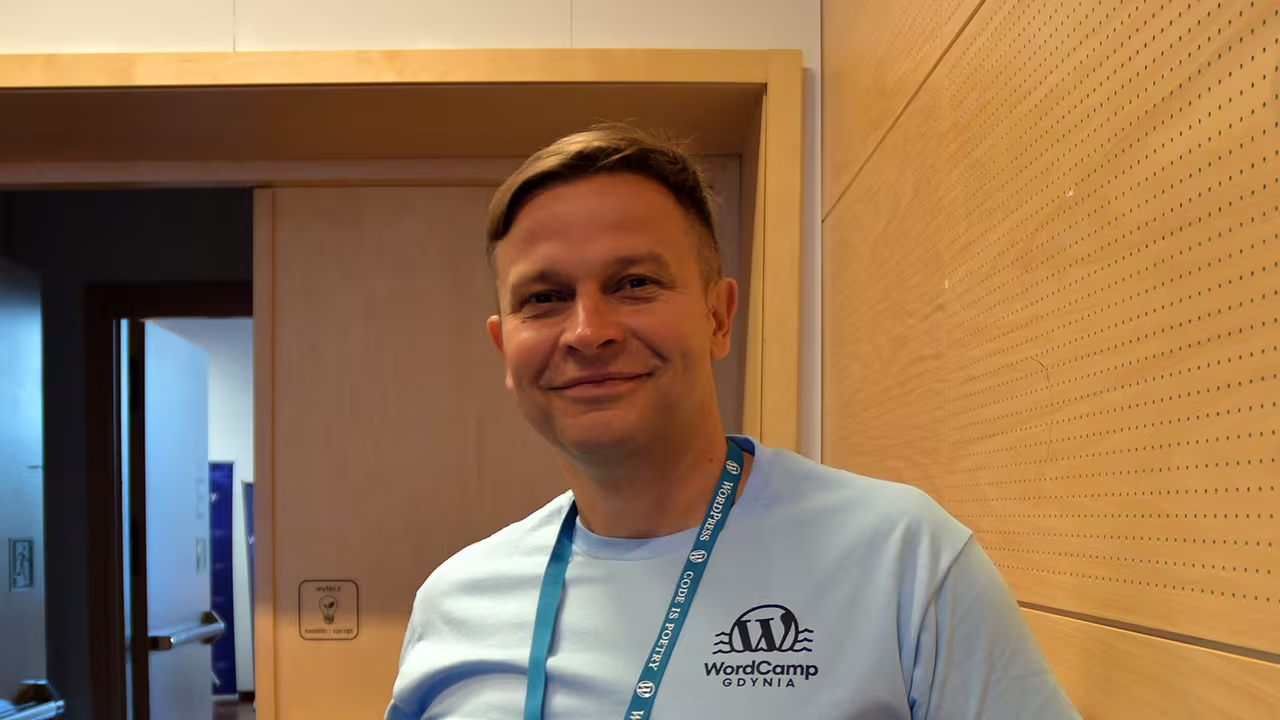
Warsaw is the centre of gravity for Polish technology. It concentrates the country’s fintech and SaaS companies, a strong gamedev sector, and a mature e-commerce industry, and it hosts an active WordPress community around WordCamp events in the capital and local meetups that has trained a generation of developers who work fluently in English. That mix shapes the WordPress work in two directions at once.
Outward, Warsaw is one of Europe’s established nearshore hubs. Western European and US companies come here for senior engineering at a workable distance and inside a shared time zone, and WordPress travels especially well remotely because the artefact is a reviewable pull request, not a presence in a meeting room. Inward, Warsaw’s own companies increasingly want their WordPress properties held to the same standard as the rest of their stack: regulated businesses that need a security posture and audit trail their compliance team can sign off, SaaS companies that treat the marketing site as a product surface, and e-commerce operators running cross-border WooCommerce where performance and correct invoicing decide whether a campaign day is routine or an incident.
How a nearshore engagement works
We work with Warsaw companies and, in English, with Western European and US clients, both directly and as white-label overflow for agencies. The mechanics are unremarkable, which is the point: standard B2B contracts, cross-border invoicing as a Polish company inside the EU single market with reverse-charge VAT handled the normal way, and everything shipped through version-controlled pipelines you can inspect.
The way in is deliberately small: a codebase audit and a written scope that separates real requirements from the wish list, followed by staged delivery where the first reviewed branch is also the first point at which you can judge the work and decide how much further to go. Pricing is individual and tied to the scope the audit justifies, not to your company size or location. The exit is built in from the start, with living documentation and a handover session, so whether the project moves to your own developers, stays with an agency, or continues on an optional maintenance retainer, you own the result rather than depending on us to read our own code.
When you do not need a dedicated WordPress developer
The section most agency pages leave out. If your site is a handful of pages, your content changes rarely, and you have no integrations or performance pressure, you do not need a dedicated WordPress developer and hiring one is money spent on capability you will never use. A reputable theme, a small number of well-chosen plugins and a designer who keeps it tidy will serve you, and a good developer will point you there rather than invent a build. The same applies when your real problem is content or marketing rather than code: no amount of custom development fixes a site that nobody visits.
There is a second, quieter case for declining. Custom code is a commitment, because a bespoke plugin needs an owner and a maintenance path. If a project cannot fund its own upkeep, an orphaned custom plugin that nobody understands is worse than the off-the-shelf one it replaced. The honest trigger for dedicated development is a genuine mismatch between what you need and what assembly can deliver: a content model that does not fit, a WooCommerce integration with KSeF or Przelewy24 that has to be built correctly, a performance target a builder cannot reach, a multisite or membership system that has to stay correct under load, or an inherited code base that needs rescuing. Where none of those is present, the recommendation is to save the budget.
Get in touch
Ready to start your WordPress project? Contact us today for a consultation. We’ll discuss your needs and develop solutions.
Warsaw businesses trust our WordPress expertise. Let’s build your digital success together.
Partnership approach
We build lasting relationships with clients through professional collaboration.
Project communication
Clear communication ensures successful projects. Regular updates keep stakeholders informed. Prompt responses address questions and concerns. Documentation preserves project knowledge.
Professional correspondence maintains productive relationships. Clear expectations prevent misunderstandings. Honesty builds trust over time.
Flexibility
Projects evolve through development. Requirements change, priorities shift, and opportunities emerge. Flexible approaches accommodate these changes. Agile methodologies adapt efficiently.
Change management handles scope adjustments professionally. Change orders address additional work fairly. Communication prevents surprises.
Quality focus
Quality underlies all our work. Code follows WordPress standards. Testing verifies functionality. Performance optimization improves user experience.
Security protects sites and users. Accessibility ensures inclusive design. Documentation enables future maintenance.
Summary
Professional WordPress development delivers lasting value. Quality websites support business objectives for years. Ongoing maintenance ensures continued success.
Warsaw businesses deserve professional digital presence. Our expertise delivers results. Contact us to begin your project today.
WordPress development in other Polish cities
Nearshore clients often compare Warsaw with other Polish delivery hubs before choosing a team. See also WordPress developer in Krakow, WordPress developer in Gdansk, WordPress developer in Poznan, WordPress developer in Wroclaw and WordPress developer in Lodz.