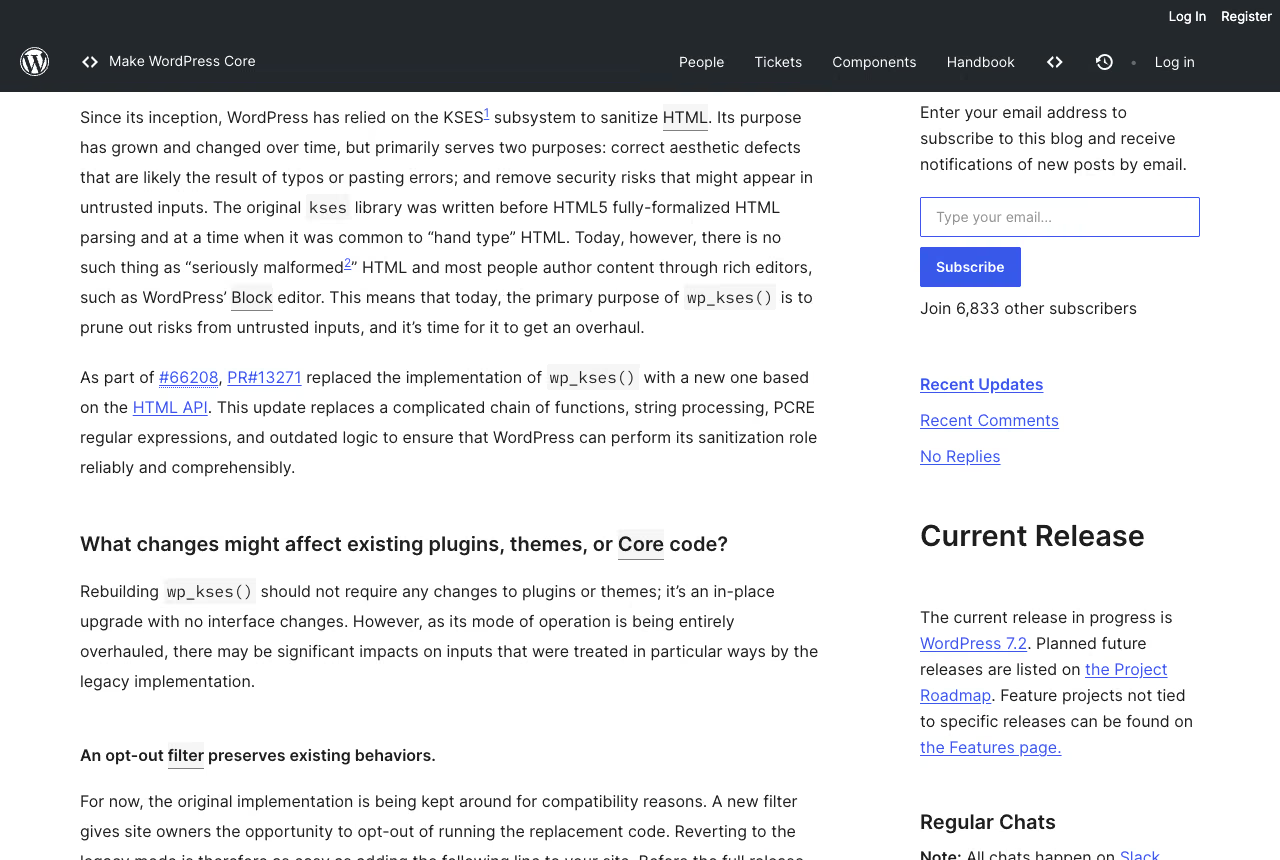
wp_kses() is the function behind wp_kses_post(), comment sanitizing, widget text and every wp_kses( $html, $allowed ) call in your plugin. In trunk it now runs on the WordPress HTML API instead of regular expressions. Dennis Snell’s progress report says it should land in WordPress 7.2 or 7.3, depending on what testing turns up. This post covers what changes in the output, how to find out which of your code cares, and what the temporary opt-out is for.
What exactly is changing in wp_kses()?
The old implementation tore markup apart with regular expressions. The new one reads it with the HTML API tokenizer, decides per tag and attribute what is allowed, and writes the result back out. The pull request that did this is titled “KSES: Reimplement with Tag Processor” (PR 13271), tracked in Trac 66208. Per the PR, the new code lives in a function named wp_sanitize_html_kses().
The progress report is explicit about the intent: do not make wp_kses() worse than it was. It also states that plugins and themes should not need changes. Both statements can be true and your tests can still go red, because “same safety” is not “same bytes”. Re-serialization is the whole point, and it changes strings.
Primary source: Progress Report: wp_kses(), published 7 October 2026.
Which inputs produce different output?
The report lists before and after pairs. The block below is modelled on them (my allowed-tags array, the report’s inputs). Run them on your own trunk build before you trust my transcription.
<?php
// Modelled on the examples in the Make Core progress report.
$allowed = array(
'a' => array( 'href' => true ),
'code' => true,
'img' => array( 'src' => true, 'class' => true ),
);
wp_kses( 'Click on my <script>alert(1)</script>!', $allowed );
// legacy: Click on my alert(1)!
// new: Click on my !
wp_kses( 'The <IMG class=bike class="boat" src=\'vehicle.png\' /> & the wheels…', $allowed );
// legacy: The <IMG class="bike" src="vehicle.png" /> & the wheels…
// new: The <img class="bike" src="vehicle.png"> & the wheels…
wp_kses( 'Add <code>/?preview=true§ion=grilling</code>.', $allowed );
// legacy: Add <code>/?preview=true&section=grilling</code>.
// new: Add <code>/?preview=true§ion=grilling</code>.
wp_kses( 'Click on the <butto', $allowed );
// legacy: Click on the <butto
// new: Click on the (trailing space, nothing else)The report groups the differences like this:
- Normalization. Tag names are lowercased, attributes are double-quoted, duplicate attributes collapse to the first, and character references are re-escaped.
- Stray angle brackets. Text such as
<$500or>5yoused to be swallowed. Now it is escaped as<and>, so the text survives. - Ambiguous ampersands. A named reference without a semicolon, such as
§ioninside a URL in a text node, is decoded the way a browser decodes it. That is how§ionturns into the section sign in the third case above. - Script and style. When these elements are not allowed, their contents are removed together with the tags. The old code left the contents behind as visible text.
- Incomplete trailing input. A truncated last tag is discarded, not escaped.
- Special elements. Tag-like text inside an allowed
<title>is escaped, while the same text inside a<div>is removed with the unknown tag. - SVG and MathML. Content that needs complex parsing makes the function stop and return only what came before that point. The report shows an
<li>with MathML containing a nested<span>being cut at that point. - Hard limits. Some malformed comments,
NOSCRIPTand confusable elements are now rejected. - Unbalanced tags. Preserved on purpose, because existing code depends on it.
Where to look first on a typical agency estate: WooCommerce product descriptions with spec text such as “<5 cm” pasted from a supplier sheet, imported supplier HTML with uppercase tags, and page-builder widgets that print inline SVG. That is a guess about where to look, not a measurement.
I could not confirm from the sources I read how <script> behaves when it is explicitly allowed in your array, so test that case yourself instead of assuming either result.
Does my custom allowed-html array still work?
Most arrays keep working, because the allow-list logic is the same: a tag or attribute is either in the array or not. What changes is what comes out around it. Three patterns deserve a look.
- Arrays that allow inline
scriptorstyle. A shortcode that prints an inline script and then passes the result throughwp_kses()withscriptallowed sits exactly in the area the report touches. Look at what the old output was, what the new output is, and whether the shortcode should print the script throughwp_add_inline_script()instead of through the sanitizer at all. - Arrays that allow
svgormath. Inline icon sets are the common case. If the report’s rule applies, output can be truncated at the first construct the parser cannot handle. Diff every icon you ship. - Arrays for
<title>and similar.<title>is a special element. Their contents are treated as text, which is where the escaped<sneaky>example comes from.
If your array only allows a, strong, em, img and a few attributes, the likely effect is cosmetic: <IMG ... /> becomes <img ...>.
What breaks in tests that compare sanitized HTML?
Anything that asserts an exact string. A test like the first assertion below passes today and may fail after the rewrite, even though the markup means the same thing. The second assertion survives normalization.
<?php
// Brittle: pins the exact string the sanitizer happens to emit.
$this->assertSame( '<a href="/x">Read</a>', wp_kses_post( "<A HREF='/x'>Read</A>" ) );

// Sturdier: asserts on what the markup means.
$p = new WP_HTML_Tag_Processor( wp_kses_post( "<A HREF='/x'>Read</A>" ) );
$this->assertTrue( $p->next_tag( 'a' ) );
$this->assertSame( '/x', $p->get_attribute( 'href' ) );
Pin behavior, not bytes. For fixtures that must stay string-exact, regenerate them once on trunk, read the diff as a human, and commit the new expected value together with a comment naming the version where it changed. A blanket “update snapshots” is how a real regression gets approved.
Visual and golden-file tests need the same treatment. Email templates that you sanitize before sending are a typical place where a stored string is compared against a fresh one.
How do I test on trunk without touching production?
Three routes, all on staging or locally. These are my suggestions, not part of the official report.
Beta Tester plugin. The WordPress Beta Tester plugin can move a staging site to the bleeding-edge nightlies and later to the 7.2 betas. According to the release schedule post, Beta 1 is on 20 October 2026. Whether the rewrite is in Beta 1 is not something I could confirm, so check for the wp_kses_force_legacy_parser filter in the code you actually installed.
WP-CLI nightly. On a disposable copy:
# Staging only, never production.
wp core update --version=nightly --force
wp core version
wp eval-file bin/kses-diff.php > kses-diff.txt
tail -n 1 kses-diff.txt
wp-env. Point the core at the trunk mirror and mount your plugin:
{
  "core": "WordPress/WordPress#master",
  "plugins": [ "." ]
}
Whatever route you pick, finish by confirming the filter exists, for example with grep -rn wp_kses_force_legacy_parser wp-includes/. If it is not there, you are not testing the rewrite.
How do I diff the sanitized output of real content?
Synthetic cases only find the bugs you already imagined. The useful test is your own database. The script below sanitizes every published post twice, once with the legacy parser forced and once without, and prints only the posts that differ.
<?php
// bin/kses-diff.php
// Run on a trunk build: wp eval-file bin/kses-diff.php > kses-diff.txt
$ids  = get_posts( array(
	'post_type'   => 'any',
	'post_status' => 'publish',
	'numberposts' => -1,
	'fields'      => 'ids',
) );
$diff = 0;

foreach ( $ids as $id ) {
	$raw = get_post_field( 'post_content', $id );

	add_filter( 'wp_kses_force_legacy_parser', '__return_true' );
	$old = wp_kses_post( $raw );
	remove_filter( 'wp_kses_force_legacy_parser', '__return_true' );

	$new = wp_kses_post( $raw );

	if ( $old !== $new ) {
		++$diff;
		printf( "== %d %s\n--- old\n%s\n+++ new\n%s\n", $id, get_permalink( $id ), $old, $new );
	}
}

printf( "%d of %d posts differ\n", $diff, count( $ids ) );
Run it where wp_kses_post() matters most: a copy of the production database, since real editors paste odd things. Read the first twenty diffs by hand. Expect a handful of recurring causes (self-closing tags, a stray < in a price, an inline SVG), and fixing a cause fixes many posts at once.
Widen the net with the same pattern: swap wp_kses_post() for the call your plugin makes with its own allowed array, and feed it option values, widget text and comment content, not only posts.
When should I use the legacy-parser opt-out?
The filter is wp_kses_force_legacy_parser. Returning true restores the legacy parser. The report describes it as a way for site owners to opt out of running the replacement code, and the word that matters is temporary.
<?php
// wp-content/mu-plugins/kses-legacy-parser.php
// Stopgap only. Delete it once your output diff is clean.
add_filter( 'wp_kses_force_legacy_parser', '__return_true' );
Use it in two situations. First, you found a regression on a client site during the testing window and need the site stable while you fix the code or report the bug. Second, a plugin you do not control breaks and the vendor has not shipped a fix. Put it in an mu-plugin so it is visible in one place, and give it a ticket with a removal date.
Do not ship it as a permanent default. The legacy implementation has known problems that the rewrite exists to fix, among them regex crashes on large attribute values and script contents appearing as visible text, per the PR description. A silent opt-out keeps those problems and hides the migration from the next developer.
I did not find a confirmed date for removing the legacy parser. Treat the opt-out as something that will go away and plan accordingly.
What is the WordPress 7.2 timeline?
From the 7.2 release party schedule, all at 15:00 UTC:
| Milestone | Date |
|---|---|
| Beta 1 | 20 October 2026 |
| Beta 2 | 27 October 2026 |
| Beta 3 | 3 November 2026 |
| Beta 4 | 10 November 2026 |
| RC1 | 17 November 2026 |
| RC2 | 24 November 2026 |
| RC3 | 1 December 2026 |
| Final release | 8 December 2026 |
The report says 7.2 or 7.3. That means you cannot count on either release, and you cannot rule out 7.2. A sensible plan: run the diff script on staging before Beta 1, again after RC1, and file anything surprising on the Trac ticket while the window is open. Feedback is exactly what the author asks for.
What should an agency do this week?
- Grep your codebase for
wp_kses(,wp_kses_post(,wp_kses_data(and for your own$allowedarrays. List which ones receive user-controlled or editor-controlled HTML. - Spin up a trunk staging copy using one of the routes above and confirm the filter exists.
- Run the diff script against a copy of production content. Triage by cause, not by post.
- Rewrite brittle tests to assert structure, and regenerate string fixtures once, reviewed by a human.
- Check shortcodes and blocks that emit inline script, style, SVG or MathML.
- Decide per client whether the opt-out is needed, document it, and set a removal date.
If a codebase has years of custom sanitizing around a plugin ecosystem, this is the kind of audit our custom WordPress development work covers.
Sources
- Progress Report: wp_kses(), Make Core, 7 October 2026. Examples, filter name, the 7.2 or 7.3 statement.
- WordPress 7.2 release party schedule, Make Core, 6 October 2026.
- Pull request 13271, KSES: Reimplement with Tag Processor. Function name, filter, listed behavior changes. Trac tickets 66208 and 65984 are referenced there.
- Trac ticket 66208. I could not open the ticket directly, so ticket facts come from the PR page.
Last verified 10 October 2026. The behavior of trunk can change before release.