WordCamp Portugal 2026 Porto recap {#opening}
I flew to Porto for WordCamp Portugal 2026, 15-17 May 2026, and the eleven sessions I sat in on changed how the WPPoland accessibility audit gets delivered. They also sharpened the project queue for the WordPress Abilities API and gave me concrete language for the agency-model shift clients keep asking about after AI. Below is what each session said, what it means for production WordPress and headless work, and the two changes I have already shipped to wppoland.com on the back of it. Thanks to Toze Vasconcelos and Carolina Osório Pinho for running the Porto edition.
Does web accessibility improve SEO {#bovelett}
Anne-Mieke Bovelett, “SEO visibility: 23 per cent more traffic through accessibility”. Anne-Mieke walked through a case study in which a site gained 23 per cent organic traffic after closing the WCAG 2.2 AA gaps that overlap with on-page SEO signals: heading hierarchy, alt text quality, specific link text, form labelling, and clear error copy. The point landed hard because she did not frame accessibility as compliance theatre. She framed it as a Google signal many teams miss because the budget owner sits in a different department from the SEO owner.
The practical move on the WPPoland side is already shipped: the accessibility-audit page on /en/services/accessibility-audit-wcag/ now lists Anne-Mieke’s session as a citation source, and the conformance report carries an overlap-analysis appendix so the fix list can be sorted by both legal exposure and organic-search impact. Same audit, two assessment axes, one decision tree.
What is the WordPress Abilities API {#abilities-api}
Uros Tasic, “WordPress Abilities API: Bridging the gap between code and AI”. The Abilities API exposes site operations (publish a post, update an option, create a user, run a CLI-style command) as structured actions that agents and AI tools can call safely. Uros showed the current shape of the API, the permission negotiation between the agent and the site, and where the boundary sits between read-only operations and write operations that require explicit consent. The cleanest analogue is the MCP server pattern from the Anthropic ecosystem, but anchored in WordPress core rather than in a separate companion layer.
For agencies, this is the most interesting WordPress platform move of the year because it changes the integration story for two product types we keep getting briefed on. First, agency back-office automation where a content team wants a real assistant rather than a chat window. Second, customer-side AI features that need to perform admin actions (moderate a comment, schedule a post, generate a sitemap entry) without exposing the wp-admin password.
AI features already in WordPress core {#wp-ai-core}
Jorge Costa, “AI is in WordPress core. Here is how to use it”. Jorge walked through the AI features that already ship in WordPress core (image alt-text suggestions, block content drafting, search-and-replace assist) plus the configuration plumbing (the AI services registry, capability flags per role, model-provider switching). Two things stood out. First, the alt-text generator is good enough that it removes the “but writing alt text is hard” excuse from accessibility audits. Second, the AI services registry is the on-ramp for plugin authors to ship features without bundling their own client library.
The takeaway for client projects: stop treating WordPress as a CMS that always needs a separate AI plugin layer. The hooks already exist in core. Plugin layers should add product-specific intelligence, such as editorial taxonomy, industry vocabulary, and safety rules, not just generic model wiring.
How to build admin tools with the WordPress AI API {#welcher-studio}
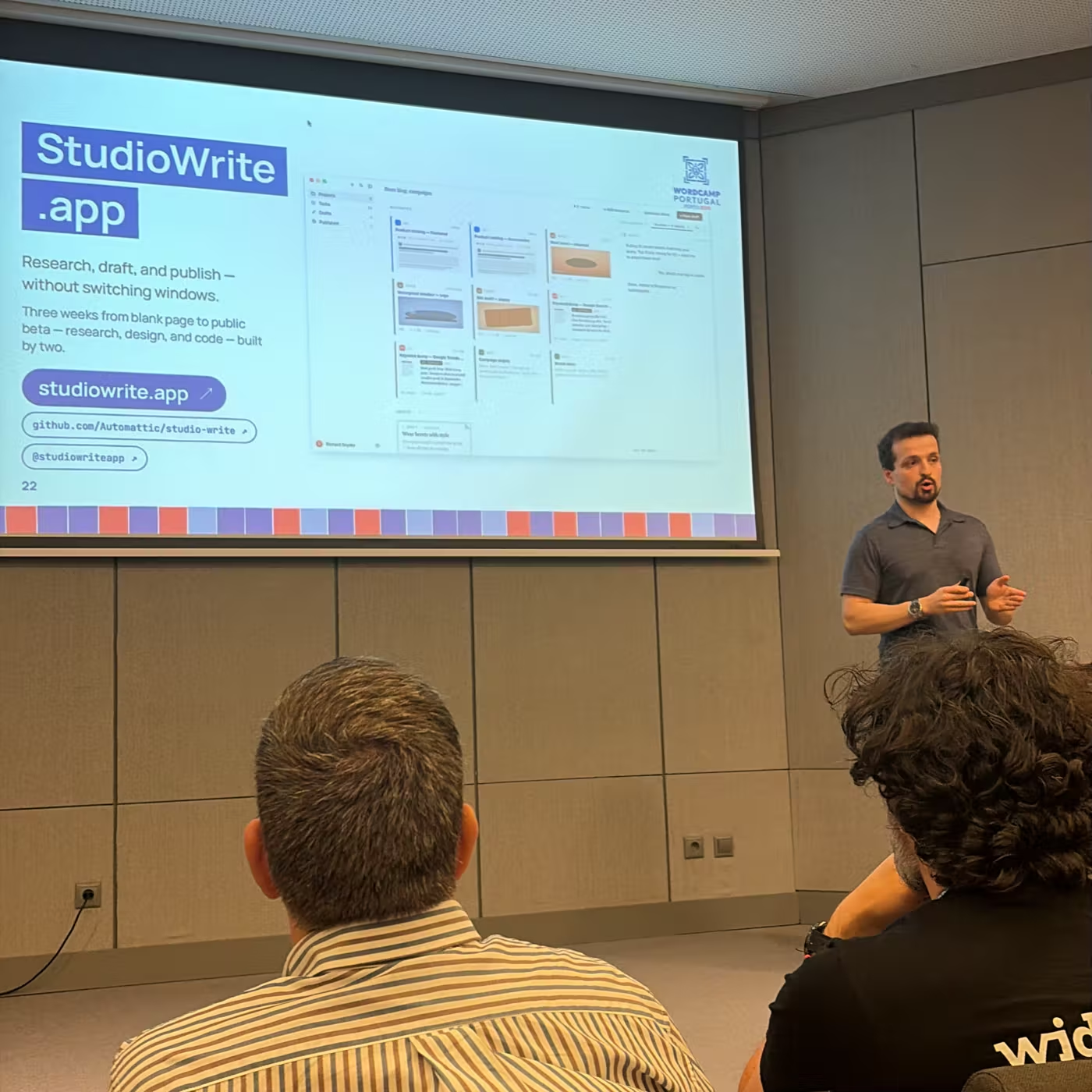
Ryan Welcher, “Stop doing it yourself: building AI-powered admin tools with the WordPress AI API”. Ryan ran a 3.5-hour session demonstrating the WordPress AI API in practice, with Automattic’s Studio Write as the worked example. Studio Write takes the writer from research, to draft, to publish by using the WordPress AI API and block-editor mechanisms in one view. The session was part product demonstration, part guide for plugin authors who want to ship AI features without building custom client logic from scratch.
The implementation slide that stuck: the WordPress AI API treats each operation as a structured intention, not a free-text prompt. That is the right abstraction for plugin authors because the same interface can work with different model providers, and the audit log records what happened in terms a human owner can review. Studio Write is the demo, but the pattern is reusable for any editorial tool that needs to perform several administrative operations on the same site.
WordPress development with Claude Code {#claude-code}
JuanMa Garrido, “WordPress development and management with Claude Code”. JuanMa walked through how he runs WordPress development from the terminal with Claude Code: initial plugin setup, theme adjustments, promotion across environments, and content audits. The session was practical and honest about where it works (well-defined tasks with concrete acceptance criteria, refactors that touch a known part of the system) and where it does not (anything that requires reading three plugin codebases at once without a clear contract).
The piece of this I have already lifted into WPPoland work is the agent-assisted content audit pattern. Instead of running a content audit as a one-off human read-through, I now run it as a structured terminal loop that produces a JSON report against explicit criteria. This shows up in reports/answer-source-audit-2026-05-19.json on the WPPoland repo as part of the daily content checks.
How AI changes WordPress agency pricing {#agency-reset}
Juan Manuel Rodriguez Jurado, “The agency reset”. Juan Manuel made the case that AI changes agency pricing and project definition before it becomes a tooling problem. The data point that landed: agencies still selling time-based packages are losing margin to competitors with clearly defined projects because clients now know AI lowers production cost. The recommendation was concrete. Price from the outcome (“ship a checkout that converts above X” rather than “30 hours of WooCommerce work”), show the engineering budget separately from the project budget, and treat AI tooling cost as part of margin, not as a separate product.
This matches what I see in inbound briefs. Clients who arrive with an outcome (“our SaaS marketing site needs a measurable lift in demo bookings”) make decisions more clearly than clients who arrive with a list of things to build (“we need a new WordPress theme”). The rest is sales process discipline. Juan Manuel is right that if AI lowers production cost, hourly pricing becomes a weaker model for senior-led work over 12-24 months.
Other WordCamp Portugal 2026 talks worth watching {#mentions}
- Milana Cap, “WordPress gems for devs: Accessibility with Interactivity API”. Milana showed the Interactivity API as a way to build accessible interactions from the start, with concrete
wp-interactiveexamples that handle keyboard focus, ARIA state, and screen-reader messages by default rather than as add-ons. If you are still hand-rolling client-side state in WordPress front-ends, this is the talk to watch. - Imran Sayed, “The fastest way to build Gutenberg blocks: modern tools, scripts, and AI”. A focused tooling session. The takeaway is that block scaffolding with
create-block+ AI-assisted code completion now collapses the boilerplate to minutes, leaving the actual block logic as the real work. - Jorge Cabaço, “Beyond the funnel: how AI is redefining customer journeys”. Marketing-side framing that pairs well with Juan Manuel’s session on agency change. The pricing model follows from how you understand the customer journey.
- Gustavo Galati, “Web design for 2026”. Trend session, less technical, but useful for understanding where web design is moving as it gets away from page-builder maximalism.
- Gemny Andreina Ibarra Salamanca, “From burnout to balance: build your AI accountability bot”. Practical pattern for solo operators and small agencies. Worth watching if you have ever logged a workday in chronos and lost the audit trail by Friday.
WordCamp Portugal takeaways for WordPress clients {#takeaways}
Three concrete changes in WPPoland work have already come out of the conference in Porto:
- The accessibility audit has been expanded. The conformance report now includes the SEO-overlap appendix, with each WCAG 2.2 AA failure marked for both legal exposure and on-page SEO impact. Same audit price, two assessment axes, one prioritised fix list.
- WordPress Abilities API on the Tech Radar. Moving from Assess to Trial on the next quarterly review, conditional on a real production reference. If you are scoping an agent-side WordPress integration in the next six months, this is the platform conversation to start.
- The pricing conversation is clearer in the engagement-model section. Outcome-anchored project definitions now get explicit treatment. The engagement-model section of
/en/about/already carried this idea, and the proposal template now anchors against a written success criterion rather than a simple delivery list.
Sources and reading
- WordCamp Portugal 2026 programme: https://portugal.wordcamp.org/2026/programa/
- WordCamp Portugal 2026 speaker list: https://portugal.wordcamp.org/2026/oradores/
- WordPress.tv (session recordings, published over the following weeks): https://wordpress.tv/
- WPPoland accessibility-audit pillar (now citing Anne-Mieke Bovelett): https://wppoland.com/en/services/accessibility-audit-wcag/
- WPPoland Tech Radar (Abilities API entry to ship at next refresh): https://wppoland.com/en/tech-radar/
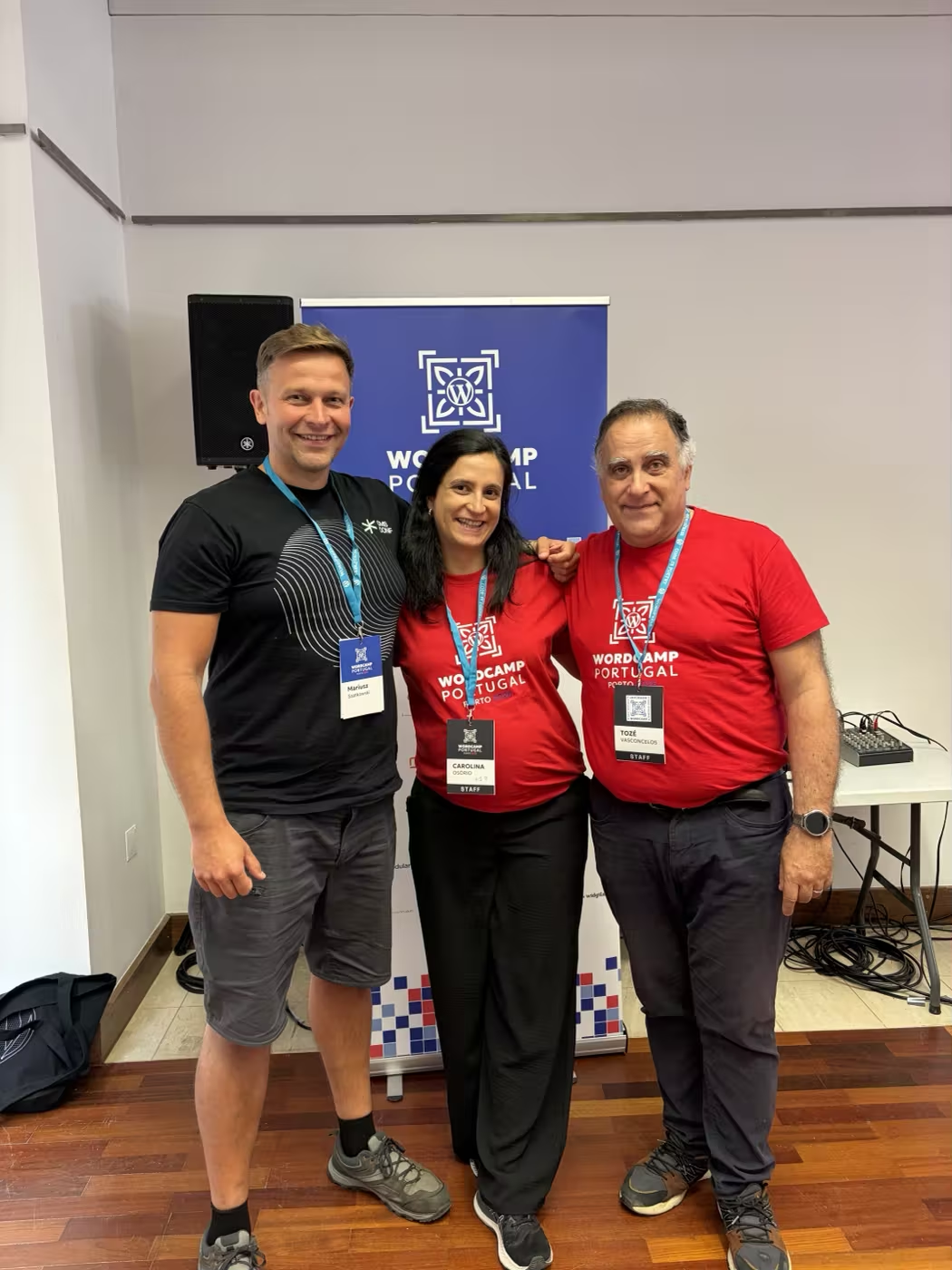
Thanks again to Toze Vasconcelos and Carolina Osório Pinho for hosting an event that delivered more practical engineering material per hour than I have seen at a regional WordCamp in years.
Last updated: 19 May 2026.