How to prepare WordPress for AI search citations
If your site runs on WordPress, optimisation for generative engines and AI assistants is not just a matter of text. It also involves decisions about themes, plugins, custom fields, a potential headless layer and how many times the same schema.org fragment is emitted without your knowledge. WPPoland delivers implementations that combine GEO and AEO strategy with a real WordPress or WordPress-plus-Astro or Next.js stack so that citations are consistent with the code and with the content visible to the user.
This guide is a proposed framework for teams that need to demonstrate to investors or compliance departments that AI-response visibility does not rely on a magic plugin but on a process: an audit, an orderly structured-data graph, answer-focused editing and iteration. We work with clients from Poland, across the European Union and with global firms that need a consistent publication model across several markets simultaneously. Project pricing is always individual and depends on catalogue scale, the number of templates and whether you maintain a single instance or a network of sites.
How GEO on WordPress differs from general GEO
GEO and LLMO in their strategic form describe the way entities, conversational content and source relationships are built. On WordPress an implementation layer is added: block or classic theme, meta fields, WooCommerce, REST endpoints, sometimes GraphQL, and sometimes a separate Astro front end publishing static HTML. If each of these layers contributes its own JSON-LD, models still attempt to read the page, but humans see chaos in Search Console and you risk contradictory service definitions between languages.
That is why the WordPress programme starts with a map of emitted schemas and with canonicality rules, not with another keyword count. Only then do we move to editing sections with clear definitions: what the service is, who delivers it, what scope it does not cover, what data the client must supply. That framework aligns with Answer Engine Optimisation expectations, where a short answer must be anchored in a longer, honest context.
Content model for AI citations across WordPress templates
In editorial practice, copying the same block into every page type causes the most damage. A better pattern is one entity vocabulary maintained in a spreadsheet or lightweight CRM, used by:
- service landing pages,
- reference blog posts,
- WooCommerce products,
- local city pages (if you have them).
Each entity receives a definition, boundaries, typical implementation risk and links to external sources that are digestible for models (WordPress.org documentation, WCAG guidelines, EU digital-resilience documents). This prevents content on WordPress from diverging between language versions, the exact failure documented in how AI translation breaks multilingual SEO.
Which page elements matter for AEO on WordPress
| Page element | What the model may cite | Typical CMS mistake |
|---|---|---|
| Intro with definition | One sentence on what the service is | Marketing platitudes without nominal definitions |
| Scope and out-of-scope | List of included and excluded items | Generic “we help with everything” |
| Comparisons | Honest “when A, when B” | Fabricated tables without criteria |
| WooCommerce policies | Returns, delivery, service | Divergence between PL and EN in terms and conditions |
| Schema metadata | Consistent service name and description | JSON-LD copied from a different industry |
How to avoid duplicate Schema.org markup on WordPress
WordPress makes life easier with hooks and filters, but an SEO plugin, a builder, a theme and custom code can simultaneously print Organisation or WebSite. For language models a contradiction is less dangerous than for Google Rich Results, but it still corrupts brand definition consistency: the company is “an agency” in one place, “a studio” in another, and “a freelancer” in a third.
The process we use:
- Inventory: review of theme and plugin code, list of
wp_headhooks and headless front-end components. - Single source of truth: we decide who emits
Organisation,LocalBusinessorProfessionalService. - Test: markup validation and comparison of visible content with JSON-LD.
- Change rule: every new marketing section must pass an entity review.
If you publish a lot of content from Gutenberg blocks, it is worth maintaining block patterns with established headings and lists so that editors do not invent a new hierarchy every week. A stable heading structure helps both crawlers and answer generators.
Heading template for service landing pages
The following skeleton is not production-ready code, but it shows how to maintain section repeatability across services:
## Service definition
## When it is worth it (minimum three short points)
## When it is not worth it (honest exclusions)
## What the process looks like week by week
## Risks and dependencies on your side
## FAQ related to the SLA contract
The point is for every author to see the same headings regardless of which department requested the publication.
How site speed and INP affect expert content
Models do not “measure” INP, but users do. If the site is sluggish, people return to the search result and you lose behavioural signals. That is why the programme combines:
- reduction of unnecessary JavaScript on the theme and plugin side,
- rational use of builders,
- lazy loading of media with sensible sizes,
- testing on real devices, not only Lighthouse in isolation.
For WooCommerce it is essential to maintain a stable basket and legible checkout steps. Fragments that AI cites in commercial queries often come from returns sections, delivery costs and fulfilment times, so they must be semantically identical to what the customer sees in the basket.
Headless WordPress with an Astro or Next.js front end
When the editorial team stays in WordPress and the front end is in Astro or Next.js, you gain cleaner HTML and faster static deploys. This helps maintain a uniform heading structure and control schema from one place. At the same time complexity increases: you must manage preview environments, staging and mappings of ACF fields or blocks to front-end components.
In such projects we plan:
- a data contract between CMS and front end,
- regression tests for structured data after every major template change,
- entity documentation for content authors.
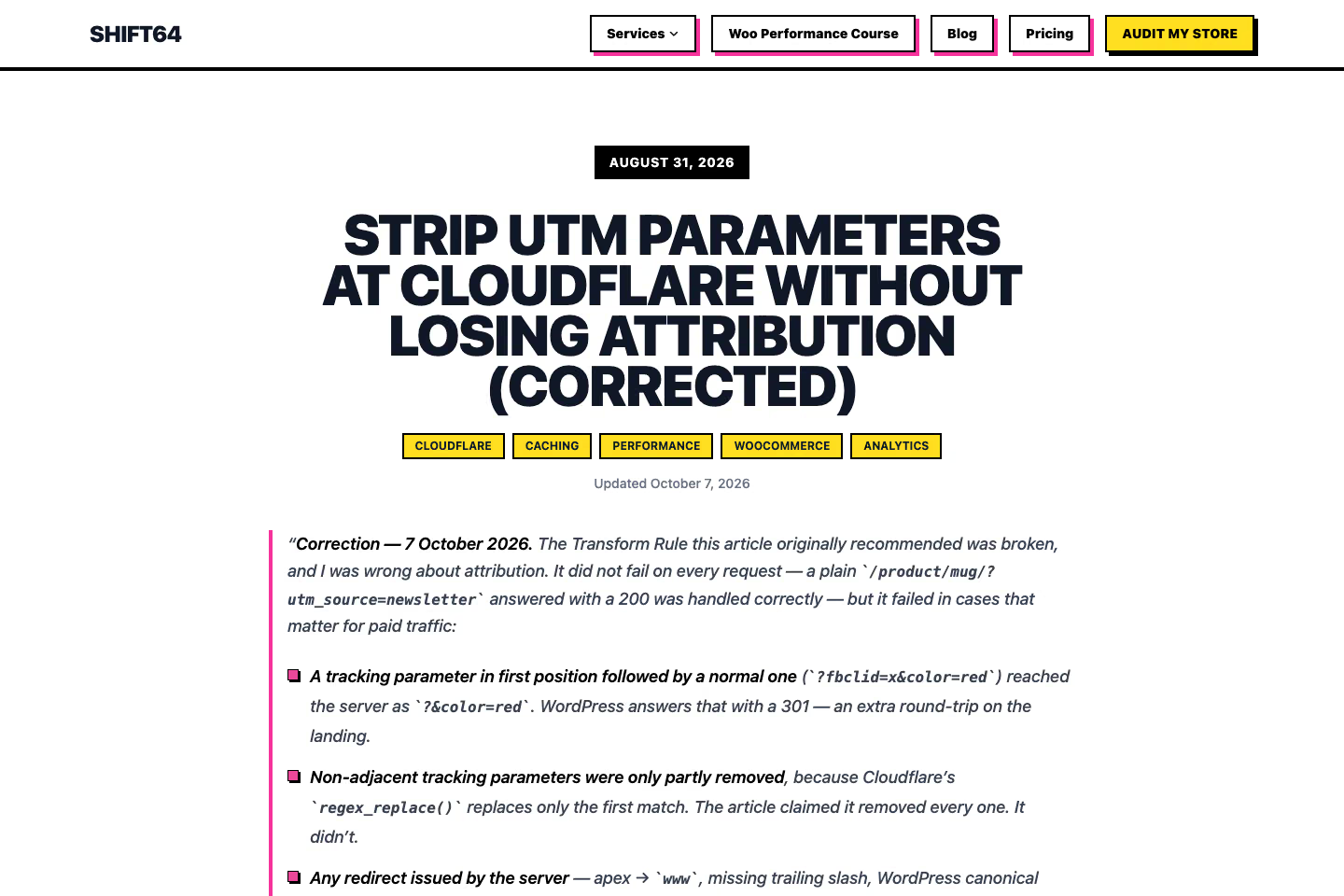
For a field account of what this shift actually costs once the templates are done, see our twelve-month report on migrating WordPress to Astro on Cloudflare Pages, including the silent redirect-truncation trap a static move can hide from search engines.
How a GEO implementation project on WordPress runs
At the start we carry out a technical and content audit that results in a prioritised P0 and P1 list. We then work in sprints: first the schema foundations and duplication, then the key landing pages, finally the long tail of the blog and products. Each iteration ends with a short test-prompt report and editorial tasks.
The collaboration path may include:
- consultations with the person responsible for compliance,
- synchronisation with an existing GEO LLMO service,
- integration with WordPress maintenance after implementation.
How to control content changes with revisions and the REST API
WordPress stores revision history for posts and pages. In larger editorial teams it is worth establishing who can publish changes on key landing pages, because a single edit can break service-definition consistency. If the front end uses REST API endpoints or WooCommerce endpoints, we also verify that publicly accessible fields do not expose premature product descriptions prepared for future campaigns.
In headless projects we additionally define which fields are preview-only and which enter the production build. This prevents you from accidentally publishing a draft with a different service name than the one in JSON-LD on the static front end.
What results to expect from GEO on WordPress
We do not promise a permanent first position in model responses. We do promise a process: honest definitions, consistent graph, technical WordPress preparation and editing for real customer questions. This approach aligns with transparency best practices and reduces the risk that the model will cite your site in a way that contradicts operational reality.
GEO implementation scenarios for WordPress sites
Corporate site with multiple departments
In these projects different definitions of the same service appear in PDFs, intranets and the public site. Before adding another Gutenberg block, it is worth aligning those definitions and choosing one that is consistent with contracts. We then map it to WordPress templates so that H2 headings and lists in subsequent languages maintain the same order of intent, even if sentence structure naturally differs in translation.
WooCommerce store with configurable products
Here citability depends on consistency between the product card and the terms and conditions. If a return is possible “after consultation” but the basket page says “14 days unconditionally”, the model may choose the shorter version and create operational problems. We therefore prepare short, deterministic policy descriptions and separate FAQ sections for digital products, physical goods and pre-orders.
A site built on a heavy page builder
We regularly see dozens of hero sections and carousels that contribute nothing to citation-ready content but weigh down the HTML. In the GEO-AEO approach on WordPress you cut the decorative layer, keep the copy that answers customer questions, and add comparisons and checklists. This is not a “pretty redesign” but a reduction of information noise.
Multilingual publication with WPML or Polylang
Every language version must have equivalent entity definitions. If the English page describes the service scope more broadly than the Polish one, you risk contradictory citations depending on the language of the query. We establish rules: which fields are translated literally, which are locally adapted, and which require legal review before publication.
What the first GEO sprint covers and what drives the budget
It is unrealistic to “close GEO in two weeks” for a site with thousands of subpages and dozens of templates. In practice the first sprint addresses P0: schema conflicts, critical landing pages and the most significant regulatory contradictions in the content. Subsequent iterations handle the long tail of the blog, the news archive and custom CPTs that still rank and are cited through older links.
The budget at the start should also allow for lawyer or DPO time when compliance declarations appear on the site relating to law, GDPR or sector-specific requirements. AI citations love fragments such as “we comply with…”, so every such line must have a real document or process behind it, not only a hero-section slogan.
The budget should account for:
- the number of templates and post types,
- the number of languages and the quality of technical translations,
- the presence of a marketplace or multiple legal entities in a single WooCommerce engine,
- ERP and CRM integrations that may overwrite product-description fragments.
How to prepare custom post type and taxonomy archives for AI
WordPress allows you to build advanced structures with CPTs and taxonomies. If a case-study archive exists but contains no introductory definition or consistent scope description, the model may hallucinate context or skip the archive entirely. That is why for each content type we establish a minimum publication package: one definitional paragraph, a list of typical customer questions, a link to parent services and a block of related evidence material.
Product taxonomies and blog tags have the same limitation: if a tag is only an SEO bucket with no content on its archive page, it does not build an entity. A better pattern is curation: a few key tags with descriptions, the rest hidden from indexing or consolidated.
How cookie consent skews analytics and content decisions
Analytics tools are not directly visible to language models, but they influence which content you promote in campaigns and which landing pages people actually visit. When cookie consent is poorly configured, you distort data about popular paths and make poor editorial decisions. In practice we recommend a consistent set of landing pages linked to entities and a check that you are not promoting temporary pages that have not undergone the same compliance review as core services.
How to log changes to service definitions
In larger teams a lightweight log proves useful: who changed a service definition, when and for what reason (for example, a new framework agreement). WordPress does not provide that business view out of the box, but it can be added procedurally alongside tools such as Git for a child theme, a ticketing system or a simple spreadsheet with text versioning aligned to translations.
How to make video and image content citable by AI
Videos and webinars are excellent material for people, but if key statements exist only in the recording, an AI assistant cannot cite them from the page HTML. The solution is a short text section with the most important theses, a timestamp list or publication of the transcript with an editorial summary. This does not duplicate work if you treat the transcript as “the source of truth” and the video as a conversion medium.
Images containing text remain an accessibility and citation problem: it is worth replicating the most important information as select-friendly text rather than relying on OCR built into the models. This also helps WCAG and aligns with WordPress publication best practices.
How to roll out GEO without pausing the blog
Many companies cannot pause their blog for a month “for GEO”. In that situation we establish a schedule: the first phase covers the highest-priority templates and the most visible legal conflicts in the content; the second migrates older posts according to a list of URLs with the highest traffic and Search Console queries. The editorial team receives a clear update template for one post type to avoid creating five parallel formats.
If you work with an external SEO agency, we integrate their guidelines with our entity map so that new landing pages are not created outside the concept vocabulary, or appear deliberately as a separate entity with a description of its relationship to existing services.
Who owns content accuracy in a GEO project
Implementing GEO on WordPress is not a single-person role. You need someone who understands the actual scope of services the company delivers, a technical person managing the theme, and an editor who maintains style and definition completeness. In larger organisations a legal risk person signs off on any claim about a certification or industry membership.
We prepare a short RACI matrix for public content only: who approves changes to service landing pages, who implements them in code, who verifies consistency across languages. Without that accountability grid publication accelerates but citations diverge across quarters.
How to train editors to write content AI can cite
Team content training focuses on customer questions from sales conversations and support, not on heading generators. We collect real sentences from people (“do you do live-store migrations?”) and map them to page sections. That sounds simple, but it eliminates most hollow phrases like “comprehensive support” that models skip anyway because they carry no information distinguishing your company from ten others.
The second element is practising boundaries: every author must be able to name two things you consciously do not do. Paradoxically, this builds trust and reduces the risk of an outdated promise being cited.
If you use a translation management panel, it is worth inserting a synchronisation rule at process level: what happens when the English landing page is ahead of the Polish one by a legal revision. Either both versions are published simultaneously, or the more conservative one in scope becomes the template for the other.
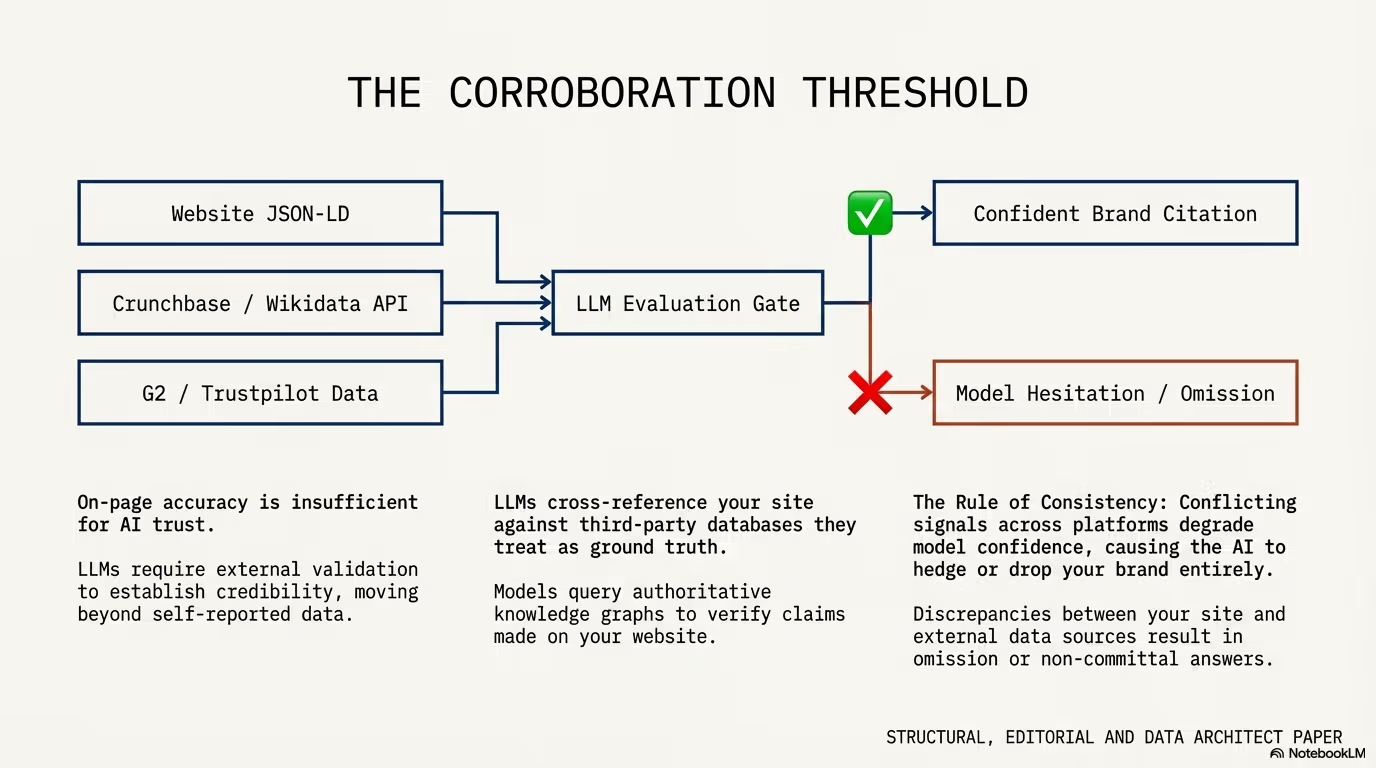
At the end of each quarter it is worth conducting a quick review of outgoing links from landing pages. Non-functioning sources reduce the credibility of evidence sections, and a neglected bibliography can signal to models that the content is out of date even if users do not intuitively articulate that. This review can be combined with a Search Console report covering pages with the largest click drops or with uptime-monitoring alerts for critical reference partners. Twenty minutes of this work each quarter often prevents larger reputation crises later, because external sources are one of the invisible pillars of responses generated from the page, and the consistency between your own description and what authorities say builds long-term trust in AI channels too.
GEO checklist before publishing a blog post
- Does the new article unambiguously indicate which service it extends and which entity it concerns?
- Does it introduce new promises relative to the terms and conditions or SLA that require document updates?
- Does the schema on the page still describe the same scope as the content after editing?
- Do added media have a meaningful
altand not mask content the model cannot read from an image? - Does the content link to canonical service pages rather than to transient campaign landing pages?
How the EU AI Act and UK guidance affect compliance claims
For clients operating in the United Kingdom and the European Union, the regulatory environment around AI-generated content is changing quickly. The EU AI Act introduces transparency obligations for providers of general-purpose AI systems, and the UK Information Commissioner’s Office has issued guidance on how organisations should disclose AI involvement in customer-facing outputs. Neither document directly controls how a third-party AI assistant cites your site, but both affect how you present compliance claims in your own content.
The practical implication is straightforward: any line of copy that declares regulatory conformity - “we comply with GDPR”, “our product meets the EU Accessibility Act requirements” - must link to a specific policy document or audit report, not to a general about-us page. Models parsing your page will often extract the compliance claim in isolation. If the linked evidence contradicts the claim, or is missing, a retrieval-augmented generation system may rate your content as low-confidence and exclude it from cited answers.
The Automattic-backed WordPress ecosystem, including hosting environments such as WP Engine and Kinsta, has started logging structured-data validation errors to developer dashboards by default, making schema-conflict detection easier. Building that same feedback loop into your own WordPress maintenance routine is the minimum viable starting point for sustained AI-citation health. Combine it with a quarterly GDPR and cookie-consent review - two areas where UK and EU requirements still diverge post-Brexit - so that the compliance sections of your landing pages remain legally accurate and therefore safe to cite without modification by language models.
Related services and next steps
Pair this programme with a broader AI visibility strategy:
- GEO and LLMO optimisation for brand narrative and citations independent of CMS.
- WooCommerce developer when the store requires integrations and checkout hardening.
- Speed up WordPress as part of quality signals.
- How to make your website visible to AI and LLMs - the full GEO playbook with implementation steps independent of CMS.
- How we tracked wppoland.com’s own AI citations for 90 days - a case study with the measurement methodology on a live site.
- AI-citation monitoring: what to track and how often - a checklist of tools and monitoring cadence after go-live.
- Why Perplexity cites your brand and ChatGPT does not - the differences in citation mechanics between assistants.
- Does AI render JavaScript - why front-end architecture decides what the model can see at all.
- Contact if you want to send the site address, a description of your editorial team and your timeline expectations.