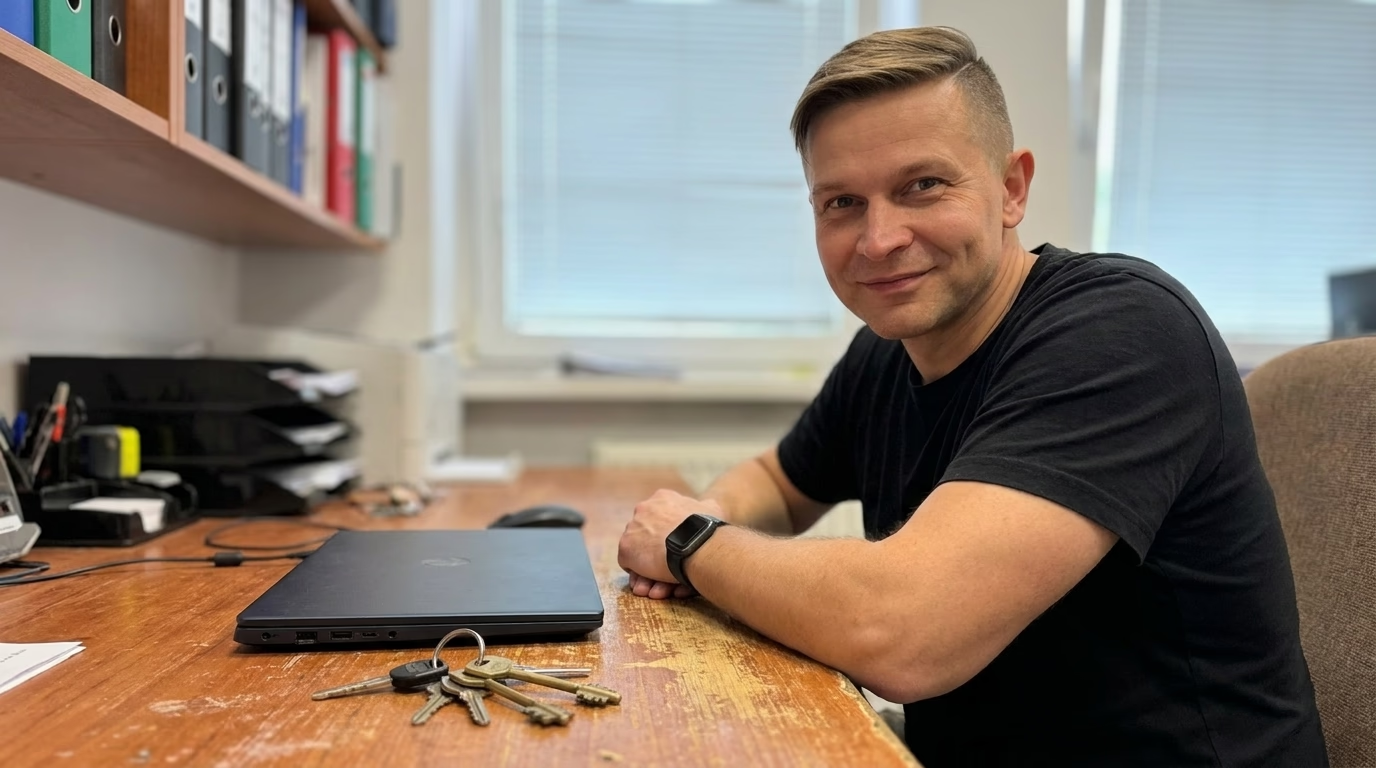
Looking for a WordPress developer from Poland? You are hiring a senior engineer in the EU who builds, optimises, and rescues WordPress and WooCommerce sites for companies in the UK, Western Europe, the US, and the Nordics. Poland is nearshore for most of Europe: the same working hours, EU jurisdiction, GDPR handled by default, and English as the working language. If you already know what you need, the scope and how to hire are below.
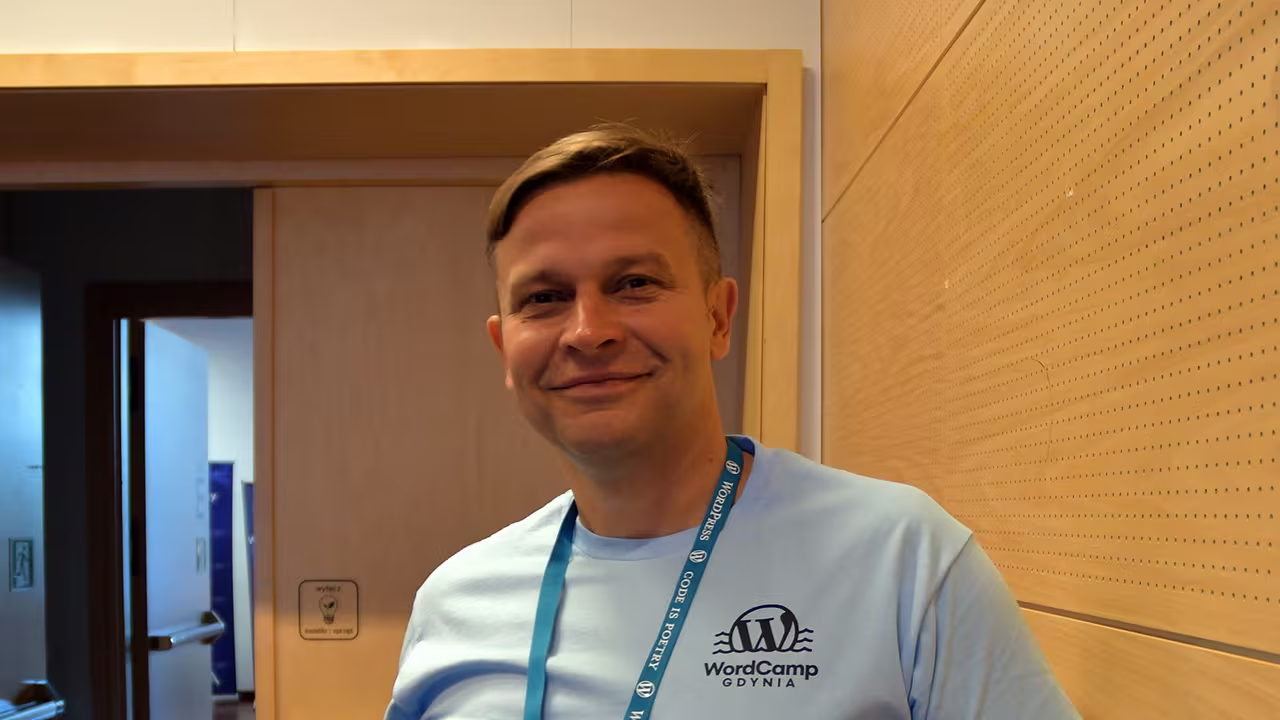
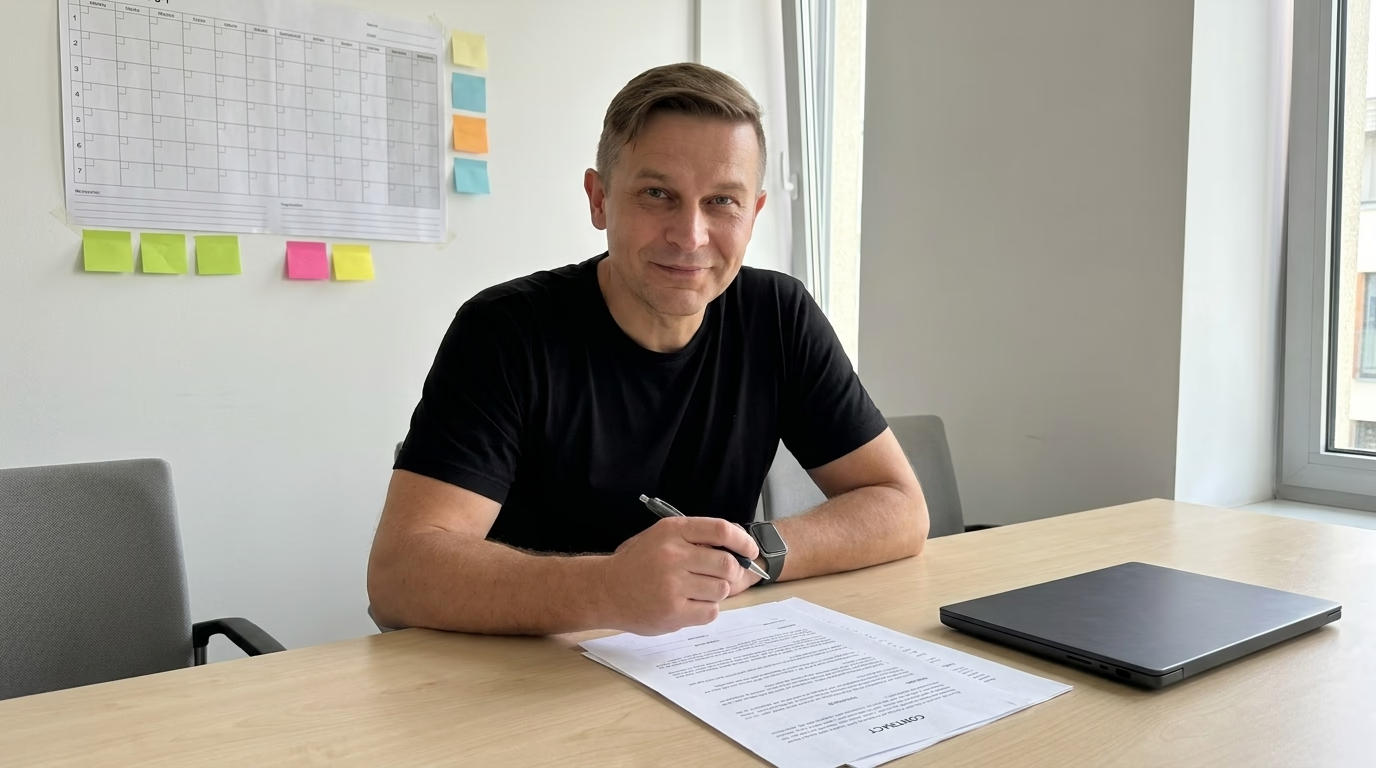
Who: Mariusz Szatkowski, senior WordPress developer based in Gdynia, Poland. Shipping commercial WordPress since 2006, with clients across Europe, the United Kingdom, the United States, and Norway.
What: custom WordPress and WooCommerce engineering, headless architectures, Core Web Vitals optimisation, security hardening, migrations, and long-term maintenance, delivered nearshore from the EU.
Pricing: scope and budget are defined individually per project. Typical timeline: a simple site in one to two weeks, a business site in three to six weeks, a WooCommerce store in six to ten weeks, and enterprise scope in eight to twelve weeks or more.
Why hire a remote WordPress developer from Poland?
Most companies that reach out are not looking for the cheapest possible code. They are looking for someone who picks up the phone when a checkout breaks on a Friday afternoon, who can read a five-year-old plugin someone else abandoned, and who will still be reachable in six months. That is the gap a senior nearshore developer fills.
Theme builds and site assembly from a brief sit under development, customisation and themes adaptation.
For a single senior pair of hands without an agency layer, see WordPress freelancer.
I work as a single point of technical responsibility. When a Manchester agency needs overflow capacity on a client build, or a Norwegian retailer needs a WooCommerce store that survives a seasonal traffic spike, the person scoping the work is the person writing the code. There is no account manager translating your requirements into a ticket for a junior three timezones away.
Ongoing WordPress development for companies
Ongoing engineering for teams that already run on WordPress: new features, integrations with a CRM or ERP, marketing-site changes that do not break the build, and the unglamorous work of keeping PHP and plugin versions current so the site does not rot. This is retainer-shaped work for businesses that treat their site as infrastructure rather than a one-off project.
Theme and plugin customisation
Custom themes built to a design rather than assembled from a page builder, and custom plugins when an off-the-shelf one does ninety percent of the job and fails at the last ten. I also spend a lot of time inside other people’s code: inheriting an Elementor site with thirty active plugins and untangling which three are actually load-bearing is a normal Tuesday.
Technical SEO and Core Web Vitals audits
Technical SEO that a developer can actually action: crawlability, structured data, hreflang for multilingual sites, and Core Web Vitals measured before and after with Lighthouse CI and Cloudflare RUM rather than guessed at. The point is measurable movement, not a PDF of recommendations nobody implements.
Who is Mariusz Szatkowski?
I have been building commercial WordPress since 2006, which means I was shipping sites before Gutenberg, before the REST API, and before most of the plugins now considered standard existed. That length of context matters when you inherit a legacy site: I have usually seen the pattern that broke it before.
Alongside client work I am a Full-Stack Engineer at a Vienna-based digital agency, part of the WordCamp Europe organising team for 2024 to 2026 (the budget track, and we delivered WCEU 2026 in Kraków), and a WordPress Foundation Credits mentor since 2025. I mention this not as a trophy shelf but because it is verifiable: you can check the WordCamp Europe team pages and the WordPress.org credits yourself. In a market where anyone can claim to be senior, public community footprint is one of the few signals that does not lie.
Why do Western companies hire WordPress developers in Poland?
The honest reason companies in the UK, Germany, or the US hire from Poland is a combination of two things that rarely come together: senior engineering and a sane cost structure. Western agency day rates buy you a project manager, a designer, and a junior; the same budget in a nearshore arrangement buys you the senior directly.
But cost is the weakest reason to hire, and the one most likely to burn you if it is the only one. The reasons that hold up over a two-year relationship are structural.
Contract, timezone and language with a Polish developer
- EU jurisdiction. Poland is an EU member state. Your contract runs under EU law, invoices are clean B2B, and GDPR is not an afterthought bolted on for a UK or German client, it is the default the whole market already operates under.
- Timezone overlap. Central European Time covers the entire UK and continental working day and reaches into the US East Coast morning. A question asked at 9am in London is answered before lunch, not the next day.
- English as the working language. Documentation, commit messages, and calls are in English. Poland has one of the deepest English-speaking engineering pools in the EU precisely because it has spent two decades serving Western clients.
- Senior, not a body shop. You are not renting a seat in a rotating team. The engineer you scope with is the one who ships.
What to check before hiring a nearshore developer
Nearshore is not automatically safe. The same distance that makes it cost-effective makes a bad hire hard to unwind. Before you sign anything, the checks below separate a senior engineer from a reseller.
| What to verify | Why it matters | How to check |
|---|---|---|
| Verifiable community footprint | Fake seniority collapses under public scrutiny | WordCamp team pages, WordPress.org credits, conference talks |
| Portfolio with metrics | ”Made it faster” is not a number | Ask for before/after Lighthouse and RUM data |
| Direct access to the engineer | Middlemen dilute accountability | Insist the person on the call writes the code |
| Contract under EU or UK law | Enforceability if it goes wrong | Read the jurisdiction clause before signing |
| Handover and documentation | You must be able to leave | Ask what you get if the relationship ends |
Nearshore vs offshore vs local agency for WordPress
There is no universally correct answer, only trade-offs. The table below is the one I would want if I were on the buying side.
| Local agency | Offshore team | Nearshore senior (Poland) | |
|---|---|---|---|
| Timezone | Same | Often 5 to 8 hours off | 0 to 1 hour off for EU and UK |
| Legal framework | Local | Varies, harder to enforce | EU jurisdiction, GDPR default |
| Who writes the code | Junior under a PM | Rotating team | The senior you hired |
| Cost structure | Highest | Lowest, hidden rework | Senior rate without the agency layer |
| Continuity | Staff churn | Team churn | One engineer, long-term |
The failure mode of offshore is not the hourly rate, it is the rework and the communication tax you pay when a requirement gets lost in translation. The failure mode of a local agency is paying senior prices for junior output. Nearshore is the middle path when the engineer is genuinely senior.
What does full-scope WordPress development include?
Custom WordPress themes and plugins
Themes and plugins written to your requirement, not adapted from a marketplace template that you then fight for the next three years. Clean, documented code following PSR-12 and WordPress Coding Standards, with a Git workflow and CI so changes are reviewable and reversible.
PHP, React and headless WordPress
PHP 8.x, JavaScript and React for Gutenberg blocks, MySQL, and the WordPress core APIs. Headless setups where WordPress is the editorial backend and a modern frontend consumes the REST or GraphQL API. Performance engineering that targets 90-plus Core Web Vitals scores and proves it with measurement.
Multisite and multilingual WordPress for enterprises
Multisite networks, multilingual architectures with correct hreflang, high-traffic WooCommerce, and integrations with the systems a real business runs on: payment providers, an ERP, a CRM, a marketing automation platform. The kind of scope where a mistake is expensive and a plan matters more than speed.
WordPress maintenance and support
Updates, monitored backups, security hardening, and fast incident response after launch. A site is not finished at go-live; it is finished when it has run cleanly through a year of updates, a traffic spike, and at least one thing going wrong at the worst possible moment.
How a WordPress project works
Audit and analysis
Every engagement starts by understanding what exists. For a new build that means the goal, the audience, and the constraints. For an inherited site it means reading the code, the plugin stack, and the performance profile before touching anything, so the first change does not become the first outage.
Phased implementation on staging
Work proceeds in reviewable phases with weekly checkpoints. You see progress on a staging environment, not a surprise at the end. Decisions get documented so that in six months there is a record of why something was built the way it was.
Monitoring and maintenance after launch
After launch the site is monitored, backed up, and kept current. Small improvements happen continuously rather than accumulating into a scary quarterly release. This is where a long-term relationship pays for itself: the developer who built it is the one maintaining it, and nothing has to be re-learned.
What technical expertise does a WordPress developer in Poland cover in detail?
WordPress frontend development
Semantic HTML5, accessible components, and Gutenberg blocks built in React. The frontend is where Core Web Vitals are won or lost, so layout stability, lazy loading, and a disciplined asset budget are treated as engineering concerns, not afterthoughts.
WordPress backend development
Custom post types, the REST API, secure form handling, and integrations written to fail safely. A concrete example of the work: a WooCommerce store arrived with thirty-plus plugins and a time-to-first-byte near 1.8 seconds; the fix was not a caching plugin, it was removing three plugins doing redundant database queries on every request and adding object caching where it actually mattered.
WooCommerce development
WooCommerce builds, migrations from Shopify or a legacy platform, and stores hardened to survive a Black Friday spike instead of collapsing under it. Payment, tax, and shipping integrations that behave correctly at the edges, because in commerce the edge cases are where the money is.
What are the stages of a WordPress development project?
The process is the same whether you are a UK agency subcontracting a build or a Norwegian retailer commissioning a store directly. It exists so that distance never turns into a surprise.
Analysis phase
Before a line of code, the goal, the audience, and the constraints get written down. For an inherited site this is where the existing plugin stack and performance profile are read, so the plan accounts for what is already there rather than fighting it later.
Design and prototyping
Layout and key flows are agreed on a staging environment or a prototype, not described in an email and hoped for. For a store, the checkout path is prototyped first, because that is the one screen where a wrong assumption costs real revenue.
Development and testing
Work lands in reviewable increments with weekly checkpoints. Every change goes through Git with a clear history, so a decision made in week two is still legible in month six, and a regression can be traced to the commit that caused it.
Deployment and launch
Deployment runs through a repeatable pipeline rather than a manual file copy at midnight. Launch includes a rollback plan, because the professional difference is not never having a problem, it is having already decided what happens when one appears.
What quality assurance do we apply on WordPress projects?
Quality is checked before you see the work, not after your customers do. Every build passes a code review against PSR-12 and WordPress Coding Standards, cross-browser and mobile checks, an accessibility pass on the key templates, and a performance budget verified with Lighthouse CI so a heavy third-party script cannot quietly erase a Core Web Vitals gain. On WooCommerce, the checkout and payment path is tested end to end, including the failure cases, before anything reaches production.
How does communication work with a nearshore WordPress developer?
Distance only works with discipline about communication. The overlap below is what makes nearshore feel local.
| Your location | Working-hour overlap with CET |
|---|---|
| London | Full day |
| Berlin, Oslo, Amsterdam | Full day |
| US East Coast | Morning, roughly 3 to 4 hours |
| US West Coast | Late afternoon, limited but workable |
Project tracking is transparent, decisions are written down, and response time is one business day or faster. You always know what is being worked on and why.
How to hire a nearshore WordPress developer from Poland
If you are weighing a nearshore WordPress developer from Poland against a local agency or an offshore team, the deciding question is simple: who actually writes your code, and can you reach them. Get in touch and you will talk to the engineer who would do the work, not a salesperson.
Related delivery work sits under WordPress developer.